An autoimmune disease in which the immune system attacks the lining of the joints. It is not wear and tear, and it is not osteoarthritis. Early treatment changes the long-term outcome substantially, which is why nothing on this page should delay getting seen.
Last updated:
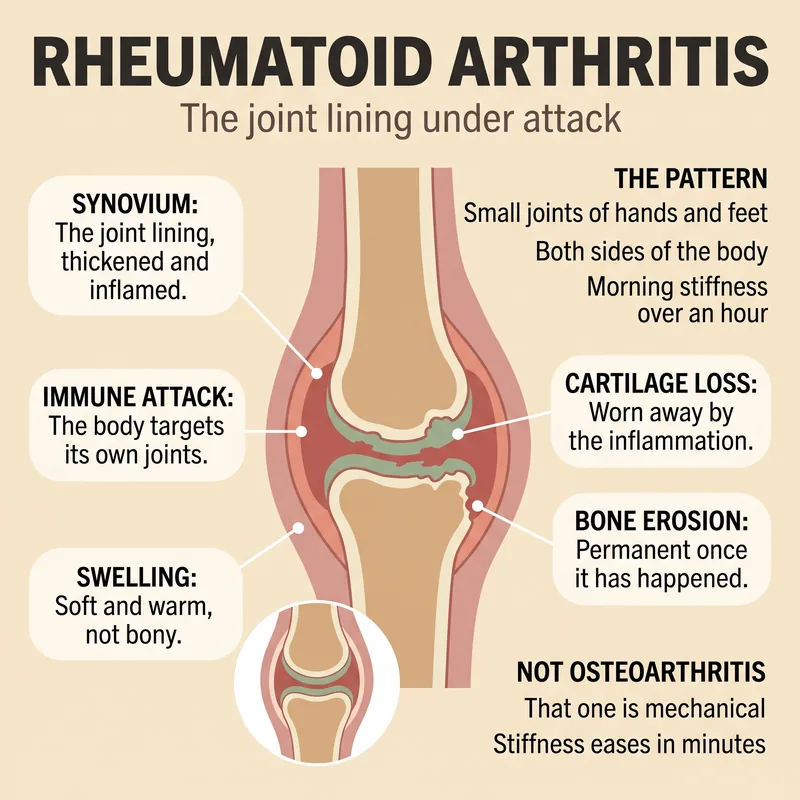
A systemic autoimmune disease. The immune system targets the synovium, the membrane lining joints, producing inflammation that is painful in the short term and erosive in the long term. It typically affects small joints on both sides of the body.
The distinction from osteoarthritis matters, because the advice differs completely. Osteoarthritis is mechanical, worse after use, and stiffness eases within minutes. Rheumatoid arthritis is inflammatory, often worse after rest, and morning stiffness lasts an hour or more. It also affects the whole body, causing fatigue, and it raises cardiovascular risk independently of the usual factors.
Nutrition has a genuine but bounded role here. A Mediterranean dietary pattern and marine omega-3 both have randomised evidence for symptoms12. Neither slows joint erosion, which is what the prescribed medicines do.
A randomised Mediterranean diet intervention in rheumatoid arthritis patients changed serum fatty acid composition alongside reported symptom benefit1. Modest, real, and not a replacement for treatment.
A meta-analysis of randomised trials found marine omega-3 reduced joint pain intensity, morning stiffness duration and the number of painful joints in inflammatory joint pain2.
It does not stop joint erosion. Disease-modifying treatment does that, and the damage prevented in the first year or two is the damage you do not live with later.
The pattern is what distinguishes it: which joints, both sides, and how long the stiffness lasts.
| Feature | What it looks like | Worth knowing |
|---|---|---|
| Morning stiffness over an hour | Hands difficult to use on waking, easing slowly | The most useful single discriminator from osteoarthritis, where stiffness eases in minutes |
| Symmetrical small joint swelling | Knuckles and middle finger joints, wrists, forefeet, both sides | The joints at the very ends of the fingers are usually spared, unlike osteoarthritis |
| Soft, warm swelling | Boggy rather than bony | Bony enlargement points toward osteoarthritis instead |
| Fatigue | Often profound, and frequently the worst symptom | A feature of the systemic inflammation, not a separate problem or a lack of effort |
| Worse after rest, better with gentle movement | The opposite of mechanical joint pain | Sometimes called gelling; a useful thing to describe to a clinician |
| Weight loss, low-grade fever, general unwellness | Particularly at onset or in a flare | Reflects that this is systemic rather than local |
| Firm nodules near joints or on forearms | Painless, under the skin | Rheumatoid nodules, seen in a minority |
| Dry eyes and dry mouth | Gritty eyes, difficulty with dry food | Suggests coexisting Sjogren's; worth mentioning rather than enduring |
No single test confirms it. The diagnosis combines pattern, blood tests and imaging.
| Measure | What it tells you | What it misses |
|---|---|---|
| Anti-CCP antibodies | Reasonably specific, and associated with more erosive disease | Can be negative in genuine rheumatoid arthritis |
| Rheumatoid factor | Supports the diagnosis when positive | Positive in other conditions and in some healthy people, so not diagnostic alone |
| CRP and ESR | How much inflammation is present, and the response to treatment | Can be normal despite active disease |
| Joint ultrasound or MRI | Synovitis and early erosion before plain X-rays show anything | Availability varies; X-ray changes appear late |
| Disease activity score | The number treatment is titrated against, combining joint counts with blood tests | Does not capture fatigue well, which is often what limits people most |
| Full blood count, liver and kidney function | Required before and during several treatments | Monitoring is not optional on these medicines |
| Vitamin D, and bone assessment | Relevant because of steroid exposure and reduced mobility | See osteoporosis |
| Cardiovascular risk assessment | Risk raised by the disease itself | Standard calculators may underestimate it in inflammatory arthritis |
Stopping smoking, a Mediterranean pattern, oily fish, weight and movement
One pattern with trial support, one supplement with trial support, and a long history of unsupported elimination.
| Change | Evidence | Practical note |
|---|---|---|
| Stop smoking | Strongest of anything here | Not a diet change, and more important than every diet change on this page |
| Mediterranean pattern | Randomised, small | Vegetables, legumes, fruit, whole grains, fish, olive oil. Also addresses the raised cardiovascular risk |
| Oily fish twice a week | Supported | The food source of the omega-3 studied in the pain meta-analysis2 |
| Weight reduction where relevant | Associated | Excess weight is associated with poorer response to treatment. See the obesity guide |
| Alcohol | Ask your team | Limits differ on methotrexate because of liver monitoring. Get your own limit rather than a general one |
| Nightshade vegetables | No good evidence | A persistent belief with no trial support. Removing tomatoes and peppers narrows the diet for nothing |
| Elimination and fasting diets | Weak, and risky in practice | Some short-term reports, poor durability, real malnutrition risk, and months lost while erosion continues |
| Gluten or dairy exclusion without coeliac disease | Not supported | If coeliac disease is suspected, test for it properly first; see coeliac disease |
One with genuine trial evidence, one that is prescribed rather than chosen, and several to be careful with.
| Supplement | What it is actually for | Typical range | Timing | Notes & cautions |
|---|---|---|---|---|
| Omega-3 (EPA and DHA) | Reducing joint pain, morning stiffness duration and the number of painful joints. The best-supported supplement on this page2. | Trials used doses above general-health amounts; agree yours with your clinician | With a fat-containing meal | Symptom benefit, not disease modification. Effects took months in the trials. Tell your clinician if you take an anticoagulant or antiplatelet, and before any planned surgery. |
| Folic acid, as prescribed | Reducing the side effects of methotrexate. Prescribed rather than self-selected. | Exactly as your rheumatology team directs | On the day they specify, usually not the methotrexate day | See the warning above. Follow their instruction rather than a general supplement dose, and do not add more on your own. |
| Vitamin D3 and calcium | Bone protection, which matters here because of steroid exposure and reduced mobility. | Test 25-OH-D first and set a daily dose with your clinician | With a fat-containing meal; calcium with food | See osteoporosis, where the cautions apply unchanged, including avoiding large intermittent vitamin D doses. |
| Iron, only if deficient | Correcting deficiency. Anaemia is common in rheumatoid arthritis and has more than one cause. | Test first; dose set with your clinician | As advised | Anaemia of chronic inflammation is not treated with iron, and giving iron when it is not deficiency does not help. Ferritin is raised by inflammation here, so interpretation needs care; see iron deficiency anaemia. |
Each numbered entry below is either a source you can follow or a note setting out what the evidence does and does not support. Both are numbered together so the markers in the text line up.
Last reviewed 3 September 2026. Supplement entries are cross-checked against the NIH National Center for Complementary and Integrative Health and the Linus Pauling Institute Micronutrient Information Center.4 This page is nutrition education, not medical advice, and it does not replace your doctor. Nutrition does not treat rheumatoid arthritis. Diet and omega-3 improve symptoms modestly; disease-modifying treatment prevents joint destruction, and nothing here is a reason to delay, decline or stop it. What nutrition education can do is help you understand the evidence well enough to have a better conversation with the clinician who does treat you.