About one adult in seven lives with it1. It is common, usually not dangerous and more responsive to food than most people are told. The fruit and fiber evidence on this page comes from randomized trials, not tradition.
Last updated:
Constipation is not only about how often you go. Hard stools, straining and the feeling that you have not finished count just as much, and many people who go every day are constipated by that definition.
Clinicians use the Rome IV criteria. Constipation is diagnosed when, for at least three months, a quarter or more of bowel movements involve straining, lumpy or hard stools, a sense of incomplete emptying, a sense of blockage, or needing to press or support to pass stool, or when there are fewer than three bowel movements a week2. Two of those are needed, not one.
It is more common in women, in older adults and in people on lower incomes1. Most chronic constipation has no single structural cause, which is why food, fluid, routine and position matter as much as they do.
The Bristol stool form scale runs from type 1, hard separate lumps, to type 7, liquid. Types 1 and 2 reflect slow transit through the colon, which is why stool form is used in trials rather than frequency alone3.
Opioid pain relief, iron and calcium supplements, some antacids, several antidepressants, some blood pressure medicines and anticholinergic drugs all slow the bowel. Ask your prescriber before stopping any of them.
Slow transit, where stool moves too slowly through the colon, and an evacuation problem, where the pelvic floor does not relax to let it out. They feel similar and are treated differently.
The pattern of symptoms points to which kind of constipation it is, and that decides what is likely to help.
| Symptom | What happens |
|---|---|
| Hard, lumpy stools and few bowel movements | Slow transit, often with low fiber or fluid intake. What usually helps: Fiber built up gradually, fruit, fluid alongside it. |
| Straining even when the stool is soft | An evacuation problem at the pelvic floor. What usually helps: Position on the toilet, and assessment for pelvic floor retraining. |
| Feeling of blockage, or needing to press to pass stool | An evacuation problem. What usually helps: Assessment. Extra fiber alone can make this worse. |
| Constipation with abdominal pain relieved by a bowel movement | Irritable bowel syndrome with constipation. What usually helps: See the IBS guide. |
| Liquid stool leaking in an older person who has been constipated | Impacted stool with overflow. What usually helps: Medical assessment, not an anti-diarrhea medicine. |
Constipation often has more than one cause at a time18, and sometimes there is no obvious reason19.
| Cause | How It Contributes to Chronic Constipation | What Helps |
|---|---|---|
| Too little fiber, fluid or activity | Not eating enough fiber, not drinking enough and not moving enough are among the most common causes1918. | Fiber raised gradually with more fluid, green kiwifruit or prunes (Nutritional Strategy)45; a daily walk (conventional care) |
| Slow transit | Stool moves too slowly through the colon18, which shows as hard, lumpy stools3. | Fiber and, when needed, an osmotic laxative that draws water into the stool (conventional care)11 |
| A pelvic floor problem | The colon empties late because the pelvic floor does not work properly, especially in women18; extra fiber alone can make this worse. | Assessment, then biofeedback therapy to retrain the muscles (conventional care)18; feet on a footstool10 |
| Medicines and supplements | Opioid painkillers, iron supplements, antacids containing aluminum or calcium, anticholinergics, some antidepressants and some blood pressure medicines can all cause it18. | A review with your prescriber, never stopping or changing a medicine on your own (conventional care)18 |
| Routine and life changes | Ignoring the urge to go, travel, pregnancy, getting older and changes in diet or medicines all change bowel habits18. | A regular time 15 to 45 minutes after breakfast, and going as soon as you feel the urge (conventional care)18 |
| Another medical condition | Less often, an underactive thyroid, diabetes, celiac disease, Parkinson's disease or a blockage such as a bowel tumor is the cause1819. | Blood tests, and colonoscopy when red flags are present (Diagnosis) |
Most people need no tests. These are what a clinician considers when the history or the red flags suggest they do.
| Test | What it shows |
|---|---|
| History and medicine review | Diet, fluid, routine and medicines that slow the bowel. When it is used: Always first, and often all that is needed. |
| Blood tests | Thyroid function, calcium and blood count, to look for an underactive thyroid, high calcium or anemia, which can each cause or accompany constipation. When it is used: When symptoms are new or there are other signs; see thyroid disorders. |
| Colonoscopy | Rules out a structural cause such as a growth. When it is used: With red flags, and at the usual screening age. |
| Anorectal manometry and balloon expulsion test | Whether the pelvic floor relaxes properly during a push. When it is used: When constipation persists despite fiber and laxatives. |
| Colonic transit study | How long stool takes to move through the colon. When it is used: When slow transit is suspected and treatment has not helped. |
Fiber, fruit, fluid, routine and position
These foods and drinks have been tested in trials of people with constipation. Build them in gradually.
Foods and drinks tested for chronic constipation
| What to eat or do | Details |
|---|---|
| Green kiwifruit | What the evidence shows: Two a day improved complete bowel movements and abdominal comfort8. Practical note: Well tolerated, with less bloating than fiber supplements. |
| Prunes | What the evidence shows: More effective than psyllium in one crossover trial6. Practical note: The trial used about 3.5 oz (100 g) a day, roughly ten to twelve prunes, split in two. |
| High-mineral water | What the evidence shows: Better response than low-mineral water across four trials5. Practical note: Waters naturally rich in magnesium sulfate are the ones studied. |
| Water with your fiber | What the evidence shows: More benefit from the same fiber when fluid was raised9. Practical note: Fiber without fluid can make stools harder. |
| Legumes, oats and whole grains | What the evidence shows: Raise overall fiber toward the level that helped in trials. Practical note: Add one portion at a time over two to three weeks. |
| Vegetables and whole fruit | What the evidence shows: Part of the same fiber total. Practical note: Whole fruit, not juice, keeps the fiber. |
Food and fluid come first. These are the options with trial evidence behind them.
| Supplement | What it is for | Typical range | Timing | Notes & cautions |
|---|---|---|---|---|
| Psyllium husk | The best-supported fiber supplement for constipation4. | Start low and build toward the higher doses that helped in trials, above 10 g a day | With a full glass of water, split through the day | Give it at least four weeks. Take it at least two hours apart from medicines, because it can reduce their absorption. Not with a history of bowel obstruction or narrowing without medical advice. |
| Magnesium oxide | An osmotic laxative that draws water into the stool. It improved bowel movements and stool form against placebo12. | Set with your clinician or pharmacist | Usually evening | Avoid with reduced kidney function, where magnesium can build up to harmful levels15; see chronic kidney disease. It interacts with some antibiotics and thyroid medicine, so separate the doses. |
| Probiotics | Some strains may help some people, but results are inconsistent between trials and strains16. | As labeled for the specific strain | Daily, for a four-week trial | Not a first step. If there is no change after four weeks, stop rather than trying product after product. |
Most chronic constipation improves over weeks with fiber, fluid and routine, with laxatives or pelvic floor therapy when those are not enough.
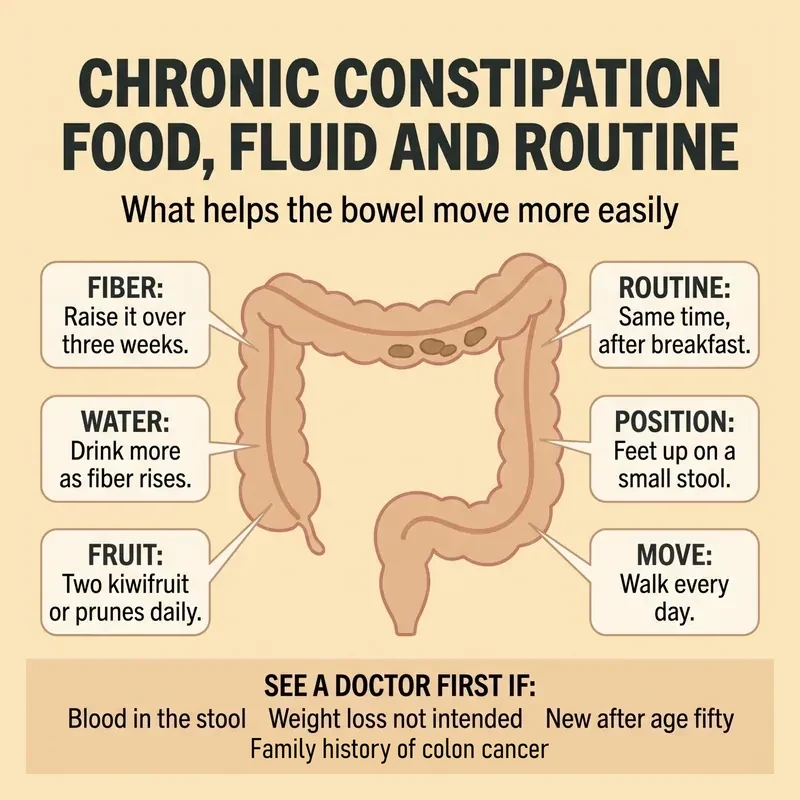
Check the red flags first. Raise fiber over two to three weeks with more fluid, try kiwifruit or prunes, and keep a regular time after breakfast with your feet on a footstool18. Changes can help within a few days; a laxative a pharmacist suggests usually works within 3 days and is for short-term use19.
If symptoms persist, see a clinician: testing can find a pelvic floor problem, which biofeedback retrains. A prescription medicine may also be added18.
See a doctor promptly for constipation with bleeding from the rectum or blood in the stool, constant abdominal pain, vomiting, fever, lower back pain or weight loss without trying18. Call 911 or go to the emergency department for severe abdominal pain with vomiting, a swollen abdomen or being unable to pass gas or stool, which can mean a bowel obstruction20.
Get new guides in your inbox. Once a month: new condition guides and research updates, including the trials that did not work. Free, no spam, and you can unsubscribe in one click.
Raise fiber slowly with enough water, eat two kiwifruit or ten to twelve prunes a day, keep a regular time after breakfast and put your feet on a small stool. Give it four weeks, and see a clinician first if any of the red flags apply.
Each numbered entry below is either a source you can follow or a note setting out what the evidence does and does not support. Both are numbered together so the markers in the text line up.
Last reviewed October 20, 2026. Supplement entries are cross-checked against the NIH National Center for Complementary and Integrative Health and the Linus Pauling Institute Micronutrient Information Center.17 This page is nutrition education, not medical advice, and it does not replace your doctor. Most constipation responds to food, fluid and routine, but constipation can also be the first sign of something that needs investigating. Blood in the stool, weight loss you did not intend, or a new change in bowel habit after fifty is a reason to see a clinician before changing your diet, not after.