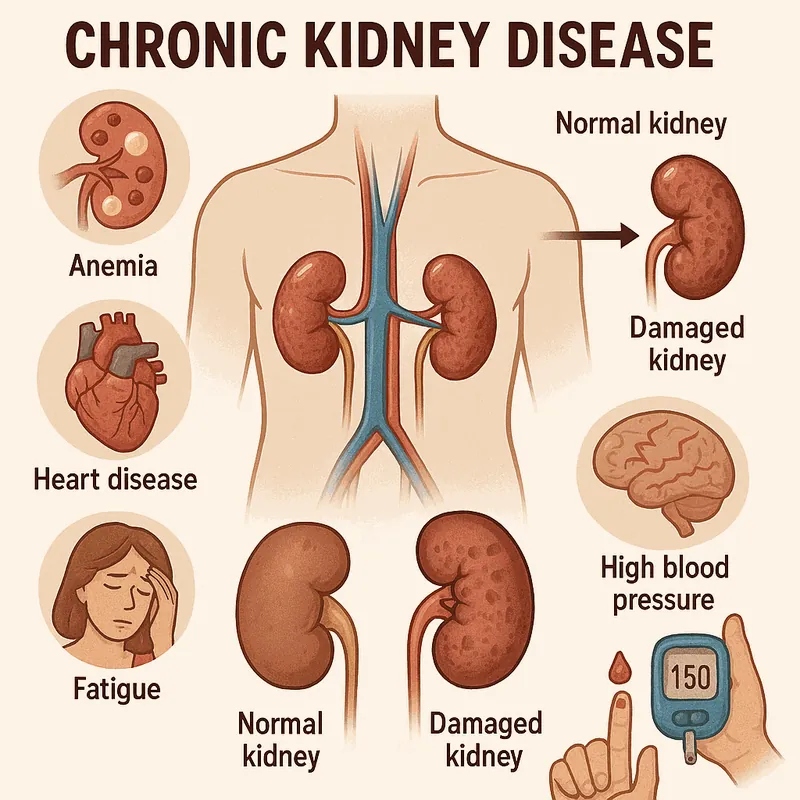
Chronic Kidney Disease (CKD) is a progressive loss of kidney function over months or years. Affects ~10% of US adults and is often silent until late stages. Driven by diabetes, hypertension, and inflammation, root causes that nutrition can profoundly influence.
Last updated:
Chronic Kidney Disease (CKD) is the gradual, progressive loss of kidney filtration capacity over months to years. The kidneys, which filter ~150 liters of blood daily and remove metabolic waste, electrolytes, fluid, and toxins, lose nephrons (functional units) faster than they can be replaced, eventually leading to retention of waste products, fluid overload, electrolyte imbalances, and systemic toxicity.
CKD is classified into 5 stages based on estimated Glomerular Filtration Rate (eGFR). Stages 1โ3 are often asymptomatic; stages 4โ5 represent advanced disease requiring intensive management or renal replacement therapy (dialysis or transplant). The transition from early to late CKD is often preventable through addressing the root drivers.
~90% of CKD cases are driven by diabetes (38%), hypertension (26%), or both, making CKD largely a downstream consequence of metabolic dysfunction. The gut-kidney axis is increasingly recognized: uremic toxins of microbial origin (indoxyl sulfate, p-cresyl sulfate, TMAO) directly accelerate kidney injury and cardiovascular complications.
eGFR โฅ60 mL/min/1.73mยฒ with kidney damage markers (proteinuria, abnormal imaging). Asymptomatic but reversible window. Lifestyle and dietary interventions here have the most leverage, aggressive blood pressure control, glucose management, and dietary protein optimization can halt or reverse progression.
eGFR <30. Significant symptoms: marked fatigue, edema, uremic symptoms (nausea, itching, metallic taste). Stage 5 (eGFR <15) is kidney failure, dialysis or transplant required. Even at this stage, nutrition supports symptom control and slows residual function loss.
CKD is "silent" in early stages. Most symptoms emerge only in moderate-to-advanced disease, by then, significant function is already lost. Annual screening is the only way to catch early CKD.
Foamy urine (proteinuria), blood in urine (hematuria), nocturia (waking to urinate), decreased urine volume, or paradoxically increased volume in early stages. Often the first observable sign, but easily dismissed.
Failing kidneys retain sodium and water, fluid accumulates in ankles, feet, and around the eyes (especially in the morning). Severe cases develop pulmonary edema (shortness of breath when lying flat).
CKD both causes and is caused by hypertension. Newly diagnosed or harder-to-control BP in someone with risk factors should trigger kidney function testing, the kidneys regulate fluid volume and renin output, both critical to BP.
Failing kidneys produce less erythropoietin โ anemia โ reduced oxygen-carrying capacity โ coldness, pallor. CKD anemia is a major driver of fatigue and is often underdiagnosed before stage 3โ4.
Multifactorial: anemia (low erythropoietin), uremic toxin buildup, sleep disruption, metabolic acidosis, mitochondrial dysfunction. CKD fatigue is profound and unresponsive to sleep, a key marker that quality of life is being compromised.
Uremia (waste buildup) suppresses appetite and causes nausea, often worst in the morning. Many CKD patients develop unintentional weight loss and muscle wasting that paradoxically worsens prognosis.
Urea breakdown in saliva produces ammonia, creates a metallic taste and characteristic "fishy" breath. Foods (especially red meat) start tasting wrong. Powerful subjective marker of advanced uremic toxin retention.
Mineral imbalances (calcium, phosphorus, magnesium), uremic toxin buildup, and peripheral neuropathy cause restless legs at night, severe muscle cramps, and persistent generalized itch (uremic pruritus). These late-stage symptoms severely impact quality of life.
Calculated from serum creatinine, age, sex, and (formerly) race. Normal: โฅ90. Stage 1โ2: โฅ60 with damage markers. Stage 3a: 45โ59. Stage 3b: 30โ44. Stage 4: 15โ29. Stage 5: <15. Modern CKD-EPI 2021 formula removed race coefficient for accuracy.
Detects kidney damage BEFORE eGFR declines. Normal: <30 mg/g. Moderately increased (microalbuminuria): 30โ300. Severely increased: >300. Microalbuminuria is the earliest detectable kidney injury, and is also a powerful cardiovascular risk marker.
Blood Urea Nitrogen, creatinine, sodium, potassium, calcium, phosphorus, bicarbonate. Trends matter more than single values. Rising creatinine, hyperkalemia, hyperphosphatemia, or acidosis (low bicarbonate) all signal progressing CKD.
Plant-forward Mediterranean diet, controlled protein, gut microbiome support, blood sugar & BP control, anti-inflammatory nutrients
The CKD diet evolves with stage. Early CKD focuses on prevention (DASH/Mediterranean); late CKD requires careful management of protein, sodium, potassium, and phosphorus based on labs.
Legumes, tofu, tempeh, lentils. Plant proteins produce fewer uremic toxins than animal protein, are less acidifying, and contain phosphorus in less-absorbable phytate form. Aim for โฅ50% plant protein in CKD 3+.
Especially berries, apples, cabbage, cauliflower, peppers, leafy greens (in moderation if potassium restriction). Provide natural alkali to counter metabolic acidosis, fiber for the microbiome, and antioxidants for kidney protection.
Salmon, sardines, mackerel. Anti-inflammatory EPA/DHA reduce proteinuria and cardiovascular risk. Smaller fish are lower in mercury, important when kidney clearance is reduced.
Mediterranean staple. Anti-inflammatory, supports cardiovascular health (CKD doubles CV risk), and provides calorie density without protein burden, useful for maintaining weight in advanced CKD.
Single biggest dietary lever. Hidden sodium in bread, deli meats, canned soups, restaurant food, and condiments adds up fast. Read labels, anything >200mg sodium per serving is high. Cook at home to control intake.
Red meat especially. Generates acid load, uremic toxin precursors (TMAO from carnitine, indoxyl sulfate from tryptophan via gut bacteria). Limit to 1โ2 servings/week in CKD 3+; replace with plant proteins.
Inorganic phosphate additives in processed foods (look for "PHOS" on labels) are 100% absorbed, vs ~50% for natural phosphorus. Sodas, processed meats, fast food, frozen meals. Single biggest dietary phosphorus source, and the most avoidable.
Drives diabetes/insulin resistance (the #1 cause of CKD), accelerates inflammation, and promotes AGE (advanced glycation end-product) formation that directly damages renal microvasculature.
CKD supplementation requires special caution, failing kidneys can't clear excess nutrients normally. Always coordinate with your nephrologist; some supplements are dangerous in advanced CKD.
| Supplement | Mechanism & Evidence | Suggested Dose | Timing | Notes |
|---|---|---|---|---|
| Omega-3 EPA/DHA | Reduces proteinuria, slows progression, lowers cardiovascular risk (CKD has 2x CV mortality). Multiple meta-analyses show modest but consistent benefit. Anti-inflammatory and lipid-modulating effects. | 2โ3g combined EPA+DHA/day | With largest fat meal | Triglyceride form, IFOS-certified. Discontinue 1 week before surgery (anti-platelet effect). |
| Vitamin D3 | 80%+ of CKD patients deficient. Kidneys convert 25-OH-D to active 1,25-OH-D, this conversion fails as CKD progresses. Supplementation improves bone health, immune function, BP control. | D3: 2,000โ5,000 IU/day | With fat meal | Test 25(OH)D; target 50โ70 ng/mL. In CKD 4โ5, prescription active D (calcitriol) often needed. |
| Sodium Bicarbonate (alkali) | Metabolic acidosis (low serum bicarbonate) accelerates CKD. Repletion to bicarbonate โฅ22 mmol/L slows progression by ~40% in trials (UBI study). Reduces muscle wasting. | 0.5โ1.0 mEq/kg/day (typically 1โ2g sodium bicarbonate 2x/day) | Between meals | Prescribed when bicarbonate <22. Adds sodium load, monitor BP. Capsules better tolerated than powder. |
| CoQ10 (Ubiquinol) | Mitochondrial cofactor. CKD impairs mitochondrial function in kidneys and heart. RCTs show CoQ10 reduces oxidative stress markers and modestly improves eGFR/proteinuria. Cardioprotective. | 100โ200mg/day (ubiquinol) | With fat meal | Especially valuable on statin therapy (statins deplete CoQ10). Ubiquinol form better absorbed in CKD. |
| Curcumin (Turmeric Extract) | Anti-inflammatory, anti-fibrotic. Small RCTs in CKD show reduced proteinuria, inflammatory markers, and oxidative stress. Promising adjunct to standard therapy. | 500โ1,000mg curcumin (with piperine or phytosome) | With food, 2x/day | BCM-95, Meriva, or Theracurmin forms have superior bioavailability. Avoid with anticoagulants. |
| Probiotic + Prebiotic (Synbiotic) | Gut dysbiosis in CKD increases uremic toxin (indoxyl sulfate, p-cresyl sulfate) production. Specific probiotics + prebiotic fiber reduce these toxins, improving outcomes. Strongest evidence: Lactobacillus, Bifidobacterium strains with resistant starch. | Multi-strain 25โ50 billion CFU + 5โ10g resistant starch | With meals | Eat fermented foods alongside. Adjust prebiotic fiber gradually to avoid gas. Avoid high-potassium prebiotic foods if hyperkalemic. |
| L-Carnitine (in dialysis patients) | Dialysis depletes L-carnitine; supplementation may reduce dialysis-associated symptoms (fatigue, muscle weakness, cardiac dysfunction). Mixed evidence; NOT for pre-dialysis CKD (could increase TMAO). | 500โ1,000mg/day (dialysis patients only) | Post-dialysis days | Discuss with nephrologist. TMAO concerns in non-dialysis CKD. |
| Iron + B-Vitamins (for CKD anemia) | Iron-restricted erythropoiesis is common in CKD. Oral iron may be poorly absorbed; IV iron often needed. B12 and folate support red cell production. | Per nephrologist (often IV iron in clinic + oral B-complex) | โ | Coordinate with nephrology, iron repletion requires monitoring ferritin and transferrin saturation. Excess iron is harmful. |
CKD is largely a consequence of upstream metabolic dysfunction. Addressing diabetes, blood pressure, gut dysbiosis, and inflammation can stabilize kidney function for years, and sometimes reverse early disease.