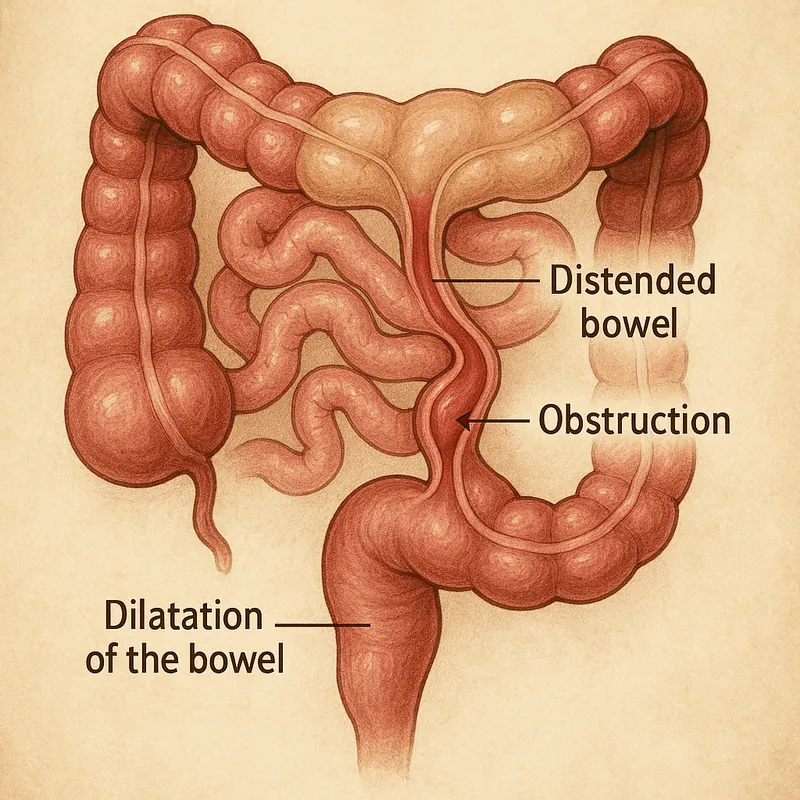
A blockage preventing normal intestinal contents from passing through. Adhesions from prior surgery, hernias, tumors, or volvulus are common causes. This is a MEDICAL EMERGENCY requiring immediate evaluation; nutrition supports post-recovery.
Last updated:
Bowel obstruction is a partial or complete blockage of the small or large intestine that prevents normal passage of intestinal contents. It can be mechanical (physical blockage) or functional (ileus, bowel doesn't contract). Mechanical obstruction is a MEDICAL EMERGENCY requiring urgent evaluation.
The most common causes of small bowel obstruction (SBO) are post-surgical adhesions (~60-70%), hernias (~10-15%), and tumors. Large bowel obstruction (LBO) is most often caused by colorectal cancer, diverticular strictures, or volvulus (twisted bowel). Untreated, obstruction can progress to bowel ischemia, perforation, sepsis, and death.
"Strangulation" occurs when the obstruction also cuts off blood supply, this is a surgical emergency with mortality >25% if not relieved within 6 hours. Closed-loop obstructions (both ends blocked) are particularly dangerous and often require emergency surgery.
Most common type. Adhesions from prior surgery (60-70%), hernias, Crohn's strictures. High vomiting, early dehydration, less distension. Often responds to conservative management.
Blood supply compromised; both ends blocked. Severe pain, peritonitis signs, hemodynamic instability. SURGICAL EMERGENCY, mortality >25% if >6 hours.
Classic four cardinal symptoms: pain, vomiting, distension, obstipation. Combination and pattern depend on location and completeness of obstruction.
Crampy, wave-like pain that comes and goes (every few minutes). Progresses to constant severe pain if strangulation develops. Pain location may suggest level of obstruction.
Early in high SBO (gastric contents, then bile). Late and feculent in distal SBO or LBO. Bilious vomiting suggests proximal obstruction. Feculent vomiting (rare but classic) suggests distal obstruction.
More marked in distal SBO and LBO. May be subtle in proximal SBO. Visible peristaltic waves possible. Tympanic to percussion.
Failure to pass flatus or stool. Complete obstruction โ no passage. Partial obstruction โ reduced passage. Sometimes paradoxical diarrhea early.
Change from colicky to constant pain suggests strangulation/ischemia. Out-of-proportion pain especially worrisome. URGENT surgery.
Signs of sepsis from bowel ischemia/perforation. Systemic inflammatory response. Aggressive resuscitation + emergency surgery needed.
Diffuse abdominal tenderness, guarding, rebound tenderness, rigid abdomen. Suggest perforation or peritonitis. SURGICAL EMERGENCY.
Lab evidence of bowel ischemia. Elevated lactate, leukocytosis with left shift. Indicates surgical urgency.
Quick, available. Shows distended loops, air-fluid levels, free air (perforation). Less sensitive than CT but useful initial screen.
Standard test. Identifies obstruction location, cause, signs of ischemia (bowel wall thickening, pneumatosis, free fluid). Critical for surgical decision-making.
Water-soluble contrast through NG tube, both diagnostic AND therapeutic. May relieve adhesive SBO. Avoid if perforation suspected.
For large bowel obstruction, can identify tumor, allow stent placement to relieve obstruction prior to surgery in malignant cases.
For POST-RECOVERY and PREVENTION. Active obstruction is a medical emergency.
Low-residue during acute partial obstruction; gradual progression post-recovery. Long-term: anti-inflammatory, adequate fiber, address constipation.
After full recovery: vegetables, fruits, whole grains, legumes. Prevent constipation and fecal impaction. Add fiber gradually if strictures present.
Fiber needs fluid to work. Helps prevent constipation. Increase if active or in hot climates.
Reduces adhesion-related inflammation, supports gut health. Vegetables, fish, olive oil, nuts, whole grains.
1-1.5g/kg/day during recovery. Tissue healing requires amino acids. Eggs, fish, poultry, legumes.
After surgery: clear liquids โ soft foods โ regular diet over days-weeks. Avoid high-residue foods initially.
Don't eat or drink anything if obstruction suspected. Even water can worsen vomiting and aspiration risk.
Persimmons, orange pith, large amounts of unchewed vegetables, popcorn, nuts in those with known strictures. Can clump and re-obstruct.
NEVER take laxatives if obstruction suspected. Can cause perforation. Don't use enemas without medical guidance.
Low fiber, high processed food. Causes chronic constipation that contributes to fecal impaction and obstruction risk.
Cause constipation, can trigger ileus. Minimize after surgery; use stool softeners if necessary.
For post-recovery and constipation prevention. Discuss with surgical team before resuming any supplements after surgery.
| Supplement | Mechanism & Evidence | Suggested Dose | Timing | Notes |
|---|---|---|---|---|
| Magnesium | Prevents/treats constipation. Citrate form has gentle laxative effect. Often deficient. | 200-400mg/day | Evening | Magnesium citrate for constipation; glycinate if no constipation issues. |
| Probiotics (Multi-Strain) | Restore microbiome after antibiotics. Improve motility. | 10-30 billion CFU/day | 2 hours after antibiotics | Continue 2-4 weeks after antibiotic course. |
| Saccharomyces boulardii | Yeast probiotic. Prevents antibiotic-associated diarrhea, C. difficile. | 250-500mg, 2x/day | With or without food | Not affected by antibiotics. |
| Fiber Supplements (Gradual) | Psyllium, partially hydrolyzed guar gum. For constipation prevention long-term. | Start low (5g/day), increase to 20-30g | With adequate water | AVOID if active obstruction or significant strictures. |
| Vitamin C | Collagen synthesis for wound healing post-op. | 500-1,000mg/day | Divided doses | Higher doses may cause diarrhea, useful if constipated. |
| Zinc | Wound healing, immune function post-op. | 15-30mg/day | With food | Don't exceed 30mg long-term, copper deficiency risk. |
| Vitamin D3 | Supports recovery, immune function. Universal deficiency. | 2,000-5,000 IU/day (titrate to 50-80 ng/mL) | With fat meal | Test baseline. |
| Omega-3 (EPA/DHA) | Anti-inflammatory. May reduce adhesion-related inflammation long-term. | 2,000-3,000mg/day | With fat meal | Discontinue 1 week before any planned surgery (bleeding risk). |
Active bowel obstruction can become life-threatening within hours. If you have prior abdominal surgery or hernias and develop severe abdominal pain with vomiting and distension, go to the ER immediately. Holistic strategies focus on prevention and recovery, never on managing active obstruction.