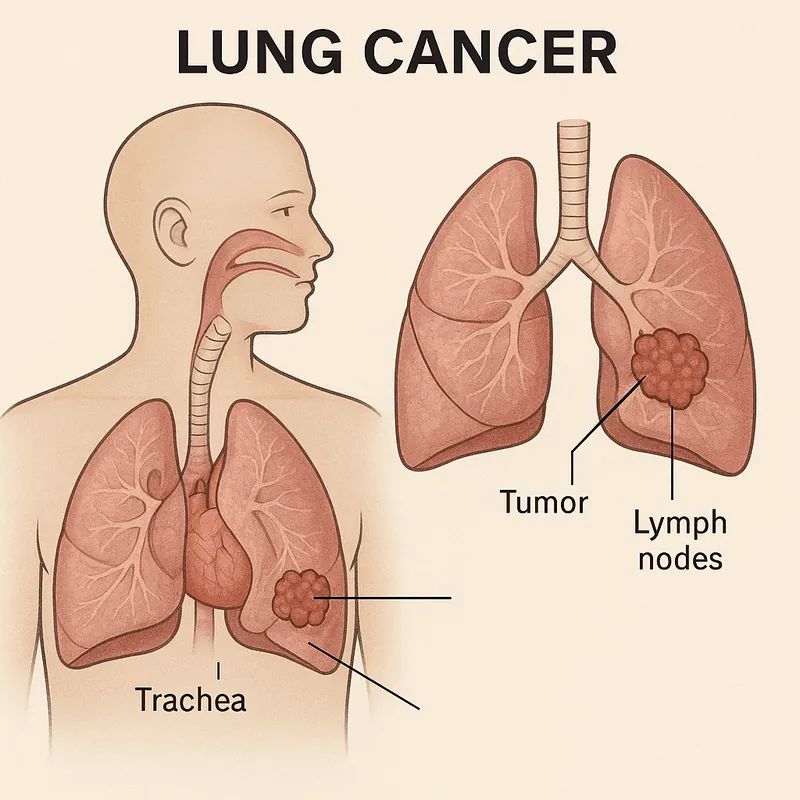
Lung Cancer

The leading cause of cancer death globally. Smoking causes ~85% of cases; radon, air pollution, and asbestos contribute. Prevention: smoking cessation, cruciferous vegetables, lycopene, vitamin D, and antioxidant nutrition.

Cancer Evidence-Based Root-Cause Focus

Last updated:

What Is Lung Cancer?

Lung cancer is the leading cause of cancer death globally, killing more people than breast, colon, and prostate cancers combined. It arises from cells lining the airways (bronchogenic carcinoma) or alveoli, with most cases driven by carcinogen-induced DNA damage to lung epithelium.

Two main histologic categories: Non-small cell lung cancer (NSCLC, ~85%, includes adenocarcinoma, squamous cell, large cell) and Small cell lung cancer (SCLC, ~15%, more aggressive, strongly smoking-related). Modern treatment is increasingly stratified by molecular markers (EGFR, ALK, ROS1, KRAS, BRAF) and PD-L1 expression.

~85% of lung cancers are caused by tobacco smoking, but ~15% occur in never-smokers, often adenocarcinoma in women, driven by radon, air pollution, asbestos, secondhand smoke, or genetic factors. Low-dose CT screening dramatically improves mortality in high-risk current/former smokers, yet uptake remains low (~6%).

๐Ÿšจ If you smoked 20+ pack-years and are age 50-80 (current or quit within 15 years), get screened with annual low-dose CT. NLST and NELSON trials showed 20-26% reduction in lung cancer mortality. This is one of the most underused preventive interventions in medicine.
Lung Cancer illustration

Major Lung Cancer Types

๐ŸŒฑ Adenocarcinoma (~40%)

Most common in never-smokers and women. Often peripheral. Targetable mutations frequent (EGFR, ALK, ROS1, KRAS). Best response to targeted therapies and immunotherapy.

๐ŸŒ— Squamous Cell (~25%)

Strongly smoking-related. Often central, near major airways. May cause hemoptysis, post-obstructive pneumonia. Limited targetable mutations; immunotherapy increasingly important.

๐ŸŒ‘ Small Cell (~15%)

Aggressive, fast-growing, strongly smoking-related. Often disseminated at diagnosis. Initially chemo/RT-responsive; immunotherapy (atezolizumab) now standard for extensive stage.

~234K
Annual US new diagnoses
#1
Cause of US cancer deaths
~85%
Of cases attributable to smoking
~6%
Of eligible adults get LDCT screening

Symptoms of Lung Cancer

Most early lung cancers are asymptomatic, found only by screening. By the time symptoms appear, disease is often advanced. Persistent symptoms in smokers warrant urgent evaluation.

๐Ÿซ Pulmonary Symptoms

๐Ÿคง

Persistent Cough

New cough lasting >3 weeks, OR change in chronic smoker's cough. May be dry or productive. Don't dismiss in smokers.

๐Ÿฉธ

Hemoptysis (Coughing Blood)

Even small streaks of blood. ALWAYS warrants evaluation. May indicate central tumor erosion. CT chest immediately.

๐Ÿ˜ฎโ€๐Ÿ’จ

Shortness of Breath

Progressive dyspnea, especially with exertion. May indicate tumor blocking airway, pleural effusion, or lymphangitic spread.

๐Ÿ˜ฃ

Chest Pain

Dull, aching pain. May worsen with deep breathing or cough. Pleural/chest wall involvement. Shoulder pain may indicate Pancoast tumor.

โš ๏ธ Systemic & Advanced

โš–๏ธ

Unexplained Weight Loss

10+ pounds without trying. Combined with respiratory symptoms in smoker, urgent CT. Often paraneoplastic.

๐Ÿ˜ด

Profound Fatigue

Disproportionate to activity. Often paraneoplastic. Combined with constitutional symptoms (weight loss, night sweats) raises concern.

๐Ÿฆด

Bone Pain (Metastases)

Persistent back, hip, or rib pain. Lung cancer commonly metastasizes to bones. Sudden severe pain may indicate pathologic fracture.

๐Ÿง 

Neurologic Symptoms (Brain Mets)

Headache, seizures, vision changes, focal weakness. Lung cancer is leading source of brain metastases. Some paraneoplastic syndromes (Lambert-Eaton, SIADH) are specific to lung cancer.

How Lung Cancer Is Diagnosed

๐Ÿฉป Screening & Imaging

๐Ÿ“ก Low-Dose CT Screening

Annual LDCT for adults 50-80 with 20+ pack-year smoking history (current or quit within 15 years). Reduces lung cancer mortality by 20-26%.

๐Ÿ“ก Diagnostic CT Chest

When symptoms present or screening finds nodule. Characterizes lesions, identifies mediastinal nodes, plans biopsy approach.

๐Ÿ“ก PET-CT

For staging, identifies metastases. Differentiates benign from malignant nodules (SUV uptake). Standard for stages I-III workup.

๐Ÿ”ฌ Biopsy

CT-guided needle biopsy, bronchoscopy (EBUS), VATS. Tissue for histology + molecular testing + PD-L1. Essential for treatment decisions.

๐Ÿงฌ Molecular & Staging

๐Ÿงฌ Molecular Testing (NSCLC)

EGFR, ALK, ROS1, BRAF, MET, RET, KRAS, NTRK, HER2, EGFR Exon 20. Required for advanced adenocarcinoma. Determines targeted therapy options.

๐Ÿฉธ PD-L1 Expression

Immunohistochemistry. Determines immunotherapy choice. High expression (โ‰ฅ50%) supports first-line pembrolizumab monotherapy.

๐Ÿฉธ Liquid Biopsy

Blood-based circulating tumor DNA (ctDNA) testing. Useful when tissue insufficient. Monitors response and resistance mutations during treatment.

๐Ÿ“ก Brain MRI

Standard staging for stages II-IV NSCLC and all SCLC. Lung cancer is leading cause of brain metastases.

Holistic vs. Conventional Treatment

๐ŸŒฟ HOLISTIC
๐Ÿ’Š CONVENTIONAL
๐ŸŒฟ

Holistic / Integrative Approach

For PREVENTION (most important) + SUPPORTIVE during conventional treatment + SURVIVORSHIP

Active Treatment
Holistic = SUPPORTIVE only. Conventional oncology essential for any cure.
Prevention
~85% of cases preventable via smoking cessation + radon mitigation + air quality
Survivorship
Nutrition, exercise reduce recurrence and improve quality of life
Avoid
High-dose antioxidants during chemo/RT (may reduce efficacy); beta-carotene supplements in smokers (increases risk)
Comprehensive Prevention & Support
  • Smoking cessation, non-negotiable. Risk falls 50% within 10 years of quitting. Even after diagnosis, quitting improves treatment response and survival.
  • Radon testing & mitigation, 2nd leading cause of lung cancer. Free/cheap home testing. Mitigation systems install easily.
  • Reduce indoor air pollution, HEPA filters, ventilation, gas stove caution, avoid wood/incense burning indoors
  • Reduce outdoor air pollution exposure, monitor AQI, exercise in cleaner air times, N95 masks when AQI poor
  • Mediterranean / cruciferous-rich diet, modest protective effect. Cooked tomatoes, leafy greens, cruciferous vegetables daily.
  • Vitamin D optimization, deficiency associated with worse prognosis
  • Avoid beta-carotene supplements in smokers, CARET trial showed INCREASED lung cancer risk. Food sources are safe.
  • Avoid high-dose antioxidant supplements during chemo/RT, may reduce treatment efficacy. Food sources are safe.
  • During treatment: adequate protein (1-1.5g/kg), maintain weight, address nausea
  • Exercise as tolerated, reduces fatigue, improves outcomes
  • Acupuncture, for chemo-induced nausea, neuropathy
  • Mind-body practices, meditation, yoga, support groups improve quality of life
  • Pulmonary rehabilitation, for those with reduced lung function
  • Address depression, common; treat aggressively
โœ… Critical Safety Note: Lung cancer is dramatically more treatable when caught early. If you have a smoking history, ask your doctor about LDCT screening. Holistic approaches help with prevention and supportive care, they cannot replace surgery, targeted therapy, immunotherapy, or chemotherapy for active disease.

Diet for Lung Cancer

Mediterranean + cruciferous + adequate protein. NO beta-carotene supplements in current/former smokers. Caution with high-dose antioxidant supplements during treatment.

โœ… Prioritize:

๐Ÿฅฆ Cruciferous Vegetables Daily

Broccoli, broccoli sprouts, cauliflower, kale, Brussels sprouts. Isothiocyanates may reduce lung cancer risk in smokers and former smokers.

๐Ÿฅš Adequate Protein

1-1.5g/kg/day. Critical during treatment to maintain muscle mass. Sarcopenia worsens chemotherapy outcomes. Eggs, fish, poultry, legumes.

๐Ÿต Green Tea

EGCG has anti-cancer effects in lab studies. 2-3 cups/day. Long-term consumption associated with reduced lung cancer risk.

๐Ÿ… Lycopene from Food

Cooked tomatoes. Inverse association with lung cancer risk. Food sources only, NOT supplements during/after smoking.

๐ŸŸ Fatty Fish (2x/week)

Omega-3 may reduce cancer cachexia. Supports immune function during treatment.

โŒ Strictly Avoid:

๐Ÿšญ ALL Tobacco & Vaping

Cigarettes, cigars, pipes, e-cigarettes, vaping. Continuing to smoke after diagnosis worsens treatment response. Quitting at ANY time improves outcomes.

๐Ÿ’Š Beta-Carotene Supplements (in Smokers)

CARET and ATBC trials: INCREASED lung cancer risk and mortality in current/former smokers. Food sources are safe, supplements are not.

๐Ÿฅฉ Heavily Charred Meats

HCAs and PAHs from grilling. Reduce charring, marinate first, use indirect heat. Limit red and processed meat overall.

๐Ÿท Heavy Alcohol

Increases lung cancer risk, especially when combined with smoking. Synergistic with tobacco. Limit or abstain.

๐Ÿ’Š High-Dose Antioxidants During Chemo/RT

May reduce treatment effectiveness. Food-based antioxidants are safe; mega-dose supplements should pause during active treatment per oncologist.

Evidence-Based Supplements

CRITICAL: Coordinate with oncology, many supplements can interfere with chemo, targeted therapy, immunotherapy. Best supportive: vitamin D, omega-3, probiotics.

SupplementMechanism & EvidenceSuggested DoseTimingNotes
Vitamin D3Deficiency strongly associated with lung cancer mortality. Anti-proliferative in lab studies.2,000-5,000 IU/day (titrate to 50-80 ng/mL)With fat mealTest baseline. Universal nutritional gap.
Omega-3 (EPA/DHA)Reduces cancer cachexia. Supports muscle preservation during chemo. Anti-inflammatory.2,000-3,000mg EPA+DHA/dayWith fat mealDiscuss with oncologist; possible interaction with some treatments.
CurcuminAnti-inflammatory, anti-proliferative in lab. May sensitize cancer to chemo (data limited in humans).500-1,500mg/day (bioavailable form)With fat mealDiscuss timing around chemo with oncologist.
Mushroom Extracts (AHCC, Maitake)Beta-glucans support immune function. May reduce chemo-induced immunosuppression.1-3g/dayEmpty stomachAHCC most studied for cancer support.
L-GlutamineReduces chemo-induced mucositis and neuropathy. Supports muscle.10-30g/day during chemoDivided dosesDiscuss with oncologist, some controversy about feeding tumors (mostly unfounded).
MelatoninAnti-tumor effects in lab; may improve chemo tolerance. Improves sleep, supports immune function.3-20mg at bedtime30 min before sleepHigher doses studied in cancer, discuss with oncologist.
ProbioticsCritical for immunotherapy response. Healthy gut microbiome enhances immune checkpoint inhibitor efficacy.10-30 billion CFU/day, multi-strainWith or without foodAkkermansia and Bifidobacterium especially important. Avoid antibiotics around immunotherapy if possible.
NAC (N-Acetyl Cysteine)Glutathione precursor. Reduces chemo-induced toxicity. CAUTION, controversial in lung cancer.600-1,200mg/dayDivided dosesSome studies suggest may protect cancer cells. Discuss carefully with oncologist.

Screening Saves Lives

If you've smoked 20+ pack-years and are 50-80, annual low-dose CT screening can detect lung cancer years before symptoms. Combined with smoking cessation, modern targeted therapies and immunotherapy, lung cancer outcomes have improved dramatically. Don't delay screening, and never give up on smoking cessation, even after diagnosis.