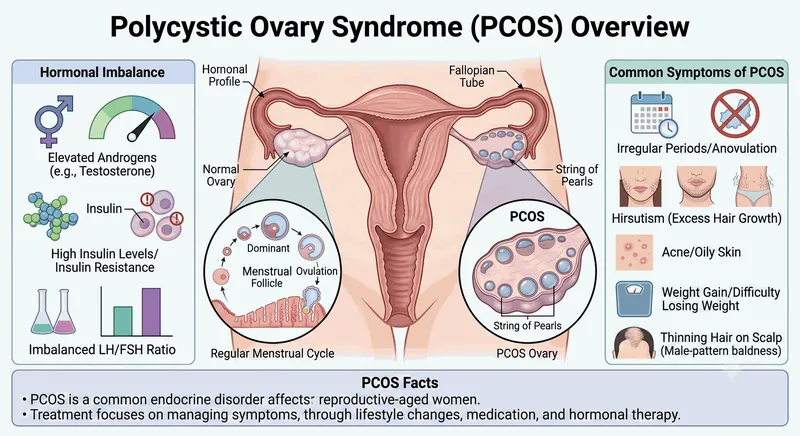
Polycystic Ovary Syndrome (PCOS), Insulin Resistance + Hyperandrogenism

The most common endocrine disorder in women of reproductive age, affecting 1 in 10 women, yet up to 70% of cases go undiagnosed. Reversible at the metabolic root in most women.

4 Phenotypes 1 in 10 Women 70% Undiagnosed Reversible at the Root

Last updated:

What Is Polycystic Ovary Syndrome (PCOS)?

PCOS is a complex endocrine and metabolic disorder, despite the name, it is not a cyst disease, the small follicles seen on ultrasound are immature follicles that failed to ovulate.

Clinically, PCOS is defined by the Rotterdam criteria, which require two of three features: irregular or absent ovulation, clinical or biochemical hyperandrogenism (acne, hirsutism, alopecia, or elevated androgens on labs), and polycystic-appearing ovaries on ultrasound. It affects an estimated 8 to 13 percent of women of reproductive age worldwide, making it the most common endocrine disorder in this group. Insulin resistance is present in 70 to 80 percent of cases and is the primary driver of hyperandrogenism, weight gain, and long-term cardiometabolic risk.

There are four distinct Rotterdam phenotypes based on which combination of features is present. Each phenotype presents differently and benefits from a tailored treatment focus (see below):

Polycystic Ovary Syndrome, ovarian follicles and insulin signaling

"PCOS is the most common endocrine disorder of reproductive-aged women, affecting 8 to 13 percent worldwide, and up to 70 percent of affected women remain undiagnosed."

โ€” Teede et al., 2023 International Evidence-Based Guideline for PCOS

๐Ÿ…ฐ๏ธ Phenotype A, Classic PCOS (most common, ~70%)

All three Rotterdam features present, hyperandrogenism + oligo/anovulation + polycystic ovaries. Strongest association with insulin resistance, central weight gain, and long-term metabolic risk. Responds best to insulin-sensitizing strategies.

  • โ†’Hallmarks: Irregular periods, acne, hirsutism, central weight gain, often acanthosis nigricans
  • โ†’Primary lever: Insulin resistance, addressed with low-glycemic eating, strength training, inositol
  • โ†’Labs: High fasting insulin, elevated HOMA-IR, high free T, low SHBG, elevated AMH
  • โ†’Key supports: Inositol, berberine, vitamin D, omega-3, magnesium

๐Ÿ…ฑ๏ธ Phenotype B, Non-PCO PCOS

Hyperandrogenism + oligo/anovulation, but ovaries appear normal on ultrasound. Often misdiagnosed because the ultrasound is "clean". Symptom picture and metabolic risk are similar to Phenotype A.

  • โ†’Hallmarks: Same as classic PCOS minus the polycystic ovaries
  • โ†’Watch-out: Easily missed by ultrasound-only diagnosis, demand AMH and androgen labs
  • โ†’Labs: Elevated free T, normal AMH, normal ovarian morphology
  • โ†’Key supports: Same as Phenotype A, insulin sensitizers plus anti-androgen support

๐Ÿ…ฒ Phenotype C, Ovulatory PCOS

Hyperandrogenism + polycystic ovaries, but periods are regular. Often confused with "just hormonal acne" or persistent PMS. Insulin resistance is still present in many cases.

  • โ†’Hallmarks: Regular cycles with persistent acne, hirsutism, or hair thinning
  • โ†’Primary lever: Anti-androgen strategy, spearmint tea, saw palmetto, inositol, zinc
  • โ†’Labs: Elevated free T or DHEA-S, regular ovulation confirmed (day 21 progesterone)
  • โ†’Key supports: Inositol, zinc, spearmint tea, saw palmetto, vitamin D

๐Ÿ…ณ Phenotype D, Non-Hyperandrogenic PCOS

Oligo/anovulation + polycystic ovaries, with no clinical or lab hyperandrogenism. Often presents in thinner women and women with post-pill PCOS. Lowest metabolic risk profile, but real fertility impact.

  • โ†’Hallmarks: Irregular cycles, anovulation, no acne or hair changes
  • โ†’Primary lever: Restore ovulation, support stress and gut, screen for thyroid as common driver
  • โ†’Labs: Normal androgens, elevated AMH, sometimes elevated LH:FSH ratio
  • โ†’Key supports: Inositol, vitex (once cycles return), B-complex, magnesium, gut work

PCOS Statistics & Research

1 in 10
women of reproductive age worldwide (Teede et al., 2023)
70%
of cases are undiagnosed or misdiagnosed
70โ€“80%
have insulin resistance regardless of body weight
4ร—
higher risk of developing type 2 diabetes over a lifetime
3ร—
higher risk of endometrial cancer if anovulation persists
~2 yrs
average diagnostic delay from symptom onset

How PCOS Presents

PCOS rarely shows up as a single symptom. The classic pattern combines skin (acne and hirsutism), cycle (irregular or absent), and energy (post-meal crashes, cravings). It is a full-body condition, not just an ovary problem.

๐Ÿฉธ Reproductive & Hormonal Symptoms

๐Ÿ“…

Irregular or Absent Periods (Oligo/Amenorrhea)

Cycles longer than 35 days, fewer than 8 periods per year, or no periods at all. Driven by anovulation, the ovaries are not releasing an egg consistently. This is the most universal hallmark of PCOS and the symptom that ties together every other one.

๐Ÿ˜ฃ

Hormonal Acne (Jawline, Chin, Chest)

Persistent inflammatory acne along the jawline, chin, lower cheeks, and sometimes the chest and upper back. Often cystic, often worsens premenstrually, and does not respond well to topical-only treatment. Driven directly by elevated free testosterone and DHT.

๐Ÿช’

Hirsutism (Excess Facial and Body Hair)

Coarse, dark hair on the upper lip, chin, sideburns, chest, abdomen (often a midline "happy trail"), and inner thighs. Driven by androgen stimulation of hair follicles in androgen-sensitive regions. Scored clinically with the Ferriman-Gallwey scale.

๐Ÿ’†โ€โ™€๏ธ

Scalp Hair Thinning (Androgenic Alopecia)

Diffuse thinning at the crown, widening part, and receding temples. The same androgens that grow hair on the chin shrink the follicles on the scalp. Often slow-progressing over years and easy to miss until significant loss.

๐Ÿคฐ

Infertility / Anovulatory Cycles

PCOS is the leading cause of anovulatory infertility, accounting for over 70 percent of cases. Without consistent ovulation, conception is dramatically less likely. Restoring ovulation often restores fertility, even without medical fertility treatment.

๐Ÿฉธ

Heavy Bleeding & Recurrent Miscarriage

When months of unopposed estrogen build up the uterine lining without progesterone, the eventual bleed can be heavy, prolonged, or clot-filled. The same imbalance raises miscarriage risk in early pregnancy, addressable with cycle support and progesterone if needed.

๐Ÿž Metabolic, Systemic & Skin Symptoms

โš–๏ธ

Weight Gain (Central / Visceral)

Tendency to gain weight around the midsection and extreme difficulty losing it on conventional advice. Insulin resistance directs energy into fat storage and away from muscle, and signals the brain that more food is needed. "Eat less, move more" fails for the same reason it fails in diabetes.

๐ŸŸซ

Acanthosis Nigricans & Skin Tags

Velvety dark patches on the back of the neck, in the armpits, under the breasts, or in skin folds. Skin tags often appear alongside. Both are skin manifestations of hyperinsulinemia, when present, insulin resistance is almost certain even before labs confirm it.

๐Ÿ˜ด

Severe Fatigue & Post-Meal Energy Crashes

"Food coma" so heavy after carb-heavy meals that focus and productivity collapse. Reflects the insulin-glucose roller coaster, a steep rise after eating followed by an overshooting insulin response. Many women describe needing a nap by 2 to 3 PM.

๐Ÿฉ

Intense Carbohydrate Cravings & "Hangry" Mood Swings

Sharp drops in blood sugar between meals trigger urgent cravings for fast carbs and sugar, often with irritability, shakiness, and anxiety if a meal is delayed. One of the earliest and most predictable signs of insulin resistance.

๐Ÿ˜Ÿ

Anxiety, Depression & PMS / PMDD

Women with PCOS have 3x the rate of anxiety and depression of the general female population. Severe PMS and full Premenstrual Dysphoric Disorder are also more common, driven by androgen excess, blood sugar swings, and disrupted progesterone production.

๐Ÿ˜ฎโ€๐Ÿ’จ

Sleep Apnea & Poor Sleep Quality

Obstructive sleep apnea is 5 to 10x more common in PCOS, independent of weight. Poor sleep in turn worsens insulin resistance and androgen excess, creating a feedback loop. Loud snoring, gasping awakenings, and morning headaches warrant a home sleep test.

โš ๏ธ Pattern to watch for: Skin (acne + hirsutism + acanthosis nigricans) + cycle (irregular or missing) + energy (crashes + cravings) is a near-certain PCOS triad even before a single lab is run. If two of the three are present, the third is usually findable on closer questioning.

How to Test for PCOS

Diagnosis is clinical and lab-supported. The Rotterdam criteria require two of three features after ruling out conditions that mimic PCOS. The phenotype identified determines the treatment plan.

๐Ÿ  At-Home Screening

These are not diagnostic on their own, but strong patterns can guide your next steps before investing in formal testing:

๐Ÿ“… Cycle Length & Regularity Tracking

Track at least 3 to 6 cycles. Cycles longer than 35 days, fewer than 8 cycles per year, or no period for 3+ months in someone previously regular is the strongest single screening signal. Apps like Clue and Flo make this easy. In adolescents, cycle irregularity for more than 2 years post-menarche is the equivalent threshold.

๐ŸŒก๏ธ Basal Body Temperature (BBT) Charting

A flat BBT chart without the post-ovulation 0.4 to 1.0ยฐF rise suggests anovulation. Combine with cervical mucus observation for a low-cost ovulation check. Multiple flat months in a row strongly suggests PCOS over an isolated stress cycle.

๐Ÿ“‹ The PCOS Symptom Checklist

Score 1 point for each: irregular cycles, acne (especially jawline), unwanted facial or body hair, scalp hair thinning, weight gain around the midsection, post-meal energy crashes, intense carb cravings, acanthosis nigricans or skin tags, family history of PCOS or type 2 diabetes, severe PMS or PMDD. Score of 4 or more strongly suggests PCOS and warrants formal labs.

๐Ÿ”ฌ Lab & Clinical Tests

๐Ÿ’‰ Reproductive Hormone Panel (Day 2 to 5 of cycle)

Total and free testosterone (elevated free T is a hallmark), SHBG (often low), DHEA-S (adrenal androgen), androstenedione, LH and FSH (LH:FSH ratio often greater than 2:1 in classic PCOS), estradiol, progesterone (day 21 to confirm ovulation), and AMH (often elevated in PCOS).

๐Ÿž Metabolic / Insulin Panel

Fasting glucose, fasting insulin (often missed in standard panels, demand it), HOMA-IR (greater than 2.0 suggests insulin resistance), HbA1c, and ideally a 2-hour OGTT with insulin to catch resistance that fasting numbers miss. Also a fasting lipid panel, women with PCOS often show high triglycerides and low HDL early.

๐Ÿฆ‹ Thyroid & Pituitary

TSH, free T4, free T3, TPO antibodies, and prolactin. Hypothyroidism and hyperprolactinemia can mimic PCOS by causing anovulation. Autoimmune thyroid disease (Hashimoto's) is more common in women with PCOS and must be screened for.

๐Ÿฉบ Adrenal / Rule-Out Panel

17-OH progesterone (rules out non-classical CAH, draw morning, day 2โ€“5), 24-hour urinary cortisol or 1-mg dexamethasone suppression test if Cushing's syndrome is suspected. Important to rule these out before committing to a PCOS treatment plan.

๐Ÿงซ Nutrient & Inflammation Status

25-OH vitamin D (target 50 to 80 ng/mL, low D is near-universal in PCOS), ferritin (low common with heavy bleeds), B12, magnesium RBC, hs-CRP (chronic low-grade inflammation marker), and homocysteine. These are the levers a holistic protocol uses.

๐Ÿ“ท Transvaginal Pelvic Ultrasound

Looks for follicle count and ovarian volume, ideally early in the cycle (day 3 to 5). Twenty or more follicles per ovary, or ovarian volume greater than 10 mL, meets criteria. Not required in adolescents within 8 years of menarche, because polycystic-appearing ovaries are common and benign in that window.

Holistic vs. Conventional Treatment for PCOS

Toggle between the two approaches to compare treatments, outcomes, and what each looks like in practice.

๐ŸŒฟ HOLISTIC
๐Ÿ’Š CONVENTIONAL
๐ŸŒฟ

Holistic / Functional Approach

Address the metabolic root, insulin resistance and inflammation, and let the ovaries follow

Primary Treatment
Low-glycemic whole-food nutrition + strength training + targeted supplements (inositol, berberine, vitamin D)
Duration
3 to 6 months for early improvement; 6 to 12 months for full ovulation restoration
Effect on Underlying Disorder
Treats the root, long-term remission possible
Fertility Outcome
Spontaneous ovulation often returns; many conceive without IVF
Protocol Includes
  • Low-glycemic, anti-inflammatory whole-food eating, protein at every meal, half the plate non-starchy vegetables
  • Strength training 2 to 4x per week, plus daily walking, the most powerful insulin sensitizers
  • Inositol (myo + D-chiro 40:1, 4 g per day), berberine, vitamin D3, omega-3, magnesium
  • Sleep optimization, 7 to 9 hours, screen for sleep apnea
  • Stress and HPA-axis work, breath work, vagal tone, daylight exposure, no late caffeine
  • Gut work, fiber, fermented foods, address dysbiosis or candida if present
  • Endocrine-disruptor reduction, replace plastic, fragranced cosmetics, conventional cleaning products
  • Cycle tracking, identify ovulation and progesterone-phase return as treatment progresses
โœ… Side effects: Mild blood-sugar fluctuations the first 2 weeks as insulin sensitivity restores; occasional GI changes from berberine; weight may shift before the scale moves as muscle replaces visceral fat.

Root Causes of PCOS

PCOS is rarely caused by a single thing. It is a stack of metabolic, inflammatory, gut, stress, and environmental drivers, and the relative contribution differs by phenotype.

Root Cause How It Contributes to PCOS Holistic Solution
Insulin Resistance / HyperinsulinemiaHigh insulin signals the ovaries to produce testosterone and suppresses SHBG, raising free androgens. Present in 70 to 80 percent of cases.Low-glycemic eating, strength training, intermittent fasting (if appropriate), inositol, berberine, metformin if needed
Chronic Low-Grade InflammationElevated cytokines (TNF-ฮฑ, IL-6) impair follicle maturation and worsen insulin resistance, independent of body weight.Anti-inflammatory diet, omega-3, curcumin, address food sensitivities (gluten, dairy in some), heal the gut
Gut Dysbiosis & Intestinal PermeabilityAn imbalanced microbiome contributes to LPS leakage and systemic inflammation, alters estrogen metabolism via the estrobolome.Fermented foods, soluble fiber, targeted probiotics, address SIBO or candida if present, L-glutamine
Chronic Stress / HPA-Axis DysfunctionSustained cortisol drives DHEA-S production (adrenal PCOS), worsens insulin resistance, and suppresses ovulation directly.Breathwork, vagal-tone exercises, daylight exposure, magnesium, adaptogens (ashwagandha, rhodiola), boundaries
Vitamin D DeficiencyVitamin D regulates insulin signaling, ovarian follicle development, and AMH levels. Deficient in 67 to 85 percent of women with PCOS.Sunlight, vitamin D3 2000 to 5000 IU/day with K2, retest 25-OH-D after 3 months (target 50 to 80 ng/mL)
Endocrine-Disrupting ChemicalsBPA, phthalates, parabens, and pesticides mimic estrogen, disrupt androgen signaling, and damage ovarian function over time.Glass / stainless instead of plastic, fragrance-free personal care, EWG Clean Fifteen / Dirty Dozen, filter water
Sleep Disturbance & Sleep ApneaEven one week of restricted sleep worsens insulin sensitivity and elevates androgens. OSA is 5 to 10x more common in PCOS.Consistent sleep schedule, cool dark room, magnesium glycinate, screen for OSA if snoring or BMI greater than 30
Post-Pill Hormonal Rebound3 to 6 months after stopping oral contraceptives, androgens can spike as the pituitary axis re-engages, especially if synthetic progestins were androgenic.Cycle-supportive nutrition, methylated B-complex, zinc, vitex (chasteberry) once cycles resume, give 9 to 12 months
Genetic PredispositionHeritability is approximately 20 to 40 percent. Family history of PCOS, type 2 diabetes, or hirsutism increases risk.Genetics load the gun, lifestyle pulls the trigger. The same lifestyle levers work even with strong family history.
Magnesium & Zinc DeficiencyMagnesium is required for insulin signaling and progesterone production. Zinc modulates androgen metabolism and skin healing.Pumpkin seeds, dark chocolate, leafy greens; supplement magnesium glycinate 300 to 400 mg, zinc 15 to 30 mg if deficient

PCOS Diet Guide

Food is the single highest-leverage intervention for PCOS, more powerful than any single supplement and the only thing that consistently shifts the underlying insulin resistance.

๐Ÿž

What Is the Insulin-First Eating Pattern?

Most PCOS dietary advice quietly assumes the goal is weight loss. The actual goal is insulin restoration. When insulin normalizes, ovulation, androgens, and weight follow on their own. The eating pattern that does this best is not strictly keto, vegan, or paleo, it is whole-food, protein-anchored, low-glycemic, and consistent.

The framework is simple, and it is more powerful than any supplement: anchor every meal with protein, fill half the plate with non-starchy vegetables, add healthy fat, and treat slow carbs from whole foods as the smaller side, not the centerpiece.

The 4 Anchors of Every Meal:

  • 1Protein 25 to 40 g, anchor first to blunt the glucose curve
  • 2Non-starchy vegetables fill half the plate, fiber and micronutrients
  • 3Healthy fat, olive oil, avocado, nuts, wild fish for satiety and hormone support
  • 4Slow carbs from whole foods only, sweet potato, quinoa, lentils, berries

Timing & Meal Pattern:

  • โฑEat within an 8 to 10 hour window if comfortable. Avoid grazing.
  • ๐ŸŒ…Largest meal earlier in the day, insulin sensitivity is highest in the morning
  • ๐ŸŒ™Finish dinner 3+ hours before sleep, supports overnight blood sugar and growth hormone
  • ๐Ÿšถ10 to 15 minute walk after each meal, single most effective glucose-lowering habit
๐Ÿ’ก Intermittent fasting helps many women with PCOS but worsens cycles in some (especially adrenal-type PCOS). If sleep, energy, or cycles get worse, eat sooner.
โš ๏ธ These foods spike insulin, drive inflammation, and feed the underlying disorder. The first three rows below are non-negotiable.
  • โœ—Refined sugar: Soda, juice, candy, baked goods, "natural" cane sugar, honey or maple syrup in large quantities
  • โœ—Refined flour: White bread, white pasta, pastries, crackers, even "whole wheat" that's mostly refined and labeled organic
  • โœ—Industrial seed oils: Soybean, canola, corn, cottonseed, sunflower, safflower
  • โœ—Conventional dairy: Inflammatory for many with PCOS; A1 casein and IGF-1 can worsen acne and androgen excess. Trial removal for 30 days; reintroduce systematically if desired.
  • โœ—Gluten (worth a trial): 30 to 40 percent of women with PCOS report significant improvement off gluten, often via inflammation or autoimmune overlap. Trial removal for 60 to 90 days.
  • โœ—Excess soy isolates: Soy protein isolates, soy "burgers," soybean oil. Whole fermented soy (tempeh, miso, edamame) in moderation is fine.
  • โœ—Alcohol: Disrupts blood sugar, raises androgens, impairs sleep, depletes B vitamins and magnesium. Limit to occasional, with food.
  • โœ—Artificial sweeteners: Aspartame, sucralose, saccharin, can still spike insulin and disrupt the gut microbiome. Stevia and monk fruit are gentler choices.
  • โœ—"Diet" packaged foods: Low-fat, "skinny," and protein-bar-style products are usually high in seed oils, refined carbs, and sweeteners
๐Ÿ’ก Foods that lower insulin, fight inflammation, and feed hormone production. Build every meal around these.
  • โœ“Quality proteins: Wild salmon and sardines, pastured eggs, grass-fed beef, pastured poultry, plain Greek yogurt or kefir if tolerated
  • โœ“Non-starchy vegetables: Leafy greens, broccoli, cauliflower, Brussels sprouts (cruciferous help estrogen metabolism), zucchini, peppers, cucumbers, asparagus
  • โœ“Healthy fats: Extra-virgin olive oil, avocado, walnuts, almonds, pumpkin seeds, flax seeds, coconut oil in moderation
  • โœ“Slow carbs: Sweet potato, butternut squash, quinoa, lentils, chickpeas, steel-cut oats, brown rice in moderation
  • โœ“Low-glycemic fruits: Berries, kiwi, citrus, green apple, pear (always paired with protein or fat)
  • โœ“Anti-androgen foods: Spearmint tea (2 cups/day), flax seeds (1 to 2 tbsp ground daily), green tea, soy in moderate amounts (whole, not isolated)
  • โœ“Magnesium-rich foods: Pumpkin seeds, dark chocolate (85%+), spinach, Swiss chard, almonds, black beans
  • โœ“Fermented foods: Kimchi, sauerkraut, plain kefir, miso, natto, for gut and estrobolome support
  • โœ“Spices: Cinnamon (blood sugar), turmeric (inflammation), ginger (digestion), garlic (insulin sensitivity)

Key Supplements for PCOS Recovery

Supplements are accelerators, not replacements for nutrition and lifestyle. The list below combines the most evidence-backed PCOS interventions with foundational nutrients commonly depleted by the condition.

Supplement Role in PCOS Recovery Suggested Dose Timing Notes
Myo-inositol + D-chiro-inositol (40:1)The single most-evidence-backed PCOS supplement. Restores insulin sensitivity at the cellular level, improves ovulation rates, reduces androgens, and improves egg quality. Multiple RCTs show effects comparable to metformin with far better tolerability.4 g myo + 100 mg D-chiro per daySplit, half AM and half PM, with or without food3 to 6 months for full effect. Maintain the 40:1 ratio, higher D-chiro doses can hurt ovulation.
BerberineA plant alkaloid that activates AMPK, the cellular energy sensor that metformin also targets. Lowers fasting insulin, improves lipid panels, supports gut antimicrobial balance. Head-to-head trials show efficacy comparable to metformin for insulin resistance.500 mg 2 to 3x per day (1500 mg/day total)With mealsCan lower blood sugar, monitor if diabetic. Do not combine with statins or cyclosporine without supervision.
N-Acetylcysteine (NAC)Increases glutathione, the master antioxidant. Restores ovulation in PCOS at rates comparable to clomiphene. Supports liver detoxification of estrogens and lowers homocysteine, often elevated in PCOS.1200 to 1800 mg per dayEmpty stomach, 30 min before food, split twice dailyOne of the few supplements with RCT data for fertility in PCOS.
Vitamin D3 (with K2)Regulates insulin signaling, AMH, and follicular maturation. Deficient in 67 to 85 percent of women with PCOS. Restoring optimal levels (50 to 80 ng/mL) improves cycle regularity, mood, and immunity.2000 to 5000 IU D3 + 100 to 200 mcg MK-7 K2 per dayWith a fat-containing meal, morning preferredTest 25-OH-D first; retest after 3 months. Higher doses (10,000 IU) may be needed temporarily if severely deficient.
Omega-3 EPA/DHAReduces systemic inflammation, lowers triglycerides (often elevated in PCOS), improves insulin sensitivity, and supports the menstrual-cycle phase prostaglandin balance. EPA particularly helps mood.2 g combined EPA+DHA per dayWith mealsChoose IFOS-certified for purity. Cod liver oil is acceptable, but watch for total vitamin A intake.
Magnesium GlycinateRequired for insulin signaling, progesterone production, GABA synthesis, and sleep. Magnesium deficiency directly worsens insulin resistance and PMS symptoms.300 to 400 mg elemental magnesium per dayEvening, 30 to 60 min before bedGlycinate is the most absorbable and calming form. Magnesium oxide is poorly absorbed.
ZincModulates testosterone metabolism, reduces 5-alpha-reductase activity (the enzyme that converts testosterone to DHT), supports skin healing, and improves insulin signaling.15 to 30 mg per dayWith meals (food prevents nausea)If using long-term (greater than 8 weeks at higher doses), add 1 to 2 mg copper to prevent imbalance.
Saw PalmettoMild plant-based anti-androgen, inhibits 5-alpha-reductase, helpful for hirsutism, hormonal acne, and scalp hair thinning. Slow-acting, expect 3 to 6 months for visible effect.320 mg per day (standardized extract)With mealsPair with spearmint tea and zinc for synergistic anti-androgen effect.
Spearmint TeaRCT-validated reduction in free testosterone in women with PCOS. Modest but real, especially for mild hirsutism and acne.2 cups (each from ~1 g dried leaf) per dayDaily, any timeUse loose-leaf or single-ingredient teabags. Effect builds over 30+ days.
Chromium PicolinateTrace mineral that enhances insulin action at the cell membrane. Modest improvements in fasting glucose and HbA1c in PCOS trials.200 to 400 mcg per dayWith mealsMost useful when fasting glucose is borderline. Diet remains primary.
Alpha-Lipoic Acid (ALA)Universal antioxidant that improves insulin sensitivity, supports mitochondrial function, and protects egg quality from oxidative stress.600 to 1200 mg per day, R-ALA preferred30 minutes before meals on an empty stomachCan lower blood sugar, monitor if on diabetes medications.
Coenzyme Q10 (Ubiquinol)Mitochondrial fuel for the developing egg and the energy demands of ovulation. Improves egg quality and IVF outcomes in women over 35 and in PCOS-related fertility.100 to 300 mg ubiquinol per dayWith a fat-containing meal, morning preferredEspecially helpful when trying to conceive. Combine with omega-3.
L-Carnitine (Acetyl-L-Carnitine)Improves insulin sensitivity and fat metabolism; supports egg quality and fertility outcomes. Some trials show improved ovulation rates when combined with inositol.1000 to 3000 mg per dayMorning, empty stomachVegetarians and vegans tend to be lower in carnitine, especially helpful in that population.
Curcumin (Turmeric Extract)Potent anti-inflammatory. Reduces NF-kB-driven inflammation, supports insulin signaling, helps cycle pain and acne.500 to 1000 mg curcumin per dayWith a fat-containing mealMust include piperine (black pepper) or be liposomal for absorption.
ResveratrolPolyphenol with anti-androgen and insulin-sensitizing effects. RCT data shows reduced testosterone and DHEA-S in PCOS.800 to 1500 mg per day (trans-resveratrol)Morning, with foodStrong evidence in PCOS specifically; effects build over 8 to 12 weeks.
Vitex (Chasteberry)Supports luteal phase by raising progesterone via the pituitary. Most useful in post-pill PCOS and ovulatory-PCOS phenotypes once cycles begin returning.400 to 800 mg per day (standardized extract)Morning, dailyAvoid during pregnancy and with hormonal contraception. Discontinue if cycles shorten unhelpfully.
Methylated B-Complex (with L-methylfolate)Supports methylation, neurotransmitter balance, and homocysteine metabolism. Critical for women with PCOS who carry MTHFR variants.1 capsule per day per product labelMorning with foodIf trying to conceive, ensure at least 400 to 800 mcg L-methylfolate.
Multi-Strain ProbioticImproves the estrobolome (gut bacteria that metabolize estrogen), reduces inflammation, and supports insulin sensitivity in PCOS-specific RCTs.25 to 50 billion CFU per day, multi-strainEmpty stomach or with light mealRotate brands every 2 to 3 months for strain diversity. Stop if SIBO symptoms worsen.

Healing Timeline: Conventional vs. Holistic

Understanding what to expect from each approach helps set realistic expectations and make informed choices.

๐ŸŒฟ Holistic Protocol
Week 1โ€“2

Cravings drop sharply; energy and post-meal crashes begin to stabilize. Begin foundational supplements (inositol, vitamin D, magnesium).

Month 1โ€“3

Insulin and fasting glucose normalize on labs. Acne and skin start clearing. Sleep and mood improve. Some women resume cycles already.

Month 3โ€“6

Cycles regularize for many; ovulation often returns. Hirsutism slows. Weight redistribution begins. Energy steady.

Month 6โ€“12

Full ovulation restoration for most. Significant reduction in androgens on labs. Conception possible for many without medical fertility treatment.

Long-Term Outlook

Sustainable remission when lifestyle is maintained; durable metabolic recovery

๐Ÿ’Š Conventional Treatment
Week 1โ€“4

Pill regularizes withdrawal bleeds (which are not true periods). Mood, libido, weight, or skin changes possible as side effects.

Month 1โ€“6

Acne and hirsutism improve with COCP + spironolactone. Metformin reduces fasting glucose. Underlying insulin resistance unaddressed.

Year 1โ€“2

Symptom suppression continues. Long-term medication side effects emerge for some, B12 depletion (metformin), mood changes (COCP), electrolyte shifts (spironolactone).

On Discontinuation

Symptoms often return rapidly. Post-pill amenorrhea common. Underlying syndrome unchanged. Metabolic risk continues to climb.

Long-Term Outlook

4x higher risk of type 2 diabetes; 3x higher risk of endometrial cancer if anovulation persists

"PCOS is fundamentally a metabolic disorder masquerading as a reproductive one. Treat the insulin, and the ovaries follow."

Ready to Address Your PCOS at the Root?

Explore related conditions below or revisit the Symptom Checker to map your full symptom picture across the library.