Age-Related Macular Degeneration

The leading cause of central vision loss after 50, and the condition with one of the strongest supplement evidence bases in medicine. That evidence is also among the most commonly misapplied. The AREDS formula slows an AMD that is already there, and it does not prevent AMD in people who do not have it.

Your Stage Decides Evidence-Based Root-Cause Focus

Last updated:

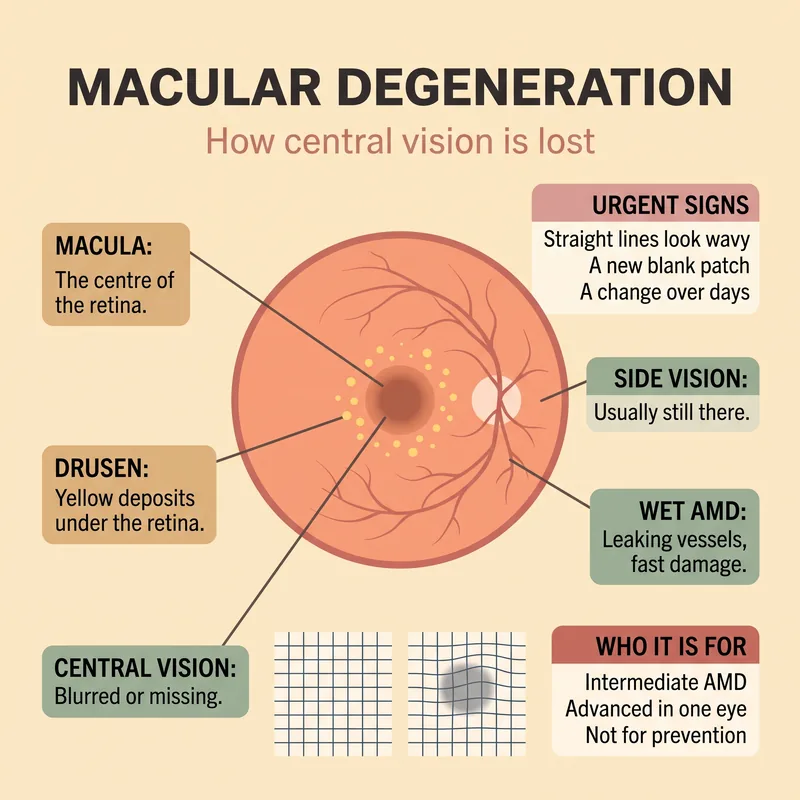
🚨 Straight lines that suddenly look bent or wavy, a new grey or blank patch in the centre of your vision, or a rapid change over days, all need an eye assessment urgently rather than an appointment in a few weeks. That pattern can mean wet AMD, and the injection treatment for it works best when it is started before scarring forms. Vision already lost to a delay does not usually come back. Nothing on this page is a reason to wait. This warning is placed first because it is the part of the page that could matter this week.

What Is Age-Related Macular Degeneration?

Damage to the macula, the small central part of the retina responsible for reading, faces and fine detail. It takes two forms. Dry AMD is gradual, far more common, and has no drug treatment in general use. Wet AMD is caused by abnormal blood vessels leaking under the retina, moves much faster, and does have treatment.

Peripheral vision is usually spared, so AMD does not typically cause total blindness. What it takes is the centre: the part used for reading a label, recognising a face across a room, and driving. That is why it is the leading cause of severe central vision loss in older adults across the United States and Europe.

Early AMD shows as drusen, small yellow deposits under the retina, and is often found on a routine eye examination before anything is noticed. The stage matters more than almost anything else on this page, because it decides whether the supplement evidence applies to you at all.
💡 Key Insight: This is a condition where the same supplement is well evidenced for one group and pointless for another. A Cochrane review found antioxidant supplements probably slow progression in people who already have AMD3. A separate Cochrane review by the same team found they do not prevent it in people who do not4. Which group you are in is the whole question.
Front-on view of the retina showing the dark central macula ringed by yellow drusen deposits, with the optic disc and blood vessels to one side, beside two grids showing straight lines and the same lines distorted around a grey central patch

🚬 Smoking is the largest modifiable risk

A systematic review and meta-analysis of clinical risk factors found current smoking among the strongest and most consistent modifiable associations with AMD8. Stopping matters more here than any capsule does.

👁️ The formula is for a specific stage

The original trial limited its recommendation to people with extensive intermediate drusen, at least one large druse, non-central geographic atrophy, or advanced AMD in one eye1. Not to everyone over 50.

⚠️ Beta-carotene was removed for a reason

Ten-year follow-up of AREDS2 reported that beta-carotene use nearly doubled the risk of lung cancer5. The current formula uses lutein and zeaxanthin instead.

How AMD Presents

Usually silently at first, because one eye compensates for the other until it cannot.

FeatureWhat it looks likeWorth knowing
Straight lines appearing bent or wavyDoor frames, tiles or lines of text bowingReport this urgently. It is the classic sign of wet AMD, and treatment is time-critical
A new grey, dark or blank patch in central visionA smudge that does not move when you look awayReport this urgently. Sudden onset needs same-week assessment
Blurred central visionFaces harder to recognise, text harder to readGradual blurring is more typical of dry AMD, and still needs assessing
Needing much more light to readLamps moved closer, print held differentlyCommon, and easy to attribute to ageing, which is why diagnosis is late
Slow adjustment coming indoorsTaking longer than it used toAn early functional change people rarely mention to anyone
Colours looking washed outLess vivid than rememberedUsually gradual, and usually noticed in hindsight
Nothing at allDrusen found on a routine eye testThe most common presentation of early AMD. This is the argument for regular eye examinations
Seeing shapes or patterns that are not thereCharles Bonnet syndrome, in significant vision lossDistressing, well recognised, and not a sign of mental illness. Worth raising, because being told what it is helps a great deal
⚠️ Check one eye at a time. AMD often starts in one eye, and the other covers for it well enough that people notice nothing for a long time. Covering each eye in turn, looking at the same object, once a week finds changes far earlier than waiting until both eyes are affected. If your clinic has given you an Amsler grid, use it as instructed. Any new distortion or new patch is a reason to be seen, not a reason to watch it for a fortnight.

How AMD Is Assessed

The examination decides your stage, and the stage decides whether any of the supplement evidence is about you.

MeasureWhat it tells youWhat it misses
Dilated eye examinationDrusen, pigment changes and atrophy. This is what stages the disease1Nothing else on this list replaces it, and it is the step most often skipped
Optical coherence tomographyA cross-section of the retina, showing the fluid that indicates wet AMDAvailability varies, and a single scan is a snapshot rather than a trend
Amsler grid, if your clinic provides oneDistortion you can detect at home between appointmentsInsensitive on its own and easy to do wrongly. It supplements examination rather than replacing it
Visual acuityHow much central function remainsCan look reassuring while distortion is already present
Fluorescein angiography where indicatedLeaking abnormal vessels in suspected wet AMDUsed selectively, when the treatment decision needs it
Smoking statusThe largest modifiable risk factor8, and a contraindication to older formulas containing beta-caroteneRarely revisited once recorded, though it changes what is safe to take
Blood pressure and cardiovascular riskShares risk factors with AMD, and worth managing regardlessSee high blood pressure
What you already takeWhether you are on a formula suited to your stage, or none, or the wrong oneAlmost never asked, and it is where most of the avoidable error on this page sits
💡 Ask your ophthalmologist or optometrist one specific question: what stage is my AMD? The answer decides everything that follows. Early AMD, intermediate AMD, advanced AMD in one eye and no AMD at all lead to four genuinely different answers about supplements, and a product label cannot tell you which one you are.

Holistic vs. Conventional Treatment for AMD

🌿 HOLISTIC
💊 CONVENTIONAL
🌿

Holistic / Functional Approach

Stopping smoking, a Mediterranean pattern, and the right formula for your actual stage

Best Evidenced Change
Stopping smoking, the strongest modifiable association found in a systematic review of clinical risk factors8
Where Supplements Work
Slowing progression in people who already have intermediate AMD, or advanced AMD in one eye3
Timeline
Measured in years. The trials ran five years and the follow-up ten, which tells you the honest scale
Limitation, stated plainly
Nothing here restores vision already lost, and no supplement prevents AMD in someone who does not have it4

Full Holistic Approach Includes

  • Stopping smoking, with proper support, at any age and any stage.
  • A Mediterranean dietary pattern, associated with lower incidence of advanced AMD across pooled European cohorts9.
  • Leafy greens, eggs and coloured vegetables, the food sources of lutein and zeaxanthin, which is where the pigment in the macula comes from.
  • Oily fish for the wider cardiovascular reasons, while being clear that omega-3 capsules did not slow AMD progression in AREDS22.
  • The correct formula, only if your stage matches the trial population, agreed with your eye clinician.
  • Sunglasses in bright light, sensible and low-cost, though the evidence is weaker than it is usually presented.
  • Managing blood pressure and cardiovascular risk, which share ground with AMD.
  • Regular dilated eye examinations, since early AMD is usually silent.
🌿 Worth knowing: the supplement evidence here is genuinely strong, and it is strong for one specific group. Presenting it as an eye vitamin for everyone over 50 is the most common way this evidence gets misused, and it is why this page keeps returning to your stage.

Diet for Macular Degeneration

The pattern has better evidence behind it than any single food, and it is the part that applies to everyone regardless of stage.

💡 The dietary pattern applies to everybody. The formula does not. Higher adherence to a Mediterranean pattern was associated with lower incidence of advanced AMD across two large European cohorts9. That is observational, so it shows association rather than proof, but it points the same way as the wider cardiovascular evidence and it carries no risk. It is the sensible thing to do at any stage, including no AMD at all.
ChangeWhyPractical note
Leafy green vegetablesThe main food source of lutein and zeaxanthin, the pigments concentrated in the maculaKale, spinach, chard, collards. Cooked with a little fat, since these pigments absorb better with it
A Mediterranean pattern overallAssociated with lower incidence of advanced AMD in pooled cohort data9Vegetables, fruit, legumes, whole grains, olive oil and fish. The pattern, not any one item on this list
EggsA well absorbed source of the same two pigmentsUseful for people who eat few leafy greens
Oily fishCardiovascular benefit, and associated with lower AMD risk in observational workNote the honest limit: omega-3 capsules did not slow progression in AREDS22. Fish as food is still worth eating
Orange and yellow vegetablesCarotenoids from food, which do not carry the concern that high-dose beta-carotene supplements doCarrots, squash, sweet potato, peppers
Nuts and olive oilPart of the pattern that carried the associationUnsalted nuts, and extra virgin olive oil as the main fat
Less ultra-processed food and refined carbohydrateHigher intake is associated with higher AMD risk in cohort studiesDisplacing them with the foods above does both jobs at once
SmokingThe largest modifiable risk factor8Not a dietary change, and more important than every dietary change on this table
⚠️ Food carotenoids and high-dose beta-carotene supplements are not the same thing. The lung cancer signal in the CARET and ATBC trials came from high-dose supplements67, not from eating carrots or sweet potato. This site applies that caution to the supplement and not to the vegetable, consistently, on every page where it comes up. See lung cancer.

Evidence-Based Supplements

One of the best evidenced supplement recommendations in medicine, for one clearly defined group of people.

🚨 No supplement treats wet AMD, and none replaces the injections. Delaying assessment or treatment because a formula seems to be helping is the most dangerous thing associated with this topic, since the vision lost while waiting does not usually return. If you smoke or used to smoke, do not take any formula containing beta-carotene, and check the label rather than assuming the product was reformulated5. Tell your eye clinician everything you take.
SupplementWhat it is actually forTypical rangeTimingNotes & cautions
The AREDS2 formulation Slowing progression if you already have intermediate AMD, or advanced AMD in one eye. This is where the evidence sits23. Sold as a single product at the composition used in the trial. Confirm with your eye clinician that your stage matches before starting With food, usually split across the day as the product directs The zinc content is above the general population upper intake level, which is why this belongs to a supervised decision for people who meet the trial criteria rather than to general use. It includes copper for the reason in the row below. Check the label says lutein and zeaxanthin, not beta-carotene.
Copper, as part of the formula Preventing the copper deficiency that sustained high-dose zinc can cause, which is why the trial formula contains it. Included in the formulation. Not a separate purchase With the formula Do not take the zinc without the copper. Copper deficiency from sustained high-dose zinc can cause anaemia and neurological problems, and it is the reason the trial formula was built this way.
Lutein and zeaxanthin The replacement for beta-carotene in the current formula. Alone against placebo the evidence was weaker, and as a substitute within the formula it performed at least as well35. Best taken as part of the formulation rather than separately, unless your clinician advises otherwise With a fat-containing meal The food sources are leafy greens and eggs, and eating them is worthwhile at any stage, including no AMD at all.
Omega-3 capsules Not for slowing AMD. Adding them to the formula did not reduce progression in AREDS22, and ten-year follow-up did not change that5. Listed here to answer the question, not to recommend it for this purpose Not applicable They may still be appropriate for other reasons agreed with your clinician. Buying them specifically for your eyes is buying the wrong thing.
🚨 What to avoid, specifically. Any formula containing beta-carotene if you smoke or have ever smoked, since ten-year follow-up of AREDS2 reported it nearly doubled lung cancer risk5 and two earlier trials found the same direction of harm67; see lung cancer. High-dose zinc taken without copper. Products marketed to reverse macular degeneration or restore vision, which nothing does. Buying an eye formula as prevention when you have no AMD, since a Cochrane review found antioxidant supplements do not prevent or delay its onset4. And any supplement used as a reason to postpone an urgent eye assessment.
💡 Where the real leverage is. Stopping smoking, getting your stage established by dilated examination, being seen urgently for new distortion, eating the pattern rather than buying the pill, and taking the correct formula only if your stage matches the trial. Those five do more than every eye supplement on the market combined.

References & Evidence Notes

Each numbered entry below is either a source you can follow or a note setting out what the evidence does and does not support. Both are numbered together so the markers in the text line up.

Last reviewed 3 September 2026. Supplement entries are cross-checked against the NIH National Center for Complementary and Integrative Health and the Linus Pauling Institute Micronutrient Information Center.10 This page is nutrition education, not medical advice, and it does not replace your doctor. Nutrition does not reverse macular degeneration, and no supplement restores vision that has been lost. The supplement evidence here is about slowing progression in people who already have a specific stage of the disease, and it does not apply to people who do not. Wet AMD is treated with injections and that treatment is time-critical, so nothing on this page is a reason to delay being seen. What nutrition education can do is help you understand the evidence well enough to have a better conversation with the clinician who does treat you.

  1. Age-Related Eye Disease Study Research Group. A randomized, placebo-controlled, clinical trial of high-dose supplementation with vitamins C and E, beta carotene, and zinc for age-related macular degeneration and vision loss: AREDS report no. 8. Arch Ophthalmol. 2001;119(10):1417–1436. PubMed 11594942. The trial that established the formula. Its own conclusion limited the recommendation to people with extensive intermediate drusen, at least one large druse, non-central geographic atrophy, or advanced AMD or vision loss from AMD in one eye, and to those without contraindications such as smoking. Both halves of that sentence are load-bearing on this page.
  2. Age-Related Eye Disease Study 2 Research Group. Lutein + zeaxanthin and omega-3 fatty acids for age-related macular degeneration: the Age-Related Eye Disease Study 2 (AREDS2) randomized clinical trial. JAMA. 2013;309(19):2005–2015. PubMed 23644932. Adding omega-3 fatty acids to the formula did not further reduce progression to advanced AMD. Lutein and zeaxanthin were tested as a replacement for beta-carotene. This is the reference for the honest statement that fish oil capsules are not an AMD treatment.
  3. Evans JR, Lawrenson JG. Antioxidant vitamin and mineral supplements for slowing the progression of age-related macular degeneration. Cochrane Database Syst Rev. 2023;(9):CD000254. PubMed 37702300. Moderate-certainty evidence that the AREDS combination probably slows progression to late AMD, with people who have intermediate AMD more likely to benefit because their risk of progression is higher. Lutein and zeaxanthin alone against placebo showed little effect on low-certainty evidence, while subgroup analysis supported them as a replacement within the formula.
  4. Evans JR, Lawrenson JG. Antioxidant vitamin and mineral supplements for preventing age-related macular degeneration. Cochrane Database Syst Rev. 2017;(7):CD000253. PubMed 28756617. The companion review by the same team, reaching the opposite conclusion for a different population: vitamin E or beta-carotene supplements will not prevent or delay the onset of AMD, and the same probably applies to vitamin C and to the multivitamin tested. Cited alongside the review above because the pair of them is the entire argument of this page.
  5. Chew EY, Clemons TE, Agrón E, et al. Long-term outcomes of adding lutein/zeaxanthin and omega-3 fatty acids to the AREDS supplements on age-related macular degeneration progression: AREDS2 report 28. JAMA Ophthalmol. 2022;140(7):692–698. PubMed 35653117. Ten-year follow-up. The authors state that beta-carotene use nearly doubled the risk of lung cancer, with no statistically significant increase for lutein and zeaxanthin, and that omega-3 fatty acids showed no effect on progression to late AMD. This is the single most important reference on the page for what to avoid.
  6. Goodman GE, Thornquist MD, Balmes J, et al. Chemoprevention of lung cancers: lessons from CARET, the beta-carotene and retinol efficacy trial. Eur J Cancer Prev. 2007;16(3):175–180. PubMed 17415088. High-dose beta-carotene supplementation increased lung cancer incidence in smokers and in asbestos-exposed workers. This site applies the caution consistently wherever beta-carotene supplements appear. See the lung cancer guide.
  7. The Alpha-Tocopherol, Beta Carotene Cancer Prevention Study Group. The effect of vitamin E and beta carotene on the incidence of lung cancer and other cancers in male smokers. N Engl J Med. 1994;330(15):1029–1035. PubMed 8127329. The earlier of the two trials, in male smokers. Cited with CARET because the finding was independently reproduced, which is why it is treated on this site as settled rather than as one surprising result.
  8. Chakravarthy U, Wong TY, Fletcher A, et al. Clinical risk factors for age-related macular degeneration: a systematic review and meta-analysis. BMC Ophthalmol. 2010;10:31. PubMed 21144031. Current smoking was among the strongest and most consistent modifiable associations with AMD. Age and genetic factors carry more weight overall and cannot be changed, which is why smoking is described here as the largest modifiable risk rather than the largest risk.
  9. Merle BMJ, Colijn JM, Cougnard-Grégoire A, et al. Mediterranean diet and incidence of advanced age-related macular degeneration: the EYE-RISK consortium. Ophthalmology. 2019;126(3):381–390. PubMed 30114418. Higher adherence to a Mediterranean pattern was associated with lower incidence of advanced AMD across pooled European cohorts. Observational, so it establishes association rather than causation, and it is presented on this page as a sensible pattern rather than as a proven treatment.
  10. NIH National Center for Complementary and Integrative Health, nccih.nih.gov, and the Linus Pauling Institute Micronutrient Information Center, lpi.oregonstate.edu.