COPD

Chronic obstructive pulmonary disease: airways narrowed and lung tissue damaged, so breathing out becomes hard work. The nutrition story here inverts the usual one. In COPD, being underweight carries the greater risk, and breathing itself burns energy that many people are not replacing.

Muscle Matters Evidence-Based Root-Cause Focus

Last updated:

🚨 Seek urgent care for breathlessness much worse than your usual, for confusion or drowsiness, for blue lips or fingertips, or for chest pain. A COPD exacerbation treated early is far easier to recover from than one left for days, and drowsiness in particular can mean carbon dioxide is building up. Never stop an inhaler or any prescribed medicine because you feel better, and never adjust home oxygen yourself, since in some people too much oxygen suppresses breathing. This warning is placed first because it is the part of this page that could matter tonight.

What Is COPD?

Persistent airflow limitation that does not fully reverse, from a combination of narrowed inflamed airways and destroyed lung tissue. Smoking is the dominant cause in high-income countries; indoor cooking smoke is a major cause elsewhere.

The mechanical problem creates a nutritional one. Damaged lungs trap air, the diaphragm works at a mechanical disadvantage, and the effort of breathing consumes noticeably more energy than it does in healthy lungs. At the same time, breathlessness while chewing and swallowing, early fullness from a flattened diaphragm pressing on the stomach, and fatigue all reduce how much people eat.

More energy out, less energy in. That is why unintended weight loss and muscle wasting are common in COPD, and why they matter: low body mass index is associated with higher mortality in COPD1. On this page, protecting weight and muscle is the goal.
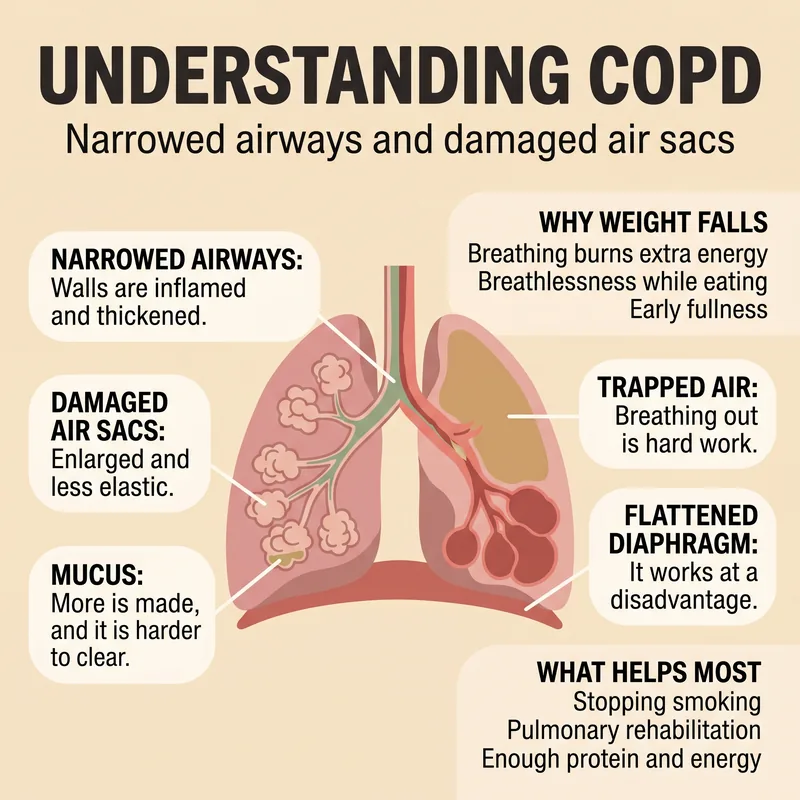
💡 Key Insight: The muscle that matters most is not in the lungs. Skeletal muscle strength, particularly in the legs, predicts how far someone with COPD can walk and how they fare, and it responds to protein and to training in a way that damaged lung tissue does not.
Anatomical illustration comparing healthy airways and alveoli with narrowed inflamed airways and enlarged damaged air sacs, with a flattened diaphragm below

🚬 Stopping smoking is the intervention

It is the only thing shown to change the rate at which lung function declines. Nothing on the rest of this page comes close, and saying otherwise would be dishonest.

🍲 Supplements help the malnourished

A Cochrane review found nutritional supplementation produced weight gain and improvements in respiratory muscle strength and walking distance in malnourished patients, and little in the well-nourished2.

☀️ Vitamin D only if deficient

An individual-participant meta-analysis found vitamin D reduced exacerbation rates in those with very low baseline levels, and not in those with higher levels3. Who you are decides whether it helps.

How COPD Presents

Slowly, which is why it is typically diagnosed years after it started.

FeatureWhat it looks likeWorth knowing
Breathlessness on exertionProgressive, over yearsFrequently attributed to age or weight, which is why diagnosis is late
Chronic cough, with or without sputumOften dismissed as a smoker's coughA daily productive cough is not normal and is worth investigating
Wheeze and chest tightnessVariable, worse with infectionsOverlaps with asthma, and the two can coexist
ExacerbationsDays of worse breathlessness, more sputum, or a change in its colourTreat early. Each severe exacerbation is associated with worse subsequent decline
Unintended weight lossClothes looser, muscle visibly reducedA poor prognostic sign in COPD, not a success. Report it
Breathlessness while eatingStopping mid-meal, avoiding large platesA major and rarely asked-about reason for low intake
Leg weakness, difficulty with stairsOut of proportion to the lungs aloneSkeletal muscle loss, which responds to training and protein
Morning headache, daytime drowsinessParticularly in more advanced diseaseMay indicate carbon dioxide retention or coexisting sleep apnea; report it
⚠️ Weight in COPD is not simply better lower. Being underweight is associated with higher mortality1, while excess weight adds to breathlessness and to the work of breathing. Neither extreme is good, and the target is a healthy weight with preserved muscle rather than a number pushed in one direction. If you have both COPD and excess weight, any weight loss should be deliberate, supervised, and protective of muscle. See the obesity guide.

How COPD Is Assessed

Spirometry makes the diagnosis. The nutritional assessment is the part usually left out.

MeasureWhat it tells youWhat it misses
SpirometryAirflow limitation, and whether it reverses. Required for the diagnosisCorrelates only loosely with how breathless someone actually feels
Body mass index and weight trendWhether weight is being lost, which carries prognostic weight here1BMI alone hides muscle loss in someone whose weight looks stable
Muscle mass or grip strengthThe thing that actually predicts functionRarely measured outside pulmonary rehabilitation programmes
25-OH vitamin DWhether you are in the group that benefits from correction3A single value; and correcting it is not a treatment for the airflow limitation
Walking testFunctional capacity, and change over timeEffort-dependent, so it needs consistent conditions
Oxygen saturation, and blood gases where indicatedWhether oxygen therapy is needed, and whether carbon dioxide is retainedA resting reading misses desaturation on exertion or in sleep
Sleep assessment where symptoms suggest itCoexisting sleep apnea, which is treatable and commonly missedSee sleep apnea
Referral to pulmonary rehabilitationThe single best-evidenced non-drug intervention for symptoms and capacityUnder-referred almost everywhere; worth asking for by name
💡 Ask to be referred to pulmonary rehabilitation. It combines supervised exercise with education and nutritional input, it improves breathlessness, exercise capacity and quality of life, and it is consistently under-offered. It is also where muscle loss actually gets addressed rather than noted.

Holistic vs. Conventional Treatment for COPD

🌿 HOLISTIC
💊 CONVENTIONAL
🌿

Holistic / Functional Approach

Stopping smoking, protecting muscle, eating enough, and correcting real deficiencies

The Only Disease-Modifier
Stopping smoking, which changes the rate of lung function decline. Nothing else on this page does
Where Nutrition Works
In malnourished patients, supplementation improved weight, respiratory muscle strength and walking distance2
Timeline
Weight and strength respond over weeks to months, alongside training rather than instead of it
Limitation, stated plainly
In well-nourished patients, nutritional supplementation adds little. This is a targeted intervention, not a general one

Full Holistic Approach Includes

  • Stopping smoking, with proper support, at any stage and any age.
  • Eating enough energy and protein, in smaller more frequent meals if breathlessness limits portions.
  • Resistance training alongside aerobic work, which is what pulmonary rehabilitation provides.
  • Correcting vitamin D if genuinely deficient, which is the group that benefited3.
  • Vegetables and fruit, associated with better lung function in observational work, and worth eating regardless.
  • Vaccination as advised, since infections drive exacerbations.
  • Treating coexisting sleep apnea, reflux and anxiety, each of which worsens the experience of breathlessness.
🌿 Worth knowing: none of this reverses the airflow limitation, which is structural. It addresses the muscle, the weight and the exacerbations, and those determine a great deal of how life with COPD actually goes.

Diet for COPD

The central question is not what to cut. It is whether you are managing to eat enough at all.

💡 Nutrition support works in the people who need it, which is not everyone. A Cochrane review of nutritional supplementation in stable COPD found improvements in weight, respiratory muscle strength and walking distance in malnourished participants, with little effect in those who were already adequately nourished2. That is a more useful finding than a blanket recommendation, because it tells you which group you are in.
ChangeWhyPractical note
Eat enough energyBreathing costs more energy in COPD, and intake often fallsSmall, frequent, energy-dense meals. Rest before eating, and eat the highest-energy part first
Protein at every mealSkeletal muscle predicts function and responds to protein plus trainingSpread it across the day rather than concentrating it in one meal
Smaller portions, more oftenA full stomach pushes on a flattened diaphragm and worsens breathlessnessFive or six small meals rather than three large ones
Vegetables and fruitAssociated with better lung function and slower decline in cohort studiesObservational, so this is sensible rather than proven. Worth eating anyway
Avoid becoming constipatedStraining is hard work when breathless, and a distended abdomen worsens itFibre and fluid, within any limits your clinician has set
Watch for fatigue while eatingBreathlessness while chewing genuinely limits intakeSofter textures and nutrient-dense foods reduce the effort per calorie
AlcoholSuppresses breathing and interacts with sedating medicinesWorth moderating, particularly in advanced disease
Restrictive or detox dietsActively harmful hereThe risk in COPD is eating too little, not too much of the wrong thing
⚠️ Do not start a weight-loss diet in COPD without discussing it first. Because low body weight is associated with higher mortality here1, unsupervised dieting can do real harm, and weight lost without resistance training is disproportionately muscle. If weight loss is appropriate for you, it should be deliberate, gradual and paired with training that protects muscle.

Evidence-Based Supplements

Two entries with real evidence, both of which depend on which group you are in.

🚨 No supplement treats COPD, and none replaces an inhaler. Stopping or reducing inhaled therapy because a supplement seems to be helping is the most dangerous thing associated with this topic, because the deterioration is gradual and the exacerbation that follows is not. Never adjust prescribed oxygen yourself, either. Tell your clinician about everything you take.
SupplementWhat it is actually forTypical rangeTimingNotes & cautions
Oral nutritional supplements Adding energy and protein if you are malnourished or losing weight. This is where the evidence sits2. As advised by a dietitian, usually alongside meals rather than replacing them Between meals, so they add to intake rather than displacing it Ask for a dietitian referral rather than self-selecting a product. Little benefit if you are already well nourished, and taking them instead of meals defeats the purpose.
Vitamin D3 Correcting deficiency. An individual-participant meta-analysis found reduced exacerbation rates in those with very low baseline levels, and no benefit in those with higher levels3. Test 25-OH-D first and set a daily dose with your clinician With a fat-containing meal Test rather than assume. A later Cochrane review of vitamin D in COPD reached more cautious overall conclusions4, which is why this is framed as correcting deficiency rather than as treatment. Avoid large intermittent doses; see osteoporosis.
Calcium and vitamin D together, if on long-term steroids Protecting bone, since repeated or long-term corticosteroids raise fracture risk. Discuss with your clinician, who may also assess fracture risk Calcium with meals Relevant to many people with COPD because of repeated steroid courses. See osteoporosis for the calcium and vitamin D cautions, which apply here unchanged.
🚨 What to avoid, specifically. Any product claiming to cleanse, detoxify or repair the lungs, none of which has evidence and some of which delays real treatment. High-dose antioxidant supplements taken on the theory that COPD is oxidative, which has not translated into benefit in trials. High-dose beta-carotene supplements in anyone who smokes or has smoked, which increased lung cancer incidence in two large trials and is a caution this site applies consistently5; see lung cancer. Sedating supplements and alcohol in advanced disease. And restrictive diets, since the risk in COPD is undernutrition.
💡 Where the real leverage is. Stopping smoking, getting into pulmonary rehabilitation, using inhalers correctly, eating enough protein and energy, and treating exacerbations early. Those five do more than every supplement on the market combined.

References & Evidence Notes

Each numbered entry below is either a source you can follow or a note setting out what the evidence does and does not support. Both are numbered together so the markers in the text line up.

Last reviewed 3 September 2026. Supplement entries are cross-checked against the NIH National Center for Complementary and Integrative Health and the Linus Pauling Institute Micronutrient Information Center.6 This page is nutrition education, not medical advice, and it does not replace your doctor. Nutrition does not treat COPD. The airflow limitation is structural, stopping smoking is the only thing shown to change its rate of decline, and nothing here replaces inhaled therapy, pulmonary rehabilitation or prescribed oxygen. What nutrition education can do is help you understand the evidence well enough to have a better conversation with the clinician who does treat you.

  1. Association of body mass index with mortality in COPD. BMJ Open Respir Res. 2026. PubMed 42580774. Low body mass index is associated with higher mortality in COPD, a relationship reported consistently across cohorts. Observational, so low weight may partly be a marker of more severe disease rather than purely a cause, which is why this page frames it as a sign to report rather than a number to chase.
  2. Ferreira IM, et al. Nutritional supplementation for stable chronic obstructive pulmonary disease. Cochrane Database Syst Rev. 2012;(12):CD000998. PubMed 23235577. Supplementation produced weight gain and improvements in respiratory muscle strength and exercise tolerance in malnourished participants, with little effect in the well nourished. The subgroup distinction is the finding, and it is the reason this page does not recommend supplements to everyone.
  3. Jolliffe DA, et al. Vitamin D to prevent exacerbations of COPD: systematic review and meta-analysis of individual participant data from randomised controlled trials. Thorax. 2019;74(4):337–345. PubMed 30630893. Supplementation reduced exacerbation rates in participants with very low baseline 25-hydroxyvitamin D, and had no significant effect in those with higher baseline levels. This is why the page frames vitamin D as correcting deficiency rather than as treatment.
  4. Vitamin D for the management of chronic obstructive pulmonary disease. Cochrane Database Syst Rev. 2024;(9). PubMed 39329240. A more cautious overall assessment than the individual-participant analysis above. Both are cited because they do not say quite the same thing, and a reader is entitled to know that.
  5. On beta-carotene: high-dose supplementation increased lung cancer incidence in smokers and asbestos-exposed workers in the CARET and ATBC trials, a finding this site applies consistently wherever smokers are a large part of the readership. See the review of lessons from CARET, PubMed 17415088, and the lung cancer guide. Beta-carotene from food does not carry the same concern.
  6. NIH National Center for Complementary and Integrative Health, nccih.nih.gov, and the Linus Pauling Institute Micronutrient Information Center, lpi.oregonstate.edu.