An immune attack on the insulation around nerve fibres in the brain and spinal cord. Few conditions attract more confident dietary claims, and few have a wider gap between what the observational evidence suggests and what the trials have shown. Diet can help how you feel. It does not replace disease-modifying treatment, and nothing here is worth a relapse.
Last updated:
A condition in which the immune system damages myelin, the insulating sheath around nerve fibres in the brain and spinal cord, and damages the fibres themselves. Signals slow or fail, and what that looks like depends entirely on where the damage is, which is why no two people describe the same illness.
Most people begin with a relapsing pattern: episodes of new symptoms lasting days to weeks, then partial or full recovery. Over time, some move to a more gradually progressive course. Modern treatment has changed this substantially, and it works best started early.
The largest recent finding is not nutritional. A study following millions of young adults found infection with Epstein-Barr virus greatly increased the subsequent risk of MS, and the authors describe it as the leading cause4. Vitamin D, adolescent weight and smoking sit alongside it as contributors to risk.
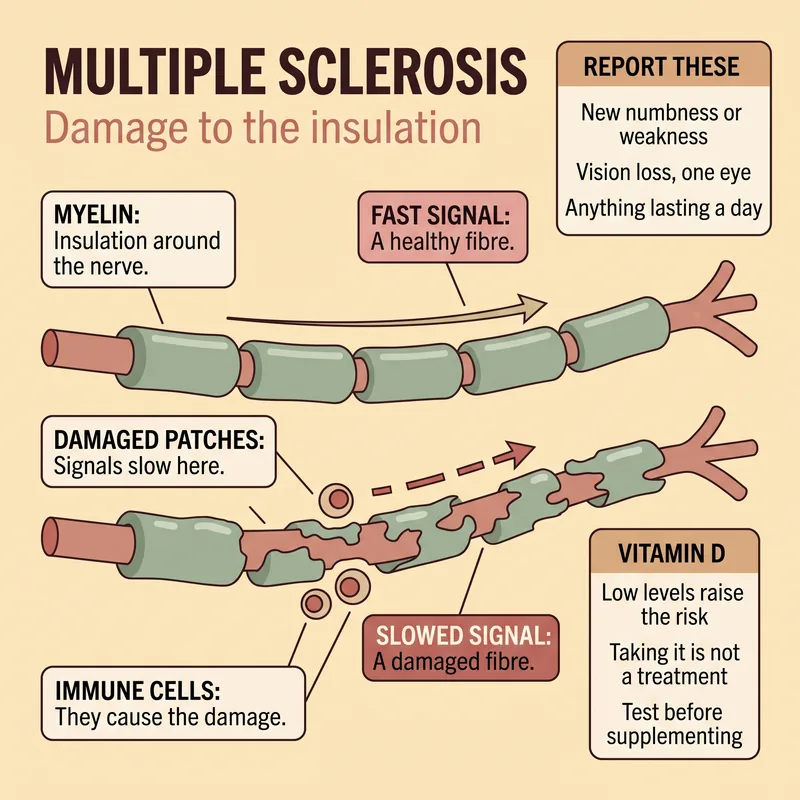
Mendelian randomisation supports a causal role for low vitamin D in MS risk1. Supplementation in established MS has not delivered the matching benefit2.
A network meta-analysis found several dietary patterns reduced fatigue and improved quality of life, while warning the underlying trials were of low quality3.
Smoking is associated with both developing MS and with faster progression. It is the modifiable factor with the least controversy attached to it.
Differently in everyone, because the symptom depends on the site.
| Feature | What it looks like | Worth knowing |
|---|---|---|
| Vision loss or pain in one eye | Blurring or dimming over hours to days, pain on moving the eye | Report urgently. Optic neuritis is a common first presentation and is treatable |
| New numbness, tingling or weakness | Often on one side, or a band around the trunk, lasting more than a day | Report it. A relapse treated early is managed better than one reported late |
| Fatigue | Out of proportion to activity, worse as the day goes on | The symptom people most often rank as their worst, and the one diet research has actually targeted |
| Balance and coordination difficulty | Unsteadiness, clumsiness, tremor | Responds to rehabilitation more than most people are told |
| Bladder and bowel changes | Urgency, frequency, incomplete emptying, constipation | Very common, very treatable, and under-reported through embarrassment |
| Cognitive change | Processing speed, memory, word-finding | Real and measurable. Worth naming rather than absorbing |
| Worsening in heat | Symptoms returning in hot weather, a hot bath or with fever | Usually not a relapse. It typically settles when you cool down. A true relapse persists |
| Spasticity and pain | Stiffness, spasms, nerve pain | Treatable, and worth raising specifically since it is often assumed to be unavoidable |
By a neurologist, and the nutritional part is a small and specific piece of it.
| Measure | What it tells you | What it misses |
|---|---|---|
| MRI of brain and spinal cord | Lesions, their distribution, and whether new activity is present | Lesion count correlates only loosely with how someone actually functions |
| Neurological examination | Where the damage is showing, and change over time | Fatigue and cognitive symptoms are poorly captured by it |
| Lumbar puncture where needed | Supporting evidence for the diagnosis | Not required in every case |
| 25-OH vitamin D | Whether you are deficient, which is common and worth correcting1 | Correcting it is not a treatment for MS, and the trial evidence is why2 |
| B12 and thyroid function | Conditions that can mimic or compound MS symptoms | See B12 and folate deficiency and thyroid disorders |
| Bone health assessment | Fracture risk, raised by reduced mobility and by steroid courses | Frequently overlooked in a younger population. See osteoporosis |
| Swallowing assessment where indicated | Whether eating is becoming unsafe, which changes nutrition entirely | Ask for it if coughing on food or drink has started |
| Mood and fatigue assessment | Two of the largest contributors to how life actually goes | Both treatable, and both regularly left out of a neurology appointment |
Fatigue, function and general health, alongside treatment rather than instead of it
Aimed at fatigue, function and general health, which is where the evidence points, and not at the disease course.
| Change | Why | Practical note |
|---|---|---|
| A Mediterranean pattern | Reduced fatigue and improved quality of life in the pooled trials, and it is sustainable3 | Vegetables, fruit, legumes, whole grains, olive oil, fish. Chosen here partly because it is the least punishing of the options that performed well |
| Correct vitamin D if deficient | Deficiency is common in MS and matters for bone health1 | Test first. Correcting a deficiency is not treating the MS2 |
| Enough fibre and fluid | Constipation is very common and worsens bladder symptoms and spasticity | Increase fibre gradually. Reducing fluid to manage bladder urgency usually backfires |
| Adequate protein and energy | Preserving muscle supports mobility, and unintended weight loss is a poor sign | Particularly if fatigue or hand function is making cooking difficult |
| Oily fish as food | Part of the pattern above, with the usual cardiovascular benefit | The capsule evidence in MS is much weaker than the enthusiasm for it |
| A healthy weight | Higher body weight is associated with MS risk5, and excess weight worsens fatigue and mobility | Gradual, and never at the cost of muscle or of eating enough |
| Texture changes if swallowing is affected | Choking and aspiration are real risks in more advanced disease | Ask for a swallowing assessment rather than improvising this |
| Highly restrictive named MS diets | Weak evidence, high cost, and frequently abandoned | If you want to try one, do it alongside treatment, with dietetic support, and with your team told |
Vitamin D is the entry everyone asks about, and the honest answer has two halves.
| Supplement | What it is actually for | Typical range | Timing | Notes & cautions |
|---|---|---|---|---|
| Vitamin D3 | Correcting deficiency, and bone health. Genetic evidence supports low vitamin D as a causal factor in MS risk1, while a randomised trial of high-dose vitamin D added to existing treatment did not meet its primary outcome2. | Test 25-OH-D first and set a daily dose with your clinician | With a fat-containing meal | The two halves of that sentence are the whole entry. A cause of risk is not automatically a treatment. Avoid large intermittent doses and self-escalation; see osteoporosis for the vitamin D cautions. |
| Calcium and vitamin D together, if on repeated steroids | Protecting bone, since repeated steroid courses and reduced mobility both raise fracture risk. | Discuss with your clinician, who may also assess fracture risk | Calcium with meals | Relevant to many people with MS and routinely overlooked in a younger population. See osteoporosis. |
| B12, if deficient | Correcting a deficiency whose neurological symptoms overlap with MS and which is treatable in its own right. | Set by your clinician on the basis of blood results | As advised | Worth separating from MS rather than folding into it. See B12 and folate deficiency. |
| Omega-3 capsules | Not established as changing the course of MS. Widely taken, and the trial evidence does not support the claim made for it. | Listed to answer the question, not to recommend it for this purpose | Not applicable | May be appropriate for other reasons agreed with your clinician. Oily fish as food is part of the dietary pattern that did help fatigue. |
Each numbered entry below is either a source you can follow or a note setting out what the evidence does and does not support. Both are numbered together so the markers in the text line up.
Last reviewed 3 September 2026. Supplement entries are cross-checked against the NIH National Center for Complementary and Integrative Health and the Linus Pauling Institute Micronutrient Information Center.6 This page is nutrition education, not medical advice, and it does not replace your doctor. No diet and no supplement is disease-modifying in multiple sclerosis. The dietary evidence that exists is about fatigue and quality of life, it comes from small trials whose own authors call for better ones, and it says nothing about relapses or disability. Nothing here replaces disease-modifying treatment, and stopping that treatment because something else seems to be helping is the most dangerous thing associated with this topic. What nutrition education can do is help you understand the evidence well enough to have a better conversation with the clinician who does treat you.