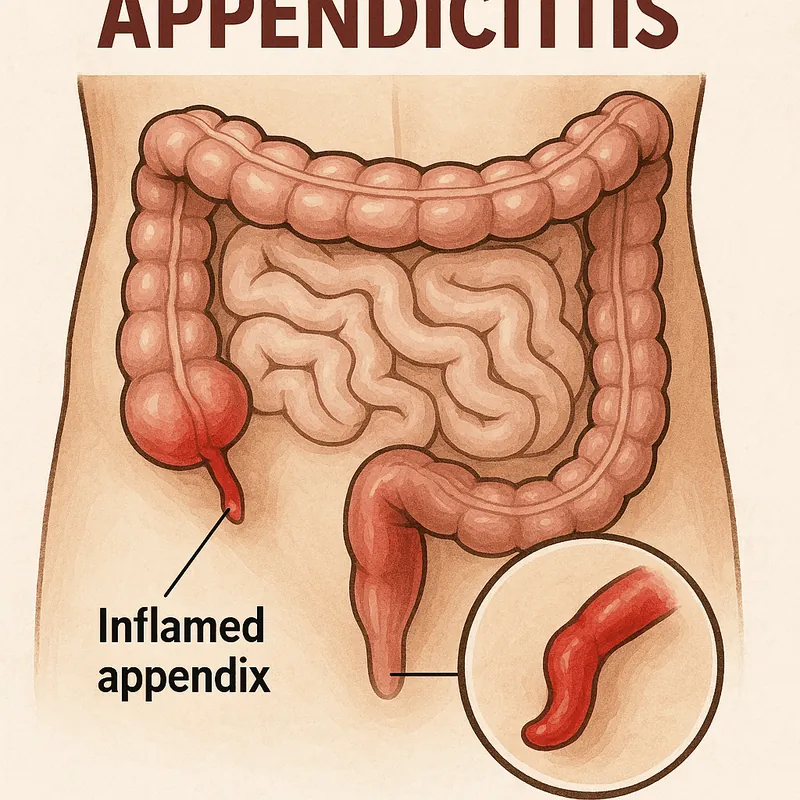
Appendicitis

Acute inflammation of the appendix, typically presenting as periumbilical pain migrating to the right lower quadrant. This is a SURGICAL EMERGENCY. Nutrition is for post-operative recovery only; severe abdominal pain requires immediate medical evaluation.

Gut & Digestive Evidence-Based Root-Cause Focus

Last updated:

What Is Appendicitis?

Appendicitis is acute inflammation of the vermiform appendix, a finger-like pouch attached to the cecum at the start of the colon. It typically results from obstruction of the appendiceal lumen by a fecalith (hardened stool), lymphoid hyperplasia, or rarely a tumor, leading to bacterial overgrowth, inflammation, and potential rupture.

Untreated, appendicitis progresses from inflammation (24-48 hours) to gangrene to perforation with peritonitis, abscess formation, and potentially sepsis. Perforation rates are ~20-30% by 36 hours from symptom onset. This is a SURGICAL EMERGENCY, time matters significantly.

Lifetime risk is ~7-8%, with peak incidence in adolescents and young adults (10-30 years). Children and elderly often present atypically and have higher complication rates. Modern management is increasingly individualized, uncomplicated appendicitis may sometimes be treated with antibiotics alone, but surgery remains the gold standard for definitive treatment.

๐Ÿšจ EMERGENCY: Severe right lower quadrant abdominal pain, especially with fever and nausea, requires IMMEDIATE emergency room evaluation. Do not eat or drink. Do not take pain medications that may mask symptoms. Don't delay, every hour of delay increases perforation risk.
Appendicitis illustration

Stages of Appendicitis

๐ŸŒฑ Early / Uncomplicated

First 24-48 hours. Inflammation only, no perforation. Symptoms classic. Surgical removal curative; antibiotics sometimes sufficient. Excellent prognosis.

๐ŸŒ— Gangrenous

36-72 hours. Tissue necrosis develops. Pain may temporarily improve before perforation. Increased risk of complications. Surgery urgent.

๐ŸŒ‘ Perforated / Abscess

>48-72 hours. Appendix ruptures โ†’ peritonitis or contained abscess. Worse prognosis. Possible delayed surgery after drainage. Sepsis risk.

~7-8%
Lifetime risk
~300K
Annual US appendectomies
10-30
Peak age (years)
20-30%
Perforation rate by 36 hours

Symptoms of Appendicitis

Classic presentation is migrating abdominal pain. Atypical presentations common in children, elderly, and pregnant patients.

๐Ÿ” Classic Symptoms

โ†ฉ๏ธ

Migrating Abdominal Pain

Pain starts near belly button (periumbilical) for hours, then localizes to right lower quadrant (McBurney's point). Pathognomonic when present. Worse with movement.

๐Ÿฝ๏ธ

Anorexia (Loss of Appetite)

Sudden loss of appetite, characteristic feature. Important enough that "hungry for a cheeseburger" is sometimes used clinically as a sign against appendicitis.

๐Ÿคข

Nausea, Vomiting

Develops AFTER pain begins (key distinction from gastroenteritis where vomiting precedes pain). Usually 1-2 episodes only.

๐ŸŒก๏ธ

Low-Grade Fever

38-38.5ยฐC typically. High fever (>39ยฐC) suggests perforation or other diagnosis. Combined with right lower quadrant pain, urgent evaluation.

โš ๏ธ Examination Signs & Atypical

๐Ÿ“

McBurney's Point Tenderness

Maximum tenderness 1/3 of distance from anterior superior iliac spine to navel. Classic exam finding. Guarding and rebound tenderness develop with peritoneal irritation.

๐Ÿคธ

Psoas, Obturator, Rovsing's Signs

Psoas: pain extending right leg. Obturator: pain rotating right hip. Rovsing's: RLQ pain with LLQ palpation. Suggest retrocecal or pelvic appendix.

๐Ÿ‘ถ

Atypical (Children, Elderly, Pregnant)

Children: irritability, vomiting, refusing food. Elderly: vague abdominal pain, often delayed diagnosis with higher perforation rates. Pregnant: pain may be higher in abdomen.

โš ๏ธ

Red Flag: Sudden Pain Relief

Sudden disappearance of pain may indicate perforation (briefly less pressure) followed by worsening peritonitis. Don't be reassured, seek immediate care.

How Appendicitis Is Diagnosed

๐Ÿฉป Clinical & Imaging

๐Ÿ“‹ Clinical Diagnosis (Alvarado Score)

Migrating pain, anorexia, nausea, RLQ tenderness, rebound, fever, leukocytosis, left shift. Score โ‰ฅ7 highly suggestive. Score 5-6: imaging needed.

๐Ÿ“ก Ultrasound (First-Line in Children/Pregnant)

No radiation. Operator-dependent. Diameter >6mm, non-compressible, hyperemia. Good for thin patients and children.

๐Ÿ“ก CT Scan (Adults)

Most accurate (>95% sensitivity/specificity). Appendiceal diameter >6mm, wall thickening, fat stranding. Identifies complications (abscess, perforation).

๐Ÿ“ก MRI (Pregnant)

No ionizing radiation. Used in pregnant patients when ultrasound inconclusive. Accuracy comparable to CT.

๐Ÿฉธ Labs & Rule-Outs

๐Ÿฉธ CBC + CRP

Leukocytosis with left shift (neutrophil predominance). Elevated CRP. Normal WBC doesn't exclude appendicitis (~10% have normal WBC).

๐Ÿฉธ Urinalysis

Rule out UTI, kidney stone. May show mild pyuria from inflamed appendix irritating ureter (pseudo-UTI).

๐Ÿฉบ Pelvic Exam (Women)

Rule out ovarian cyst rupture, ovarian torsion, ectopic pregnancy, PID. Pregnancy test in all reproductive-age women.

๐Ÿคฐ hCG (Reproductive-Age Women)

ALWAYS in any woman with abdominal pain. Rules out ectopic pregnancy, a life-threatening surgical emergency that mimics appendicitis.

Holistic vs. Conventional Treatment

๐ŸŒฟ HOLISTIC
๐Ÿ’Š CONVENTIONAL
๐ŸŒฟ

Holistic / Functional Approach

For POST-OPERATIVE RECOVERY and PREVENTION through gut health. Active appendicitis is a surgical emergency.

Acute Appendicitis
EMERGENCY, go to ER. NO holistic treatment for active disease. Surgery within hours is critical.
Prevention
High-fiber diet may reduce risk (less constipation, fecaliths)
Post-Op Recovery
Anti-inflammatory nutrition, probiotic restoration, scar healing support
Antibiotics Side Effects
Probiotics during/after antibiotic course; restore microbiome diversity
Prevention & Post-Operative Recovery
  • Acute appendicitis is a surgical emergency, call 911 or go to ER immediately. Don't attempt home remedies.
  • Don't eat or drink if appendicitis suspected, surgery may be needed soon
  • Avoid pain medications that mask symptoms before evaluation
  • Prevention via high-fiber diet, vegetables, fruits, whole grains, legumes. Reduces constipation and fecalith formation.
  • Adequate hydration, 2-3 L water daily helps prevent fecaliths
  • Probiotics during/after antibiotics, restore microbiome diversity. Saccharomyces boulardii prevents antibiotic-associated diarrhea.
  • Post-op recovery nutrition: anti-inflammatory diet, adequate protein for healing (1-1.5g/kg), zinc, vitamin C for collagen synthesis
  • Bone broth, collagen peptides, support tissue healing post-surgery
  • Gradual return to fiber, start with easily digestible foods, progress to normal diet over 1-2 weeks
  • Light walking from day 1 post-op, reduces blood clots, improves recovery
  • Avoid heavy lifting 4-6 weeks, allow wound healing
  • Address constipation from post-op opioids, magnesium, prunes, gentle laxatives if needed
  • Wound care, keep clean and dry; watch for signs of infection (increasing redness, warmth, drainage)
  • Watch for complications: fever, worsening pain, drainage from wound, ileus (no bowel movements)
โœ… Critical Safety Note: There is NO holistic treatment for active appendicitis. Delaying surgical evaluation can be fatal. Time matters, perforation rates increase significantly with delays. Holistic medicine plays a role in post-operative recovery and prevention only.

Diet for Prevention & Post-Op Recovery

High-fiber diet for prevention; gradual progression and anti-inflammatory eating for post-operative healing.

โœ… Prioritize:

๐ŸŒพ High Fiber (30-40g/day)

Vegetables, fruits, whole grains, legumes, ground flax. Reduces constipation and fecalith formation. Prevention strategy.

๐Ÿ’ง Adequate Hydration (2-3 L/day)

Prevents fecalith formation. Helps fiber work properly. Increase if active or in hot climates.

๐Ÿฅš Adequate Protein Post-Op

1-1.5g/kg/day for tissue healing. Eggs, fish, poultry, legumes. Critical first 4-6 weeks after surgery.

๐Ÿฒ Bone Broth & Collagen

Provides amino acids for wound healing. Easy to digest post-op. Combine with vitamin C-rich foods.

๐Ÿฅฌ Anti-Inflammatory Foods

Berries, leafy greens, olive oil, fatty fish, turmeric. Support recovery and reduce inflammation.

โŒ Avoid:

๐Ÿ” Low-Fiber Western Diet

Processed foods, refined grains, low vegetable intake. Associated with higher appendicitis rates historically. Causes constipation and fecalith formation.

๐Ÿšซ Eating/Drinking If Symptoms Present

If suspected appendicitis, STOP eating/drinking. Surgery may be imminent. Stomach contents complicate anesthesia.

๐ŸŒถ๏ธ Heavy/Spicy Foods Early Post-Op

First few days post-op: bland, easily digestible. Gradually progress to normal diet over 1-2 weeks.

๐Ÿž Refined Carbs During Recovery

Limit white bread, sweets, sodas. Pro-inflammatory. Choose nutrient-dense whole foods to maximize healing.

๐Ÿท Alcohol

Avoid for 1-2 weeks post-op. Interferes with healing, antibiotics, pain medications. Increases bleeding risk.

Evidence-Based Supplements

For post-operative recovery and microbiome restoration after antibiotics. Discuss with surgical team.

SupplementMechanism & EvidenceSuggested DoseTimingNotes
Probiotics (Multi-Strain)Restore gut microbiome after antibiotic course. Prevent C. difficile and antibiotic-associated diarrhea.10-30 billion CFU/day2 hours after antibioticsContinue 2-4 weeks after antibiotics complete.
Saccharomyces boulardiiYeast probiotic. Strong evidence for preventing antibiotic-associated diarrhea and C. difficile.250-500mg, 2x/dayWith or without foodNot killed by antibiotics. Especially useful during/after antibiotic courses.
Vitamin CEssential for collagen synthesis and wound healing.500-1,000mg/dayDivided dosesTake with iron-rich meals for absorption.
ZincCritical for wound healing, immune function. Often deficient.15-30mg/dayWith foodDon't exceed 30mg long-term, risks copper deficiency. Take 2 weeks post-op.
Collagen PeptidesProvides building blocks for wound healing. Tasteless when dissolved.10-20g/dayAny timeAdd to coffee, smoothies. Pair with vitamin C.
Vitamin D3Supports immune function and recovery. Universal deficiency.2,000-5,000 IU/day (titrate to 50-80 ng/mL)With fat mealTest baseline.
MagnesiumPrevents constipation (especially with post-op opioids). Supports recovery.200-400mg/dayEveningGlycinate or citrate forms. Citrate has gentle laxative effect.
Omega-3 (EPA/DHA)Anti-inflammatory; supports tissue healing.2,000-3,000mg/dayWith fat mealDiscontinue 1 week before any further surgery (bleeding risk).

Time Is Everything

Active appendicitis is a true surgical emergency, every hour of delay increases risk of perforation, peritonitis, and serious complications. Don't try home remedies for suspected appendicitis. Once you're recovered from surgery, focus on nutrition for healing, microbiome restoration after antibiotics, and high-fiber prevention strategies.