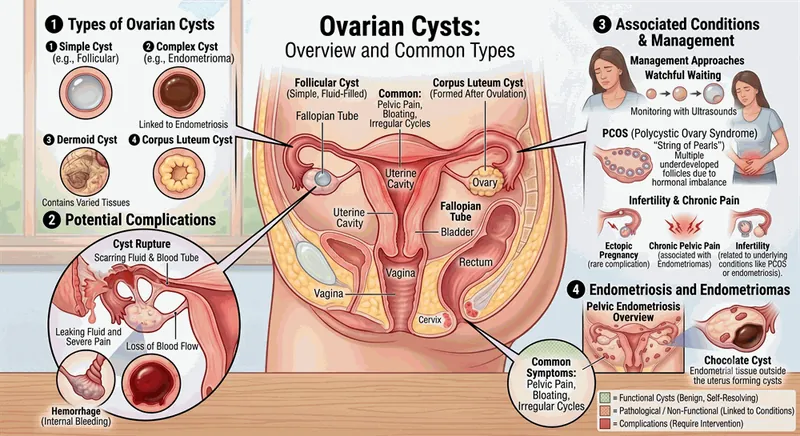
Ovarian Cysts: Functional, Endometrioma, Dermoid + Cystadenoma

Fluid-filled sacs that form on or inside the ovary. The vast majority are benign functional cysts that self-resolve within 1 to 3 menstrual cycles, but recurrent or pathological cysts often signal an underlying hormonal pattern worth addressing at the root.

6+ Subtypes Up to 20% Lifetime Risk Most Self-Resolve Reversible at the Root

Last updated:

What Is Ovarian Cysts?

An ovarian cyst is a fluid-filled (or sometimes solid-and-fluid mixed) sac that develops on or within the ovary. Most are a normal byproduct of monthly ovulation, not a disease in their own right.

Functionally, the ovary makes a new follicle every cycle. When that follicle does not rupture cleanly to release the egg, or when the post-ovulation corpus luteum fails to involute, what remains is a "cyst" on imaging. These functional cysts are essentially temporary plumbing problems of the cycle and resolve on their own in the vast majority of cases. Pathological cysts (endometriomas, dermoids, cystadenomas) are biologically different and reflect either ectopic endometrial tissue, embryonic remnants, or epithelial overgrowth.

Cysts are classified into six main subtypes based on origin and tissue composition. The category matters enormously because the treatment, the cancer risk, and the holistic root-cause approach differ for each (see below):

Ovarian cysts, functional and pathological subtypes on the ovary

"Most ovarian cysts in premenopausal women are functional and resolve spontaneously within one to three menstrual cycles; surgical intervention is rarely required for simple cysts less than 5 cm."

โ€” ACOG Practice Bulletin No. 174, Evaluation and Management of Adnexal Masses

๐Ÿ…ฐ๏ธ Functional Cysts, Follicular + Corpus Luteum (most common, >80%)

Born of the normal cycle itself. Follicular cysts form when a follicle grows but fails to rupture and release the egg; corpus luteum cysts form when the post-ovulation corpus luteum seals and fills with fluid. Almost always benign, resolve within 1 to 3 cycles, and rarely require any intervention beyond observation.

  • โ†’Hallmarks: Simple anechoic cyst under 5 cm, often discovered incidentally on ultrasound
  • โ†’Primary lever: Cycle support, ovulation quality, watchful waiting with repeat imaging at 6 to 12 weeks
  • โ†’Imaging: Thin-walled, single chamber, no internal echoes or solid components
  • โ†’Key supports: Vitex, magnesium, B6, vitamin E, anti-inflammatory diet

๐Ÿ…ฑ๏ธ Endometriomas, "Chocolate Cysts"

Cysts formed when ectopic endometrial tissue implants on the ovary, bleeds with each cycle, and accumulates dark, thick, "chocolate-colored" old blood. A hallmark of endometriosis and a sign that systemic estrogen-inflammation drivers need addressing alongside any local treatment.

  • โ†’Hallmarks: Painful periods, deep dyspareunia, often subfertility, ground-glass appearance on TVUS
  • โ†’Primary lever: Full endometriosis protocol, estrogen detox, inflammation reduction
  • โ†’Imaging: Homogeneous low-level internal echoes (ground-glass), thick wall, often bilateral
  • โ†’Key supports: DIM, NAC, omega-3, curcumin, cruciferous vegetables, gut work

๐Ÿ…ฒ Dermoid Cysts (Mature Cystic Teratomas)

Germ-cell tumors that can contain hair, teeth, skin, sebum, and other mature tissues. Usually benign, slow-growing, and often discovered incidentally. Surgical removal is generally recommended once identified because of torsion risk and the small (less than 2%) chance of malignant transformation.

  • โ†’Hallmarks: Often asymptomatic; may cause torsion if greater than 5 cm or pedunculated
  • โ†’Primary lever: Laparoscopic cystectomy preserving the ovary, then holistic recovery
  • โ†’Imaging: Mixed echogenicity with fat, calcifications (teeth), and "tip of the iceberg" sign
  • โ†’Key supports: Pre/post-surgical nutrition, ovarian reserve preservation, antioxidants

๐Ÿ…ณ Cystadenomas + Hemorrhagic Cysts

Cystadenomas are benign epithelial tumors (serous or mucinous) that arise from the ovarian surface and can grow quite large (10 to 30+ cm). Hemorrhagic cysts form when a functional cyst bleeds internally, often painfully, and usually resolve within 6 to 12 weeks but require follow-up to confirm.

  • โ†’Hallmarks: Cystadenomas grow slowly without symptoms; hemorrhagic cysts present with sudden one-sided pain
  • โ†’Primary lever: Repeat imaging for hemorrhagic; surgery for cystadenoma greater than 5 to 6 cm or symptomatic
  • โ†’Imaging: Cystadenoma, septations or papillary projections; hemorrhagic, fishnet / lace-like internal pattern
  • โ†’Key supports: Anti-inflammatory diet, estrogen-clearance support, monitor with serial ultrasound

Ovarian Cysts Statistics & Research

~20%
lifetime prevalence in women, most are clinically silent
>80%
of premenopausal cysts are functional and self-resolving
1โ€“3 cycles
typical resolution window for simple functional cysts
~7%
of women have at least one symptomatic cyst before menopause
17โ€“44%
of women with endometriosis have ovarian endometriomas
<1%
malignancy rate for simple cysts in premenopausal women

How Ovarian Cysts Presents

Most ovarian cysts are clinically silent and discovered incidentally on imaging done for something else. When symptoms do appear, the pattern is usually one-sided pelvic ache + cycle disruption + bloating, with red-flag symptoms (severe sudden pain, fever, fainting) requiring urgent evaluation for torsion or rupture.

๐Ÿฉธ Pelvic, Reproductive & Pain Symptoms

๐Ÿ“

One-Sided Pelvic Pain or Dull Ache

A persistent ache localized to the right or left lower pelvis is the most common symptom of a cyst large enough to be felt. The pain often worsens with movement, exercise, or sex, and may radiate into the lower back or thigh. Distinguishing it from cycle pain is its one-sided, persistent quality between periods.

โšก

Sudden Sharp Pain (Rupture or Torsion)

A ruptured cyst produces sudden, severe, one-sided pelvic pain that can radiate down the leg, often with nausea and brief faintness. Ovarian torsion (the ovary twisting on its pedicle) is a true surgical emergency that presents with similar pain plus vomiting and sometimes fever. Both warrant immediate evaluation.

๐Ÿ“…

Cycle Changes (Irregular, Heavy, or Delayed)

A persistent corpus luteum cyst can hold progesterone production high and delay the next period by days or weeks. Functional cysts that disrupt the hormonal balance of the cycle commonly cause spotting, longer cycles, or unusually heavy bleeds when the period finally arrives.

๐Ÿ’”

Pain with Intercourse (Dyspareunia)

Cysts large enough to occupy pelvic space or those tethered to the ovary by inflammation (especially endometriomas) cause sharp pain with deep penetration. The pain often persists for hours after sex and is a hallmark of an endometrioma that ultrasound has missed.

๐Ÿคฐ

Subfertility & Difficulty Conceiving

Recurrent cysts, especially endometriomas and persistent functional cysts, can damage ovarian tissue, reduce egg quality, and disrupt the hormonal milieu required for ovulation. Repeated rupture and surgery further compound the impact on ovarian reserve.

๐Ÿฉธ

Mid-Cycle Spotting & Mittelschmerz

An exaggerated mid-cycle "ovulation pain" (mittelschmerz) that lasts longer than 24 to 48 hours, or that comes with a small bleed, often signals a functional cyst forming around ovulation. It is not dangerous on its own but is a useful pattern to track.

๐Ÿซƒ GI, Urinary, Systemic & Hormonal Symptoms

๐ŸŽˆ

Persistent Bloating & Pelvic Fullness

A sensation of feeling "full" or distended that does not match what was eaten, especially when persistent and one-sided. Larger cysts physically take up pelvic space and press on surrounding organs. Persistent bloating lasting more than 2 to 3 weeks always deserves an ultrasound to rule out a mass.

๐Ÿšฝ

Urinary Frequency & Incomplete Emptying

A growing cyst that compresses the bladder produces a constant urge to urinate, frequent small voids, and a sense of not being able to fully empty. Differs from a UTI in that there is no burning and urine cultures are negative.

๐Ÿ’ฉ

Bowel Pressure & Constipation

A cyst pressing on the rectum or sigmoid colon causes new-onset constipation, painful bowel movements, or a rectal-pressure sensation, especially around the period. Often misdiagnosed as IBS for years, particularly when endometriomas are involved.

๐Ÿคข

Nausea, Vomiting & Loss of Appetite

Especially around the period or after exercise, these symptoms can reflect a cyst that is irritating the peritoneum or partially twisting. Sudden nausea with severe one-sided pain is a torsion red flag and demands ER evaluation.

โš–๏ธ

Hormonal Symptoms (Acne, PMS, Tender Breasts)

Recurrent cysts almost always sit on a backdrop of cycle dysregulation. Hormonal acne along the jawline, severe PMS, cyclical breast tenderness, and water retention often appear together and reflect the broader estrogen-progesterone imbalance worth addressing.

๐Ÿ˜ด

Fatigue, Anxiety & Sleep Disruption

Chronic pelvic pain and cycle disruption keep the nervous system on alert, impair sleep quality, and amplify anxiety and low mood. Women with recurrent cysts and endometriomas commonly describe deep, persistent fatigue that does not improve with rest alone.

โš ๏ธ Red flags, go to the ER: Sudden severe one-sided pelvic pain, especially with nausea, vomiting, fever, fainting, or shoulder-tip pain (referred from internal bleeding). These can indicate ovarian torsion or significant cyst rupture and require urgent surgical evaluation.

How to Test for Ovarian Cysts

Diagnosis combines symptom history, pelvic exam, and imaging, with bloodwork to characterize the cyst and rule out malignancy in higher-risk presentations. The goal is to identify the cyst type so that the right approach, observe or intervene, is chosen.

๐Ÿ  At-Home Screening

These are not diagnostic on their own but help build the case for or against further imaging:

๐Ÿ“… Cycle & Symptom Tracking

Track at least 3 cycles, noting one-sided pelvic pain, mid-cycle pain, ovulation signs, bleeding patterns, and bloating. Apps like Clue, Flo, or a simple paper chart work. A repeating pattern of one-sided pain that always shows up at a specific phase strongly suggests a functional or recurrent cyst worth imaging.

๐Ÿคฒ Self Pelvic Awareness

Without trying to feel the cyst directly (it is rarely palpable through the abdomen unless very large), note where pain is reproducibly worse with movement, deep pressure, or after sex. Asymmetry, the same spot every time, distinguishes a localized cyst pattern from generalized cramping.

๐Ÿ“‹ Ovarian Cyst Symptom Checklist

Score 1 point for each: persistent one-sided pelvic pain, mid-cycle pain longer than 48 hours, painful intercourse, new-onset bloating lasting more than 2 weeks, urinary frequency without infection, painful bowel movements around your period, irregular or delayed periods, hormonal acne or severe PMS, and family history of endometriosis or ovarian cysts. Score of 3 or more warrants formal pelvic ultrasound.

๐Ÿ”ฌ Lab & Clinical Tests

๐Ÿ“ท Transvaginal Pelvic Ultrasound (gold standard)

The single most important test. Characterizes cysts by size, wall thickness, septations, internal echoes, and solid components. Simple anechoic cysts under 5 cm are reassuring and managed conservatively; complex features (septations, papillary projections, solid areas, ascites) require deeper workup. Should be repeated at 6 to 12 weeks for functional-appearing cysts to confirm resolution.

๐Ÿ’‰ Tumor Marker Panel (CA-125, HE4, ROMA)

CA-125 is the classic ovarian tumor marker, useful primarily in postmenopausal women and for monitoring endometriomas (often modestly elevated). HE4 and the combined ROMA score improve specificity. Premenopausally, CA-125 can be elevated by endometriosis, fibroids, pregnancy, and PID, interpret carefully. AFP, hCG, LDH, inhibin B, AMH may be added when germ-cell or stromal tumors are suspected.

๐Ÿ’‰ Reproductive Hormone Panel (Day 2 to 5)

Estradiol, progesterone (day 21), LH, FSH, AMH, prolactin, testosterone, DHEA-S, SHBG, TSH, free T3 and T4. Establishes the underlying cycle pattern, identifies anovulation, low progesterone, or hyperandrogenism, and guides the holistic root-cause work for women with recurrent cysts.

๐Ÿ“ท Pelvic MRI (for indeterminate cysts)

When ultrasound cannot fully characterize the cyst (especially suspected endometrioma versus dermoid versus complex hemorrhagic cyst), pelvic MRI with and without contrast adds tissue specificity. Recommended for cysts greater than 7 cm, persistent complex features, or pre-surgical planning.

๐Ÿงซ Inflammation & Nutrient Status

hs-CRP (systemic inflammation), 25-OH vitamin D (target 50 to 80 ng/mL), ferritin (heavy bleeders often deplete), B12, RBC magnesium, homocysteine. These are the levers a holistic protocol uses to address the soil that grows recurrent cysts.

๐Ÿฉบ Pregnancy Test (always first)

Beta-hCG must be drawn first in any reproductive-age woman with pelvic pain and an adnexal mass, both to rule out ectopic pregnancy (a true emergency that can mimic a cyst) and to interpret the rest of the workup. Non-negotiable before any imaging-guided intervention.

Holistic vs. Conventional Treatment for Ovarian Cysts

Toggle between the two approaches to compare treatments, outcomes, and what each looks like in practice.

๐ŸŒฟ HOLISTIC
๐Ÿ’Š CONVENTIONAL
๐ŸŒฟ

Holistic / Functional Approach

Restore ovulation quality, support estrogen clearance, lower inflammation, and let the cycle do the cleanup

Primary Treatment
Anti-inflammatory whole-food nutrition + estrogen-detox support (cruciferous, DIM, calcium-D-glucarate) + cycle support (vitex, magnesium, B6) + gut/estrobolome work
Duration
1 to 3 cycles for resolution of functional cysts; 6 to 12 months for endometrioma + recurrent-cyst protocols
Effect on Underlying Pattern
Treats the soil, fewer new cysts, healthier ovulation
Fertility Outcome
Often improves: better-quality ovulation, lower inflammation, preserved ovarian reserve
Protocol Includes
  • Anti-inflammatory whole-food eating: protein at every meal, half the plate non-starchy vegetables, minimize seed oils and refined sugar
  • Estrogen-detox support: cruciferous vegetables (broccoli, cauliflower, Brussels sprouts) daily, DIM 100 to 200 mg, calcium-D-glucarate 500 to 1500 mg
  • Cycle and progesterone support: vitex (chasteberry) 400 to 800 mg, magnesium glycinate 300 to 400 mg, vitamin B6 25 to 50 mg, vitamin E 400 IU
  • Gut and estrobolome work: fiber 30+ g/day, fermented foods, address constipation aggressively (daily BM is non-negotiable for estrogen clearance)
  • Stress and HPA-axis support: breathwork, walking, daylight, ashwagandha if appropriate, sleep 7 to 9 hours
  • Castor oil packs over the lower abdomen 3 to 4x per week (avoid during menstruation and pregnancy) for lymphatic support
  • Endocrine-disruptor reduction: glass or stainless instead of plastic, fragrance-free personal care, filter drinking water
  • Serial ultrasound monitoring at 6 to 12 weeks to confirm functional cyst resolution; coordinate any necessary surgery with skilled minimally-invasive surgeon
โœ… Side effects: Mild GI changes the first 2 weeks as fiber and cruciferous intake rises; possible cycle shifts as vitex re-tunes the HPO axis; castor oil packs occasionally cause mild skin irritation. None of these worsen the underlying picture.

Root Causes of Ovarian Cysts

Recurrent or pathological cysts almost always sit on a stack of hormonal, inflammatory, gut, and environmental drivers. Addressing these is what shifts the long-term picture, not removing the cyst that already formed.

Root Cause How It Contributes to Ovarian Cysts Holistic Solution
Anovulation / Poor Ovulation QualityWhen a follicle grows but fails to rupture and release the egg, it becomes a follicular cyst. Chronic anovulation, often from PCOS, stress, or thyroid issues, sets the stage for recurrent functional cysts.Cycle support (vitex, B6, magnesium), address PCOS or thyroid drivers, anti-inflammatory diet, restore ovulation quality with adequate calories and protein
Estrogen Dominance / Poor Estrogen ClearanceUnopposed estrogen relative to progesterone drives follicular overgrowth and feeds endometriomas and cystadenomas. Sluggish liver and gut clearance amplifies this pattern.Cruciferous vegetables daily, DIM, calcium-D-glucarate, daily bowel movement, fiber 30+ g/day, support liver phase I and II detoxification (B vitamins, glycine)
Chronic InflammationElevated cytokines and oxidative stress impair follicle development, encourage cyst persistence, and feed endometrioma growth. Inflammation is the soil endometriosis thrives in.Anti-inflammatory diet, omega-3 EPA/DHA, curcumin, NAC, remove seed oils and refined sugar, address food sensitivities
Gut Dysbiosis & Estrobolome ImbalanceThe gut microbiome regulates estrogen recycling via beta-glucuronidase. Dysbiosis raises beta-glucuronidase activity, recirculating estrogens and worsening estrogen dominance.Fermented foods, soluble fiber, targeted probiotics, address SIBO or candida, calcium-D-glucarate to inhibit beta-glucuronidase
Chronic Stress / HPA-Axis DysfunctionSustained cortisol suppresses ovulation directly, lowers progesterone, and worsens inflammation. "Pregnenolone steal" diverts hormone precursors away from progesterone toward cortisol.Breathwork, vagal tone, daylight exposure, magnesium, adaptogens (ashwagandha, rhodiola), 7 to 9 hours of sleep, boundaries
Endocrine-Disrupting ChemicalsBPA, phthalates, parabens, and pesticides mimic estrogen and disrupt ovarian function over time. Linked to higher rates of cysts, endometriosis, and recurrence.Glass or stainless instead of plastic, fragrance-free personal care, EWG Clean Fifteen / Dirty Dozen, filter water, avoid heating food in plastic
EndometriosisEctopic endometrial tissue implants on the ovary, bleeds with each cycle, and forms endometriomas. The systemic disease, not just the local lesion, drives recurrence.Full endometriosis protocol, comprehensive anti-inflammatory and estrogen-detox approach, gut-immune work, refer to skilled excision surgeon if severe
Insulin Resistance & Metabolic DysfunctionHigh insulin promotes ovarian androgen production, disrupts ovulation, and contributes to PCOS-related cysts. Even without full PCOS, mild insulin resistance is a driver.Low-glycemic eating, protein at every meal, strength training, inositol, berberine if appropriate, post-meal walks
Thyroid DysfunctionHypothyroidism and Hashimoto's directly disrupt ovulation, raise prolactin, and contribute to recurrent ovarian cysts. Frequently missed because TSH alone is inadequate.Full thyroid panel (TSH, free T3, free T4, TPO antibodies, reverse T3), iodine and selenium adequacy, address autoimmune drivers, gluten trial if Hashimoto's present
Nutrient Deficiencies (D, Mg, B6, Zinc)Vitamin D regulates ovarian follicle development and immune balance; magnesium and B6 support progesterone production; zinc supports ovulation. Deficiencies are common in women with recurrent cysts.25-OH vitamin D target 50 to 80 ng/mL (D3 + K2), magnesium glycinate 300 to 400 mg, B6 25 to 50 mg, zinc 15 to 30 mg, retest after 3 months

Ovarian Cysts Diet Guide

Food is the single most powerful tool for changing the hormonal climate that grows cysts. The goal is not weight loss but estrogen balance, anti-inflammation, and good gut clearance, so the body stops recreating the conditions that cysts thrive in.

๐Ÿฅฆ

What Is the Estrogen-Balance Eating Pattern?

Most women with recurrent cysts have estrogen dominance, too much estrogen activity relative to progesterone, often paired with sluggish estrogen clearance by the liver and gut. The eating pattern that resolves this is not strictly any branded diet, it is whole-food, anti-inflammatory, fiber-rich, with daily cruciferous vegetables, adequate protein, and minimal endocrine-disrupting inputs.

The framework is simple: anchor every meal with protein, fill half the plate with non-starchy vegetables (with cruciferous featured most days), add healthy fat, include whole-food slow carbs, and keep the gut moving with fiber and fermented foods.

The 4 Anchors of Every Meal:

  • 1Protein 25 to 35 g, supports progesterone production and stable blood sugar
  • 2Non-starchy vegetables fill half the plate, cruciferous featured 5+ days/week
  • 3Healthy fat, olive oil, avocado, nuts, wild fish for hormone synthesis
  • 4Slow carbs from whole foods only, sweet potato, quinoa, lentils, berries

Estrogen-Clearance Habits:

  • ๐ŸฅฆCruciferous daily, broccoli sprouts, broccoli, cauliflower, Brussels, kale (provides DIM and sulforaphane)
  • ๐ŸŒพ30+ g fiber/day, binds estrogens for excretion (vegetables, beans, ground flax 1 to 2 tbsp/day)
  • ๐Ÿ’ฉDaily bowel movement, non-negotiable, constipation recirculates estrogens via the gut
  • ๐Ÿ’งFiltered water 2 to 3 L/day, supports kidney and liver clearance of metabolized estrogens
๐Ÿ’ก Daily ground flaxseed (1 to 2 tbsp) is one of the most evidence-backed single foods for ovarian-cyst patterns, it provides lignans that modulate estrogen and fiber that aids excretion.
โš ๏ธ These foods raise estrogen, drive inflammation, and burden estrogen-clearance pathways. The first three rows are the highest-leverage cuts.
  • โœ—Conventional dairy: Contains pregnancy-cycle estrogens and IGF-1 that can worsen cysts and acne; trial removal for 30 to 60 days. Organic A2 or sheep/goat dairy in small amounts is often tolerated.
  • โœ—Refined sugar: Soda, juice, candy, baked goods, drives inflammation and insulin spikes that worsen ovarian androgen production and recurrent cyst formation.
  • โœ—Industrial seed oils: Soybean, canola, corn, cottonseed, sunflower, safflower, drive pro-inflammatory omega-6 dominance and disrupt prostaglandin balance during the cycle.
  • โœ—Refined flour & processed grains: White bread, white pasta, pastries, crackers, even "whole wheat" that's mostly refined. Spikes blood sugar and feeds the inflammatory cascade.
  • โœ—Alcohol: Burdens liver phase I and II estrogen-detox pathways, lowers progesterone, depletes B vitamins and magnesium. Limit to occasional, with food.
  • โœ—Conventional meat & poultry: May contain residues of growth hormones and antibiotics; choose grass-fed, pastured, organic when budget allows. Lean ground meat is a good entry point.
  • โœ—Soy isolates & conventional soy products: Soy protein isolates and conventional soy contain isoflavones that can be problematic in already-estrogen-dominant women. Whole fermented soy (tempeh, miso, edamame) in moderation is fine.
  • โœ—Plastic-stored food & bottled water in plastic: BPA, phthalates, and other plasticizers act as xenoestrogens. Switch to glass, stainless steel, and silicone for storage and reheating.
  • โœ—Conventional produce (Dirty Dozen): Strawberries, spinach, kale, grapes, apples, pesticide residues act as endocrine disruptors. Buy organic for the Dirty Dozen list; conventional is fine for the Clean Fifteen.
๐Ÿ’ก Foods that support estrogen clearance, lower inflammation, and feed healthy hormone production. Build every meal around these.
  • โœ“Cruciferous vegetables (daily): Broccoli, broccoli sprouts, cauliflower, Brussels sprouts, cabbage, kale, bok choy, provide DIM, sulforaphane, and indole-3-carbinol for healthy estrogen metabolism.
  • โœ“Ground flaxseed (1 to 2 tbsp/day): Lignans modulate estrogen receptors and fiber aids gut clearance, one of the most evidence-backed single foods for cyclic estrogen balance.
  • โœ“Quality proteins: Wild salmon and sardines (omega-3 anti-inflammatory), pastured eggs, grass-fed beef and bison, pastured poultry, plain Greek yogurt or kefir if dairy tolerated.
  • โœ“Healthy fats: Extra-virgin olive oil, avocado, walnuts, almonds, pumpkin seeds, hemp seeds, coconut oil in moderation, for hormone synthesis and satiety.
  • โœ“Fiber-rich foods: Lentils, chickpeas, black beans, oats, chia seeds, raspberries, target 30+ g/day to bind and excrete estrogens.
  • โœ“Fermented foods: Kimchi, sauerkraut, plain kefir, miso, natto, support a healthy estrobolome and lower beta-glucuronidase activity.
  • โœ“Low-glycemic fruits: Berries, kiwi, citrus, green apple, pear, polyphenols support liver detox and the antioxidant capacity needed for healthy ovulation.
  • โœ“Magnesium-rich foods: Pumpkin seeds, dark chocolate (85%+), spinach, Swiss chard, almonds, black beans, supports progesterone, sleep, and stress resilience.
  • โœ“Anti-inflammatory spices: Turmeric (curcumin), ginger, cinnamon, garlic, rosemary, use generously across meals for cumulative inflammation reduction.

Key Supplements for Ovarian Cysts Recovery

Supplements are accelerators, not replacements for nutrition, lifestyle, and stress work. The list below combines the most evidence-backed cyst- and cycle-supportive interventions with foundational nutrients commonly depleted by this pattern.

Supplement Role in Recovery Suggested Dose Timing Notes
Vitex (Chasteberry)Acts on the pituitary to support healthy LH:FSH balance and raise progesterone in the luteal phase. One of the most evidence-backed herbs for functional ovarian cysts and corpus luteum dysfunction.400 to 800 mg per day (standardized extract)Morning, daily, on an empty stomachAllow 3 to 6 cycles for full effect. Avoid in pregnancy and with hormonal contraception. Pause if cycles shorten unhelpfully.
DIM (Diindolylmethane)A cruciferous-vegetable metabolite that shifts estrogen metabolism toward the favorable 2-hydroxy pathway and away from 16-hydroxy. Directly relevant for estrogen-dominant cyst patterns and endometriomas.100 to 200 mg per dayWith a meal containing fatCombine with calcium-D-glucarate for synergy. May darken urine harmlessly.
Calcium-D-GlucarateInhibits beta-glucuronidase, the gut enzyme that recirculates estrogens. Supports complete excretion of metabolized estrogens via stool.500 to 1500 mg per daySplit, with mealsMost useful when paired with DIM and adequate fiber. Constipation must be addressed first.
N-Acetylcysteine (NAC)Glutathione precursor that lowers ovarian oxidative stress and has RCT data for shrinking endometriomas and improving ovulation. Among the most evidence-backed supplements for women with recurrent cysts.1200 to 1800 mg per dayEmpty stomach, split twice dailyTake 30 minutes before food. Pair with zinc and selenium for antioxidant synergy.
Omega-3 EPA/DHAReduces systemic inflammation, supports balanced prostaglandin signaling around ovulation, lowers ovarian inflammation, and is especially helpful with endometriomas.2 g combined EPA+DHA per dayWith mealsChoose IFOS-certified for purity. Cod liver oil is acceptable, watch total vitamin A.
Vitamin D3 (with K2)Regulates ovarian follicle development, immune balance, and inflammation. Low D is associated with higher cyst recurrence, endometriosis, and PCOS overlap.2000 to 5000 IU D3 + 100 to 200 mcg MK-7 K2 per dayWith a fat-containing meal, morning preferredTest 25-OH-D first; retest after 3 months. Target 50 to 80 ng/mL.
Magnesium GlycinateSupports progesterone production, smooth-muscle relaxation (helpful for cyst pain), sleep, and stress resilience. Magnesium deficiency directly worsens PMS and cycle pain.300 to 400 mg elemental magnesium per dayEvening, 30 to 60 min before bedGlycinate is the most absorbable and calming form. Magnesium oxide is poorly absorbed.
Vitamin B6 (P-5-P preferred)Supports progesterone production, dopamine balance, and luteal-phase symptoms. Helpful for corpus luteum cysts and cyst-associated PMS.25 to 50 mg P-5-P per dayMorning with foodAvoid sustained doses greater than 100 mg/day long-term, peripheral neuropathy risk.
Vitamin E (mixed tocopherols)Antioxidant for ovarian tissue, supports luteal function, and has small studies showing benefit for cyclical breast pain and functional cysts.400 IU mixed tocopherols per dayWith a fat-containing mealUse mixed tocopherols, not just alpha-tocopherol. Discontinue 1 week before any surgery.
ZincSupports ovulation, modulates androgens, lowers inflammation, and is essential for skin healing in cyst-associated acne.15 to 30 mg per dayWith mealsAdd 1 to 2 mg copper if using long-term at higher doses to prevent imbalance.
Curcumin (Turmeric Extract)Potent anti-inflammatory and antioxidant. Reduces NF-kB-driven inflammation, supports liver detoxification, and has emerging evidence for endometrioma volume reduction.500 to 1000 mg curcumin per dayWith a fat-containing mealMust include piperine (black pepper) or be liposomal for absorption.
ResveratrolPolyphenol with anti-estrogenic, anti-inflammatory, and anti-angiogenic effects. RCT data for endometrioma and ovarian-cyst reduction when combined with myo-inositol.800 to 1500 mg per day (trans-resveratrol)Morning, with foodEffects build over 8 to 12 weeks. Pair with omega-3 for synergy.
Myo-InositolImproves ovarian insulin signaling and follicle quality. Helpful when there is PCOS overlap or metabolic dysfunction driving the cyst pattern.2 to 4 g per daySplit, half AM and half PM, with or without foodUse the myo:D-chiro 40:1 ratio if PCOS overlap is clear. 3 to 6 months for full effect.
Castor Oil (topical packs)Traditional remedy with mild lymphatic, anti-inflammatory, and circulation-supporting effects when applied as a warm pack over the lower abdomen. Often subjectively reduces cyclical pain.2 to 4 tbsp on a flannel cloth, 30 to 60 min, 3 to 4x per weekEvening, lower abdomenAvoid during menstruation and pregnancy. Use cold-pressed, hexane-free, glass-bottled castor oil.
Methylated B-Complex (with L-methylfolate)Supports methylation, liver phase II estrogen detox, and homocysteine metabolism. Important if MTHFR variants are present (very common).1 capsule per day per product labelMorning with foodEnsure 400 to 800 mcg L-methylfolate if trying to conceive.
Multi-Strain ProbioticImproves the estrobolome (gut bacteria that metabolize estrogen), lowers beta-glucuronidase activity, and supports healthy estrogen clearance.25 to 50 billion CFU per day, multi-strainEmpty stomach or with light mealRotate brands every 2 to 3 months for strain diversity. Stop if SIBO symptoms worsen.
Milk Thistle (Silymarin)Hepatoprotective and supports liver phase I and II estrogen-clearance pathways. Helpful when estrogen-detox capacity is sluggish.140 to 420 mg silymarin per dayWith mealsGenerally well-tolerated. Coordinate with provider if on prescription medications metabolized by the liver.
AshwagandhaAdaptogen that lowers cortisol, supports the HPA-HPO axis, and improves sleep. Especially helpful when stress is a clear driver of cycle disruption and recurrent cysts.300 to 600 mg KSM-66 extract per dayEvening with foodAvoid in hyperthyroidism and during pregnancy. Trial for 8 to 12 weeks.

Healing Timeline: Conventional vs. Holistic

Understanding what to expect from each approach helps set realistic expectations and make informed choices.

๐ŸŒฟ Holistic Protocol
Week 1โ€“2

Begin anti-inflammatory diet, cruciferous daily, and foundational supplements (vitex, magnesium, vitamin D, B6). Improved sleep and reduced bloating common.

Cycle 1โ€“3

Most simple functional cysts have resolved on serial ultrasound. PMS, mid-cycle pain, and one-sided pelvic ache notably improved. Cycle becomes more predictable.

Month 3โ€“6

Estrogen-clearance pathways stronger, endometrioma-related pain reduced, fewer new cysts forming. Skin and mood notably better. Progesterone rebuilding.

Month 6โ€“12

Recurrence rates drop substantially. Endometriomas may shrink on imaging in some women. Fertility outcomes often improve for those trying to conceive.

Long-Term Outlook

Stable hormonal pattern, dramatically reduced recurrence, ovarian reserve preserved

๐Ÿ’Š Conventional Treatment
Week 1โ€“4

Initial ultrasound and observation, or COCP started to suppress ovulation. Pain managed with NSAIDs. Reassurance offered but no underlying-cause work.

Cycle 1โ€“3

Most functional cysts resolve regardless (this is the natural history). Pill prevents new functional cysts while taken. Endometriomas typically persist.

Month 3โ€“12

Surgery (laparoscopic cystectomy) considered for cysts greater than 5 to 6 cm, persistent, or symptomatic. Each cystectomy slightly reduces ovarian reserve.

On Discontinuation

Cysts often return rapidly when pill is stopped, because the underlying hormonal pattern was never addressed. Repeated cycles of pill plus surgery are common.

Long-Term Outlook

Symptom suppression while medicated; recurrence common after stopping; ovarian reserve cumulatively reduced by repeat surgery

"Most ovarian cysts are not a disease, they are a symptom of a cycle that is struggling. Help the cycle, and the cysts almost always take care of themselves."

Ready to Address Your Ovarian Cysts at the Root?

Explore related conditions below or revisit the Symptom Checker to map your full symptom picture across the library.