Low Back & Neck Pain

The most common cause of disability worldwide. Often driven by disc degeneration, muscle imbalances, inflammation, and prolonged sitting. Anti-inflammatory nutrition, magnesium, omega-3, and targeted movement modulate the pain cycle.

Musculoskeletal Evidence-Based Root-Cause Focus

Last updated:

What Is Low Back & Neck Pain?

Low back and neck pain together represent the leading cause of disability worldwide. Most pain is "non-specific", meaning no identifiable structural cause despite imaging findings. The relationship between imaging findings (disc bulges, mild stenosis) and pain is weak, many asymptomatic adults have abnormal MRIs.

Acute pain (<4 weeks) is typically musculoskeletal and self-limiting in >90% of cases. Subacute (4-12 weeks) and chronic (>12 weeks) pain involves central sensitization, the nervous system amplifying pain signals, beyond any tissue damage. This is why chronic spine pain doesn't always correlate with imaging or respond to surgery.

Most pain has multifactorial causes: postural strain, deconditioning, muscle imbalances, prolonged sitting, stress, poor sleep, obesity, and central sensitization. Less commonly: disc herniation with nerve root compression, spinal stenosis, spondylolisthesis, or rarely serious causes (fracture, tumor, infection, "red flags"). Modern management emphasizes active treatment, not bed rest or imaging chasing.
โš ๏ธ Red Flag Symptoms (Urgent Evaluation): Sudden severe pain, fever, unexplained weight loss, history of cancer, recent trauma, age >50 with new pain, bladder/bowel dysfunction, saddle anesthesia (numbness in groin area), progressive weakness. These require imaging and evaluation. Most pain does NOT have red flags.
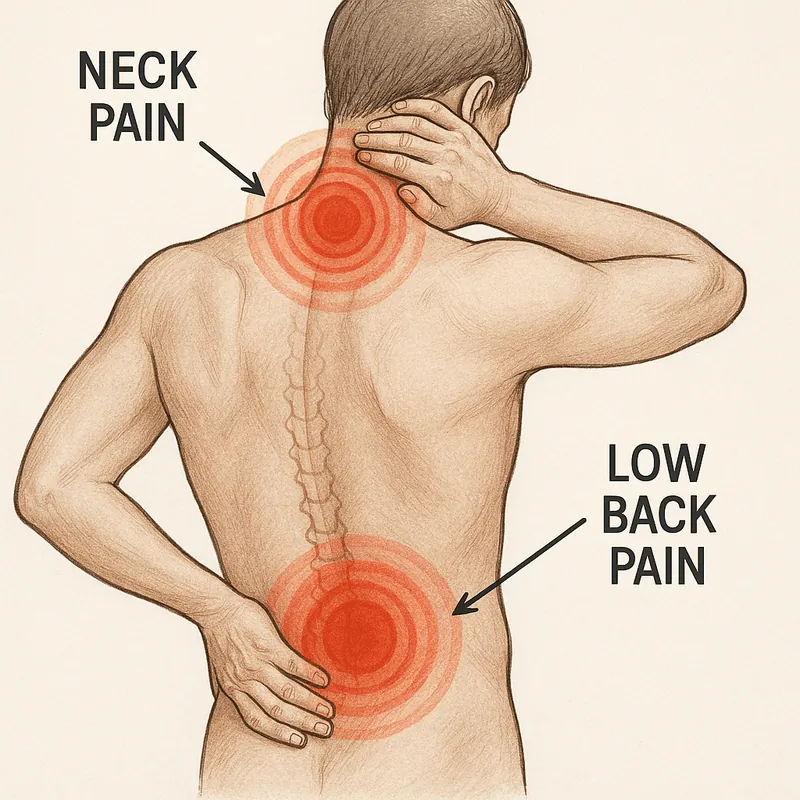
Low Back & Neck Pain illustration

Types of Spine Pain

๐ŸŒฑ Acute Non-Specific Pain

Most common. <4 weeks. No identifiable structural cause. Resolves in >90% with conservative management. Avoid early imaging, promotes harmful interventions.

๐ŸŒ— Chronic / Centralized Pain

>12 weeks. Central sensitization develops. Pain disproportionate to tissue damage. Requires multimodal approach. CBT, exercise, mind-body essential.

๐ŸŒ‘ Specific / Structural Cause

Radiculopathy (sciatica, cervical), spinal stenosis, spondylolisthesis, fracture. ~10% of cases. May benefit from specific interventions including surgery.

~80%
US adults experience back pain in lifetime
#1
Cause of years lived with disability globally
~90%
Of acute non-specific pain resolves in 4-6 weeks
~$365B
Annual US spine pain costs (med + lost productivity)

Symptoms of Back & Neck Pain

Most pain is mechanical (worse with movement, better with rest). Watch for red flags that warrant urgent evaluation.

๐Ÿ” Typical Pain Patterns

๐Ÿ˜ฃ

Mechanical Pain

Worse with certain movements/positions, better with others. Stiff in mornings, improves with movement. Worse with prolonged sitting (low back) or computer use (neck).

โšก

Muscle Spasm

Painful muscle tightness, often after injury or overuse. Antalgic posture. Limited range of motion. May feel "knotted" or twisted.

๐Ÿ“

Stiffness & Reduced Range

Difficulty bending, rotating. Worse with inactivity. May limit daily activities. Improves with gentle movement and stretching.

๐Ÿ˜ด

Sleep Disturbance

Pain worsens at certain positions. Difficulty finding comfortable position. Creates vicious cycle, poor sleep amplifies pain perception.

โš ๏ธ Red Flags (Urgent Eval)

๐Ÿšจ

Bladder / Bowel Dysfunction

Loss of control, urinary retention, saddle anesthesia (numbness in groin). Suggests cauda equina syndrome, SURGICAL EMERGENCY. ER immediately.

๐Ÿ’ช

Progressive Weakness

Foot drop, leg weakness, loss of grip strength. Major neurologic deficit. Requires urgent imaging and possible surgery.

๐ŸŒก๏ธ

Fever, Weight Loss, History of Cancer

Raises concern for spinal infection, malignancy, or metastases. Age >50 with new pain also warrants imaging. Don't dismiss.

โšก

Radiating Pain with Numbness

Sciatica: pain down leg, possibly with numbness/weakness. Cervical radiculopathy: pain down arm. May indicate nerve root compression. Evaluate especially if persistent.

How Spine Pain Is Evaluated

๐Ÿฉบ Clinical Assessment

๐Ÿ“‹ History & Physical Examination

Most important assessment. Identifies red flags, assesses nerve involvement, evaluates psychosocial factors. Most pain diagnosed without imaging.

๐Ÿงช Neurologic Exam

Reflexes, muscle strength, sensation, gait. Identifies nerve root or spinal cord involvement. Critical for treatment decisions.

๐Ÿงช Functional Assessment

Range of motion, posture, gait, ability to perform daily activities. Often more useful than imaging for treatment planning.

๐Ÿ“‹ Psychosocial Screening

STarT Back screening, anxiety/depression screens. High psychosocial risk predicts chronicity. Drives treatment intensity decisions.

๐Ÿ“ก When to Image

๐Ÿ“ก X-Ray (Limited Role)

For trauma, suspected fracture, spondylolisthesis. Not routine for non-specific pain. Findings often unrelated to pain.

๐Ÿ“ก MRI (Selected Cases)

For red flags, persistent radiculopathy >6 weeks, surgical consideration. NOT routine, findings of disc bulges, mild stenosis common in pain-free adults.

โš ๏ธ Don't Over-Image

Early MRI in non-specific pain leads to worse outcomes, more interventions, more surgery. Choose Wisely guidelines recommend AGAINST routine imaging.

๐Ÿฉธ Labs (Red Flag Workup)

CBC, ESR, CRP if infection or inflammatory cause suspected. Vitamin D level (deficiency worsens chronic pain).

Holistic vs. Conventional Treatment

๐ŸŒฟ HOLISTIC
๐Ÿ’Š CONVENTIONAL
๐ŸŒฟ

Holistic / Functional Approach

FIRST-LINE for most spine pain. Modern guidelines emphasize non-pharmacologic management.

First-Line
Movement, exercise, manual therapy, mind-body, NOT bed rest or opioids
Chronic Pain
Multimodal: exercise + CBT + sleep + anti-inflammatory diet + targeted supplements
Central Sensitization
Pain neuroscience education, graded exposure, address fear-avoidance, stress reduction
Address Lifestyle
Sleep, stress, weight, ergonomics, smoking cessation
Evidence-Based Approach
  • Stay active, bed rest is harmful. Continue normal activities as tolerated. Walking is excellent.
  • Exercise therapy, strongest evidence for both acute and chronic pain. McKenzie method, Pilates, yoga, tai chi, swimming, Williams flexion exercises
  • Core stability training, strengthens deep abdominal and back muscles. Bird-dog, dead bug, planks, glute bridges.
  • Yoga & tai chi, improve pain and function comparable to physical therapy in chronic pain trials
  • Spinal manipulation (chiropractic/osteopathic), modest evidence for acute pain; combined with exercise more effective
  • Massage therapy, moderate evidence; useful adjunct
  • Acupuncture, moderate evidence for chronic back and neck pain
  • Cognitive behavioral therapy (CBT), addresses fear-avoidance, catastrophizing; significantly improves chronic pain
  • Pain neuroscience education, understanding pain reduces it; addresses central sensitization
  • Mindfulness-based stress reduction, reduces pain intensity, improves function
  • Sleep optimization, poor sleep amplifies pain perception. Treat insomnia, sleep apnea.
  • Address obesity, significant load reduction, especially for low back
  • Quit smoking, major risk for chronic back pain, disc disease
  • Anti-inflammatory diet, Mediterranean pattern reduces chronic inflammation
  • Ergonomic optimization, workstation setup, breaks, posture, lifting technique
  • Heat & cold therapy, symptomatic relief; heat for stiffness, cold for acute injury
  • Topical capsaicin, menthol, arnica, modest evidence, well-tolerated
  • Targeted supplements, vitamin D, magnesium, omega-3, curcumin, Boswellia (anti-inflammatory)
โœ… Modern Guidelines Support This: Multiple international guidelines (NICE, ACP, WHO) now recommend non-pharmacologic treatments as FIRST-LINE for most spine pain. Movement, exercise, mind-body therapies, and physical treatments are evidence-based. Don't let early imaging or opioid prescriptions derail your recovery.

Diet for Spine Health & Pain

Anti-inflammatory Mediterranean pattern. Weight optimization. Address vitamin D deficiency.

โœ… Prioritize:

๐ŸŸ Fatty Fish (2-3x/week)

Wild salmon, sardines, mackerel. Omega-3 EPA/DHA anti-inflammatory. Reduces pain markers.

๐Ÿฅฌ Colorful Anti-Inflammatory Vegetables

Leafy greens, cruciferous, beets, peppers. Polyphenols, antioxidants reduce inflammation driving pain.

๐Ÿซ’ Extra Virgin Olive Oil

Oleocanthal, natural ibuprofen-like effects. 2-4 tbsp daily as primary fat.

๐ŸŒถ๏ธ Turmeric & Ginger

Anti-inflammatory spices. Curcumin and gingerols reduce pain markers. Use generously in cooking.

๐Ÿฒ Bone Broth & Collagen

Provides amino acids for connective tissue. Glycine for sleep quality. Supports joint and disc health.

โŒ Avoid:

๐Ÿฌ Refined Sugar / Refined Carbs

Drive inflammation. Worsen chronic pain. Eliminate sodas, sweets, white bread, pastries.

๐Ÿ” Ultra-Processed Foods

Pro-inflammatory. Trans fats, additives, low nutrient density. Replace with whole foods.

๐Ÿฅฉ Excessive Red & Processed Meats

Pro-inflammatory in excess. Limit red meat <3 servings/week; eliminate processed (bacon, sausage, deli).

๐Ÿšญ Tobacco

Major risk factor for chronic back pain, disc disease. Reduces nutrient delivery to discs. Quit at any age helps.

๐Ÿท Heavy Alcohol

Disrupts sleep needed for pain modulation. Inflammatory effects. Interferes with medications. Limit to <1 drink/day.

Evidence-Based Supplements

Best evidence: vitamin D, omega-3, magnesium, curcumin. Mind-body and movement are foundation; supplements are adjunctive.

SupplementMechanism & EvidenceSuggested DoseTimingNotes
Vitamin D3Deficiency strongly associated with chronic pain. Inverse association with low back pain.2,000-5,000 IU/day (titrate to 50-80 ng/mL)With fat mealTest baseline. Universal deficiency in chronic pain patients.
MagnesiumMuscle relaxation, reduced neural excitability. Especially helpful with muscle spasm.200-400mg/dayEveningGlycinate or malate forms best. Improves sleep quality.
Omega-3 (EPA/DHA)Anti-inflammatory. Reduces inflammatory mediators driving pain.2,000-3,000mg EPA+DHA/dayWith fat mealHigher doses for active inflammation.
Curcumin (Bioavailable)Anti-inflammatory. Multiple RCTs show pain reduction comparable to NSAIDs without side effects.500-1,500mg/day (Meriva, liposomal, or with piperine)With fat mealChoose bioavailable forms, standard curcumin poorly absorbed.
Boswellia Serrata5-LOX inhibitor. Reduces inflammatory leukotrienes. Beneficial for chronic spine pain.300-400mg, 3x/day (60% boswellic acids)With mealsSynergistic with curcumin.
Glucosamine + ChondroitinMixed evidence; some benefit for chronic spine pain with arthritis component.Glucosamine 1,500mg + Chondroitin 1,200mg/dayWith mealsTrial 3 months before judging effect.
Collagen PeptidesAmino acids for connective tissue. May support disc and joint health.10-15g/dayAny timePair with vitamin C for collagen synthesis.
PEA (Palmitoylethanolamide)Endogenous fatty acid amide. Reduces neuropathic and inflammatory pain.600-1,200mg/dayEmpty stomachGrowing evidence for chronic neuropathic pain.

Movement Is Medicine

Most spine pain responds to active treatment, exercise, mind-body therapies, anti-inflammatory nutrition, sleep optimization. Avoid early imaging unless red flags. Reject opioids for chronic pain. Be cautious about elective spine surgery for non-specific chronic pain. Modern evidence strongly supports the active, multimodal approach.