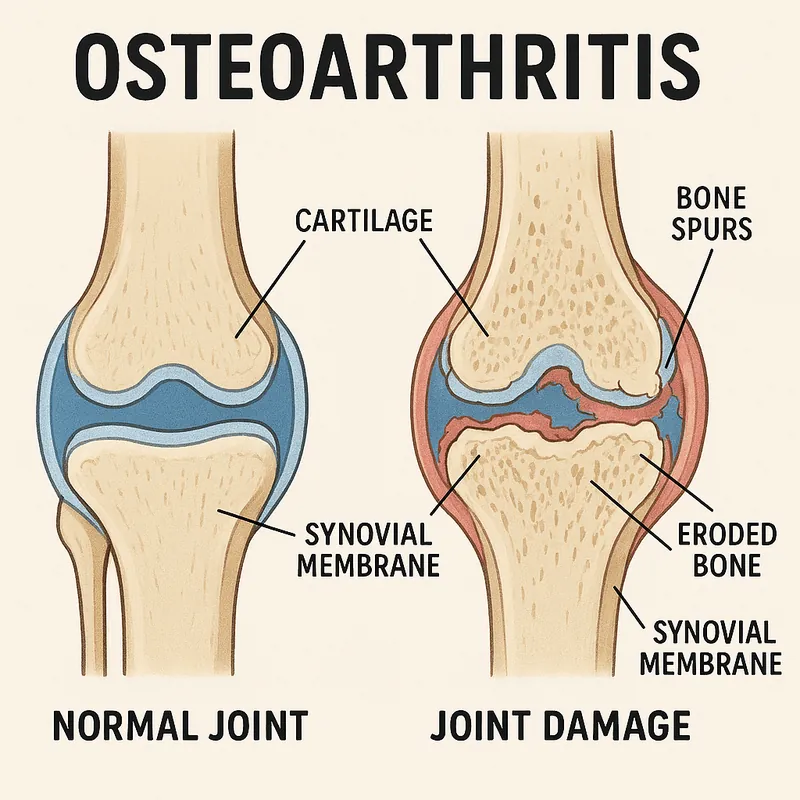
Progressive cartilage breakdown in joints, most often knees, hips, hands, spine. Driven by mechanical wear plus chronic low-grade inflammation. Curcumin, omega-3, collagen peptides, and weight optimization reduce pain and slow progression.
Last updated:
Osteoarthritis (OA) is the most common form of arthritis, characterized by progressive breakdown of articular cartilage, changes in underlying bone, and inflammation of the joint lining. Once viewed as simple "wear and tear," OA is now understood as an active, dynamic disease involving the entire joint, cartilage, bone, synovium, ligaments, and surrounding muscles.
OA primarily affects weight-bearing joints (knees, hips, spine) and frequently-used joints (hands, base of thumb). Risk factors include age, obesity (mechanical AND metabolic, adipose tissue produces inflammatory cytokines), joint injury, genetics, and post-traumatic causes.
Modern understanding identifies low-grade chronic inflammation as a key driver, making OA much more responsive to anti-inflammatory diet, weight loss, exercise, and supplements like curcumin and omega-3 than previously appreciated. Cartilage cannot regenerate fully, but progression can be dramatically slowed.
Highly responsive to weight loss and quad-strengthening exercise. Pain with weight-bearing, stiffness, crepitus. Eventually limits walking; replacement surgery effective.
Hand: thumb base, finger joints (Heberden's/Bouchard's nodes). Spine: facet joint OA, disc degeneration. Strong genetic component for hands.
Symptoms develop slowly over years. Distinguished from inflammatory arthritis (rheumatoid) by pattern, lab tests, and morning stiffness duration.
Pain worsens with activity, improves with rest (opposite of inflammatory arthritis). Eventually persistent pain even at rest in advanced disease. Night pain in late stage.
Short-duration morning stiffness (typically <30 minutes). Distinguishes from rheumatoid arthritis (>1 hour). "Gel phenomenon", stiffness after periods of inactivity.
Audible or palpable crackling/grinding with joint movement. Caused by rough cartilage surfaces. Common in knees.
Difficulty fully flexing/extending joint. Hip OA: hard to put on shoes. Knee OA: trouble climbing stairs. Hand OA: difficulty gripping.
Heberden's nodes (DIP joints), Bouchard's nodes (PIP joints) on fingers. Bony enlargement, deformity. Bowleg or knock-knee deformity in advanced knee OA.
Fluid accumulation, especially after activity. "Baker's cyst" behind knee. May indicate inflammatory flare or other secondary diagnosis.
Difficulty walking, climbing stairs, getting up from chair. Reduced exercise tolerance. May require cane or walker. Falls risk.
Chronic pain affects sleep and mood. Depression common in advanced OA. Pain catastrophizing worsens outcomes. Address holistically.
History (joint pain with activity, brief morning stiffness, age >50) + examination (crepitus, reduced range, bony enlargement) is often sufficient. Lab tests are usually unnecessary.
Joint space narrowing, osteophytes (bone spurs), subchondral sclerosis, cysts. Standing knee/hip films more informative than lying down. Kellgren-Lawrence grading.
Used when diagnosis unclear, evaluating for secondary causes, or surgical planning. Detects early cartilage damage, meniscal tears, bone marrow lesions.
Only if acutely inflamed joint to rule out infection (septic arthritis), gout, pseudogout. OA fluid: clear, low cell count (<2,000).
Highly effective for OA, exercise + weight loss + anti-inflammatory diet rivals NSAIDs without side effects.
Anti-inflammatory Mediterranean diet + weight optimization + targeted joint support nutrients. Reduces pain and slows progression.
Wild salmon, sardines, mackerel. Omega-3 EPA/DHA reduce joint inflammation. Anti-resolution mediators.
Cruciferous (broccoli, kale), colorful peppers, beets, leafy greens. Sulforaphane has cartilage-protective effects.
Oleocanthal has natural ibuprofen-like effects on COX enzymes. 2-4 tbsp daily as primary fat.
EGCG and curcumin both reduce joint inflammation. Daily green tea + turmeric in cooking. Black pepper enhances curcumin absorption.
Bone broth, slow-cooked meats with connective tissue, fish skins. Provides building blocks for cartilage and connective tissue.
Drive inflammation through advanced glycation end-products (AGEs). Sodas, juices, sweets, HFCS. Each daily sugary drink linked to increased OA risk.
White bread, pasta, pastries. High glycemic load increases inflammation. Replace with whole grains in moderation.
Fast food, packaged snacks, commercial baked goods. Trans fats and seed oils (corn, soybean, canola) drive inflammation.
High intake of grilled/charred meats produces AGEs and inflammatory compounds. Limit red meat <3 servings/week; eliminate processed.
Increases inflammation and weight gain. Disturbs sleep needed for joint recovery. Limit to <1 drink/day.
Best evidence for joint pain: curcumin, omega-3, collagen, glucosamine/chondroitin combo, Boswellia. Multiple RCTs and meta-analyses.
| Supplement | Mechanism & Evidence | Suggested Dose | Timing | Notes |
|---|---|---|---|---|
| Curcumin (Bioavailable) | Multi-mechanism anti-inflammatory. Multiple RCTs show comparable to NSAIDs for OA pain with better safety profile. | 500-1,500mg/day (with piperine or liposomal) | With fat meal | Standard curcumin poorly absorbed. Choose Meriva, BCM-95, Theracurmin, or liposomal. |
| Omega-3 (EPA/DHA) | Anti-inflammatory; reduces leukotrienes and prostaglandins driving joint pain. | 2,000-3,000mg EPA+DHA/day | With fat meal | Higher doses (3-4g) for active inflammation. |
| Collagen Peptides (Hydrolyzed) | Multiple RCTs show improved joint pain and function. Type II collagen also for cartilage. | 10-15g/day collagen peptides OR 40mg undenatured type II collagen | Any time | Tasteless when dissolved in coffee, smoothies. Synergistic with vitamin C. |
| Glucosamine + Chondroitin | Mixed evidence but GAIT trial showed benefit for moderate-severe knee OA. Mechanisms: cartilage matrix components. | Glucosamine 1,500mg + Chondroitin 1,200mg/day | With meals (divided) | Glucosamine sulfate form preferred. Trial for 3 months before judging effect. |
| Boswellia Serrata | 5-LOX inhibitor, reduces leukotrienes. Multiple trials show pain and function improvement. | 300-400mg, 3x/day (standardized to 60% boswellic acids) | With meals | Synergistic with curcumin. AKBA-enriched extracts most potent. |
| Vitamin D3 | Deficiency worsens OA pain and progression. Anti-inflammatory. | 2,000-5,000 IU/day (titrate to 50-80 ng/mL) | With fat meal | Test baseline. Pair with K2 200mcg. |
| MSM (Methylsulfonylmethane) | Sulfur compound; reduces oxidative stress in joints. Modest evidence for OA pain. | 1,500-3,000mg/day | With meals (divided) | Well-tolerated. Often combined with glucosamine/chondroitin. |
| SAMe (S-Adenosylmethionine) | Cartilage matrix support; anti-inflammatory. Comparable to NSAIDs in some studies but expensive. | 600-1,200mg/day | Empty stomach | Expensive. Useful with concurrent depression. Don't combine with antidepressants without doctor. |
Osteoarthritis is one of the most responsive conditions to integrative care. Weight management + structured exercise + anti-inflammatory diet + evidence-based supplements often achieve pain control equivalent to medications, with the bonus of slowing disease progression. Surgery is a last resort, not an inevitability.