Metabolic Syndrome

Not one disease but a cluster of five measurements that tend to travel together, and that together predict cardiovascular disease and type 2 diabetes better than any of them alone. Roughly one in three US adults meets the criteria2. It is also the diagnosis on this site most responsive to what you eat.

Three of Five Criteria About 1 in 3 US Adults Highly Diet-Responsive

Last updated:

What Is Metabolic Syndrome?

A diagnosis you receive when any three of five specific measurements fall outside their thresholds at the same time. No single one of them is metabolic syndrome; the clustering is the point.

The five come from a joint statement agreed in 2009 by the International Diabetes Federation, the American Heart Association and several other bodies, which ended a long period in which different organisations used different cut-offs and produced different prevalence figures from the same population1.

What links them is not coincidence. Visceral fat, the fat packed around the liver and pancreas rather than under the skin, releases free fatty acids and inflammatory signals into the portal circulation. That drives insulin resistance, and insulin resistance in turn raises triglycerides, lowers HDL, pushes blood pressure up and lifts fasting glucose. One upstream process, five downstream measurements.
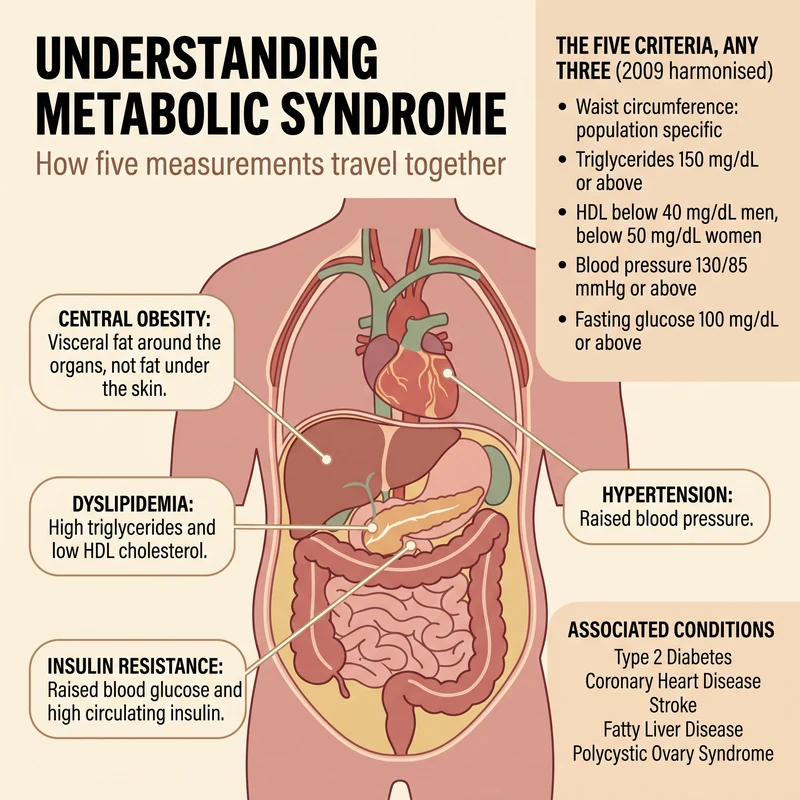
💡 Key Insight: This is why treating the five separately, one prescription per number, can improve each reading while leaving the process that produced them untouched. The dietary pattern that shifts insulin resistance tends to move several of the five at once.
Diagram of the five metabolic syndrome criteria arranged around a central illustration of visceral adipose tissue, showing how insulin resistance links waist circumference, triglycerides, HDL cholesterol, blood pressure and fasting glucose

🧭 Why the cluster matters

Three mildly abnormal readings together carry more risk than one markedly abnormal reading alone. The syndrome exists because the combination predicts outcomes the individual numbers do not.

📏 Why waist, not weight

Waist circumference is one of the five criteria and body weight is not. Where fat sits carries the metabolic risk, which is why a tape measure earns its place beside the scale.

🔄 Why it is reversible

Because the criteria are thresholds rather than damage, crossing back below them is possible. In one trial a Mediterranean-style diet returned more than half of participants to below the diagnostic threshold within two years4.

⚠️ A label, not a destiny, and not a reason to stop treatment. Meeting the criteria describes risk over years, not a fixed outcome. It also does not replace treating the individual components: blood pressure, lipids and glucose are each worth controlling now, on their own terms, whatever else changes. Nothing on this page is a reason to alter or stop a prescribed medicine, which is a conversation for your prescriber.

How Metabolic Syndrome Is Recognised

Metabolic syndrome has almost no symptoms. It is found on a blood test and with a tape measure, which is why it is so often missed until something else brings someone to a clinic.

CriterionThresholdWhat it reflects
Waist circumferencePopulation and country specific; in the United States commonly 102 cm or more in men and 88 cm or more in women, with lower cut-offs used for several Asian populationsVisceral fat, the driver most upstream of the other four
Triglycerides150 mg/dL or above, or already treated for itHow much fat the liver is exporting, which rises with insulin resistance
HDL cholesterolBelow 40 mg/dL in men, below 50 mg/dL in women, or already treated for itFalls as triglycerides rise; see the high cholesterol guide
Blood pressure130 mmHg systolic or above, or 85 mmHg diastolic or above, or already treated for itVascular effects of insulin resistance and sodium handling; see high blood pressure
Fasting glucose100 mg/dL or above, or already treated for itGlucose handling that has begun to fail; see the diabetes guide
💡 Any three of the five, and being treated counts. Someone whose blood pressure is well controlled on medication still meets that criterion, because the criterion describes the underlying state and not the current reading. This is the part most often misread, and it means people on treatment are not thereby excluded from the diagnosis.
⚠️ What usually travels with it, and is worth asking about. Fatty liver disease, which frequently accompanies the same insulin resistance, so see the NAFLD guide. Obstructive sleep apnea, which is common, treatable and rarely volunteered. Polycystic ovary syndrome in women, covered in the PCOS guide. And raised uric acid. None of these is part of the five criteria, and each changes what the right next step is.

What a Thorough Assessment Looks At

The five criteria are the diagnosis. These are the measurements that tell you what is happening underneath it.

MeasureWhat it tells youWhat it misses
Waist circumference and waist-to-height ratioAbdominal fat, scaled to body size in the second caseTechnique varies between measurers, and both remain external proxies
Fasting lipid panelTriglycerides and HDL, two of the five criteria, in one testA single reading; triglycerides in particular move a great deal with recent eating and alcohol
Fasting glucose and HbA1cWhether glucose handling has already been affected, and roughly for how longBoth can be normal while insulin resistance is well established
Repeated blood pressure readingsWhether the blood pressure criterion is genuinely metSingle clinic readings mislead in both directions; home readings over days are more informative
Liver enzymes and liver imagingFatty liver, which frequently travels with the same insulin resistanceEnzymes are often normal in significant steatosis; see the NAFLD guide
Sleep apnea screeningA common, treatable and frequently missed contributor to blood pressure and daytime fatigueRequires asking; it is rarely raised by the patient
Uric acidOften raised alongside insulin resistance, and relevant if there is joint painNot a criterion, and raised levels alone are not a diagnosis
💡 Ask what changed, and when. A cluster that appeared over two years after a change in work pattern, medication, activity or food access has a different starting point from one present since early adulthood. Several common prescriptions raise glucose, lipids or weight as a recognised effect. That is worth reviewing with your prescriber, and it is never a reason to stop a medicine on your own.

Holistic vs. Conventional Treatment for Metabolic Syndrome

🌿 HOLISTIC
💊 CONVENTIONAL
🌿

Holistic / Functional Approach

Dietary pattern, modest weight loss, activity, sleep, and treating what travels with it

Strongest Single Result
Structured lifestyle change reduced progression to type 2 diabetes by 58% over about three years, ahead of the medication arm in the same trial3
Reversing the Diagnosis
A Mediterranean-style diet left 40 of 90 participants still meeting the criteria at two years, against 78 of 90 in the control group4
Timeline
Triglycerides and blood pressure move within weeks; waist circumference and fasting glucose take months
Advantage
One change addresses several criteria at once, which is not true of treating each number separately

Full Holistic Approach Includes

  • A Mediterranean or DASH dietary pattern, the two with the strongest randomised support for this cluster.
  • Modest weight loss where there is weight to lose, since 5 to 10% measurably improves blood pressure, triglycerides, HDL and glycaemic control8. See the obesity guide.
  • Cutting sugar-sweetened drinks first, the single dietary change with the clearest link to this cluster6.
  • Fibre from whole foods, legumes, intact grains, vegetables and fruit, for glycaemic steadiness and satiety.
  • Activity you will repeat, combining aerobic work with resistance training, which improves insulin sensitivity partly independently of weight.
  • Sleep, since both short and long sleep duration are associated with higher odds of the syndrome7.
  • Treating sleep apnea if present, which improves blood pressure and daytime function.
🌿 Worth knowing: this is the rare condition where the dietary evidence is strong, randomised and directly on the endpoint. It is still not a substitute for treating a blood pressure or a glucose that needs treating now.

Diet for Metabolic Syndrome

Two dietary patterns carry the strongest randomised evidence here, and they overlap considerably.

💡 The Mediterranean pattern has the most direct evidence. In 180 adults who all met the criteria at baseline, a Mediterranean-style diet left 40 of 90 still meeting them at two years compared with 78 of 90 given general advice, alongside falls in inflammatory markers and improved endothelial function4. In a much larger primary-prevention trial, a Mediterranean diet supplemented with extra-virgin olive oil or nuts reduced major cardiovascular events against a low-fat control5.

🍆 The Mediterranean pattern

Vegetables, legumes, fruit, nuts, intact whole grains, fish, and olive oil as the main fat. Modest dairy and poultry, little red and processed meat, little confectionery.

Its advantage for this cluster is breadth: it moves triglycerides, HDL, blood pressure and glycaemic markers together rather than one at a time.

🥗 The DASH pattern

Built for blood pressure and strongest there. The original trial lowered blood pressure without weight loss or sodium restriction10, and reducing sodium on top of it lowered it further still11.

Choose it if blood pressure is the criterion furthest from target. See high blood pressure.

⚠️ Start with what you drink. Sugar-sweetened beverages are consistently associated with weight gain, type 2 diabetes and metabolic syndrome, and a meta-analysis found higher intake associated with greater risk of the syndrome6. Liquid sugar is poorly compensated for at later meals, which is why it is the change with the best ratio of effort to effect. Fruit juice is not exempt.
ChangeWhich criteria it tends to movePractical note
Remove sugar-sweetened drinksTriglycerides, fasting glucose, waistThe highest-yield single change. Water, unsweetened tea and coffee are the substitutions with no downside
Olive oil as the principal fatHDL, triglyceridesReplacing other fats rather than adding to them is what the trials tested
Legumes several times a weekFasting glucose, triglyceridesFibre and protein together; among the cheapest changes available
Intact whole grains instead of refinedFasting glucose, waistIntact grains, not simply products labelled wholemeal
Oily fish twice a weekTriglyceridesFood first. See the supplement section on why the capsule is not equivalent
Reduce sodiumBlood pressureMost dietary sodium comes from processed food rather than the salt cellar
Limit alcoholTriglycerides, blood pressure, waistTriglycerides in particular are sensitive to alcohol, and the effect appears quickly

Evidence-Based Supplements

The dietary pattern does the work here. These are for correcting shortfalls and supporting it, not for replacing it.

🚨 No supplement treats metabolic syndrome. The randomised evidence that changes the diagnosis is dietary pattern, activity and weight, not capsules. Products marketed for blood sugar, insulin resistance or metabolism are among the least supported categories in existence, and several ingredients are associated with liver injury12. Anyone taking glucose-lowering or blood pressure medication should discuss any supplement with their prescriber first, because additive effects are the real risk here.
SupplementWhat it is actually forTypical rangeTimingNotes & cautions
Magnesium Correcting a shortfall, which is common on Western dietary patterns. Higher dietary magnesium intake is associated with lower odds of metabolic syndrome in a dose-response meta-analysis13. 200 to 400 mg per day of elemental magnesium if intake from food is low Evening, with food The association is observational, so this corrects a dietary shortfall rather than treating the syndrome. Citrate and glycinate are better tolerated than oxide. Reduce or avoid in reduced kidney function, where magnesium accumulates; see chronic kidney disease. Can loosen stools.
Viscous fibre (psyllium) Glycaemic steadiness and satiety where fibre from food is hard to reach. 3 to 10 g per day, divided With water, before meals Increase slowly to limit bloating. Take at least 2 hours apart from medication, since viscous fibre can reduce absorption. Anyone with a stricture or previous bowel obstruction should not take bulking fibre without medical advice.
Omega-3 (EPA and DHA) Lowering raised triglycerides specifically, which is one of the five criteria. Not for the other four. Food first, oily fish twice weekly. Supplement doses for raised triglycerides are set with a clinician With a fat-containing meal The triglyceride effect is dose-dependent and the doses used clinically are well above general-health doses, which is why this is a prescriber conversation. Tell your clinician if you take an anticoagulant or antiplatelet, and before any planned surgery.
Vitamin D3 Correcting a documented deficiency, which is more common at higher body weight because vitamin D distributes into adipose tissue. Test 25-OH-D first and set the dose with your clinician With a fat-containing meal Correct a deficiency because it is a deficiency. Trials of vitamin D given to improve glycaemic or cardiovascular outcomes have not shown the benefit the observational data suggested. Retest at 3 months.
🚨 The specific interaction risk on this page. Several supplements marketed for blood sugar can lower glucose additively with prescribed glucose-lowering medication, and the result is hypoglycaemia rather than better control. Berberine additionally inhibits CYP3A4 and interacts with a long list of medicines. Red yeast rice contains a compound chemically identical to a prescription lipid-lowering drug, at an unlabelled and unregulated dose, and carries the same muscle and liver cautions without the monitoring; see high cholesterol. If you take medication for glucose, blood pressure or lipids, do not add a supplement aimed at the same number without telling your prescriber.
💡 Where the real leverage is. The drink you stop buying, the dietary pattern you can keep to, activity you will repeat, sleep, and treating sleep apnea if it is there. None of it is sold in a bottle, and all of it has better support than anything that is.

References & Evidence Notes

Each numbered entry below is either a source you can follow or a note setting out what the evidence does and does not support. Both are numbered together so the markers in the text line up.

Last reviewed 2 September 2026. Supplement entries are cross-checked against the NIH National Center for Complementary and Integrative Health and the Linus Pauling Institute Micronutrient Information Center.14 This page is nutrition education, not medical advice, and it does not replace your doctor. Nutrition does not treat metabolic syndrome on its own. Blood pressure, lipids and glucose each need treating on their own terms, and a dietary pattern is not a substitute for a medicine that is doing a job. What nutrition education can do is help you understand the evidence well enough to have a better conversation with the clinician who does treat you.

  1. Alberti KGMM, et al. Harmonizing the metabolic syndrome: a joint interim statement of the International Diabetes Federation Task Force on Epidemiology and Prevention, the National Heart, Lung, and Blood Institute, the American Heart Association and others. Circulation. 2009;120(16):1640–1645. PubMed 19805654. The statement that established the three-of-five rule and set waist thresholds as population specific.
  2. Hirode G, Wong RJ. Trends in the prevalence of metabolic syndrome in the United States, 2011–2016. JAMA. 2020;323(24):2526–2528. PubMed 32573660. A NHANES analysis reporting prevalence around one third of US adults, and rising over the period studied.
  3. Diabetes Prevention Program Research Group. Reduction in the incidence of type 2 diabetes with lifestyle intervention or metformin. N Engl J Med. 2002;346(6):393–403. PubMed 11832527. 3,234 adults with impaired glucose tolerance; the lifestyle arm reduced incidence by 58% and the medication arm by 31%, both against placebo, over a mean 2.8 years. The participants were at high risk of diabetes rather than selected for metabolic syndrome, which is the limitation on applying it directly here.
  4. Esposito K, et al. Effect of a Mediterranean-style diet on endothelial dysfunction and markers of vascular inflammation in the metabolic syndrome, a randomized trial. JAMA. 2004;292(12):1440–1446. PubMed 15383514. 180 participants, all meeting the criteria at baseline; at two years 40 of 90 in the intervention group still met them against 78 of 90 controls, with reductions in inflammatory markers. A single-centre trial, and the control group received general advice rather than an active comparator.
  5. Estruch R, et al. Primary prevention of cardiovascular disease with a Mediterranean diet supplemented with extra-virgin olive oil or nuts. N Engl J Med. 2018;378(25):e34. PubMed 29897866. The republished PREDIMED analysis, after enrolment irregularities at some sites led the original 2013 paper (PubMed 23432189) to be retracted and reanalysed. The reanalysis retained a reduction in major cardiovascular events. The history is given here because a reader deserves to know it.
  6. Malik VS, et al. Sugar-sweetened beverages, obesity, type 2 diabetes mellitus, and cardiovascular disease risk. Circulation. 2010;121(11):1356–1364. PubMed 20308626. Observational evidence, so the association cannot be read as proof of cause on its own, though it is consistent across cohorts and supported by feeding studies of liquid versus solid calories.
  7. Systematic review and meta-analysis of sleep duration and the risk of metabolic syndrome in adults. Front Neurol. 2021. PubMed 33679592. Both short and long sleep duration were associated with higher odds of the syndrome, in a U-shaped relationship. Observational, and reverse causation is plausible, since the syndrome and sleep apnea travel together.
  8. Wing RR, et al. Benefits of modest weight loss in improving cardiovascular risk factors in overweight and obese individuals with type 2 diabetes, a Look AHEAD analysis. Diabetes Care. 2011;34(7):1481–1486. PubMed 21593294. Weight loss of 5 to 10% was associated with improvements in HbA1c, blood pressure, triglycerides and HDL.
  9. Eckel RH, et al. 2013 AHA/ACC guideline on lifestyle management to reduce cardiovascular risk. Circulation. 2014;129(25 Suppl 2):S76–S99. PubMed 24222015. Places dietary pattern and physical activity first for the lipid and blood pressure components.
  10. Appel LJ, et al. A clinical trial of the effects of dietary patterns on blood pressure (DASH). N Engl J Med. 1997;336(16):1117–1124. PubMed 9099655. Blood pressure fell on the combination diet without weight loss and without sodium reduction, which is what makes the dietary pattern itself the active ingredient.
  11. Sacks FM, et al. Effects on blood pressure of reduced dietary sodium and the Dietary Approaches to Stop Hypertension (DASH) diet. N Engl J Med. 2001;344(1):3–10. PubMed 11136953. Reducing sodium lowered blood pressure further on top of the DASH pattern, with the largest effect at the lowest sodium level.
  12. National Institute of Diabetes and Digestive and Kidney Diseases, LiverTox, on herbal and dietary supplements associated with liver injury. LiverTox.
  13. Dietary magnesium intake and metabolic syndrome in the adult population, a dose-response meta-analysis. Nutrients. 2014;6(12):6005–6019. PubMed 25533010. Higher dietary magnesium intake was associated with lower odds of metabolic syndrome. Observational, and higher-magnesium diets are higher in vegetables, legumes and whole grains generally, so the mineral cannot be separated from the pattern that carries it. See also PubMed 24975384.
  14. NIH National Center for Complementary and Integrative Health, nccih.nih.gov, and the Linus Pauling Institute Micronutrient Information Center, lpi.oregonstate.edu.