Turner Syndrome (45,X), Gonadal Dysgenesis + Cardiac/Renal Monitoring

A chromosomal condition in females characterized by the complete or partial absence of one X chromosome, affecting approximately 1 in 2000 live female births. Classic features include short stature, gonadal dysgenesis, and a high lifetime risk of cardiovascular, renal, thyroid, and metabolic disease.

1 in 2000 Live Female Births 45,X Karyotype Lifelong Multidisciplinary Care Holistic Care Complements Standard

Last updated:

What Is Turner Syndrome?

Turner syndrome is a chromosomal disorder in females in which one of the two X chromosomes is completely or partially missing. The result is a wide spectrum of physical features and a stack of medical risks, from short stature and ovarian failure to congenital heart defects, kidney anomalies, autoimmune thyroid disease, and metabolic dysfunction.

Diagnosis is by karyotype, which identifies the specific chromosomal pattern. Classic Turner (45,X) accounts for about half of cases; the remainder are mosaic or structural X-chromosome variants, each with somewhat different risk profiles. Approximately 99 percent of 45,X conceptions end in early miscarriage, which is part of why Turner is relatively rare at live birth (1 in 2000).

Turner syndrome is a lifelong condition. There is no "cure," but with comprehensive multidisciplinary care, including growth hormone in childhood, estrogen and progesterone replacement during adolescence and adulthood, cardiac and renal surveillance, and metabolic care, women with Turner syndrome can lead full, healthy lives. The holistic side of care is purely complementary, supporting heart, bone, gut, autoimmune, and emotional well-being on top of medical management.
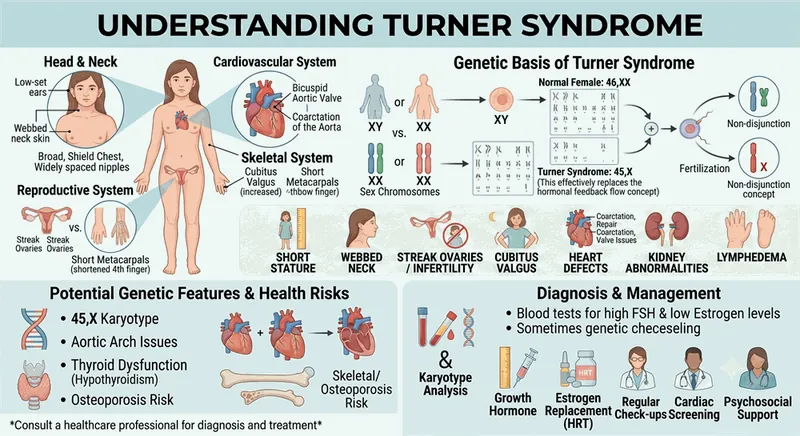
Turner syndrome, 45,X karyotype illustration

"Turner syndrome occurs in approximately 1 in 2000 live female births and is associated with multisystem involvement that requires lifelong, coordinated, multidisciplinary care to address cardiovascular, endocrine, autoimmune, and psychosocial needs."

β€” 2017 Cincinnati International Turner Syndrome Meeting Consensus

πŸ…°οΈ Classic Turner (45,X)

Complete absence of one X chromosome in all cells. About 40 to 50 percent of cases. Tends to present with the most "classic" features, short stature, gonadal dysgenesis, neck webbing, congenital heart and renal anomalies.

  • β†’Hallmarks: Short stature, primary amenorrhea, broad chest, neck webbing, lymphedema in infancy
  • β†’Cardiac risk: Bicuspid aortic valve (~30%), coarctation of the aorta (~10%), aortic dilation
  • β†’Fertility: Spontaneous puberty rare; spontaneous pregnancy rare (~2%)
  • β†’Key supports: Growth hormone in childhood, estrogen induction of puberty, lifelong HRT, cardiac surveillance

πŸ…±οΈ Mosaic Turner (45,X/46,XX or 45,X/46,XY)

Two or more cell lines, one 45,X and one with a normal or rearranged X (or Y) chromosome. ~30 to 40 percent of cases. Features tend to be milder and more variable. Some women may have spontaneous puberty and rare spontaneous pregnancy.

  • β†’Hallmarks: Milder phenotype; some women diagnosed only after infertility workup
  • β†’Special risk: 45,X/46,XY mosaicism increases risk of gonadoblastoma, prophylactic gonadectomy considered
  • β†’Fertility: Spontaneous puberty more likely; ~5 to 10% have spontaneous menarche
  • β†’Key supports: Karyotype-guided care; HRT if needed; cardiac and renal surveillance

πŸ…² Structural X Abnormalities

Includes isochromosome Xq (46,X,i(Xq)), ring X chromosome (46,X,r(X)), and X deletions. ~10 to 20 percent of cases. Phenotype depends on which X regions are affected, particularly the SHOX gene (short stature) and ovarian function genes on Xq.

  • β†’Hallmarks: Variable short stature, gonadal dysgenesis, and feature severity depending on loci involved
  • β†’Watch-out: Isochromosome Xq increases autoimmune thyroid risk and Hashimoto's specifically
  • β†’Fertility: Variable; some women cycle and conceive, others do not
  • β†’Key supports: HRT, thyroid surveillance, cardiac/renal monitoring, autoimmune workup

πŸ…³ Mosaic with Y-Chromosome Material

~5 to 10 percent of Turner mosaics carry some Y-chromosome material (45,X/46,XY, marker chromosomes containing Y). The major concern is the risk of gonadoblastoma/dysgerminoma in the dysgenetic gonads, typically warranting prophylactic gonadectomy.

  • β†’Hallmarks: Female phenotype with Y-derived material; sometimes ambiguous external genitalia
  • β†’Cancer risk: Gonadoblastoma risk ~15 to 30%; prophylactic gonadectomy usually recommended after diagnosis
  • β†’Fertility: Donor egg via gestational carrier may be considered; cardiac clearance essential
  • β†’Key supports: Gonadectomy when indicated, HRT, oncology & gyn-oncology coordination

Turner Syndrome Statistics & Research

1 in 2000
live female births globally (NIH, Endocrine Society)
~99%
of 45,X conceptions miscarry in the first trimester
~30%
of women with Turner have a bicuspid aortic valve
~10%
have coarctation of the aorta; ~3% develop aortic dissection in lifetime
30–50%
develop autoimmune thyroid disease (Hashimoto's most common)
~5%
have horseshoe kidney or other renal collecting-system anomaly

How Turner Syndrome Presents

Turner syndrome can present at any age, from prenatal ultrasound (nuchal edema, cardiac defects) through neonatal lymphedema, childhood short stature, adolescent absent puberty, or adult infertility. The phenotype is broad, but a recognizable pattern emerges across systems.

πŸ“ Growth, Skeletal & Reproductive Features

πŸ“

Short Stature (Final Height ~20 cm Below Average)

Untreated final adult height averages ~143 cm (~4'8"). Driven by SHOX-gene haploinsufficiency on the missing X. Growth hormone therapy started in early childhood typically adds 5 to 10 cm to final height.

🌸

Gonadal Dysgenesis & Primary Amenorrhea

The ovaries are typically "streak gonads" without functional follicles. Spontaneous puberty occurs in only 10 to 30 percent of women with Turner, and natural conception is rare. Estrogen induction is usually needed for breast development and uterine maturation.

🦴

Reduced Bone Density

A combination of low estrogen (until HRT begins), shorter skeleton, and possible vitamin D issues. Without adequate HRT, fracture risk is substantially elevated by midlife.

🦡

Cubitus Valgus, Madelung Deformity, Scoliosis

Cubitus valgus (an outward turning of the forearm) is seen in about half of patients. Madelung wrist deformity, scoliosis, and short fourth metacarpals reflect SHOX-related skeletal patterning.

πŸ‘‚

Recurrent Otitis Media & Hearing Loss

Anatomic narrowing of the Eustachian tube leads to frequent childhood ear infections. Sensorineural hearing loss is common by adulthood; routine audiologic monitoring is part of standard care.

🫁

Lymphedema & Neck Webbing

Lymphedema of the hands and feet at birth, neck webbing (pterygium colli) from fetal nuchal cystic hygroma, and a low posterior hairline. These features may be subtle or absent in mosaic Turner.

πŸ«€ Cardiovascular, Renal & Metabolic Features

❀️

Bicuspid Aortic Valve & Aortic Coarctation

Bicuspid valve in ~30 percent, coarctation in ~10 percent. The single most important monitoring priority in Turner is the aorta, regular echocardiograms and MRI imaging are part of lifelong care.

πŸ«€

Aortic Dilation & Risk of Dissection

Lifetime risk of aortic dissection is ~3 percent, roughly 100x the general population. Aortic root dilation must be tracked over time and managed proactively with blood pressure control and exercise modifications.

🩸

Hypertension (Even in Childhood)

Hypertension is common, often beginning in adolescence, sometimes earlier. May be primary or secondary to renal anomalies. Aggressive BP control is essential to protect the aorta.

🫘

Horseshoe Kidney & Collecting-System Anomalies

~30 percent of women with Turner have structural renal anomalies (horseshoe kidney, duplicated ureter, malrotation). Baseline renal ultrasound is standard at diagnosis.

πŸ¦‹

Autoimmune Thyroid Disease & Celiac Disease

Hashimoto's thyroiditis in 30 to 50 percent; celiac disease in ~5 percent. Annual TSH, TPO, and tissue transglutaminase IgA (with total IgA) are standard screening.

🍞

Insulin Resistance & Metabolic Syndrome

Insulin resistance, type 2 diabetes, central adiposity, and dyslipidemia all over-represented. Periodic fasting glucose, HbA1c, and lipid screening are standard.

⚠️ Pattern to watch for: A young girl in the lower percentile for height, recurrent ear infections, and absent or delayed puberty is the classic "second-look" Turner picture. Adults who were never diagnosed in childhood may present with infertility, hypertension, or autoimmune disease, karyotype confirms.

How to Test for Turner Syndrome

Diagnosis is by karyotype, ideally with both peripheral blood and (when needed) a second tissue source to rule out mosaicism. Workup at diagnosis and at regular intervals afterward covers cardiovascular, renal, endocrine, autoimmune, and audiologic systems.

🏠 At-Home / Pre-Diagnostic Observations

These observations build the case for formal karyotype testing, especially in girls whose features have been missed:

πŸ“ Growth-Chart Tracking

Plot height on the pediatric growth chart at every visit. A girl whose height crosses two major percentile lines downward, falls below the 5th percentile, or grows substantially below the parental midline target warrants endocrine and karyotype evaluation. Short stature is often the earliest sign.

πŸ‘¨β€πŸ‘©β€πŸ‘§ Puberty & Cycle Observation

Lack of breast development by age 13, absent menarche by age 15, or skipped/stopped cycles after spontaneous menarche warrants FSH, LH, AMH, and karyotype. Even small or single features (low posterior hairline, broad nipples, cubitus valgus) in this context strengthen the case for testing.

πŸ“‹ Turner Feature Checklist

Score for each: short stature, low posterior hairline, neck webbing, broad chest with wide-set nipples, cubitus valgus, short fourth metacarpal, multiple pigmented nevi, recurrent ear infections, congenital lymphedema, congenital heart defect, kidney anomaly, primary or secondary amenorrhea. Three or more in a girl or woman warrants karyotype.

πŸ”¬ Lab & Clinical Tests

🧬 Karyotype (Diagnostic Standard)

Peripheral-blood karyotype of at least 30 cells is the gold standard. If mosaicism is suspected and the initial study is normal but suspicion remains high, a second tissue (skin fibroblast or buccal mucosa) may be analyzed. Identifies the specific Turner variant.

πŸ’‰ Reproductive Hormone Panel

FSH and LH are typically elevated; estradiol low; AMH very low or undetectable in classic Turner; may be measurable in mosaic Turner. These confirm gonadal dysgenesis and guide HRT planning.

❀️ Echocardiogram & Cardiac MRI

Echocardiogram at diagnosis for all patients; cardiac MRI by adolescence for high-resolution imaging of the aorta. Repeat imaging based on findings, typically every 5 to 10 years if normal, more often if dilation or other abnormalities.

🫘 Renal Ultrasound

Baseline ultrasound at diagnosis. About 30 percent show structural anomalies. UTI history should trigger repeat imaging or referral.

πŸ¦‹ Annual Thyroid & Celiac Screening

TSH, free T4, TPO antibodies annually starting at age 4; tissue transglutaminase IgA with total IgA every 2 to 5 years. Address Hashimoto's and celiac early to prevent fatigue, growth issues, and bone loss.

🍞 Metabolic & Bone Density Workup

Fasting glucose, HbA1c, lipid panel annually starting in adolescence. DEXA scan in late adolescence and every 5 years; sooner if HRT adherence has been imperfect. 25-OH-D, calcium, ferritin, B12 as part of nutrient panel.

Holistic vs. Conventional Treatment for Turner Syndrome

Turner syndrome is a lifelong chromosomal condition. The conventional pillars, growth hormone in childhood, estrogen-progesterone replacement from adolescence to ~age 51, and surveillance imaging, are essential and not replaceable by holistic care. Holistic strategies layer on top to support cardiovascular health, bone, gut, autoimmune balance, and quality of life.

🌿 HOLISTIC
πŸ’Š CONVENTIONAL
🌿

Holistic / Functional Approach (Complementary)

Layered on standard medical care; supports cardiovascular, bone, gut, autoimmune, & psychological well-being

Primary Focus
Cardiovascular protection, bone support, autoimmune mitigation, mental-health care, fertility counseling
Duration
Lifelong; integrated with conventional medical care
Effect on Underlying Disorder
Does not change karyotype; reduces secondary risks & supports daily living
Fertility Outcome
Donor-egg IVF is the standard fertility pathway, requires aortic clearance; rare spontaneous pregnancy in mosaic Turner
Protocol Includes
  • Heart-healthy, Mediterranean-style eating with adequate protein, omega-3, and polyphenols for aortic and metabolic protection
  • Bone-supportive nutrition, calcium 1000 to 1200 mg/day, vitamin D 1000 to 2000 IU/day, magnesium, K2, protein
  • Strength training and weight-bearing exercise (cleared with cardiology for safety) for bone and metabolic health
  • Gluten trial and autoimmune-aware eating, given elevated celiac and thyroid autoimmune risk
  • Blood pressure management, low-sodium, potassium-rich foods, weight management, stress reduction
  • Mental-health support, peer community (Turner Syndrome Society, Turner Syndrome Foundation), therapy for body-image and fertility grief
  • Endocrine-disruptor reduction, replace plastic, fragrance-free personal care, filter water
  • Coordinated multidisciplinary follow-up, endocrinology, cardiology, GYN, audiology, mental health
βœ… Important boundaries: Holistic care is complementary and does not replace HRT, growth hormone, or surveillance imaging. Any pregnancy attempt in a woman with Turner syndrome requires cardiac clearance because aortic dissection risk is markedly increased; spontaneous and donor-egg pregnancies must be cardiology-cleared and managed in a high-risk maternal-fetal medicine setting.

Root Causes of Turner Syndrome

Turner syndrome is caused by a chromosomal accident, not by anything the parents or the patient did. The "root causes" relevant to a holistic plan are the secondary mechanisms that drive the cardiovascular, autoimmune, bone, and metabolic complications, where lifestyle and nutrition have real leverage.

Root Cause / Driver How It Contributes to Turner Syndrome Outcomes Holistic Solution
X-Chromosome Loss (Primary Genetic Cause)Loss of one X chromosome during meiosis or early embryonic mitosis. Not inherited from parents in most cases; not caused by lifestyle. SHOX-gene haploinsufficiency drives short stature; other X-linked genes drive gonadal, cardiac, and skeletal features.Genetic counseling for the family; no nutrition intervention changes the karyotype; downstream complications are the lever
Premature Estrogen LossGonadal dysgenesis means estrogen is missing or low throughout adolescence and adulthood. Drives bone loss, cardiovascular risk, vaginal atrophy, mood changes.Adherence to age-appropriate HRT is non-negotiable; layer in calcium, vitamin D, K2, magnesium, weight-bearing exercise
Aortic Wall VulnerabilityConnective-tissue abnormalities in the aortic wall (similar mechanisms to bicuspid aortic valve disease in general population). Drives aortic dilation and dissection risk, especially during pregnancy.Strict blood pressure control, avoid heavy isometric loading, surveillance imaging, prompt cardiology evaluation for any chest or back pain
Autoimmune PredispositionLoss of one X chromosome dysregulates immune tolerance, raising risk of Hashimoto's thyroiditis, celiac disease, and (less commonly) type 1 diabetes, IBD.Annual screening, anti-inflammatory eating, gluten trial if positive screen or symptoms, vitamin D 50 to 80 ng/mL, omega-3, gut healing
Insulin Resistance & Metabolic SyndromeIndependent of body weight, women with Turner have higher rates of insulin resistance, type 2 diabetes, and dyslipidemia. Partly driven by hormonal milieu and growth hormone exposure.Mediterranean / low-glycemic eating, strength training, omega-3, magnesium, periodic HbA1c and lipid checks
Reduced Bone Mineral DensityCombination of low estrogen until HRT, shorter skeleton, and (in some) lower physical activity and vitamin D status. Without adequate HRT and weight-bearing exercise, fracture risk is high.Calcium, vitamin D, K2, magnesium, weight-bearing exercise, strength training, DEXA monitoring, adequate HRT adherence
Lymphatic System AnomaliesUnderdeveloped lymphatic vessels contribute to neonatal lymphedema, cystic hygroma, and adult-onset lymphedema in some patients.Compression garments when indicated, manual lymph drainage, gentle exercise, weight management, skin care
Eustachian Tube AnatomyNarrow Eustachian tubes contribute to recurrent otitis media and progressive hearing loss. Drives social and learning impact if not addressed.Aggressive treatment of infections, audiologic monitoring, hearing aids when needed, mucous-thinning hydration
Psychosocial Stress & Body-Image GriefLiving with a visible difference, short stature, fertility limitation, and lifelong medical care raises anxiety and depression risk; under-recognized in standard endocrine follow-up.Therapy, peer community (Turner Syndrome Society of the US, Turner Syndrome Foundation), mental health screening at every annual visit
Y-Chromosome Material (in Mosaic Turner)~5 to 10% of mosaic Turner cases carry Y-chromosome material in some cells. Drives gonadoblastoma risk of ~15 to 30 percent if dysgenetic gonads remain in place.Karyotype-based identification; prophylactic gonadectomy is the standard once Y-material is confirmed; HRT continues afterward

Turner Syndrome Diet Guide

The Turner nutrition focus is on cardiovascular protection, bone, autoimmune mitigation, and insulin sensitivity, the systems most challenged across the lifespan. The pattern is essentially a Mediterranean + autoimmune-aware framework, with strict calcium and vitamin D adequacy.

πŸ«€

What Is the Turner-Supportive Eating Pattern?

Turner-supportive eating sits at the intersection of three priorities, protect the aorta and cardiovascular system, build and preserve bone, and quiet the autoimmune background. Insulin sensitivity is the connective tissue between all three.

The framework, anchor every meal with quality protein, fill half the plate with non-starchy and cruciferous vegetables, layer in heart-healthy fats, ensure calcium- and vitamin-D-rich foods daily, and emphasize polyphenols, omega-3s, and fiber for autoimmune and cardiovascular support. Carbohydrates come from whole-food, slow-glycemic sources.

The 4 Anchors of Every Meal:

  • 1Protein 25 to 35 g, muscle, bone matrix, and growth (childhood)
  • 2Non-starchy & cruciferous vegetables fill half the plate
  • 3Heart-healthy fat, olive oil, avocado, nuts, wild fish
  • 4Calcium-rich food at most meals, sardines, yogurt (if tolerated), leafy greens, tahini

Timing & Special Considerations:

  • ⏱3 meals + 1 to 2 snacks for stable blood sugar, especially on growth hormone
  • πŸŒ…Protein at breakfast, essential during growth-hormone treatment
  • 🦴Calcium and vitamin D daily, primarily from food, supplement as needed
  • 🩸Low-sodium emphasis, blood pressure control protects the aorta
πŸ’‘ Celiac screening positive? A strict gluten-free diet becomes lifelong and non-negotiable. Annual screening is standard regardless of symptoms.
⚠️ These foods raise blood pressure, inflammation, autoimmune activity, and metabolic dysfunction, all over-represented in Turner.
  • βœ—Refined sugar: Soda, juice, candy, baked goods; drives insulin resistance and weight gain
  • βœ—Refined flour & ultra-processed foods: White bread, crackers, packaged snacks, fast food
  • βœ—Industrial seed oils: Soybean, canola, corn, cottonseed, sunflower, safflower
  • βœ—Excess sodium: Restaurant food, canned soups, processed meats, salty snacks, sodium drives blood pressure and aortic stress
  • βœ—Gluten (if celiac screen positive): Strict, lifelong avoidance; small amounts cause ongoing intestinal damage
  • βœ—Conventional dairy (in autoimmune cases): Trial 30 to 60 days if joint pain, congestion, or thyroid antibodies are rising
  • βœ—Alcohol: Raises blood pressure, depletes B vitamins, worsens bone loss; limit to 0 to 3 drinks/week
  • βœ—Excessive caffeine: Worsens calcium loss and blood pressure; limit to 1 morning coffee or matcha
  • βœ—Smoking & secondhand smoke: Catastrophic for cardiovascular and bone outcomes; avoid completely
πŸ’‘ Foods that protect the aorta, build and maintain bone, calm autoimmune background, and support insulin sensitivity.
  • βœ“Quality proteins: Wild salmon, sardines, pastured eggs, grass-fed beef, pastured poultry, organic tempeh or tofu
  • βœ“Calcium-rich foods: Sardines with bones, plain yogurt or kefir if tolerated, tahini, kale, bok choy, broccoli, almonds, fortified plant milks
  • βœ“Cruciferous vegetables: Broccoli, cauliflower, Brussels sprouts, cabbage, kale, support estrogen metabolism on HRT
  • βœ“Polyphenol-rich produce: Berries, pomegranate, dark cherries, red grapes, beets, dark chocolate (85%+); protect the endothelium
  • βœ“Omega-3 fish: Wild salmon, sardines, anchovies, mackerel (avoid king mackerel), 2 to 3 servings per week
  • βœ“Potassium-rich foods: Avocado, banana, sweet potato, beans, leafy greens, support blood pressure
  • βœ“Healthy fats: Extra-virgin olive oil, avocado, walnuts, almonds, pumpkin seeds, flax seeds
  • βœ“Vitamin K2 sources: Natto, hard cheeses (if tolerated), pastured egg yolks; direct calcium to bone, not arteries
  • βœ“Fermented foods: Sauerkraut, kimchi, miso, plain kefir (if tolerated); gut and immune support

Key Supplements for Turner Syndrome Recovery

Supplements complement HRT and growth hormone (when used), supporting bone, cardiovascular health, autoimmune balance, mood, and energy. All should be coordinated with your endocrinologist and cardiologist.

Supplement Role in Turner Syndrome Care Suggested Dose Timing Notes
Vitamin D3 (with K2)Foundational for bone, immune regulation, and cardiovascular health. Critical given high baseline osteoporosis and autoimmune thyroid risk.1000 to 3000 IU D3 + 100 to 200 mcg MK-7 K2 per dayWith a fat-containing mealTest 25-OH-D; target 50 to 80 ng/mL. Higher doses needed if severely deficient.
CalciumBone-mineralization foundation, especially in adolescence and adulthood. Pair with K2 to direct calcium to bone, not arteries.500 to 1000 mg/day from food + supplement combinedSplit doses, with mealsFood-first; supplement only if dietary calcium below 1000 mg/day. Avoid more than 500 mg per dose.
Magnesium GlycinateSupports bone, blood pressure, insulin sensitivity, sleep, and mood. Often low across the population.200 to 400 mg elemental magnesium per dayEvening, 30 to 60 min before bedGlycinate is the calmest, most absorbable form.
Vitamin K2 (MK-7)Directs calcium into bone and away from arterial walls. Particularly important alongside calcium supplementation.100 to 200 mcg MK-7 per dayWith a fat-containing mealOften combined with vitamin D3 in one product.
Omega-3 EPA/DHAReduces inflammation, supports endothelial function and cardiovascular health, modulates autoimmune background.2 to 3 g combined EPA+DHA per dayWith mealsChoose IFOS-certified for purity. Pause about 1 week before any planned surgery.
Methylated B-ComplexSupports methylation, neurotransmitter balance, energy, and homocysteine metabolism (cardiovascular risk marker).1 capsule per day per product labelMorning with foodChoose forms with L-methylfolate and methylcobalamin.
CoQ10 (Ubiquinol)Supports myocardial energy production and endothelial health, important given cardiovascular vulnerability in Turner.100 to 300 mg ubiquinol per dayWith a fat-containing meal, morningParticularly relevant if on statins or with abnormal lipid panel.
SeleniumRequired for thyroid function and glutathione peroxidase. Often helpful in Hashimoto's-positive Turner patients.100 to 200 mcg per dayWith foodTwo Brazil nuts per day is a food alternative; do not exceed 400 mcg/day.
Iron (if needed)For iron-deficiency anemia, common in adolescent and adult women, particularly if menstruating on cyclic HRT.20 to 65 mg elemental iron, only if ferritin lowEmpty stomach with vitamin CBisglycinate avoids GI side effects. Confirm ferritin less than 50 ng/mL before supplementing.
Vitamin B12 (Methylcobalamin)Supports red-blood-cell formation, energy, and neurologic function. Frequently low in autoimmune contexts.500 to 1000 mcg per day sublingualMorningSublingual or injectable forms bypass gut absorption issues.
Multi-Strain ProbioticSupports gut, immune balance, and estrogen metabolism (estrobolome). Particularly helpful given celiac and autoimmune risk.25 to 50 billion CFU per dayEmpty stomach or with light mealRotate brands every 2 to 3 months.
Curcumin (Turmeric Extract)Anti-inflammatory; supports cardiovascular, joint, and immune health.500 to 1000 mg curcumin per dayWith a fat-containing mealPause 1 to 2 weeks before any planned surgery (mild antiplatelet).
ZincRequired for immune function, growth, taste/smell, and bone metabolism. Often modestly low in restrictive eaters.10 to 25 mg per dayWith mealsAdd 1 to 2 mg copper if using more than 8 weeks at higher doses.
L-CarnitineMitochondrial support for cardiac and skeletal muscle; modestly improves exercise tolerance and metabolic flexibility.500 to 2000 mg per dayMorning, empty stomachUseful in plant-forward eaters who get little dietary carnitine.
Hawthorn (Crataegus)Traditional cardio-supportive herb with mild blood pressure and endothelial benefit; pairs well with conventional cardiac care.300 to 900 mg standardized extract per dayMorning or split AM/PMCoordinate with cardiologist if on antihypertensives.
AshwagandhaAdaptogen for HPA-axis support, stress, sleep, and modest thyroid support.300 to 600 mg KSM-66 per dayEvening or split AM/PMAvoid in untreated hyperthyroidism and pregnancy.
Collagen PeptidesGlycine, proline, and hydroxyproline support connective tissue, joints, and skin.10 to 20 g per dayAny timeChoose grass-fed, third-party tested for heavy metals.

Healing Timeline: Conventional vs. Holistic

Turner syndrome is a lifelong condition. Both timelines reflect a long arc of integrated care across the lifespan, with very different emphases.

🌿 Holistic Protocol (Alongside Conventional Care)
Childhood (0–10)

Mediterranean-style family meals, adequate protein, calcium, vitamin D. Address recurrent ear infections aggressively. Hydration, sleep, daily activity. Early peer-community and family education.

Adolescence (10–18)

Optimize bone-building window with calcium, vitamin D, K2, magnesium, weight-bearing exercise. Mental-health support around body image and fertility education. Annual celiac and thyroid screen; gluten-free if needed.

Young Adulthood (18–35)

Heart-protective eating, blood pressure control, strength training, gut and autoimmune work, fertility & donor-egg counseling. CoQ10, omega-3, methylated B-complex, vitamin D.

Adulthood (35–51)

Continue HRT, cardiovascular surveillance, bone protection. Manage menopause-like symptoms with herbal supports if HRT alone is insufficient. Mental-health continuity.

Long-Term Outlook

Quality of life closer to non-Turner peers; durable cardiovascular, bone, autoimmune, and metabolic protection layered on standard care

πŸ’Š Conventional Treatment
Diagnosis (Prenatal–Childhood)

Karyotype confirms; baseline echocardiogram, renal ultrasound, audiology, thyroid panel, IgA-tTG. Start growth hormone when height drops below 5th percentile.

Adolescence (10–18)

Estrogen induction of puberty around age 11 to 12. Progesterone added 2 to 3 years later. Continue growth hormone until growth plates fuse. Annual thyroid, celiac, lipids, BP.

Young Adulthood

HRT continued; cardiac MRI baseline; fertility counseling, donor-egg pathway if pregnancy desired (cardiology clearance required). Annual labs and blood pressure monitoring.

Adulthood (to ~51)

HRT maintained to natural age of menopause. Surveillance imaging every 5 to 10 years (sooner if abnormal). Lifestyle and nutrition rarely incorporated into endocrine follow-up.

Long-Term Outlook

Hormonal & growth needs addressed; cardiovascular, autoimmune, and lifestyle drivers often not addressed

"Turner syndrome is not just about height and hormones. It is a multisystem story, the woman's whole life, and the care that matches her must be just as comprehensive."

Ready to Address Your Turner Syndrome at the Root?

Explore related conditions below or revisit the Symptom Checker to map your full symptom picture across the library.