Thyroid Disorders in Women

The thyroid, a small butterfly-shaped gland at the base of the neck, regulates the speed of nearly every metabolic process in the body. Women are 5 to 10 times more likely than men to develop thyroid disease, and an estimated 1 in 8 will face a thyroid disorder in their lifetime. This page covers all eight major thyroid conditions, from Hashimoto's and hypothyroidism to thyroid cancer and postpartum thyroiditis, with female-to-male prevalence ratios alongside symptoms, testing, nutrition, and supplements.

8 Conditions Covered โ™€๏ธ 5โ€“10ร— Higher Risk vs. Men ~60% Undiagnosed

Last updated:

What Are Thyroid Disorders?

Thyroid disorders are conditions in which the thyroid gland either produces too little hormone (hypothyroidism), too much hormone (hyperthyroidism), changes structure (nodules, goiter, cancer), or comes under autoimmune attack (Hashimoto's, Graves', postpartum thyroiditis).

The thyroid converts dietary iodine and the amino acid tyrosine into T4 (thyroxine) and T3 (triiodothyronine). T3 is the active hormone that drives metabolic rate, body temperature, heart rate, gut motility, mood, cognition, menstrual regularity, fertility, and skin/hair/nail turnover. Even small shifts in thyroid hormone change how every cell behaves.

Women's much higher risk is driven by a combination of X-chromosome immune-gene density, estrogen's effects on thyroid-binding globulin, life-stage hormonal swings (puberty, pregnancy, postpartum, perimenopause), and higher rates of autoimmune disease overall. Nine out of ten cases of Hashimoto's are women.

โš ๏ธ An estimated 60% of Americans with thyroid disease don't know they have it. Symptoms (fatigue, weight change, brain fog, mood swings, hair loss) overlap heavily with depression, anemia, and perimenopause, and standard TSH-only screening misses many cases.
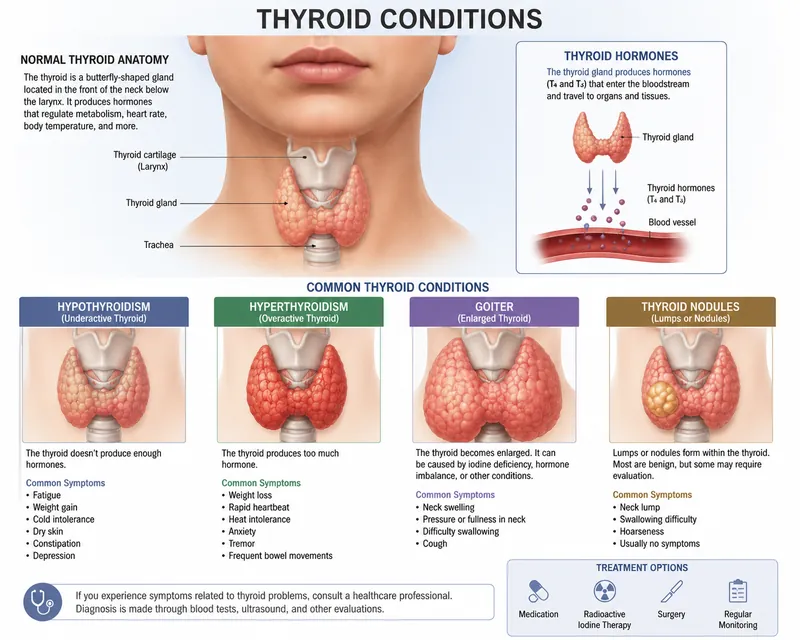
Thyroid conditions overview, anatomy of the thyroid gland with hypothyroidism, hyperthyroidism, goiter, and thyroid nodules

The 8 Major Thyroid Conditions

All eight share a thyroid origin but differ in mechanism, treatment, and severity. Several frequently overlap (e.g., Hashimoto's causes most hypothyroidism; nodules can become goiter or cancer).

๐Ÿ›ก๏ธ Hashimoto's Thyroiditis

Autoimmune attack on the thyroid by anti-TPO and anti-thyroglobulin antibodies. Gradually destroys thyroid tissue, leading to hypothyroidism. The most common thyroid disorder in the developed world. โ™€๏ธ:โ™‚๏ธ โ‰ˆ 7โ€“10:1 (often cited 10:1).

๐Ÿฅถ Hypothyroidism

Insufficient thyroid hormone production. ~90% of cases in the US/Europe are due to Hashimoto's; globally, iodine deficiency is the biggest driver. Slows metabolism, mood, gut, and cardiovascular function. โ™€๏ธ:โ™‚๏ธ โ‰ˆ 5โ€“8:1.

๐Ÿ”ฅ Hyperthyroidism

Excess thyroid hormone production. Drives weight loss, anxiety, heat intolerance, tremor, and cardiac arrhythmia. Most commonly caused by Graves' disease; can also stem from toxic nodules or thyroiditis. โ™€๏ธ:โ™‚๏ธ โ‰ˆ 5โ€“10:1.

๐Ÿ‘๏ธ Graves' Disease

Autoimmune cause of hyperthyroidism. TSI antibodies stimulate the thyroid to overproduce hormone. Often accompanied by Graves' eye disease (proptosis, double vision). โ™€๏ธ:โ™‚๏ธ โ‰ˆ 7โ€“8:1.

๐Ÿ’  Thyroid Nodules

Discrete lumps within the thyroid gland. Extremely common; ~50% of women have at least one by age 60 (most found incidentally on imaging). ~95% are benign. โ™€๏ธ:โ™‚๏ธ โ‰ˆ 4:1.

๐Ÿฆ’ Goiter

Visible or palpable enlargement of the thyroid gland. Can be diffuse or nodular, with normal, low, or high hormone output. Iodine deficiency is the leading global cause. โ™€๏ธ:โ™‚๏ธ โ‰ˆ 4:1.

๐ŸŽ—๏ธ Thyroid Cancer

Most are slow-growing papillary or follicular carcinomas with excellent prognosis (>98% 5-year survival for differentiated types). Medullary and anaplastic are rarer and more aggressive. โ™€๏ธ:โ™‚๏ธ โ‰ˆ 3:1.

๐Ÿคฑ Postpartum Thyroiditis

Autoimmune thyroid inflammation appearing within 12 months of childbirth. Classic biphasic pattern: hyperthyroid โ†’ hypothyroid โ†’ recovery (or permanent hypothyroidism in 20โ€“40%). Affects ~5โ€“10% of postpartum women. Women only.

๐Ÿ“Š Overall Risk Picture

Across all thyroid conditions combined, women are roughly 5โ€“8ร— more likely than men to be affected. Lifetime risk for a woman developing some form of thyroid disease is approximately 1 in 8.

1 in 8
Women will develop a thyroid disorder in her lifetime1
5โ€“10ร—
Higher risk in women vs. men across thyroid conditions2
~60%
Of cases remain undiagnosed at any given time3
5โ€“10%
Of postpartum women develop postpartum thyroiditis4
โ™€๏ธ Women-to-Men Susceptibility by Condition โ™‚๏ธ
Hashimoto's
7โ€“10 : 1
~88โ€“90% of cases are women
Hypothyroidism
5โ€“8 : 1
~83% of cases are women
Hyperthyroidism
5โ€“10 : 1
~85% of cases are women
Graves' Disease
7โ€“8 : 1
~88% of cases are women
Thyroid Nodules
4 : 1
~80% of cases are women
Goiter
4 : 1
~80% of cases are women
Thyroid Cancer
3 : 1
~75% of cases are women
Postpartum Thyroiditis
Women only
5โ€“10% of postpartum women
Sources & references
  1. American Thyroid Association. General Information / Press Room, prevalence of thyroid disease.
  2. Vanderpump MPJ. The epidemiology of thyroid disease. Br Med Bull. 2011;99:39โ€“51. Female-to-male ratios summarized per condition.
  3. Hollowell JG, et al. NHANES III serum TSH/TT4 survey, % undiagnosed thyroid dysfunction in the US adult population.
  4. Stagnaro-Green A. Postpartum thyroiditis. Best Pract Res Clin Endocrinol Metab. 2004;18(2):303โ€“316.

Symptoms by Thyroid Pattern

Thyroid symptoms cluster by what the gland is doing, underactive (hypo), overactive (hyper), structural change, or postpartum biphasic. Many women cycle through more than one pattern over time.

๐Ÿฅถ Underactive (Hypo): Hashimoto's, Hypothyroidism

๐Ÿ˜ด

Persistent Fatigue

Tired on waking, energy crashes mid-afternoon, needing 9โ€“10 hours but still unrefreshed. Reflects slowed cellular metabolism and reduced mitochondrial ATP output. Often the first symptom women dismiss as "stress."

โš–๏ธ

Unexplained Weight Gain

5โ€“15 lbs gain despite no diet change; difficulty losing weight despite calorie deficit. Driven by reduced basal metabolic rate, fluid retention, and impaired fat oxidation.

๐Ÿฅถ

Cold Intolerance

Cold hands and feet, needing extra layers, low body temperature (often <97.8ยฐF basal). Reflects reduced thermogenesis and slowed metabolism.

๐ŸŒ€

Brain Fog & Slowed Thinking

Difficulty concentrating, word-finding problems, slower processing. T3 modulates cerebral glucose metabolism; low T3 measurably slows cognition, often misdiagnosed as depression or perimenopause.

๐Ÿ’โ€โ™€๏ธ

Hair Loss, Dry Skin, Brittle Nails

Hair thinning, especially at the outer eyebrows; coarse, dry skin; ridged or splitting nails. Thyroid hormone drives the entire skin/hair/nail turnover cycle.

๐Ÿ’ฉ

Constipation

Stools every 2โ€“4 days, hard and hard-to-pass. Reflects slowed gut motility. Often improves dramatically once thyroid is treated.

๐Ÿฉธ

Heavy or Irregular Periods

Menorrhagia, anovulatory cycles, infertility. Thyroid dysfunction is a top under-recognized cause of infertility and miscarriage.

๐Ÿ˜”

Low Mood & Depression

Depressive symptoms that don't respond well to standard antidepressants. Thyroid hormone modulates serotonin and dopamine; subclinical hypothyroidism is present in 10โ€“15% of treatment-resistant depression.

๐Ÿ”ฅ Overactive (Hyper): Graves', Hyperthyroidism

๐Ÿ’“

Heart Palpitations / Rapid Pulse

Pounding heartbeat, resting pulse >90, atrial fibrillation risk. Excess T3 directly stimulates cardiac ฮฒ-receptors. Untreated, raises stroke and heart failure risk.

๐Ÿ˜ฐ

Anxiety, Tremor, Restlessness

Internal "revved up" feeling, fine hand tremor (especially with arms outstretched), panic-like episodes. Frequently misdiagnosed as a primary anxiety disorder.

๐Ÿฅต

Heat Intolerance & Sweating

Always too hot, especially at night; drenching sweats. Reflects elevated basal metabolic rate. Easily confused with perimenopausal vasomotor symptoms.

๐Ÿ“‰

Unexplained Weight Loss

Losing 5โ€“20 lbs despite a normal or increased appetite. Driven by metabolic acceleration and protein catabolism. Should always trigger a thyroid workup.

๐Ÿ˜ด

Insomnia

Difficulty falling and staying asleep despite exhaustion. Sympathetic overdrive prevents normal sleep onset. Often worsens anxiety in a feedback loop.

๐Ÿ’ฉ

Frequent Bowel Movements

Multiple loose stools daily, despite no infection or dietary trigger. Reflects accelerated gut transit. Often confused with IBS-D.

๐Ÿ‘๏ธ

Eye Symptoms (Graves' Specifically)

Bulging eyes (proptosis), gritty/dry sensation, double vision, eyelid retraction. Caused by inflammation of retro-orbital tissue from cross-reactive antibodies. Smoking dramatically worsens it.

๐Ÿฉธ

Light, Short, or Absent Periods

Oligomenorrhea or amenorrhea, reduced fertility. Excess thyroid hormone disrupts the HPO axis. Often the symptom that brings women in for evaluation.

๐Ÿ’  Structural: Nodules, Goiter, Thyroid Cancer

๐Ÿฆ’

Visible Neck Enlargement

Diffuse swelling at the base of the neck (goiter) or a discrete lump (nodule). Often noticed when swallowing or by a partner/photo. Should always be evaluated with ultrasound.

๐ŸŒฌ๏ธ

Difficulty Swallowing or Breathing

Sensation of pressure or "tightness" at the throat; trouble swallowing pills; air hunger when lying flat. Caused by mass effect from large goiters or substernal nodules.

๐Ÿ—ฃ๏ธ

Hoarseness or Voice Change

Persistent hoarseness lasting weeks. Can reflect compression of the recurrent laryngeal nerve. A red flag in the setting of a thyroid nodule and warrants urgent imaging.

๐Ÿ”

Asymptomatic Findings on Imaging

Nodules and small thyroid cancers are most often found incidentally on CT, MRI, or carotid ultrasound done for other reasons. Most are slow-growing and benign, but any solid nodule >1 cm warrants FNA biopsy.

๐Ÿคฑ Postpartum Thyroiditis (Biphasic)

โฑ๏ธ

Phase 1: Hyperthyroid (1โ€“6 Months Postpartum)

Anxiety, palpitations, heat intolerance, weight loss, insomnia in a new mom, often dismissed as "normal postpartum stress." Caused by inflammatory release of preformed thyroid hormone.

โฑ๏ธ

Phase 2: Hypothyroid (3โ€“12 Months Postpartum)

Profound fatigue, depression, weight gain, hair loss, cold intolerance. Frequently misdiagnosed as postpartum depression. ~20โ€“40% of women never fully recover and need lifelong thyroid hormone.

๐Ÿผ

Impact on Breastfeeding & Bonding

Hypothyroid phase can reduce milk supply and impair maternal mood and energy. Treating the thyroid often resolves what looked like a "depression that wouldn't lift."

๐Ÿ”

Recurrence Risk in Future Pregnancies

~70% recurrence in subsequent pregnancies. Anti-TPO antibodies before or early in pregnancy strongly predict it, screen women with prior episodes or known autoimmunity.

How to Test the Thyroid Properly

Standard "thyroid screening" with TSH alone misses many cases. A complete picture requires TSH, free hormones, antibodies, and, when structure is in question, ultrasound.

๐Ÿงช Complete Thyroid Blood Panel

๐Ÿ“ˆ TSH (Thyroid-Stimulating Hormone)

Pituitary signal; rises when thyroid output is low. Standard reference 0.4โ€“4.5 mIU/L. Functional/optimal range: 0.5โ€“2.5 mIU/L. A "normal" TSH does NOT rule out Hashimoto's or low-T3 problems.

โš™๏ธ Free T4 & Free T3

The actual circulating hormones. Free T3 is the active form. Some women have normal TSH and Free T4 but low Free T3 (impaired conversion), with full clinical hypothyroidism.

๐Ÿ›ก๏ธ TPO & Thyroglobulin Antibodies

Diagnose Hashimoto's. Often elevated YEARS before TSH shifts, the earliest reliable signal of autoimmune thyroid disease. Critical screen if there's any family or personal history of autoimmune disease.

๐ŸŽฏ TSI / TRAb (Graves' Antibodies)

Thyroid-stimulating immunoglobulin and TSH-receptor antibodies confirm Graves' as the cause of hyperthyroidism (vs. toxic nodule or thyroiditis). Critical before starting treatment.

๐Ÿ” Reverse T3

An inactive form of T3. Elevated in chronic stress, illness, low-calorie diets, and inflammation. A high rT3 with normal-low Free T3 explains hypothyroid symptoms despite "normal" labs.

๐Ÿ”ฌ Imaging & Structural Workup

๐Ÿฉป Thyroid Ultrasound

First-line imaging for any palpable lump, goiter, or known nodules. Characterizes size, composition (cystic vs. solid), and TI-RADS risk score. Repeat every 6โ€“24 months for surveillance.

๐Ÿชก Fine-Needle Aspiration (FNA) Biopsy

Indicated for nodules >1 cm with suspicious features (hypoechoic, irregular margins, microcalcifications, abnormal lymph nodes). Highly accurate for detecting thyroid cancer.

โš›๏ธ Radioactive Iodine Uptake (RAIU) Scan

Distinguishes Graves' (diffuse high uptake) from toxic nodule (focal "hot" uptake) from thyroiditis (low uptake) when hyperthyroidism is confirmed.

๐ŸŒก๏ธ Basal Body Temperature (At-Home)

Axillary temperature taken upon waking, before getting out of bed. Sustained <97.8ยฐF across 5 mornings is consistent with hypothyroidism. Useful adjunct but never a substitute for labs.

๐Ÿงฌ Nutrient & Cofactor Panel

Vitamin D 25(OH)D, ferritin, B12, RBC magnesium, selenium, zinc. All directly affect thyroid hormone production and conversion. Deficiency mimics or worsens primary thyroid disease.

Holistic vs. Conventional Treatment for Thyroid Disorders

๐ŸŒฟ HOLISTIC
๐Ÿ’Š CONVENTIONAL
๐ŸŒฟ

Holistic / Functional Approach

Autoimmune diet, gut healing, key micronutrients, stress & sleep, environmental triggers, and partnership with a thyroid-literate provider

Antibody Reduction
30โ€“50% reduction in TPO antibodies over 6โ€“12 months with gluten-free + AIP-style elimination in many studies
Conversion Support
Adequate selenium, zinc, and iron measurably improve T4โ†’T3 conversion
Timeline
Energy and mood improvements in 4โ€“8 weeks; antibody and structural shifts over 6โ€“12 months
Advantage
Addresses root drivers (gut, gluten, nutrients, stress) alongside replacement, so dose needs often decline over time
Full Holistic Protocol Includes
  • Strict gluten elimination (90+ days minimum), the single most evidence-supported dietary change for Hashimoto's; molecular mimicry between gluten and thyroid tissue is well documented
  • Heal the gut, ~70% of the immune system is intestinal. Address SIBO, candida, leaky gut, low stomach acid; rebuild microbiome diversity
  • Selenium-rich foods or supplementation, 2 Brazil nuts daily or 200 mcg selenomethionine; the most-studied nutrient for reducing TPO antibodies
  • Iodine: use sparingly and only with adequate selenium. Excess iodine triggers Hashimoto's flares; small amounts (from sea vegetables, eggs, dairy) are protective
  • Iron, zinc, vitamin D, magnesium, B12, all required cofactors; deficiency single-handedly causes hypothyroid symptoms even with normal TSH
  • Reduce environmental triggers, fluoride, bromide, perchlorate, heavy metals (mercury, lead) all interfere with thyroid function
  • Stress regulation, sustained cortisol elevation suppresses TSH and impairs T4โ†’T3 conversion. Daily nervous-system practice (breathwork, yoga, sleep) is non-negotiable
  • Sleep 7โ€“9 hours, the thyroid HPA axis resets overnight; chronic sleep restriction worsens every thyroid pattern
  • Treat Hashimoto's even at "subclinical" TSH, antibodies drive symptoms long before labs cross the standard cutoff. A trial of levothyroxine + lifestyle is often dramatically helpful
  • Postpartum: screen TSH + antibodies at 6 weeks, 6 months, and 12 months post-delivery for any woman with prior thyroid issues or autoimmune history
โœ… Important: The holistic approach works best as a complement to, not a replacement for, appropriate thyroid replacement or anti-thyroid medication. Hashimoto's and Graves' both progress without treatment; nodules need imaging follow-up; suspected cancer needs biopsy. Always partner with a thyroid-literate provider.

Diet for Thyroid Health

Thyroid-supportive eating reduces autoimmune flares, supplies the cofactors needed to make and convert hormone, and avoids the inputs that interfere with the gland directly.

โœ… Prioritize These:

๐Ÿฅœ Brazil Nuts (Selenium)

2 nuts/day provide ~150โ€“200 mcg selenium, enough to measurably reduce TPO antibodies over 3โ€“6 months. Essential cofactor for the deiodinase enzymes that convert T4 to active T3.

๐Ÿฆช Zinc-Rich Foods

Oysters, beef, pumpkin seeds, lamb. Zinc is required for TSH signaling and T4โ†’T3 conversion. Mild deficiency is extremely common in women on plant-forward diets.

๐ŸŸ Wild-Caught Fish & Eggs

Sardines, salmon, pasture-raised eggs. Supply iodine in physiologic amounts, plus tyrosine, omega-3s, vitamin D, and B12, the entire thyroid-building stack.

๐Ÿฅฉ Bioavailable Iron & Protein

Grass-fed red meat, liver, dark poultry. Adequate ferritin (>70 ng/mL) and 1.2โ€“1.6g protein/kg body weight are required for thyroid hormone production and immune balance.

๐ŸŒˆ Anti-Inflammatory Plants

Berries, leafy greens, olive oil, herbs, polyphenol-rich vegetables. Dampen the autoimmune inflammatory milieu that drives Hashimoto's and Graves'.

โŒ Limit or Eliminate:

๐ŸŒพ Gluten

Strongest single dietary lever in Hashimoto's. Molecular mimicry between gluten and thyroid tissue means that as long as gluten is ingested, antibodies stay elevated. Strict 90-day trial recommended.

๐Ÿฅ› Casein (Sometimes)

Cross-reactivity with gluten in ~30% of celiac/Hashimoto's patients. Worth a 60-day elimination trial if gluten-free alone doesn't move antibodies. Many tolerate ghee, butter, and aged sheep/goat cheese.

๐ŸŒŠ Excessive Iodine (Kelp, Spirulina, Mega-Doses)

Doses >500 mcg/day can trigger Hashimoto's flares and induce hypothyroidism (Wolff-Chaikoff). Avoid high-iodine supplements unless guided by labs and selenium status.

๐Ÿฐ Refined Sugar & Ultra-Processed Foods

Drive blood sugar swings and cortisol surges, both of which suppress TSH and impair T4โ†’T3 conversion. Also worsen autoimmune inflammation.

๐Ÿšฐ Fluoride & Bromide Exposure

Halogens that compete with iodine at the thyroid. Filter drinking water (reverse osmosis or activated alumina), choose fluoride-free toothpaste if antibody-positive, and avoid brominated flour and flame-retardant fabrics.

Evidence-Based Supplements for Thyroid Disorders

Supplement priorities differ by pattern. For Hashimoto's/hypothyroidism the focus is cofactor sufficiency; for Graves'/hyperthyroidism the focus is calming the immune storm and replenishing what's burned through.

SupplementMechanism & EvidenceSuggested DoseTimingNotes
Selenium (Selenomethionine)Cofactor for deiodinase (T4โ†’T3) and glutathione peroxidase (antioxidant). Multiple RCTs show ~30% reduction in TPO antibodies over 3โ€“6 months. Foundational for both Hashimoto's and Graves'.200 mcg/dayWith breakfastDon't exceed 400 mcg long-term. 2 Brazil nuts/day is a food alternative.
Vitamin D3 + K2D deficiency strongly correlated with all autoimmune thyroid disease. Modulates regulatory T cells. K2 ensures calcium goes to bone rather than soft tissues.D3: 4,000โ€“5,000 IU/day; K2 MK-7: 100โ€“200 mcg/dayWith largest fat mealTest 25(OH)D; aim 50โ€“70 ng/mL. Critical foundation supplement.
Magnesium GlycinateRequired for TSH receptor function and adrenal/cortisol balance. Improves sleep, calms hyperthyroid anxiety, supports gut motility in hypothyroid constipation.300โ€“400mg elemental/nightBefore bedGlycinate, threonate, or malate. Avoid magnesium oxide (poorly absorbed).
Iron (If Ferritin <70 ng/mL)Required for thyroid peroxidase enzyme. Low iron alone causes hypothyroid symptoms and impairs response to levothyroxine. Heavy periods (common in hypothyroid women) deepen the deficit.25โ€“50mg elemental/day with vitamin CEmpty stomach if tolerated; otherwise with mealBisglycinate is best-tolerated form. Re-test ferritin every 3 months. Do NOT supplement empirically without testing.
Zinc PicolinateRequired for TSH signaling and T4โ†’T3 conversion. Mild deficiency very common in plant-heavy diets and is widely under-diagnosed. Also supports immune balance.15โ€“30mg/dayWith foodPair with 1โ€“2mg copper if used >3 months to prevent copper deficiency.
Myo-Inositol + Selenium (Combo)Emerging evidence: the combination significantly improves TSH and reduces antibodies in subclinical Hashimoto's. Better than selenium alone in several recent trials.600mg myo-inositol + 83mcg selenium, twice dailyWith mealsParticularly useful in subclinical hypothyroidism. Branded as ITAL combos but generic works too.
L-TyrosineSubstrate for thyroid hormone synthesis (T4 = tyrosine + 4 iodines). Some symptomatic hypothyroid patients improve with supplementation, especially under stress.500โ€“1500mg/dayMorning, empty stomachAvoid in active Graves' (will fuel hyperthyroidism). Do not combine with MAOI antidepressants.
L-Carnitine (For Hyperthyroidism)Inhibits thyroid hormone entry into cells. Reduces hyperthyroid symptoms (palpitations, tremor, anxiety) in mild to moderate hyperthyroidism. Useful adjunct to antithyroid drugs.2โ€“4g/day, dividedWith mealsSpecifically useful in Graves' and toxic nodule; not for hypothyroidism (would worsen it).
Ashwagandha (For Hashimoto's)Adaptogen; modestly increases T4 and T3 in subclinical hypothyroidism. Lowers cortisol, which improves T4โ†’T3 conversion. Helpful for the "tired and wired" Hashimoto's pattern.300โ€“600mg standardized extract/dayMorning or split AM/PMAvoid in active Graves' (may worsen hyperthyroidism). Some Hashimoto's patients are sensitive; start low.
Probiotic (Multi-Strain)Gut dysbiosis is a near-universal feature of autoimmune thyroid disease. Specific strains (L. reuteri, L. plantarum, B. lactis) modulate Treg cells and reduce intestinal permeability, addressing a root driver.10โ€“50 billion CFU/dayEmpty stomach or with small mealRotate strains every few months. Combine with fermented foods for synergy.
Omega-3 EPA/DHAPowerful anti-inflammatory; reduces autoimmune flare frequency, supports mood, and lowers cardiovascular risk (a concern in untreated hypothyroidism).2g combined EPA+DHA/dayWith meal containing fatTriglyceride form best absorbed. IFOS-certified for purity.

โš ๏ธ Note: If you're on levothyroxine, separate it from calcium, iron, magnesium, and coffee by at least 60 minutes, or absorption drops 30โ€“50%. Take thyroid medication first thing in the morning on an empty stomach.

Don't Settle for "Your TSH Is Normal"

If you have unexplained fatigue, brain fog, hair loss, weight changes, mood swings, irregular periods, or postpartum struggles, ask for a complete thyroid panel (TSH, Free T4, Free T3, TPO, TG antibodies, and rT3). Treatable thyroid disease in women is one of the most under-diagnosed root causes of "I just don't feel like myself anymore."