Swollen blood vessels in the lower rectum and anus, often from straining, chronic constipation, pregnancy, or prolonged sitting. Fiber, hydration, flavonoids (diosmin/hesperidin), and squat positioning resolve most cases without surgery.
Last updated:
Hemorrhoids (also called piles) are swollen, inflamed veins in the lower rectum and anus. They are NORMAL anatomical structures, everyone has hemorrhoidal cushions that help with continence. Symptoms develop when these cushions become engorged, prolapsed, thrombosed, or inflamed.
~50% of adults experience symptomatic hemorrhoids at some point in their lives. They are most common in adults 45-65 but can occur at any age. Pregnancy, chronic constipation, chronic diarrhea, prolonged sitting (especially on the toilet with smartphones), heavy lifting, obesity, and low-fiber diets are the primary risk factors.
Despite their prevalence, most hemorrhoids resolve with conservative management, fiber, hydration, squat-position defecation, sitz baths, and topical care. Only ~10% require procedural intervention. The condition is generally benign but can significantly impact quality of life.
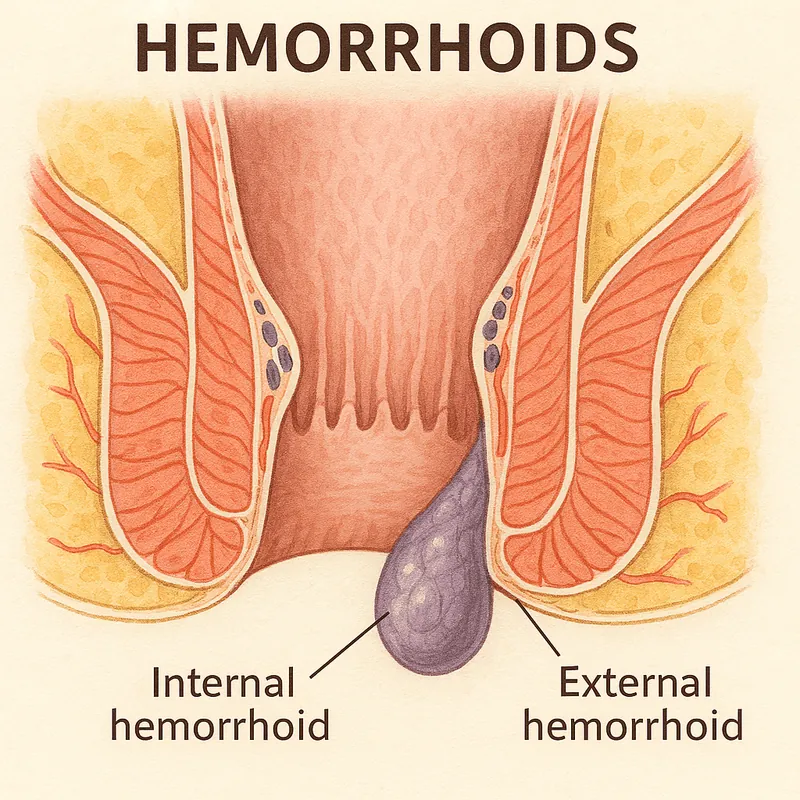
Located above the dentate line, inside the rectum. Usually painless (no pain fibers). Bleed with bowel movements. Classified by degree (I: no prolapse; II: prolapse, reduces spontaneously; III: requires manual reduction; IV: cannot be reduced).
External hemorrhoid develops a blood clot inside. Causes sudden severe anal pain, hard bluish lump. Usually self-resolves over 2-3 weeks but excision in first 72 hours provides immediate relief.
Symptoms differ between internal (mostly painless bleeding) and external (often painful) types. Always evaluate rectal bleeding, don't assume hemorrhoids.
Most common symptom. Blood seen on toilet paper, dripping into bowl, or coating stool. Bright red (not maroon or black). Painless. Usually with bowel movements.
Tissue bulging from anus with defecation. Grade II: reduces spontaneously. Grade III: requires manual reduction. Grade IV: cannot be reduced. Worse with straining.
Prolapsed internal hemorrhoids may secrete mucus, causing irritation, itching, and "wet" sensation. Skin around anus can become inflamed (pruritus ani).
Sense of incomplete evacuation, pressure in rectum. Some patients try to "finish" by straining more, which worsens hemorrhoids further.
External hemorrhoids hurt because they're covered by sensitive skin. Thrombosed: SEVERE acute pain, often described as worst when sitting. Acute thrombosis can be excruciating.
Acute thrombosis presents as a hard, bluish-purple lump at the anus, exquisitely tender. Self-limiting (2-3 weeks) but acutely very painful. Excision in first 72 hours = immediate relief.
Common with external hemorrhoids and prolapsed internal hemorrhoids. Caused by mucus, moisture, and irritation. Worsens with scratching โ cycle of itch/scratch/inflammation.
External hemorrhoids often cause pain during and after bowel movements. May lead to fear of defecation โ constipation โ worsening of hemorrhoids (vicious cycle).
External hemorrhoids visible on inspection. Digital rectal exam (DRE) assesses internal hemorrhoids, rules out masses, fissures, abscesses. Quick and definitive for most cases.
Short scope visualizes the anal canal and lower rectum. Confirms internal hemorrhoids, grades severity, rules out fissures, fistulas, abscesses. Office-based procedure.
Detailed history of bowel habits, fiber/fluid intake, occupation, prolonged sitting, pregnancy, lifting habits. Identifies modifiable risk factors for treatment plan.
High-fiber diet + hydration + squat-position toilet posture + flavonoids + sitz baths, resolves 90% without procedures
Diet is the foundation of hemorrhoid management. Goal: soft, formed stools that pass without straining. High fiber + adequate hydration + minimal constipating foods.
Highest fiber food group (15-25g per cup). Soluble + insoluble fiber. Inversely associated with hemorrhoid risk in cohort studies.
Especially berries, apples, pears, kiwi, prunes, leafy greens. Fiber + water + flavonoids that strengthen vascular walls.
Oats, quinoa, brown rice, whole wheat. Bulk and soften stool. Refined grains (white bread/rice) lack this benefit.
CRITICAL, fiber without adequate water can WORSEN constipation. Drink continuously throughout day. Add coconut water, herbal tea, vegetable broth.
White bread, white rice, pasta, chips, crackers, sweets. Cause constipation due to lack of fiber. Replace with whole-food alternatives.
Cheese, ice cream, processed meats. No fiber โ constipation. Replace heavy meat-and-cheese meals with plant-forward eating.
Cause anal burning/irritation during defecation in some patients. Test tolerance, not everyone reacts.
Both dehydrating; can worsen constipation. Moderate intake fine; excess problematic. Counter with extra water if consuming.
These supplements address the root issues, venous insufficiency, straining, and chronic constipation.
| Supplement | Mechanism & Evidence | Suggested Dose | Timing | Notes |
|---|---|---|---|---|
| Diosmin + Hesperidin (MPFF) | Micronized Purified Flavonoid Fraction. Strong evidence base, reduces hemorrhoidal bleeding, edema, pain. Cochrane review supports efficacy. Marketed as Daflon. | 500mg Daflon (450mg diosmin + 50mg hesperidin) 2x/day for 4 days, then 1x/day | With meals | For acute flares; can use longer-term for chronic hemorrhoids. |
| Psyllium Husk (Fiber) | Bulks and softens stool. Reduces straining. Meta-analysis: ~50% reduction in symptom recurrence with regular fiber supplementation. | 5-15g/day | In water, throughout day | Start low, increase gradually. Need adequate water. |
| Horse Chestnut Extract | Aescin strengthens vein walls, reduces capillary permeability. Evidence in chronic venous insufficiency; helpful for hemorrhoids. | 50-150mg aescin daily | With meals | Standardized extract. Avoid if on anticoagulants. |
| Witch Hazel (Topical) | Astringent. Reduces swelling, itching, irritation. Tucks pads or liquid applied to anal area. | Apply after each bowel movement and 2-3x daily | Topical | Pads are convenient; liquid for soaking sitz baths. |
| Vitamin C + Bioflavonoids | Strengthens connective tissue including vein walls. Synergistic with diosmin/hesperidin. | 500-1,000mg vitamin C + 500mg mixed bioflavonoids/day | With meals | Often combined in single supplement. |
| Magnesium Citrate | For chronic constipation contributing to hemorrhoids. Mild osmotic effect softens stool. | 200-400mg evening | Before bed | Citrate form for laxative effect. Glycinate form if you don't need this. |
| Butcher's Broom (Ruscus aculeatus) | Venotonic effects similar to horse chestnut. Used for chronic venous insufficiency and hemorrhoids in Europe. | 100-200mg standardized extract 2-3x/day | With meals | Less well-studied than diosmin but tolerable adjunct. |
| Coconut Oil or Calendula (Topical) | Natural moisturizers for irritated perianal skin. Reduce inflammation, itching, and barrier dysfunction. | Apply liberally after cleaning area | Topical, 2-3x/day | Coconut oil also has mild antimicrobial effect. |
Simple lifestyle and dietary measures, high fiber, hydration, squat-position toilet posture, minimal toilet time, resolve ~90% of cases. Address the root causes and most hemorrhoids never need procedural intervention.