Two vitamins that produce almost the same blood picture and completely different consequences if you get them the wrong way round. B12 deficiency can damage nerves permanently, and folate taken without checking B12 first can correct the blood test while that damage continues. That single fact is why this page exists.
Last updated:
Both vitamins are needed to make DNA, so both are needed to make red blood cells. Running short of either produces large, immature red cells and the same anaemia, called megaloblastic anaemia. On the full blood count they can look identical.
They part company outside the bone marrow. B12 is also needed to maintain the myelin sheath around nerves, and prolonged deficiency causes a progressive neurological syndrome affecting sensation, balance, and eventually cognition. Folate does not do this.
And crucially, the neurological damage of B12 deficiency can occur before, or entirely without, any anaemia, which is why a normal blood count does not exclude it and why symptoms of numbness and unsteadiness deserve a B12 test rather than reassurance.
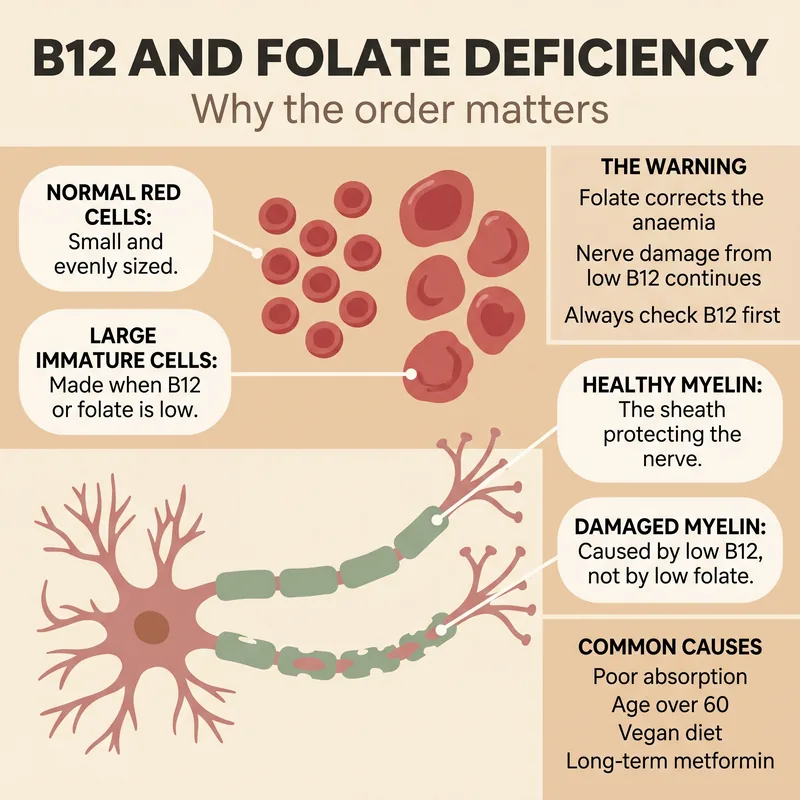
Prolonged deficiency damages the spinal cord and peripheral nerves, producing numbness, pins and needles, unsteadiness and, later, cognitive change. Treated early it reverses. Left long enough it does not1.
Metformin is associated with lower B12 levels and with deficiency in long-term users2. Long-term acid suppression reduces absorption too, since stomach acid is needed to release B12 from food.
B12 comes from animal foods and fortified products. Spirulina, algae and most seaweeds contain inactive analogues that do not work in humans and can make a blood test look falsely reassuring3.
Slowly, vaguely, and often mistaken for ageing, stress or depression.
| Feature | What it feels like | Worth knowing |
|---|---|---|
| Fatigue and breathlessness on exertion | The anaemia itself | Shared with iron deficiency, and the two can coexist |
| Numbness or pins and needles | Usually feet first, then hands, often symmetrical | A B12 sign, not a folate one. Report it promptly rather than waiting |
| Unsteadiness, worse in the dark | Balance depending on vision because position sense is impaired | Suggests spinal cord involvement. This is the presentation that must not be delayed |
| Sore, smooth, red tongue | Glossitis, sometimes with mouth ulcers | Occurs with both deficiencies |
| Memory difficulty, low mood, irritability | Often attributed to ageing or depression | B12 deficiency is one of the things worth excluding before concluding depression |
| Pale or slightly yellow skin | A lemon tinge, from anaemia plus mild jaundice | Reflects red cells being destroyed in the marrow |
| Symptoms with a NORMAL blood count | Neurological symptoms and no anaemia at all | Common, and the reason a normal full blood count does not exclude B12 deficiency |
| In pregnancy, folate matters differently | No symptoms; the risk is to the developing baby | Folate before conception and in early pregnancy reduces neural tube defects. Follow your maternity advice |
The important part is establishing WHY, because the cause determines whether tablets will work at all.
| Measure | What it tells you | What it misses |
|---|---|---|
| Full blood count and blood film | Anaemia and large red cells | Can be entirely normal in B12 deficiency with neurological damage. Also normal-looking if iron deficiency coexists, since the two cell changes cancel out |
| Serum B12 | The first-line test | An imperfect test with a grey zone. A borderline result in someone with symptoms deserves further testing rather than dismissal |
| Serum or red cell folate | Folate status | Serum folate moves with recent meals; red cell folate reflects longer-term status |
| Methylmalonic acid, and homocysteine | Functional markers that rise before stores are exhausted, useful in the grey zone | Not available everywhere, and MMA also rises in kidney impairment |
| Intrinsic factor antibodies | Pernicious anaemia, the autoimmune cause | Insensitive, so a negative result does not exclude it |
| Coeliac serology | A treatable malabsorptive cause | Must be done while still eating gluten; see coeliac disease |
| Medication review | Metformin and long-term acid suppression, both common and both reversible contributors | Requires someone to ask; a prescriber conversation, never a reason to stop a medicine yourself |
| Thyroid function | Autoimmune thyroid disease travels with pernicious anaemia | See thyroid disorders |
Food sources, reliable supplementation where diet cannot supply it, and fixing what is depleting you
Folate is easy to get from food. B12 is not, if you do not eat animal products.
| Nutrient | Best food sources | Practical note |
|---|---|---|
| Vitamin B12 | Meat, fish, shellfish, eggs, dairy, and fortified foods including some plant milks, nutritional yeast and breakfast cereals | No reliable plant source exists unfortified. Check labels rather than assuming a product is fortified |
| Folate | Leafy greens, legumes, beans, asparagus, broccoli, citrus, and fortified grains | Easy to reach from food. Prolonged boiling destroys a substantial share, so steam or use the cooking water |
| Both, together | Liver is exceptionally rich in both | Not in pregnancy, because of its very high preformed vitamin A content |
| Alcohol | — | Impairs folate absorption and metabolism, and is a common contributor to folate deficiency |
| Fortified foods | Cereals, plant milks, some yeast extracts | The practical route for vegans and for many older adults |
| Cooking method | — | Folate is heat and water sensitive; B12 is comparatively stable |
The order in which you take these matters more than the dose.
| Supplement | What it is actually for | Typical range | Timing | Notes & cautions |
|---|---|---|---|---|
| Vitamin B12 | Correcting a confirmed deficiency, and routine prevention for vegans and many older adults. | Set with your clinician. Higher oral doses are used where absorption is impaired, and injections where it fails | Daily, or as prescribed | Water-soluble and well tolerated. The form matters less than whether you can absorb it at all, which is a question about cause. Confirm the correction by retesting rather than assuming. |
| Folic acid | Correcting confirmed folate deficiency, and preconception and early pregnancy supplementation on maternity advice. | As directed by your clinician or maternity team | Daily | Only after B12 has been checked, outside of the pregnancy indication where it is standard advice. Also note folate interacts with methotrexate; on that medicine follow your rheumatology team, see rheumatoid arthritis, and some anticonvulsants lower folate. |
| Iron, only if also deficient | Correcting coexisting iron deficiency, which is common and can hide the large-cell picture on a blood count. | Test ferritin and full blood count first; dose set with your clinician | As advised, away from tea, coffee and calcium | Do not supplement iron without testing. See iron deficiency anaemia. |
Each numbered entry below is either a source you can follow or a note setting out what the evidence does and does not support. Both are numbered together so the markers in the text line up.
Last reviewed 3 September 2026. Supplement entries are cross-checked against the NIH National Center for Complementary and Integrative Health and the Linus Pauling Institute Micronutrient Information Center.4 This page is nutrition education, not medical advice, and it does not replace your doctor. A low B12 or folate needs a cause, not just a supplement. Pernicious anaemia and other absorption failures require medical replacement for life and are not corrected by diet. Neurological symptoms need assessment promptly rather than a trial of tablets. What nutrition education can do is help you understand the evidence well enough to have a better conversation with the clinician who does treat you.