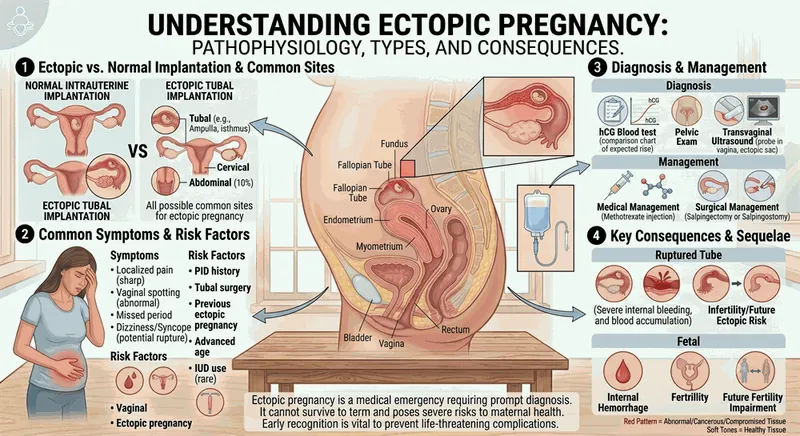
An ectopic pregnancy occurs when a fertilized egg implants outside the uterine cavity, most often in the fallopian tube. It is a surgical and medical emergency that complicates 1 to 2 percent of pregnancies and remains the leading cause of first-trimester maternal death.
Last updated:
An ectopic ("out of place") pregnancy is one in which the embryo implants and begins to develop somewhere other than the lining of the uterus. Roughly 95 percent occur in the fallopian tube, where the embryo cannot be safely sustained and the tissue is not built to expand.
An untreated ectopic carries a high risk of tubal rupture, intra-abdominal hemorrhage, and shock. Modern care, with early beta-hCG trend, transvaginal ultrasound, and treatment by methotrexate, salpingostomy, or salpingectomy, has dramatically reduced mortality, but ectopic pregnancy still accounts for the majority of first-trimester maternal deaths in high-income countries. Roughly 1 in 50 pregnancies are ectopic, and the rate is higher in women with prior PID, tubal surgery, endometriosis, IUD-in-place conception, or IVF.
Active ectopic pregnancy is always a medical and surgical emergency. The holistic content on this page is framed around two windows where nutrition and lifestyle have real leverage, before conception (preventing tubal damage that predisposes to ectopic) and after the acute event (restoring fertility, healing the remaining tube, and reducing recurrence risk).
"Ectopic pregnancy remains a leading cause of first-trimester maternal mortality. Early diagnosis using serial beta-hCG and transvaginal ultrasound is essential. Roughly 1 in 50 pregnancies are ectopic in high-resource settings."
โ ACOG Practice Bulletin 193, Tubal Ectopic PregnancyImplantation in the fallopian tube, most often in the ampulla (~70%), then isthmus (~12%), fimbria (~11%), and interstitial/cornual portion (~2 to 3%). Risk of rupture rises with location closer to the uterus and after 6 to 7 weeks of gestation.
Implantation on the surface of the ovary or directly within the peritoneal cavity (often on bowel, omentum, or peritoneum). Strongly linked to IUD-in-place conception (ovarian) and to a prior tubal ectopic or IVF (abdominal). Diagnosis is often delayed because the standard ultrasound search focuses on the tube.
Cervical ectopic implants in the cervical canal below the internal os. Cesarean scar ectopic implants in the fibrous scar of a prior C-section, the fastest-rising ectopic subtype as cesarean rates climb. Both can mimic miscarriage in progress and carry high hemorrhage risk if dilation and curettage is attempted blindly.
The classic triad is a positive pregnancy test, abdominal pain, and abnormal bleeding, but only about 50 percent of women present with all three. Any pregnancy-positive woman with unilateral pelvic pain, shoulder-tip pain, or syncope should be evaluated immediately.
A positive urine or blood test confirms pregnancy but does not localize it. In ectopic pregnancy, beta-hCG rises slowly (less than 53 percent in 48 hours) or plateaus, in contrast to the expected near-doubling of a healthy intrauterine pregnancy. Any abnormal trend warrants ultrasound.
Light to moderate brown or dark red bleeding, often intermittent, frequently misread as a "weird period" or threatened miscarriage. Bleeding comes from the decidual lining shedding without a viable intrauterine pregnancy to maintain it.
Most ectopic pregnancies present 6 to 8 weeks after the last menstrual period. The pregnancy hormones are usually high enough to delay the next period, even though the embryo is not viable.
Breast tenderness, nausea, fatigue, and other early-pregnancy symptoms may be present but are often milder than expected because hCG is rising sub-optimally. Symptoms sometimes fade as the pregnancy becomes non-viable.
When transvaginal ultrasound shows an empty uterus despite a beta-hCG above ~1500 to 2000 mIU/mL (the "discriminatory zone"), an ectopic pregnancy is one of the leading diagnoses. Repeat scans and serial hCG are used to confirm.
In a healthy early intrauterine pregnancy, hCG roughly doubles every 48 hours. In ectopic pregnancy, the rise is sluggish or hCG plateaus. Any 48-hour rise below 53 percent should trigger workup for ectopic or non-viable intrauterine pregnancy.
Sharp, stabbing, or cramping pain localized to one side of the lower abdomen, often the side of the implicated tube. Pain may be intermittent at first, then become constant and severe as the tube stretches. This is the most common warning symptom before rupture.
Pain felt at the tip of the shoulder, classically the right, is referred pain from blood irritating the diaphragm after tubal rupture. Shoulder-tip pain in a pregnant person is an emergency until proven otherwise.
Blood pooling in the cul-de-sac (the space behind the uterus) can cause a constant urge to have a bowel movement and pain or pressure on defecation. This often accompanies hemoperitoneum from a ruptured ectopic.
Caused by acute blood loss into the abdomen after rupture. Often follows a sudden worsening of pain. Any fainting episode in a pregnancy-positive woman is a surgical emergency. Call 911 or go to the ER immediately, do not drive yourself.
Pallor, sweating, rapid pulse, and a feeling of impending doom indicate hemorrhagic shock from a ruptured ectopic. Blood pressure may still appear normal in young, healthy women until late, by which point resuscitation is urgent.
A persistent heart rate over 100 bpm with low or falling blood pressure in a pregnant person is a late but unmistakable sign of hemorrhage. Combined with abdominal pain, it is an immediate operating-room indication.
Diagnosis combines a positive pregnancy test, serial beta-hCG trend, transvaginal ultrasound, and clinical exam. Time-to-diagnosis is the single biggest determinant of outcome, fertility, and life.
These observations do not diagnose ectopic pregnancy, but they help you and your clinician act quickly when something is off:
Confirm pregnancy with a urine test at home. From the first positive test, log any spotting, cramping, one-sided pain, or shoulder-tip pain with date and severity. Bring this log to every visit. In an ectopic, the timeline of symptoms is often as diagnostic as any single lab.
Before or in early pregnancy, audit your risk factors, prior PID or chlamydia, prior ectopic, prior tubal or pelvic surgery, IUD-in-place conception, IVF, endometriosis, smoking, or known tubal abnormalities. Higher risk warrants an early "viability scan" at 6 to 7 weeks instead of the standard 8 to 10 weeks.
In any pregnancy under 12 weeks, presence of any of these warrants same-day evaluation, unilateral pelvic pain, brown or red spotting with pain, shoulder-tip pain, fainting, persistent rectal pressure, sudden worsening of cramping, or pregnancy symptoms suddenly fading. Two or more present is an emergency-department-level evaluation.
An active ectopic pregnancy is always a surgical or medical emergency, treat first, restore later. The holistic side below addresses prevention (before conception) and recovery (after the acute event), never the active emergency itself.
Reduce tubal-damage risk before conception; rebuild fertility, lower inflammation, and restore cycle quality after the acute event
Ectopic pregnancy is rarely a random event. In most cases, it traces back to tubal damage, inflammation, or motility disruption, often years earlier and often quietly. Understanding the upstream drivers is the key to preventing recurrence.
| Root Cause | How It Contributes to Ectopic Pregnancy | Holistic Solution |
|---|---|---|
| Prior Pelvic Inflammatory Disease (PID) | The single largest tubal risk factor. Chlamydia and gonorrhea damage cilia and scar the tube, slowing the egg and trapping the embryo. Risk rises ~2 to 7x after one PID episode. | Aggressive STI screening and treatment, treat partners, gentle pelvic circulation support, anti-inflammatory diet, address chronic low-grade inflammation |
| Prior Tubal or Pelvic Surgery | Salpingostomy, salpingectomy, appendectomy with rupture, or any pelvic surgery can leave adhesions that distort tubal anatomy. Risk of ectopic recurrence is 10 to 15 percent after one ectopic. | Pelvic mobility work after healing (yoga, walking, visceral therapy), anti-inflammatory eating, consider HSG before next conception attempt |
| Endometriosis & Adenomyosis | Endometrial implants and adhesions disrupt tubal motility and the peritoneal environment, raising ectopic risk roughly 2-fold. | Endometriosis-specific protocol, anti-inflammatory diet, omega-3, curcumin, address estrogen dominance, see Endometriosis page for full protocol |
| Smoking (Active or Recent) | Nicotine and CO impair tubal ciliary function and slow embryo transport. Smokers have 2 to 4x higher ectopic risk; risk drops within 3 to 12 months of quitting. | Smoking cessation as the single highest-leverage change, NRT, behavioral support, antioxidant-rich diet, NAC, vitamin C, glutathione support |
| IUD-in-Place Conception | If conception occurs with an IUD in place, the relative risk of the pregnancy being ectopic is dramatically increased. Absolute risk of pregnancy is low, but if it happens, ectopic must be ruled out. | Promptly evaluate any positive test with an IUD in place; do not assume miscarriage; transvaginal ultrasound at first opportunity |
| Assisted Reproductive Technology (IVF) | IVF carries a 2 to 5 percent ectopic rate vs ~1 percent in natural conception, due to embryo transfer dynamics, tubal pathology in the population, and altered fluid currents. | Pre-IVF tubal health workup (HSG), gentle uterine receptivity support, endometrial scratch only when clinically indicated, anti-inflammatory protocol before transfer |
| Tubal Sterilization Failure | Pregnancy after tubal ligation is rare but disproportionately ectopic (about a third of post-ligation pregnancies). Reflects scarring at the ligation site. | Immediate evaluation of any positive test after sterilization, transvaginal ultrasound, do not delay; recurrence risk informs surgical decision |
| Chronic Pelvic Inflammation & Gut Dysbiosis | Chronic low-grade inflammation from gut dysbiosis, food sensitivities, or environmental toxins extends to the pelvic environment and damages tubal microvasculature over time. | Gut repair protocol, fermented foods, soluble fiber, address SIBO and candida, anti-inflammatory diet, omega-3, curcumin |
| Hormonal Contraception & Progesterone-Only Methods | Progesterone-only methods (mini-pill, Depo, implants) slow tubal motility. While they prevent most pregnancies, breakthrough conceptions tilt toward ectopic. | If using progestin-only methods, evaluate any positive test promptly; consider non-hormonal options post-ectopic if recurrence risk is high |
| Endocrine-Disrupting Chemicals (EDCs) | BPA, phthalates, and PFAS impair tubal ciliary function in lab models and are increasingly implicated in subfertility and ectopic risk in human cohorts. | Glass / stainless instead of plastic, fragrance-free personal care, filter water, EWG Clean Fifteen / Dirty Dozen, swap conventional cosmetics |
Nutrition cannot treat an active ectopic. After the acute event has resolved, food becomes a foundational tool for tubal recovery, methotrexate clearance, anemia repletion, and rebuilding the conditions for a healthy next pregnancy.
The post-ectopic eating pattern has three jobs, lower inflammation, support tissue healing (especially of the surgical or methotrexate-affected tube), and rebuild the nutrient reserves needed for a healthy next pregnancy. Anemia from acute blood loss is also extremely common and must be repleted directly.
The framework is whole-food, protein-rich, anti-inflammatory, and folate- and iron-forward (with one important caveat, in the first 3 to 6 months after methotrexate, your OB-GYN may ask you to avoid high-dose folate supplements while still keeping food folate moderate). Always confirm timing with your clinician.
These supplements support recovery, tubal healing, and preconception preparation, never an active ectopic pregnancy. Timing matters, especially after methotrexate. Always coordinate with your OB-GYN before starting.
| Supplement | Role in Ectopic Recovery | Suggested Dose | Timing | Notes |
|---|---|---|---|---|
| Iron (Bisglycinate) | Repletes iron lost in tubal bleeding or surgery; restores hemoglobin and ferritin. Anemia after ectopic pregnancy is very common and undermines energy, sleep, and tissue healing. | 20 to 65 mg elemental iron per day, dosed against ferritin | Empty stomach with vitamin C if tolerated; otherwise with light food | Confirm low ferritin (less than 50 ng/mL) before high-dose iron. Bisglycinate avoids the GI side effects of ferrous sulfate. |
| Vitamin C | Triples iron absorption, supports collagen synthesis for surgical and tubal wound healing, and reduces oxidative stress on the recovering tube. | 500 to 1000 mg per day, divided | With iron and meals | Whole-food vitamin C (camu camu, acerola) is gentler on the stomach. |
| Vitamin D3 (with K2) | Supports immune regulation, anti-inflammatory signaling, and uterine receptivity for a future pregnancy. Often low in recovering bodies. | 2000 to 5000 IU D3 + 100 to 200 mcg MK-7 K2 per day | With a fat-containing meal, morning preferred | Test 25-OH-D first; target 50 to 80 ng/mL before attempting conception. |
| Omega-3 EPA/DHA | Reduces systemic and tubal inflammation, supports vascular repair, and lays the foundation for fetal neural development in the next pregnancy. | 2 to 3 g combined EPA+DHA per day | With meals | Pause about 1 week before any planned surgery if you are still in the surgical recovery window. |
| Methylated Folate (L-methylfolate) | Critical for tubal cell repair and future pregnancy. Avoid for 3 to 6 months after methotrexate per your OB-GYN; reintroduce once cleared. | 400 to 800 mcg per day, post-methotrexate window only | Morning with food | Confirm timing with your OB-GYN. Food folate (greens, lentils) is usually allowed throughout. |
| Methylated B-Complex | Supports red-blood-cell production, methylation, and energy. Especially helpful in recovery from blood loss and surgical stress. | 1 capsule per day per product label | Morning with food | Skip during the methotrexate folate-avoidance window; restart once cleared. |
| Vitamin B12 (Methylcobalamin) | Required for red-blood-cell formation. Often low after blood loss or if iron deficiency has been chronic. | 1000 mcg per day sublingual | Morning | Sublingual or injectable forms bypass gut absorption issues. |
| Coenzyme Q10 (Ubiquinol) | Mitochondrial support for ovarian function and egg quality. Important when planning a next pregnancy, especially after age 35. | 100 to 300 mg ubiquinol per day | With a fat-containing meal, morning | Start 3 to 6 months before attempting conception. |
| NAC (N-Acetylcysteine) | Boosts glutathione, supports liver clearance of methotrexate, and reduces oxidative stress on healing tubal tissue. | 600 to 1200 mg per day | Empty stomach, split twice daily | Coordinate with OB-GYN; usually started after the acute methotrexate phase. |
| Magnesium Glycinate | Supports muscle relaxation (post-surgical cramping), sleep, blood sugar stability, and progesterone production. | 300 to 400 mg elemental magnesium per day | Evening, 30 to 60 min before bed | Glycinate is the calmest, most absorbable form. |
| Zinc | Required for wound healing, immune recovery, and ovulation. Often low after acute illness or surgery. | 15 to 30 mg per day | With meals | Add 1 to 2 mg copper if using more than 8 weeks at higher doses. |
| Curcumin (Turmeric Extract) | Powerful anti-inflammatory; supports resolution of pelvic and tubal inflammation. Improves microcirculation in healing tissues. | 500 to 1000 mg curcumin per day | With a fat-containing meal | Pause 1 to 2 weeks before any planned surgery (mild anti-platelet effect). |
| Collagen Peptides | Glycine, proline, and hydroxyproline support connective-tissue repair, including surgical sites and tubal lining. | 10 to 20 g per day | Any time; smoothies or coffee | Choose grass-fed, third-party tested for heavy metals. |
| Probiotic (Multi-Strain, Female-Specific) | Supports gut, vaginal, and pelvic microbiome health; reduces inflammation linked to recurrent PID and tubal damage. | 25 to 50 billion CFU per day | Empty stomach or with a light meal | Strains including L. crispatus, L. rhamnosus, and L. reuteri are particularly studied in female pelvic health. |
| Vitamin E (Mixed Tocopherols) | Lipid-soluble antioxidant that supports tubal cell membranes and uterine lining for next conception. | 200 to 400 IU per day | With a fat-containing meal | Pause 1 to 2 weeks before surgery; mild antiplatelet effect. |
| Selenium | Required for glutathione peroxidase, supports thyroid recovery and immune balance after surgical or methotrexate stress. | 100 to 200 mcg per day | With food | Two Brazil nuts a day is an alternative food source. |
| Castor Oil (Topical Packs) | Traditional remedy used after the surgical site has fully healed and outside of any pregnancy, to support pelvic circulation and adhesion softening. | 1 tbsp on a flannel, applied with mild heat 3 to 4 evenings/week | Outside of pregnancy and at least 6 weeks post-surgery | Stop immediately if any pregnancy is suspected. Not a treatment for ectopic. |
Recovery after ectopic pregnancy combines conventional acute treatment with longer-term holistic restoration. Both timelines below assume the acute event has been managed appropriately.
Acute physical recovery, rest, hydration, gentle whole-food meals, protein and iron focus. Coordinate medication washout windows with your OB-GYN. Begin grief and emotional processing; reach out to support groups.
Hemoglobin and ferritin recover; energy returns. First menstrual cycle typically returns 4 to 6 weeks after the event. Begin foundational supplements (D3, omega-3, magnesium, iron if needed).
Methotrexate washout completes. Add methylated B-complex, folate, CoQ10. Begin cycle tracking to confirm ovulation. Consider HSG if conception is planned.
Tubal-and-uterine support, anti-inflammatory protocol, full preconception nutrition. Many couples begin trying to conceive in this window when cleared. Roughly 60 to 70 percent conceive within 18 months.
Strong chance of healthy intrauterine pregnancy; reduced recurrence risk; durable cycle & pelvic-health recovery
Methotrexate or laparoscopic surgery resolves the ectopic. Pain control, antibiotics if surgical, Rh-immunoglobulin if Rh-negative. Hospital stay typically 0 to 2 days.
Serial beta-hCG until zero (4 to 8 weeks). Activity restrictions per OB-GYN. Limited dietary or lifestyle guidance typically offered. Mental-health follow-up often not built into the protocol.
Mandatory avoidance of pregnancy during methotrexate washout. Optional HSG to evaluate tubal patency. Underlying tubal damage, gut health, or STI history often not addressed.
Once cleared, conception attempts begin. Recurrence risk of 10 to 15 percent. Many women conceive successfully, but underlying tubal or inflammatory drivers (PID history, smoking, EDCs) are often untouched.
Acute event managed safely; recurrence risk 10 to 15% (25% after two ectopics); underlying drivers often not addressed
"An ectopic pregnancy is treated as a single event, but biologically it is the loud signal of an upstream tubal story that began years earlier. The acute treatment saves life; the recovery work writes the next chapter."
Once you are safely past the acute event and cleared by your OB-GYN, the nutrition approaches in this guide may support recovery and general reproductive health, alongside your ongoing medical care.