Eczema (Atopic Dermatitis)

A barrier and immune condition, not a food allergy, though it is treated as one more often than almost any other diagnosis in medicine. The elimination diet families reach for first can create a food allergy that was not there, including anaphylaxis. That is the single most important thing on this page.

Barrier, Not Allergy Evidence-Based Root-Cause Focus

Last updated:

🚨 Do not remove a food from a child's diet for eczema without a clinician who is following them. In a study of children with food-triggered atopic dermatitis and no history of immediate reactions, 19% developed new immediate food reactions after starting an elimination diet, and 30% of those reactions were anaphylaxis1. Avoiding a food was itself associated with the increased risk. Also seek urgent care for eczema with fever, spreading pain, yellow crusting, or clustered painful blisters, which can mean infection needing same-day treatment. This warning is first because it is the part of the page that could prevent real harm.

What Is Atopic Dermatitis?

A chronic inflammatory skin condition in which the skin barrier does not hold water in or keep irritants out, and the immune system in the skin is over-reactive. It runs in families alongside asthma and hay fever, it fluctuates, and it is driven by the barrier first.

That direction matters and it is usually reversed. Broken skin lets food proteins reach the immune system through the skin rather than through the gut, and sensitisation through skin is one of the routes by which food allergy develops. The eczema tends to come first and the food sensitisation second, which is the opposite of the story most people are told.

So treating the skin well is not merely symptom control. It is the part that addresses the mechanism.
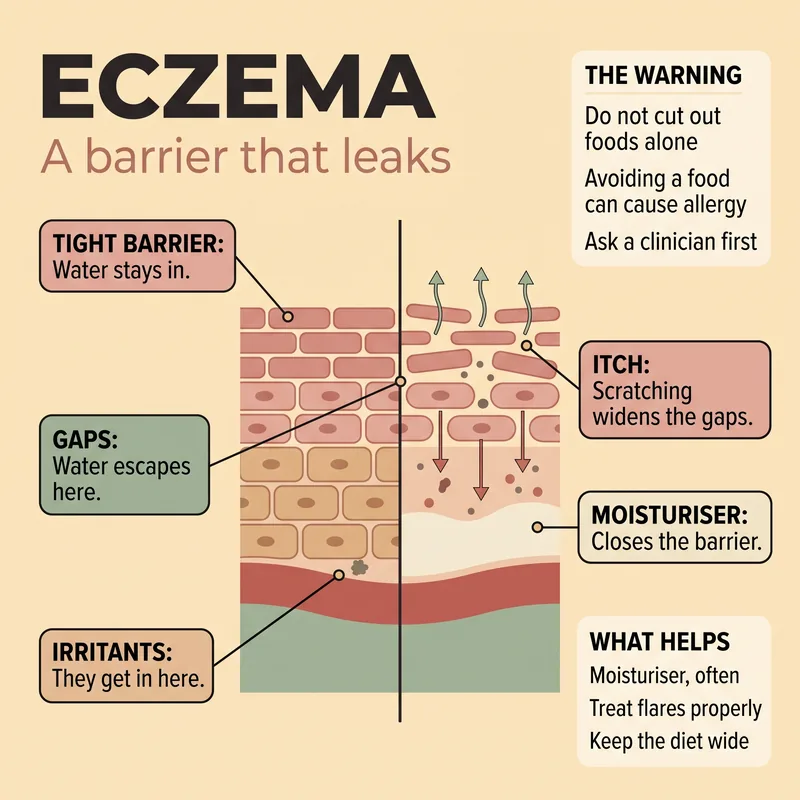
💡 Key Insight: A Cochrane review of dietary exclusions for established atopic eczema found no benefit from egg-free and milk-free diets in people not selected for allergy, and no benefit from elemental or few-foods diets in unselected cases2. The only signal of benefit was in infants with suspected egg allergy who had positive specific IgE to egg. Selection is everything here.
Cross-section of skin comparing an intact barrier with a disrupted eczema barrier showing gaps between cells, water escaping, irritants entering and immune cells below

⚠️ Elimination can create allergy

19% of children developed new immediate reactions after an elimination diet was started, and 30% of those were anaphylaxis1. Avoidance reduces oral tolerance.

🥤 Probiotics are not the answer

A Cochrane review of probiotics for treating eczema found they made little or no difference to symptoms or severity3.

💧 Moisturiser is the treatment

Generous, frequent emollient use is the foundation everything else sits on, and it is the step most often done too sparingly.

How Eczema Presents

Differently at different ages, which is part of why it gets misread.

FeatureWhat it looks likeWorth knowing
ItchThe defining symptom, often worse at nightScratching damages the barrier further, which is the cycle that keeps it going
Dry, rough, scaly skinWidespread, even between flaresThe between-flare skin is why emollients continue when the skin looks fine
Infants: cheeks, scalp, outer limbsRed, weeping or crustedThe nappy area is usually spared, which helps distinguish it
Children and adults: skin creasesElbow and knee creases, wrists, neck, eyelidsThe distribution changes with age and does not mean a new diagnosis
Thickened leathery patchesFrom long-term scratchingImproves slowly, and only once the scratching stops
Yellow crusting, weeping, pain or feverRapidly worsening areaReport urgently. Bacterial infection needing treatment
Clustered painful small blisters, feeling unwellSpreading quickly, often on a flareReport urgently. A herpes infection of eczematous skin is a same-day problem
Immediate reaction after a food: hives, swelling, vomiting, wheezeWithin minutes of eatingThis is a different problem from eczema and needs allergy assessment. Delayed worsening of eczema is not the same thing
⚠️ Two different things get called "food allergy" and they behave differently. An immediate reaction happens within minutes, involves hives, swelling, vomiting or breathing difficulty, and is a genuine emergency risk. A delayed worsening of eczema hours or days later is far harder to attribute and far more often wrong. Most of the food blamed for eczema is the second kind, and that is where elimination diets are started on the weakest evidence and carry the risk described at the top of this page.

How Eczema Is Assessed

Including which tests genuinely help, and which mislead more often than they inform.

MeasureWhat it tells youWhat it misses
Clinical examination and historyThe diagnosis, the pattern and the triggersNothing on this list replaces it
Severity and quality of life scoresHow much it is actually affecting sleep, school and workSkin scores alone underestimate the burden of itch
Checking how much emollient is being usedWhether the foundation treatment is genuinely being doneAlmost never asked, and it is the most common reason treatment fails
Checking topical steroid technique and quantityWhether under-use from fear is driving persistent diseaseSteroid phobia is extremely common and rarely addressed directly
Allergy testing where there is a clear immediate reactionWhether a genuine IgE-mediated allergy existsGuided by history, and interpreted by someone who can
Broad food allergy panels without a historyVery little of valueA positive test means sensitisation, not allergy. Testing widely produces positives to foods eaten safely, and those results start the diets that carry the risk at the top of this page
Swabs where infection is suspectedWhether an infection is present and what will treat itNot needed for routine flares
Growth monitoring in a child on any exclusionWhether the diet is costing nutritionEssential, and often not done. Any child excluding a food group needs dietetic input
💡 The question worth asking is not "what food is causing this". It is "am I using enough emollient, and am I using the treatment properly when it flares". For most people the answer to the second question explains far more than the first, and it carries no risk of creating an allergy.

Holistic vs. Conventional Treatment for Eczema

🌿 HOLISTIC
💊 CONVENTIONAL
🌿

Holistic / Functional Approach

Protecting the barrier, reducing irritants, and not removing foods on a hunch

The Foundation
Generous, frequent emollient, and enough of it. This is the intervention, not the accompaniment
Where Diet Fits
Narrowly. A Cochrane review found no benefit from exclusion diets in people not selected for allergy2
Timeline
Emollient effects build over weeks. Flares still happen, and that is not failure
Limitation, stated plainly
Removing foods is an intervention with its own risks, not a safe thing to try in case it helps1

Full Holistic Approach Includes

  • Emollient applied generously and often, including on skin that currently looks well.
  • Short lukewarm baths or showers, with emollient applied to damp skin afterwards.
  • Reducing physical irritants: soap and detergent residue, fragrance, wool next to skin, overheating at night.
  • Keeping nails short and addressing night-time scratching, which is where much of the damage happens.
  • A varied diet, which is the nutritional recommendation here. Breadth, not restriction.
  • Treating sleep loss and mood, since itch drives both and both worsen itch.
  • Dietetic supervision if any food is being excluded, particularly in a growing child.
  • Vitamin D if genuinely deficient, for the usual reasons rather than as an eczema treatment5.
🌿 Worth knowing: this is the rare page where the holistic recommendation is to do less, not more. The evidence supports protecting the barrier and keeping the diet wide. It does not support the elimination diets that most families are pushed toward, and those are not harmless.

Diet for Eczema

The most important nutrition message here is about what not to remove.

🚨 An elimination diet is not a harmless experiment. Among children with food-triggered atopic dermatitis and no previous immediate reactions, 19% developed new immediate reactions after an elimination diet was begun, and 30% of those were anaphylaxis. Avoiding a food was associated with an increased risk of reacting to that food, and the authors concluded that strict elimination diets need to be thoughtfully prescribed because they may reduce oral tolerance1. There is one condition where they are exactly that. In eosinophilic esophagitis, removing a food is genuine first-line treatment, chosen on a biopsy and confirmed by a repeat biopsy. If food catches in your chest when you swallow, that is a different problem from eczema and worth reading about. A food should only come out of a child's diet with a clinician following them.
ChangeWhyPractical note
Keep the diet variedBreadth supports tolerance. Removal is what carries risk1This is the recommendation. It is unusual to have to state it as one
Do not exclude a food group unsupervisedNutritional shortfall in children, plus the tolerance risk aboveIf a food genuinely needs removing, that comes with dietetic support and a plan to reintroduce
Get an immediate reaction assessed properlyHives, swelling or wheeze within minutes is a real allergy questionDifferent from eczema worsening a day later, and handled differently
A generally healthy varied patternA systematic review of nutritional interventions in atopic dermatitis found the overall evidence limited4Eat well for the ordinary reasons. Do not expect it to clear the skin
ProbioticsNot supported for treating eczema. A Cochrane review found little or no difference in symptoms or severity3Widely sold for this, and the evidence does not support the claim
Vitamin D if deficientReviews of supplementation in atopic dermatitis are mixed and mostly small5Correct a deficiency for the usual reasons, not as an eczema treatment
Enough fluid, and skin care around swimmingChlorine and drying are irritantsRinse and re-apply emollient afterwards rather than avoiding swimming
Hydrolysed or specialised formulas as preventionNot supported for preventing eczema in the way they were once marketedAny infant formula decision belongs with a clinician, not a marketing claim
⚠️ Prevention is not the same question as treatment, and it has disappointed too. Daily emollient from birth was tested as a way to prevent eczema in at-risk infants in the BEEP trial and did not prevent it6. That is worth knowing because emollient remains the foundation of treating established eczema even though it failed as prevention. Two different questions, two different answers, and conflating them is how confident wrong advice gets made.

Evidence-Based Supplements

Short, and mostly a list of things that were tested and did not work.

🚨 No supplement treats eczema, and none replaces emollient or prescribed topical treatment. Be careful with unregulated creams sold for eczema, particularly online and for children: undeclared potent steroids in products marketed as natural are a recurring and documented problem, and the harm comes precisely because nobody is monitoring a treatment they do not know they are using. Tell your clinician about everything you use, applied or swallowed.
SupplementWhat it is actually forTypical rangeTimingNotes & cautions
Emollient The actual treatment, listed first because it is the foundation everything else rests on, and it is used far too sparingly. Far more than most people use. Ask what quantity you should be getting through Several times daily, and on damp skin after washing Not a supplement, and deliberately at the top of this table. Fragrance-free. If one stings or is disliked, ask for a different one rather than stopping.
Probiotics Not supported for treating eczema. A Cochrane review found probiotics made little or no difference to symptoms or severity3. Listed to answer the question, not to recommend it Not applicable One of the most heavily marketed products for this condition, and the evidence does not support the claim.
Vitamin D Correcting a deficiency, for the usual reasons. Trials in atopic dermatitis are mixed and mostly small5. Test first, then set a daily dose with your clinician With a fat-containing meal Reasonable if you are deficient. Not an eczema treatment. See osteoporosis for the vitamin D cautions.
Evening primrose and borage oil Long promoted for eczema and not supported by the accumulated trial evidence. Listed to answer the question, not to recommend it Not applicable Still widely sold for this. Included so a reader who has been recommended it knows where the evidence stands.
🚨 What to avoid, specifically. Removing foods from a child's diet without supervision, which is the harm described at the top of this page. Broad food allergy panels ordered without a matching history, since a positive result means sensitisation rather than allergy and it is what starts those diets. Unregulated creams that may contain undeclared steroids. Products claiming to clear eczema from within, which nothing does. And stopping topical treatment early because the skin looks better, which produces the long grumbling flare rather than a short controlled one.
💡 Where the real leverage is. Using far more emollient than feels necessary, treating flares properly rather than timidly, keeping the diet wide, getting genuine immediate reactions assessed, and asking for referral if life is being run by the itch. Those five do more than every eczema supplement on the market combined.

References & Evidence Notes

Each numbered entry below is either a source you can follow or a note setting out what the evidence does and does not support. Both are numbered together so the markers in the text line up.

Last reviewed 3 September 2026. Supplement entries are cross-checked against the NIH National Center for Complementary and Integrative Health and the Linus Pauling Institute Micronutrient Information Center.7 This page is nutrition education, not medical advice, and it does not replace your doctor. Eczema is a barrier and immune condition, not a food allergy, and no diet treats it. The most important nutritional message here is a warning rather than a recommendation: removing foods without clinical supervision can reduce oral tolerance and has been followed by new immediate reactions including anaphylaxis. Nothing here replaces emollients or prescribed topical treatment. What nutrition education can do is help you understand the evidence well enough to have a better conversation with the clinician who does treat you.

  1. Chang A, Robison R, Cai M, Singh AM. Natural history of food-triggered atopic dermatitis and development of immediate reactions in children. J Allergy Clin Immunol Pract. 2016;4(2):229–236. PubMed 26597013. Nineteen per cent of patients with food-triggered atopic dermatitis and no previous history of immediate reactions developed new immediate food reactions after an elimination diet was started; 70% of those reactions were cutaneous and 30% were anaphylaxis. Avoidance of a food was associated with increased risk of developing immediate reactions to it, and the risk was not predicted by specific IgE level or by which food. The authors conclude that strict elimination diets need to be thoughtfully prescribed because they may lead to decreased oral tolerance. This is the single most important reference on the page.
  2. Bath-Hextall F, Delamere FM, Williams HC. Dietary exclusions for established atopic eczema. Cochrane Database Syst Rev. 2008;(1):CD005203. PubMed 18254073. Nine randomised trials, 421 participants. No benefit from egg-free and milk-free diets in unselected participants, and none from elemental or few-foods diets in unselected cases. The one signal of benefit was in infants with suspected egg allergy who had positive specific IgE to egg, which is the selection this page keeps returning to.
  3. Makrgeorgou A, Leonardi-Bee J, Bath-Hextall FJ, et al. Probiotics for treating eczema. Cochrane Database Syst Rev. 2018;(11):CD006135. PubMed 30480774. Probiotics made little or no difference to eczema symptoms or severity. Cited because probiotics are among the most heavily marketed products for this condition and a reader is entitled to know what was found.
  4. A systematic review and meta-analysis of nutritional and dietary interventions in randomized controlled trials for atopic dermatitis. Allergy. 2024. PubMed 38783644. A recent synthesis of the dietary trial evidence in atopic dermatitis, cited for the overall picture rather than for any single intervention.
  5. Vitamin D supplementation for treating atopic dermatitis in children and adults: a systematic review and meta-analysis. Nutrients. 2024. PubMed 39683522. Cited so that vitamin D is presented as correcting a deficiency rather than as a treatment for the skin disease.
  6. Chalmers JR, Haines RH, Bradshaw LE, et al. Daily emollient during infancy for prevention of eczema: the BEEP randomised controlled trial. Lancet. 2020;395(10228):962–972. PubMed 32087126. Daily emollient from birth did not prevent eczema in infants at high risk. Cited to keep prevention and treatment separate, since emollient remains the foundation of treating established eczema despite failing as prevention.
  7. NIH National Center for Complementary and Integrative Health, nccih.nih.gov, and the Linus Pauling Institute Micronutrient Information Center, lpi.oregonstate.edu.