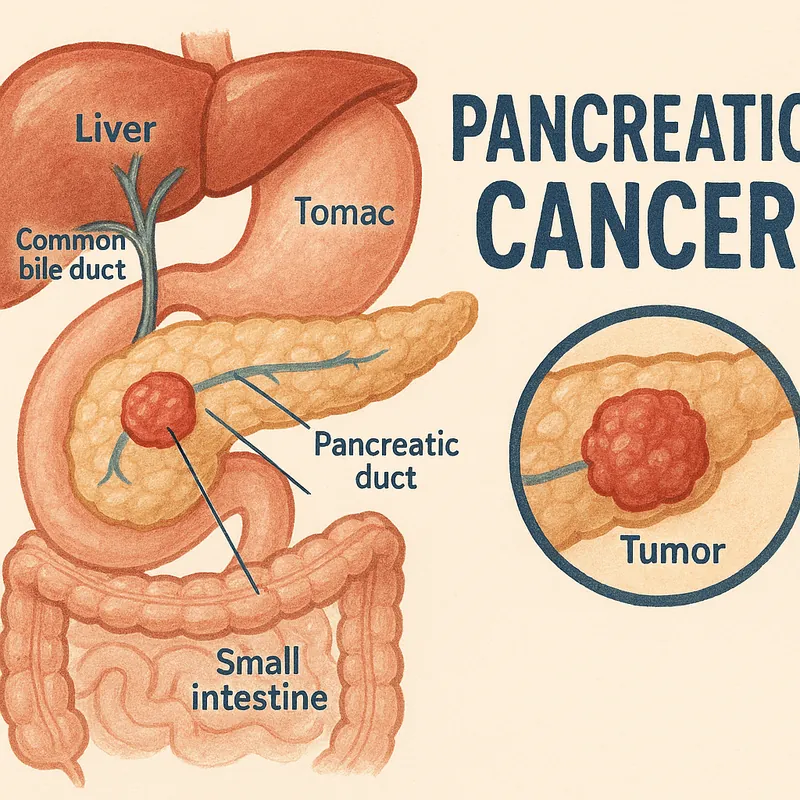
Pancreatic Cancer

One of the most aggressive cancers, often diagnosed late. Risk factors: smoking, diabetes, chronic pancreatitis, obesity, family history. Early detection is critical; nutrition supports both prevention and treatment tolerance.

Cancer Evidence-Based Root-Cause Focus

Last updated:

What Is Pancreatic Cancer?

Pancreatic cancer is among the most aggressive malignancies, with a current overall 5-year survival rate of ~13%. The dominant form (~85-90%) is pancreatic ductal adenocarcinoma (PDAC), arising from cells lining pancreatic ducts. Less common types include neuroendocrine tumors (PNETs) which have dramatically better prognosis.

The pancreas sits deep in the abdomen, allowing tumors to grow undetected. By the time symptoms emerge (jaundice, weight loss, abdominal pain), most cancers have already spread locally or distantly. Only ~20% are resectable at diagnosis, and resection is the only path to potential cure.

Risk factors include smoking, obesity, diabetes (both cause and consequence), chronic pancreatitis, family history (BRCA1/2, PALB2, ATM, Lynch syndrome, 5-10% are hereditary), and aging. New-onset diabetes after age 50 may be the earliest sign, pancreatic cancer can cause diabetes 1-3 years before diagnosis.

โš ๏ธ Critical Warning Sign: New-onset diabetes after age 50 with unexplained weight loss should trigger pancreatic imaging. Sudden development of jaundice, "tea-colored urine," or steatorrhea (greasy stools) requires immediate evaluation. Early detection, even by weeks, meaningfully changes outcomes.
Pancreatic Cancer illustration

Stages by Resectability

๐ŸŒฑ Resectable (~15-20%)

Confined to pancreas without vascular involvement. Whipple procedure or distal pancreatectomy. 5-year survival ~30%. Adjuvant chemotherapy essential.

๐ŸŒ— Borderline Resectable / Locally Advanced (~30%)

Major vessel involvement. Neoadjuvant chemo ยฑ radiation, then attempt surgery. Aggressive multimodal approach. Increasingly more patients converted to resectable.

๐ŸŒ‘ Metastatic (~50%)

Spread to liver, lungs, peritoneum. Systemic chemo (FOLFIRINOX or gemcitabine + nab-paclitaxel). Median survival improving but typically 1-2 years. Palliative care critical.

~66K
Annual US new diagnoses
~13%
Overall 5-year survival
~20%
Of cases resectable at diagnosis
3rd
Leading US cause of cancer death by 2030

Symptoms of Pancreatic Cancer

Often vague and easily missed until advanced. Combination of symptoms in middle-aged or older adults warrants evaluation. New-onset diabetes is increasingly recognized as a critical early sign.

๐Ÿ” Key Warning Signs

๐ŸŸก

Painless Jaundice

Yellow eyes/skin, dark urine, pale stools, itching. Tumor at pancreatic head obstructs common bile duct. Often THE presenting feature in resectable disease. URGENT evaluation.

โš–๏ธ

Unexplained Weight Loss

Significant unintentional weight loss (10+ pounds). Often accompanied by reduced appetite, early satiety, taste changes.

๐Ÿฉน

New-Onset Diabetes (After 50)

Increasingly recognized: new diabetes after 50, especially with weight loss, may precede pancreatic cancer diagnosis by 1-3 years. ENDPAC score helps identify high-risk patients for imaging.

๐Ÿ˜ฃ

Upper Abdominal / Back Pain

Persistent dull ache in epigastric area radiating to back. Worse lying flat, better leaning forward. Often progressive. Indicates tumor invading retroperitoneal nerves.

โš ๏ธ Additional Symptoms

๐Ÿ’ฉ

Steatorrhea (Fatty Stools)

Pale, greasy, foul-smelling, floating stools. Indicates pancreatic enzyme insufficiency from tumor blocking duct. Often accompanies weight loss.

๐Ÿคข

Nausea, Vomiting, Early Satiety

Especially with tumor in head/body. May cause gastric outlet obstruction. Feeling full after small meals. Persistent nausea unexplained.

๐Ÿฆต

Blood Clots (DVT, PE)

Pancreatic cancer is highly thrombogenic, Trousseau's syndrome. Unexplained DVT or PE, especially "migrating" clots, may be presenting feature.

๐Ÿ˜”

Depression & Profound Fatigue

New-onset depression is sometimes a paraneoplastic phenomenon preceding pancreatic cancer diagnosis. Combined with weight loss, raises suspicion.

How Pancreatic Cancer Is Diagnosed

๐Ÿฉป Imaging & Biopsy

๐Ÿ“ก Pancreas-Protocol CT

Multiphasic CT with pancreatic protocol. Identifies tumor, assesses vascular involvement (defines resectability), detects metastases. First-line imaging.

๐Ÿ“ก MRI / MRCP

Better for cystic lesions, liver metastases. MRCP visualizes pancreatic and biliary ducts. Adjunct to CT.

๐Ÿ”ฌ EUS-Guided Biopsy

Endoscopic ultrasound with fine-needle aspiration. Most accurate biopsy method. Tissue for diagnosis + molecular testing.

๐Ÿ”ฌ ERCP (When Jaundiced)

For biliary stent placement to relieve obstructive jaundice + brush cytology. Therapeutic + diagnostic.

๐Ÿงฌ Molecular & Lab Workup

๐Ÿฉธ CA 19-9 (Tumor Marker)

Elevated in ~80% of pancreatic cancers. Not a screening test (false positives common with biliary obstruction). Used for monitoring response and recurrence.

๐Ÿงฌ Germline Genetic Testing

NCCN recommends ALL pancreatic cancer patients get germline testing. BRCA1/2, PALB2, ATM, Lynch syndrome, implications for treatment (PARPi) and family screening.

๐Ÿงฌ Somatic Testing

KRAS (95%), TP53, CDKN2A, SMAD4. Identifies actionable mutations: BRCA1/2 (PARPi), microsatellite instability (immunotherapy), KRAS G12C (sotorasib trials).

๐Ÿ“ก Staging Laparoscopy

For "resectable" disease, checks for peritoneal metastases not visible on imaging. Avoids futile laparotomy.

Holistic vs. Conventional Treatment

๐ŸŒฟ HOLISTIC
๐Ÿ’Š CONVENTIONAL
๐ŸŒฟ

Holistic / Integrative Approach

CRITICAL nutritional support during conventional treatment. Cachexia is leading cause of death in pancreatic cancer.

Nutrition Priority
Aggressive nutritional support, sarcopenia/cachexia is leading cause of death
Pancreatic Enzymes
Pancreatic enzyme replacement therapy (PERT) essential, improves digestion, weight, treatment tolerance
Prevention
Smoking cessation, weight management, treat diabetes/chronic pancreatitis
Palliative Integration
Early palliative care improves quality of life and possibly survival
Comprehensive Supportive Care
  • Pancreatic Enzyme Replacement Therapy (PERT): Creon, Zenpep, Pancreaze. CRITICAL with meals and snacks. Most pancreatic cancer patients are enzyme deficient. Dramatically improves weight, fatigue, and treatment tolerance.
  • Aggressive nutritional support: 1.2-1.5g/kg protein; adequate calories (35-40 kcal/kg); small frequent meals; nutritional supplements (Boost, Ensure)
  • Address malabsorption: fat-soluble vitamin replacement (A, D, E, K), measure and replace
  • Diabetes management: most patients have or develop diabetes; coordinate with endocrinology
  • Smoking cessation, single most important prevention; improves treatment tolerance after diagnosis
  • Vitamin D optimization, pancreatic cancer patients commonly deficient; possibly affects prognosis
  • Omega-3 supplementation, may reduce cachexia, improve weight maintenance during chemo (Cochrane review)
  • Curcumin (bioavailable), anti-inflammatory; some evidence for adjunctive use; discuss with oncologist
  • Vitamin K2, pancreatic cancer is highly thrombogenic; DVT prophylaxis often needed
  • Address depression aggressively, common; improves quality of life and treatment adherence
  • Address pain, celiac plexus block can be life-changing for retroperitoneal pain
  • Early palliative care, Temel-style integration improves outcomes; not just end-of-life
  • Family genetic screening if hereditary mutation identified
โœ… Pancreatic Enzymes Are Critical: Almost every pancreatic cancer patient develops exocrine pancreatic insufficiency. PERT (Creon, Zenpep, Pancreaze) with every meal and snack dramatically improves digestion, weight maintenance, energy, and treatment tolerance. Most patients are under-dosed. Work with your oncology team to optimize.

Diet for Pancreatic Cancer

High calorie, high protein, with pancreatic enzymes at every meal. Cachexia prevention is paramount. Small frequent meals.

โœ… Prioritize:

๐Ÿฅš High Protein at Every Meal

Eggs, fish, poultry, dairy, legumes. 1.2-1.5g/kg/day minimum. Take pancreatic enzymes with every protein-containing meal.

๐Ÿณ Easily Digestible Foods

Eggs, fish, well-cooked vegetables, smoothies. Avoid very high-fiber foods if causing GI distress.

๐Ÿฅ‘ Healthy Fats (with PERT)

Olive oil, avocado, fatty fish. Need calorie-dense food + pancreatic enzymes to absorb. MCT oil bypasses pancreatic lipase needs.

๐Ÿฝ๏ธ Small Frequent Meals

5-6 small meals/day vs 3 large. Better tolerance, improved absorption with enzymes, prevents nausea.

๐Ÿ’ง Adequate Hydration

Diarrhea common (from disease and chemo). Track intake. Electrolyte solutions if losing significant volume.

โŒ Avoid:

๐Ÿšญ Smoking

Doubles pancreatic cancer risk. Continuing to smoke after diagnosis worsens treatment response. Quit at any time helps.

๐Ÿฅƒ Alcohol

Heavy use causes chronic pancreatitis โ†’ cancer risk. During treatment, abstain, affects liver, drug metabolism, healing.

๐Ÿฌ High-Fat Meals Without Enzymes

Cause diarrhea, steatorrhea, weight loss. Always take pancreatic enzymes (PERT) with fatty meals. MCT oil better tolerated.

๐Ÿ” Heavily Processed Foods

Pro-inflammatory, low nutrient density. Spend caloric intake on nutrient-dense foods that fight cachexia.

๐Ÿฃ Raw Foods (During Chemo)

During chemo-induced neutropenia: avoid raw sushi, raw eggs, unpasteurized dairy, raw sprouts. Infection risk.

Evidence-Based Supplements

CRITICAL: Pancreatic enzymes are the #1 supplement. Coordinate with oncology, many interactions with chemo.

SupplementMechanism & EvidenceSuggested DoseTimingNotes
Pancreatic Enzymes (PERT)ESSENTIAL, most patients deficient. Improves digestion, absorption, weight, energy, treatment tolerance.40,000-80,000 USP lipase per meal; 25,000 per snackWith every meal AND snackCreon, Zenpep, Pancreaze, by prescription. Open capsule onto food if can't swallow. Doses often underestimated.
Fat-Soluble Vitamins (A, D, E, K)Universal deficiency in pancreatic exocrine insufficiency. Test and replace.Multivitamin + extra D 5,000 IU + K2 200mcgWith fat meal + PERTTest D level. Measure A and E levels if symptomatic.
Omega-3 (EPA/DHA)Anti-cachexia effects (Cochrane review). May improve weight maintenance during chemo.2,000-4,000mg EPA+DHA/dayWith fat meal + PERTDiscuss with oncologist; some interactions with chemo.
Curcumin (Bioavailable)Anti-inflammatory; small trials show benefit in pancreatic cancer adjunct.500-1,500mg/day (bioavailable form)With fat mealDiscuss timing with oncologist.
Vitamin D3Universal deficiency. Possibly affects prognosis. Anti-cancer effects in lab.5,000+ IU/day (titrate to 50-80 ng/mL)With fat meal + PERTHigher doses often needed due to malabsorption. Test 3 months.
MCT Oil (Medium-Chain Triglycerides)Absorbs without pancreatic lipase, calorie source that bypasses enzyme deficiency.1-3 tablespoons/dayThroughout dayStart low to avoid GI upset. Add to smoothies, coffee.
Whey Protein / Protein PowderEasy way to boost protein intake when appetite limited. High-quality amino acid source.20-40g protein/day from supplementBetween meals or with mealsChoose pancreatic-friendly forms, whey isolate or hydrolyzed if maldigesting.
GlutamineReduces chemo-induced mucositis, neuropathy. Supports gut barrier.10-30g/day during chemoDivided dosesSome controversy; discuss with oncologist.

Aggressive Nutritional Support Saves Lives

Pancreatic cancer requires multimodal care at a high-volume center. Pancreatic enzyme replacement at every meal, aggressive nutrition to prevent cachexia, smoking cessation, family genetic testing, and early palliative care integration all matter. Clinical trials are strongly encouraged, therapy is evolving rapidly.