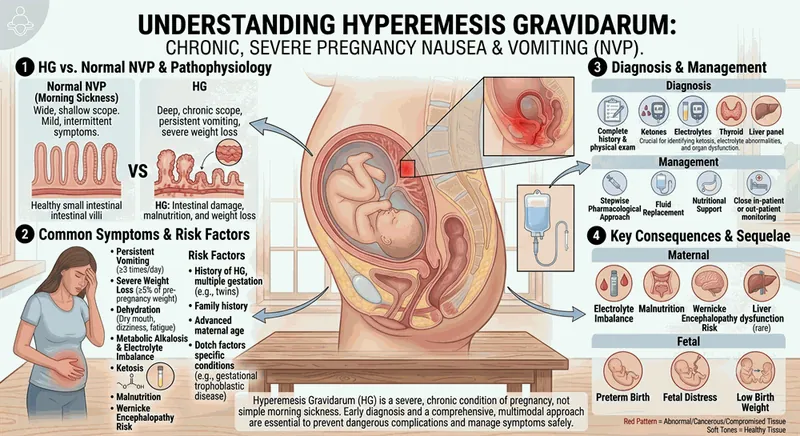
Hyperemesis Gravidarum, Severe Pregnancy Nausea + Vomiting

A severe form of pregnancy nausea and vomiting affecting 0.5 to 2 percent of pregnancies, leading to dehydration, electrolyte imbalance, ketosis, and weight loss greater than 5 percent of pre-pregnancy weight. Genetically driven and not a "psychological" condition.

0.5โ€“2% of Pregnancies PUQE Scored GDF15 Genetic Driver Highly Treatable

Last updated:

What Is Hyperemesis Gravidarum?

Hyperemesis gravidarum (HG) is a severe form of pregnancy nausea and vomiting that causes dehydration, electrolyte disturbance, nutritional deficiency, ketosis, and weight loss greater than 5 percent of pre-pregnancy weight, with significant impact on daily function.

HG is biologically distinct from "morning sickness." Landmark research has linked it to the hormone GDF15 (growth differentiation factor 15), produced by the placenta. Women with HG produce higher levels of GDF15 and respond more sensitively to it because they have less prior exposure. The hormone acts on the brainstem nausea center, causing severe and persistent symptoms that no amount of "ginger and crackers" will resolve. HG is genetic, biological, and not a psychological or motivational problem.

HG severity is most often assessed using the PUQE (Pregnancy-Unique Quantification of Emesis) score, a validated 0 to 15-point scale. The score guides treatment intensity and helps women, providers, and family members appreciate the severity objectively. Severity levels are described below:

Hyperemesis gravidarum, severe pregnancy nausea and vomiting, GDF15 signaling

"HG is associated with significantly elevated maternal levels of GDF15, a hormone produced by the placenta. Variation in pre-pregnancy GDF15 sensitivity explains much of why some women experience severe symptoms while others do not."

โ€” Fejzo et al., 2023, Nature, GDF15 linked to maternal risk of nausea and vomiting during pregnancy

๐ŸŸข Mild Nausea / NVP (PUQE 3โ€“6)

Common "morning sickness." Nausea most days, occasional vomiting, able to eat and drink, weight stable or modest loss less than 5 percent. Affects 70 to 80 percent of pregnancies. Usually resolves by 12 to 14 weeks. Manageable with diet, ginger, vitamin B6, and rest.

  • โ†’Hallmarks: Daily nausea, 0 to 2 vomiting episodes/day, retains 50 percent or more of fluids/food
  • โ†’Primary lever: Bland small frequent meals, ginger, vitamin B6, hydration, rest, acupressure
  • โ†’Labs: Normal electrolytes, no ketones in urine, weight stable
  • โ†’Key supports: Vitamin B6 (pyridoxine), ginger, Sea-Bands, sip electrolyte water, eat before standing up

๐ŸŸก Moderate HG (PUQE 7โ€“12)

Significant impact on daily life. Vomiting 3 to 5 times/day, nausea nearly constant, difficulty eating or drinking, weight loss approaching 5 percent. Functioning at work or with childcare becomes difficult. Outpatient anti-emetic therapy and IV fluids are often needed.

  • โ†’Hallmarks: Vomiting 3 to 5×/day, persistent nausea, weight loss 2 to 5 percent, ketones present
  • โ†’Primary lever: Prescription anti-emetics (doxylamine + B6, ondansetron, promethazine), outpatient IV fluids
  • โ†’Labs: Mild electrolyte shifts, urine ketones moderate, slight elevation in BUN/creatinine
  • โ†’Key supports: Schedule anti-emetics around the clock; do not wait for nausea; oral rehydration, B6, magnesium

๐Ÿ”ด Severe HG (PUQE 13โ€“15) / Hospitalization Required

Unable to keep down any fluids for 12+ hours, vomiting more than 5×/day, weight loss greater than 5 percent of pre-pregnancy weight, ketosis, dehydration, electrolyte disturbance. Requires hospital admission for IV fluids, IV anti-emetics, and electrolyte correction. Risk of Wernicke's encephalopathy from thiamine deficiency.

  • โ†’Hallmarks: Inability to retain any oral intake, weight loss > 5 percent, ketonuria, tachycardia, dry mucous membranes
  • โ†’Primary lever: Hospital admission, IV thiamine before glucose, IV fluids, IV anti-emetics, electrolyte replacement
  • โ†’Labs: Hypokalemia, hyponatremia, ketonuria, elevated BUN/creatinine, elevated hematocrit, possible TFT changes
  • โ†’Key supports: IV thiamine 100 mg before any glucose-containing fluid, IV ondansetron/metoclopramide, scheduled at-home anti-emetic regimen after discharge

โšซ Refractory / Persistent HG (beyond 20 weeks)

HG that persists beyond 20 weeks, sometimes through the entire pregnancy, or that requires escalating therapy including continuous subcutaneous infusion of anti-emetics, PICC line nutrition, or NJ feeding tubes. Recurrence in subsequent pregnancies approaches 80 percent. Multidisciplinary care is essential.

  • โ†’Hallmarks: Symptoms beyond 20 weeks, failure of standard therapy, ongoing weight loss, malnutrition
  • โ†’Primary lever: Multidisciplinary team (MFM, GI, nutrition, mental health); enteral or parenteral nutrition
  • โ†’Labs: Persistent malnutrition markers (low albumin, prealbumin), micronutrient deficiencies, possible liver changes
  • โ†’Key supports: NJ tube feeding preferred over TPN where possible; psychosocial support; recurrence planning for next pregnancy

Hyperemesis Gravidarum Statistics & Research

0.5โ€“2%
of pregnancies develop true HG; most common cause of antenatal hospitalization in the first half of pregnancy
80%
recurrence rate in subsequent pregnancies after a prior HG pregnancy
~10ร—
higher risk if your mother or sister had HG (strong genetic component, GDF15)
5โ€“10%
of HG cases persist beyond 20 weeks gestation; rare cases continue until delivery
15โ€“20%
of women with HG terminate a wanted pregnancy due to symptom severity, often the result of inadequate treatment
~5%
of women with HG develop Wernicke's encephalopathy without timely thiamine replacement

How Hyperemesis Gravidarum Presents

HG is severe, persistent, and life-disrupting. It is not "bad morning sickness." Distinguishing HG from normal NVP guides timely treatment and prevents complications like dehydration, electrolyte disturbance, and Wernicke's encephalopathy.

๐Ÿคข Gastrointestinal & Eating Symptoms

๐Ÿคฎ

Persistent Vomiting (more than 3×/day)

Vomiting that occurs throughout the day, not just in the morning, and continues even when the stomach is empty (dry heaves, bile). HG often progresses to retching after every attempt at fluid or food intake, fundamentally different from occasional NVP.

๐Ÿ˜ฃ

Continuous Nausea (Day & Night)

Unrelenting nausea that does not improve with empty stomach, food, or rest. Triggered or worsened by smells, motion, brushing teeth, opening the refrigerator, or sometimes by nothing identifiable. Often woken from sleep by nausea.

๐Ÿ’ง

Inability to Tolerate Fluids

Even small sips of water trigger vomiting. This is the threshold sign of true HG and the indication for IV fluids. Try a teaspoon of plain water, if it cannot be retained, outpatient or inpatient hydration is needed.

โš–๏ธ

Significant Weight Loss (> 5 percent)

Loss of more than 5 percent of pre-pregnancy weight (e.g., 7.5 lb for a 150 lb woman) is a diagnostic criterion for HG. Weighing weekly at home, fully clothed, same time of day, makes the trend visible early.

๐Ÿ˜–

Food Aversions & Hypersensitivity to Smells

Smell of cooking food, perfume, garbage, soap, or even your partner's deodorant becomes intolerable. Foods previously loved trigger immediate nausea. The hypersensitivity is part of the GDF15-mediated brainstem signal, not "preference."

๐ŸŒซ๏ธ

Ptyalism (Excessive Salivation)

Sometimes overlooked, women with HG can produce so much saliva they spit into a cup repeatedly. Swallowing the saliva triggers more nausea. Often coincides with the worst nausea and can persist for months.

๐Ÿšจ Systemic & Complication Signs

๐Ÿ”ด

Dehydration Signs

Dry mouth and lips, sunken eyes, decreased skin turgor, reduced urine output (less than 4×/day), dark concentrated urine, dizziness on standing, rapid pulse, headache. Each is a marker of fluid loss that needs replacement, not "drink more water" advice.

๐Ÿงช

Ketonuria (Ketones in Urine)

When the body cannot keep food down, it burns fat for fuel, producing ketones excreted in urine. A urine dipstick at home (or in the OB office) is the simplest objective marker of HG severity. Trace is mild; moderate-to-large warrants IV fluids.

โšก

Electrolyte Imbalance Symptoms

Muscle weakness, cramps, palpitations, confusion, and rarely cardiac arrhythmia can result from low potassium, sodium, or magnesium. Severe HG can require IV potassium replacement under monitoring.

๐Ÿง 

Wernicke's Encephalopathy Warning Signs

Confusion, abnormal eye movements (nystagmus), unsteady gait, and memory changes from thiamine (B1) deficiency. Rare but catastrophic if missed. Any IV fluids given to a woman with HG must include or be preceded by thiamine.

๐Ÿ’”

Depression & Isolation

HG profoundly affects quality of life. Women describe weeks or months unable to leave the bedroom, missing work, unable to care for older children, and grief over a pregnancy that does not feel "joyful." Screen for depression and PTSD; both are common during and after HG.

๐Ÿฅ

Recurrent Hospitalizations

Multiple ER visits or admissions for IV fluids and anti-emetics are common with severe HG. This is not a sign of "weakness"; it is the disease. A scheduled outpatient infusion program or home IV nursing is often more effective than repeat ER visits.

โš ๏ธ Go to the ER (or call your OB urgently) if: you cannot keep any fluids down for 12 hours, weight loss is greater than 5 percent of pre-pregnancy weight, urine is dark or you have not urinated in 8 hours, you feel confused or notice abnormal eye movements, you have severe headache or fainting, fever, or signs of severe dehydration. HG is treatable, do not wait until you are critically ill.

How to Test for Hyperemesis Gravidarum

HG is a clinical diagnosis based on history, examination, and labs. The PUQE score is the most widely used tool. Lab and ultrasound testing rule out other conditions and assess severity.

๐Ÿ  At-Home Screening

These are not diagnostic, but track severity and signal when clinical care is needed urgently:

๐Ÿ“‹ PUQE-24 Score (Pregnancy-Unique Quantification of Emesis)

Score yourself daily over 24 hours: (1) How long have you felt nauseated, 0 to 4 (not at all to more than 6 hours)? (2) How many times have you vomited, 0 to 4 (none to 7+)? (3) How many times of retching/dry heaves, 0 to 4 (none to 7+)? Total score: 3 to 6 mild, 7 to 12 moderate, 13 to 15 severe. Bring scores to every OB visit.

โš–๏ธ Weight & Hydration Diary

Weigh weekly (or daily if losing) on the same scale, same time, same clothing. Track every oz of fluid retained, vomiting episodes, urine output (number of voids and color), and any signs of dehydration. Pattern data accelerates appropriate treatment.

๐Ÿงช Urine Ketone Strips

A box of ketone strips (Ketostix) from any pharmacy lets you check ketonuria at home. Trace ketones: keep trying small frequent fluids. Moderate or large ketones: call your OB or proceed to an outpatient infusion center / ER for IV fluids. Objective ketone data is one of the strongest signals.

๐Ÿ”ฌ Lab & Clinical Tests

๐Ÿ’‰ Electrolyte & Renal Panel

Sodium, potassium, chloride, bicarbonate (look for hypokalemic, hypochloremic metabolic alkalosis), BUN, creatinine (often elevated from prerenal AKI), magnesium, phosphorus. Repeat at each significant clinical change.

๐Ÿฉธ CBC & Liver Function Tests

Hematocrit often elevated from hemoconcentration. LFTs mildly elevated in up to 50 percent of severe HG cases (transaminitis); rule out HELLP if later in pregnancy. Lipase / amylase may be mildly raised; rule out pancreatitis.

๐Ÿฆ‹ Thyroid Panel

TSH, free T4. HG is associated with transient gestational hyperthyroidism due to hCG cross-stimulation of TSH receptors; mostly self-resolving. Distinguishes HG from true Graves' disease, which would require antithyroid medication.

๐Ÿ“ท Pelvic Ultrasound

Confirms viable intrauterine pregnancy. Rules out twin/triplet pregnancy and molar pregnancy, both of which can present with severe HG due to extremely high hCG. Twin or molar pregnancies require different management.

๐Ÿงซ Urinalysis & Ketones

Urine dipstick for ketones (severity marker), specific gravity (dehydration), nitrites/leukocytes (UTI as trigger). Quantitative ketones if persistent. Rule out UTI, which can trigger or worsen HG-style symptoms.

๐Ÿง  Wernicke's Risk Assessment

Any woman with HG requiring IV fluids or with greater than 3 weeks of poor oral intake must receive IV thiamine 100 mg before any IV glucose or dextrose-containing fluid. Failure to do so risks Wernicke's encephalopathy, a preventable catastrophe. This is a non-negotiable clinical safeguard.

Holistic vs. Conventional Treatment for Hyperemesis Gravidarum

HG is a medical condition that needs both pharmacologic and supportive care. Holistic strategies complement, but never replace, anti-emetic medication and IV fluids in moderate-to-severe HG. Toggle below to compare.

๐ŸŒฟ HOLISTIC
๐Ÿ’Š CONVENTIONAL
๐ŸŒฟ

Holistic / Supportive Approach

Adjunctive support that lowers symptom burden and corrects deficiencies, layered onto OB-prescribed treatment

Primary Treatment
Vitamin B6 + ginger first-line; protein-dense bites when tolerated; electrolyte hydration; cold/bland foods; environmental control of triggers
Duration
From symptom onset (often weeks 5 to 6) until resolution (usually 14 to 20 weeks, sometimes longer)
Effect on Underlying Disorder
Modest symptom reduction; does not stop HG entirely, but lowers severity and prevents nutrient/electrolyte depletion
Maternal-Fetal Outcome
Best when combined with anti-emetic medication; helps quality of life and recovery between meds
Protocol Includes (alongside OB-prescribed treatment)
  • Vitamin B6 (pyridoxine) 25 mg 3 to 4×/day; ACOG first-line, pregnancy-safe
  • Ginger 250 mg capsules 4×/day, or fresh ginger tea/candies (modest but real evidence)
  • Sea-Bands or acupressure at P6 (wrist); some women get meaningful relief
  • Cold, bland, low-odor foods, watermelon, cold pasta, plain crackers, lemon ice, cold yogurt
  • Sip electrolyte water (LMNT, Liquid IV, Pedialyte, homemade), tiny sips every few minutes
  • Protein-dense small bites between meals (cheese cube, hard-boiled egg, plain yogurt) when tolerated
  • Smell control, partner cooks elsewhere, leave windows open, no scented products in the home
  • Rest, no shame in bed days; mental health support; HER Foundation peer support
โœ… Side effects: Minimal at recommended doses. Critical: Holistic strategies are adjuncts, not substitutes, for moderate-to-severe HG. Refusing prescription anti-emetics or IV fluids when needed is harmful to mother and baby. The goal is symptom management plus prevention of complications.

Root Causes of Hyperemesis Gravidarum

HG is biological, not psychological. The strongest driver is genetic sensitivity to placental hormones. Several modifiable factors influence severity and recovery.

Root Cause How It Contributes to HG Holistic Solution
GDF15 Hormone OverproductionThe placenta produces GDF15, which acts on the brainstem nausea center. Women with HG have higher placental GDF15 production and lower pre-pregnancy exposure, producing heightened sensitivity.Recognize HG as biological, not behavioral. Treatment focuses on lowering symptom burden; future research on GDF15-targeted therapies underway.
Genetic PredispositionHG is highly heritable. Mother or sister with HG raises risk approximately 10×. Twin studies show 73 percent heritability. Specific GDF15 and IGFBP7 gene variants are implicated.Pre-conception counseling if family history; plan medication and IV-fluid access early next pregnancy (HER Foundation pre-emptive protocol)
High hCG / Multiple GestationTwin, triplet, and molar pregnancies produce much higher hCG, which cross-stimulates TSH receptors and may amplify nausea pathways. Severe HG warrants ultrasound to rule out these.Rule out with early ultrasound; manage molar pregnancy per OB; expect higher symptom burden with multiples
Prior HG (Recurrence)Recurrence rate after one HG pregnancy is approximately 80 percent. Severity often similar or somewhat reduced.Pre-emptive treatment plan with OB: medications ready at home, infusion center identified, support system organized before symptoms start
Helicobacter pylori InfectionH. pylori is associated with HG in some studies, possibly via gastric inflammation. Treating H. pylori before pregnancy may reduce severity in subsequent pregnancies.Test pre-conception (stool antigen or breath test) if dyspepsia history; treat with eradication therapy before next pregnancy
Vitamin B6 DeficiencyB6 (pyridoxine) is required for neurotransmitter metabolism and is the most well-established nutritional contributor to NVP severity.Supplement B6 25 mg 3 to 4×/day; first-line treatment per ACOG; pregnancy-safe
Thyroid DysfunctionTransient gestational hyperthyroidism from hCG cross-stimulation occurs in many HG cases. True Graves' disease is rarer but worsens nausea.TSH, free T4 testing; usually self-resolves; refer to endocrinology if true hyperthyroidism is found
Slow Gastric Emptying (Pregnancy Physiology)Progesterone slows GI motility throughout pregnancy. Combined with GDF15 sensitivity, this magnifies nausea triggered by food sitting in the stomach.Small frequent meals (every 1 to 2 hours), upright posture after eating, low-fat low-fiber if severe, ginger
Dehydration & Electrolyte Depletion (Self-Perpetuating)Once dehydration sets in, nausea worsens, creating a vicious cycle. Ketosis itself causes nausea, deepening the spiral.Early aggressive hydration (IV if needed), electrolyte replacement, ketone monitoring at home; break the cycle before it deepens
Psychosocial Stress & Lack of SupportStress does not cause HG, but inadequate social support, financial pressure, and dismissive medical care worsen the experience and delay treatment.Peer support (HER Foundation), partner/family education, mental health screening, paid leave or work accommodation, advocate for adequate care

Hyperemesis Gravidarum Diet Guide

For HG, the question is not "what is optimal" but "what stays down." Calories from any pregnancy-safe source are better than no calories at all. The list below shifts as the woman moves through severity stages.

๐Ÿ‹

The HG Eating Pattern: Cold, Bland, Salty, Small, Frequent

The classic prenatal nutrition advice (protein-anchored Mediterranean plate, varied vegetables, healthy fats) is the goal once symptoms improve, but it is often impossible during acute HG. During the worst weeks, the goal is calories and fluid retention, period.

Most women with HG can tolerate cold, low-odor, simple-carb foods better than warm, fragrant, fat-rich foods. Salty and tart often beats sweet. Tiny portions (1 to 2 bites) every 30 to 60 minutes outperforms 3 large meals. As symptoms ease (often weeks 14 to 18), the pattern transitions back to standard prenatal eating.

Acute-Phase Tactics:

  • โ„๏ธCold beats hot, smells less, easier on the stomach
  • ๐ŸฅจSalty & sour beat sweet, lemon, pickle, olives, broth, watermelon with salt
  • โฐTiny portions every 30 to 60 min, empty stomach worsens nausea
  • ๐Ÿ›๏ธEat before getting up, crackers + water at bedside table

Hydration Hierarchy:

  • ๐Ÿ’งTiny sips (1 tsp) every 5 to 10 min, large gulps trigger vomiting
  • ๐ŸงŠIce chips, popsicles, frozen grapes, slow controlled fluid delivery
  • ๐ŸฅคElectrolyte drinks, LMNT, Liquid IV, Pedialyte, homemade with salt and lemon
  • ๐ŸตGinger or peppermint tea (cold or warm), modest evidence base but soothing
๐Ÿ’ก If you cannot keep down any fluid for 12 hours, go to the ER or your OB office for IV fluids. Hydration must include thiamine.
โš ๏ธ During acute HG, these tend to trigger or worsen vomiting. They can be reintroduced as symptoms improve.
  • โœ—Strongly fragrant foods: Garlic, onion (cooked), curries, coffee, fried foods; smell-driven nausea triggers
  • โœ—Hot/warm meals: Heat releases volatile odor molecules; cold or room-temperature versions are usually better tolerated
  • โœ—High-fat foods: Fried foods, heavy cream, fatty meats slow gastric emptying and trigger nausea
  • โœ—Spicy foods: Hot peppers, heavy seasoning, often trigger reflux and worsen nausea
  • โœ—Highly sweet foods: Cake, candy, soda; many HG women lose tolerance for sweetness; salty tart usually beats sweet
  • โœ—Carbonated and caffeinated drinks (excess): Some tolerate flat ginger ale; others gag. Limit caffeine 200 mg/day if tolerated
  • โœ—Raw / undercooked meats & seafood: Pregnancy contraindication; also higher smell intensity
  • โœ—High-mercury fish: Avoid swordfish, shark, king mackerel, bigeye tuna per standard pregnancy guidelines
  • โœ—Alcohol & unpasteurized dairy: Standard pregnancy contraindications, plus added GI burden
๐Ÿ’ก The "BRAT" approach plus cold, salty, protein-when-possible. Eat anything pregnancy-safe that stays down.
  • โœ“Cold simple carbs: Plain crackers, pretzels, dry cereal (small handful), cold toast, rice cakes; the first food many women keep down
  • โœ“Cold proteins: Hard-boiled eggs, plain Greek yogurt, cottage cheese, cold sliced turkey (well-cooked), string cheese
  • โœ“Cold hydrating fruit: Watermelon, frozen grapes, frozen mango, popsicles (real-fruit), cold cucumber
  • โœ“Salty/tart options: Pickles, olives, lemon ice, salted nuts, miso broth, plain bone broth with extra salt
  • โœ“Electrolyte fluids: LMNT, Liquid IV, Pedialyte, coconut water, homemade (1 cup water + pinch salt + squeeze lemon + tsp honey)
  • โœ“Ginger forms: Ginger candy, ginger tea (cold or warm), crystallized ginger, ginger lollipops; modest but consistent evidence
  • โœ“Smoothies (if tolerated): Frozen berries + plain yogurt + plain protein powder + ice; calorie- and protein-dense, low odor
  • โœ“Plain starches with protein: Plain pasta with butter and parmesan, plain rice with cold chicken, mashed potato with milk
  • โœ“Recovery-phase foods: Once symptoms ease (weeks 14 to 20), gently reintroduce vegetables, healthy fats, protein-anchored meals (see pregnancy plate)

Key Supplements for Hyperemesis Gravidarum Recovery

All supplements below are pregnancy-safe at the doses listed. Always confirm with your OB or midwife. Items flagged as contraindicated should not be used during pregnancy. Critically, IV thiamine must precede any IV glucose in women with HG.

Supplement Role in HG Recovery Suggested Dose Timing Notes (Pregnancy Safety)
Vitamin B6 (Pyridoxine)First-line anti-nausea treatment per ACOG. Reduces nausea severity in multiple RCTs. Combined with doxylamine is the gold standard.25 mg, 3 to 4 times per dayAround the clock, do not wait for nauseaPregnancy-safe. Max 200 mg/day. Often combined with doxylamine 12.5 mg (Diclegis/Bonjesta).
Thiamine (Vitamin B1) โš ๏ธ CRITICALPrevents Wernicke's encephalopathy in HG. Must be given before any IV glucose. Orally helpful for prevention.50 to 100 mg/day orally; 100 mg IV before any IV dextroseDaily; IV form on hospital protocolPregnancy-safe and critical. Must precede IV glucose to prevent Wernicke's.
Ginger (Capsule or Whole)Modest but consistent evidence for reducing nausea and vomiting in early pregnancy. RCT-validated at 250 mg 4×/day.250 mg, 4 times per dayAround the clock, with or without foodPregnancy-safe at culinary and supplement doses. Avoid extremely high concentrated doses (greater than 1500 mg/day).
High-Quality Prenatal MultivitaminFoundation when tolerated. Switch to liquid or chewable forms if pills are not tolerated. Skip iron temporarily if it worsens nausea.1 per day per productWith food at the best-tolerated timePregnancy-essential. If can't tolerate, take folate + B12 + iodine separately until prenatal is tolerated.
Methylated Folate (L-5-MTHF)Critical for fetal neural tube; if prenatal cannot be tolerated, ensure folate is taken separately.800 to 1000 mcg/dayBest-tolerated timePregnancy-essential. Use L-methylfolate over folic acid if MTHFR known.
Vitamin B12 (Methylcobalamin, sublingual)Sublingual form bypasses the GI tract. Supports energy, neurological function. Often depleted by repeated vomiting.500 to 1000 mcg/day sublingualMorningPregnancy-safe. Sublingual avoids triggering nausea from swallowing.
Magnesium GlycinateOften depleted by vomiting; helps with cramps, sleep, and sometimes nausea. Helps mood and reduces leg cramps.200 to 400 mg elemental Mg/dayEvening before bedPregnancy-safe in glycinate form. Avoid magnesium oxide / citrate (laxative effect; may worsen vomiting).
Electrolyte Replacement (oral)Restores sodium, potassium, chloride lost to vomiting. Critical to prevent the dehydration spiral.1 to 2 packets/day (LMNT, Liquid IV, Pedialyte) or homemadeSip throughout the dayPregnancy-safe. Choose low-sugar options. Homemade: 1 L water + 1/2 tsp salt + 6 tsp sugar (WHO ORS formula).
Vitamin D3 (with K2)Pregnancy support; often deficient. Take liquid/drop form if pills are not tolerated.2000 to 4000 IU D3 + 100 to 200 mcg MK-7 K2/dayWith a fat-containing meal if possiblePregnancy-safe. Test 25-OH-D; target 30 to 50 ng/mL.
Omega-3 DHA/EPA (delayed-release or algae)Supports fetal brain. Delayed-release or enteric-coated capsules reduce "fish burps" that can trigger nausea.1 g combined EPA+DHA/day; at least 200 mg DHAWith meals; switch to enteric-coated if reflux/nausea worsensPregnancy-safe. IFOS-certified low-mercury fish oil or algae oil. Skip if nausea is provoked.
Probiotic (pregnancy-safe strains)Supports gut health, may modestly reduce nausea. Useful when antibiotics or anti-emetics disrupt gut flora.10 to 25 billion CFU/day, multi-strainWith or after foodPregnancy-safe with mainstream strains.
Iron (only if deficient, only if tolerated)Iron deficiency common after HG; oral iron worsens nausea in many women. IV iron is an option if oral is intolerable.30 to 60 mg elemental iron/day if toleratedEvening (less nausea); empty stomach with vitamin C if toleratedPregnancy-safe when indicated. If oral is intolerable, discuss IV iron with OB. Test ferritin; do not blindly supplement.
Lemon Essential Oil (Aromatherapy)Inhaled lemon has RCT evidence for reducing nausea modestly. Cheap, simple, no GI exposure.2 to 3 drops on a tissue, inhaled as neededAs needed for nauseaPregnancy-safe topically/inhaled at low quantities. Avoid ingesting essential oils.
Peppermint Essential Oil (Aromatherapy)Similar to lemon; inhaled peppermint may reduce nausea. Avoid topical near the abdomen.2 to 3 drops on a tissue, inhaled as neededAs neededPregnancy-safe inhaled. Avoid ingesting and avoid concentrated topical use.
Choline (when tolerated)Often impossible to meet RDA from food during HG; supplement helps once nausea improves.250 to 500 mg/day when toleratedWith foodPregnancy-safe; reintroduce gradually as symptoms improve.
High-Dose Vitamin A (Retinol) โŒDoses above 10,000 IU/day are teratogenic. Avoid cod liver oil at higher doses and any "vitamin A" supplement during pregnancy.Avoid greater than 5000 IU retinol/dayStick to beta-carotene + prenatal levelsPregnancy caution. Beta-carotene from food is safe; preformed vitamin A must be limited.
Herbal Anti-Nausea Blends (Misc.) โš ๏ธMany herbal blends contain ingredients (e.g., chamomile high-dose, raspberry leaf, black cohosh) that are not pregnancy-safe.Avoid unless every ingredient is pregnancy-clearedAvoid without provider reviewCheck every ingredient. Single-ingredient ginger and B6 are safe; complex blends are not.
โš ๏ธ Pregnancy + HG supplement principle: Confirm every supplement with your OB or midwife. If you cannot keep oral supplements down, IV/IM vitamin administration (B-complex, thiamine, B12) is reasonable, talk to your provider. Thiamine before glucose is the single most important safety rule in HG care.

Healing Timeline: Conventional vs. Holistic

Understanding what to expect from each approach helps set realistic expectations. For HG, the two approaches are best used together.

๐ŸŒฟ Holistic Protocol
Pre-conception (if prior HG)

Test for H. pylori, optimize B6 and B12 status, build social support plan, identify OB experienced with HG, secure home medications and infusion plan.

Weeks 5โ€“8 (Onset)

Begin B6 25 mg 4×/day + ginger 250 mg 4×/day from first nausea. Cold bland foods, electrolyte sipping, environmental smell control, rest.

Weeks 8โ€“14 (Peak)

Add prescription anti-emetics as needed (do not delay). Outpatient IV fluids when ketones moderate-large. Mental health support. PUQE scoring weekly.

Weeks 14โ€“20 (Recovery)

Symptoms typically improve. Gradually reintroduce vegetables, protein, healthy fats. Replenish iron, B12, vitamin D, magnesium. Often back to standard prenatal plate.

Long-Term Outlook

Nutritional recovery 3 to 6 months postpartum; screen and treat post-HG PTSD; pre-emptive plan for next pregnancy

๐Ÿ’Š Conventional Treatment
Onset

Often dismissed as "morning sickness" initially. B6 + doxylamine (Diclegis) first-line. Tolerance counseling.

Escalation

Ondansetron, promethazine, metoclopramide added. Around-the-clock dosing. Outpatient IV fluid program if available.

Hospitalization (Severe)

IV thiamine before glucose. Electrolyte replacement. IV anti-emetics. Steroids in refractory cases (after 10 weeks).

Resolution

Symptoms typically ease 14 to 20 weeks. Wean anti-emetics gradually. Continue postpartum mental health support.

Long-Term Outlook

~80% recurrence in next pregnancy; pre-emptive treatment plan dramatically improves outcomes

"HG is not just 'bad morning sickness.' It is a debilitating biological illness, with a known hormonal driver. Effective treatment is available, and women deserve it without judgment or delay."

Ready to Address Your Hyperemesis Gravidarum at the Root?

Explore related conditions below or revisit the Symptom Checker to map your full symptom picture across the library.