Eosinophilic Esophagitis

An allergic inflammation of the oesophagus that stiffens and narrows it, so food sticks. This is the rare condition where an elimination diet is genuine first-line therapy rather than a folk remedy, and that is precisely why it has to be done properly: guided by endoscopy, with planned reintroduction, and with somebody watching your nutrition.

Diet Is Treatment Here Evidence-Based Root-Cause Focus

Last updated:

🚨 Food stuck in the oesophagus that will not pass, especially with inability to swallow your own saliva, is an emergency. Go to an emergency department. Do not wait it out, and do not try to force it down with more food or drink. Impaction is the commonest way this condition is first diagnosed and it needs endoscopic removal. Never make yourself vomit to clear it, because a forcefully retched oesophagus can tear. This warning is first because it is the part of this page that could matter tonight.

What Is Eosinophilic Esophagitis?

A chronic immune condition in which a type of white blood cell, the eosinophil, accumulates in the lining of the oesophagus in response to food proteins. The inflammation makes the tube stiff and narrow, so swallowing becomes slow and food catches. It is not reflux, though it is very often treated as reflux for years first.

It is diagnosed only by endoscopy with biopsies. Nothing else makes the diagnosis, and no blood or skin allergy test identifies the trigger foods reliably. That is the single most consequential fact on this page, because it means the whole approach is guided by what the biopsy shows rather than by what a test panel suggests.

Left untreated the narrowing tends to progress, which is why "I have just learned to eat slowly" is not a management plan.
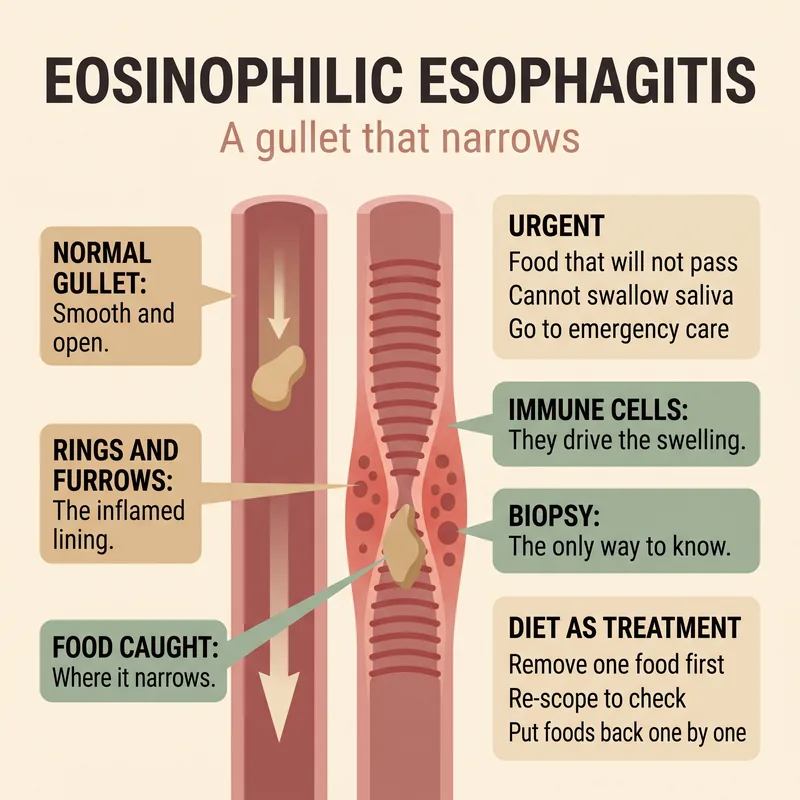
💡 Key Insight: Elimination has become simpler, not stricter. A randomised trial comparing removing one food with removing six found similar remission rates, and concluded that eliminating animal milk alone is an acceptable initial dietary therapy1. Starting with one food rather than six is easier to sustain, easier on nutrition, and no less likely to work.
Cross-section of the oesophagus comparing a normal open tube with an inflamed narrowed one showing rings and furrows, with food caught at the narrowing

🧬 Biopsy decides, not symptoms

Response is confirmed by repeat endoscopy3. People can feel better while the inflammation continues, and the narrowing progresses quietly.

🥛 Milk first is a reasonable start

One-food elimination matched six-food elimination for remission1, and six-food still helped just under half of those it did not.

↻ Reintroduction is the point

Foods are added back one at a time with repeat endoscopy to find the actual trigger2. An elimination diet with no reintroduction plan is an unfinished treatment.

How EoE Presents

Often as habits, because people adapt to it long before they report it.

FeatureWhat it looks likeWorth knowing
Food sticking on the way downBread and steak most often, needing water to push it throughThe classic adult symptom, and the one most often lived with for years
Food impactionFood stuck and not passingEmergency. Needs endoscopic removal, and it is a common first presentation
Eating slowly, chewing excessively, avoiding certain texturesCutting food very small, always drinking with meals, being last to finishThese adaptations ARE the symptom. People often report no trouble swallowing while doing all of them
Chest pain not related to the heartCentral, on swallowingFrequently investigated as cardiac or as reflux first
Heartburn that does not respond to acid treatmentReflux medicines not helping as expectedA common route to diagnosis, and worth saying explicitly to your doctor
In children: feeding difficulty, vomiting, poor growthRefusing food, pain, failure to gain weightPresents very differently from adults. Growth faltering needs assessment
Other allergic conditionsAsthma, hay fever, eczema, food allergyCommon companions, and part of the picture rather than coincidence
Symptoms improving on their ownA good week or monthNot reassuring. Inflammation can continue while symptoms settle, which is why biopsy confirms remission
⚠️ The adaptations are the diagnosis hiding in plain sight. Many people with EoE will say swallowing is fine, and in the same conversation describe cutting everything small, avoiding bread and meat, always eating with a drink, and being the last to finish every meal. If that describes you, say those things to your doctor in exactly those words. They are more informative than the word "fine".

How EoE Is Assessed

By endoscopy and biopsy, and by very little else that is reliable.

MeasureWhat it tells youWhat it misses
Endoscopy with biopsiesThe diagnosis. Eosinophil counts from several levels of the oesophagus3Nothing replaces it. The oesophagus can look normal and still be involved, which is why biopsies are taken regardless
Repeat endoscopy after a treatment changeWhether the inflammation actually settledThe step most often skipped, and the reason narrowing progresses in people who feel better
Blood or skin allergy testingVery little of use for identifying EoE trigger foodsThese do not reliably predict which food is driving it. The trigger is found by removing and reintroducing under biopsy, not by a panel2
A trial of acid suppressionPart of standard assessment, since some people respond to itImprovement does not exclude EoE, and this is where the diagnosis is often lost for years
Barium swallow where narrowing is suspectedThe length and degree of narrowingDoes not diagnose the inflammation and does not replace biopsy
Growth monitoring in childrenWhether the condition or its treatment is costing growthEssential in any child on an elimination diet
Nutritional assessment before eliminating anythingWhat the diet can safely loseFrequently omitted, and it is how an elimination diet becomes a nutritional problem
A dietitianHow to remove a food without removing a food groupNot optional if diet is the chosen treatment. Milk elimination in particular takes calcium and iodine with it
💡 Ask one question before starting any diet: what is the plan for the repeat endoscopy? Dietary therapy in EoE is a sequence, not a decision. Remove, re-scope to see whether it worked, then reintroduce one food at a time with scopes in between to find the actual trigger. Without that sequence you may end up avoiding a food for years that was never the problem.

Holistic vs. Conventional Treatment for EoE

🌿 HOLISTIC
💊 CONVENTIONAL
🌿

Holistic / Functional Approach

Dietary therapy, done as a supervised sequence rather than a permanent restriction

Where To Start
Eliminating animal milk alone was an acceptable initial dietary therapy, matching six-food elimination for remission1
How The Trigger Is Found
Reintroduction one food at a time with repeat biopsy, which is what identifies the causative food2
Timeline
Weeks per step, and the full sequence takes months. It is slow because it is being verified
Limitation, stated plainly
This is a medical treatment that happens to be food. It needs endoscopy and a dietitian, and it is not a self-directed diet

Full Holistic Approach Includes

  • A dietary plan agreed with a gastroenterologist and a dietitian, with the repeat endoscopy scheduled before you start.
  • Starting narrow rather than wide, since one-food elimination matched six-food for remission and costs far less nutritionally1.
  • Replacing what you remove. Removing milk removes a major source of calcium and iodine, which needs planning rather than hoping.
  • Reintroducing deliberately, one food at a time, so you end up avoiding only what is actually driving it.
  • Eating slowly and chewing well while narrowing is present, which reduces impaction risk without treating the disease.
  • Treating the other allergic conditions that commonly travel with it.
  • Growth monitoring in children, every time, without exception.
  • Naming the mental cost. Restriction affects eating out, school, and family meals, and that is a legitimate part of choosing between diet and medication.
🌿 Worth knowing, and this page is unusual in saying it: dietary therapy here is a real treatment with real evidence, and it competes on equal terms with medication. Choosing the medication instead is not a failure of willpower. For many people the restriction is the harder option, and it is entirely reasonable to say so.

Diet for Eosinophilic Esophagitis

The one page on this site where a restriction diet is the treatment, and where doing it alone is the risk.

🚨 Do not run an elimination diet for EoE by yourself. Two things go wrong when it is self-directed. You cannot tell whether it worked, because symptoms improve while inflammation continues and only a repeat biopsy shows the difference, so people avoid foods for years without benefit while narrowing progresses. And the nutrition falls over: removing milk removes a major source of calcium and iodine, removing wheat and milk together narrows the diet sharply, and in children this shows up as growth faltering. Dietary therapy here needs a gastroenterologist and a dietitian. That is what makes it a treatment rather than a restriction.
ChangeWhyPractical note
Start with milk alone, if diet is chosenOne-food elimination matched six-food elimination for remission1Far easier to sustain and far less nutritional cost. Agree it with your team
Replace the nutrients you removeMilk carries calcium and iodine; wheat carries fortified B vitamins and iron in many countriesThis is the dietitian's job. See osteoporosis for why the calcium matters
Reintroduce, one food at a timeIt is what identifies the actual trigger2With repeat endoscopy. Skipping this leaves you avoiding foods that were never the cause
Eat slowly, chew well, sit uprightReduces impaction risk while narrowing is presentSymptom management, not treatment. Do not let it substitute for one
Be careful with dry, fibrous, chunky texturesBread and meat are the classic offenders while the oesophagus is narrowMoisten food, cut small. If you are already doing this, tell your doctor
Do not use allergy panels to choose foodsThey do not reliably identify EoE triggers2A positive test to a food you eat safely will send you down a pointless restriction
Watch growth in childrenThe commonest harm from dietary therapy in this conditionPlotted, at intervals, by someone who will act on it
Elemental formula dietsHighly effective and very hard to live withReserved for specific situations and always specialist-supervised. Not a self-start option
💡 The distinction that makes this page consistent with the rest of the site. Everywhere else, this site argues against removing foods on a hunch, because unsupervised elimination costs nutrition, costs tolerance, and delays real treatment. EoE is not an exception to that argument. It is the case that proves it: here the removal is chosen on a biopsy, checked by a biopsy, and reversed by planned reintroduction. The evidence is not that restriction works. It is that verified, supervised, reversible restriction works.

Evidence-Based Supplements

Here supplements are about replacing what a treatment diet removes, not about treating the disease.

🚨 No supplement treats eosinophilic esophagitis. Nothing sold for gut healing, inflammation or allergy reduces oesophageal eosinophils, and using one instead of proper treatment allows the narrowing to progress silently. Never treat a food impaction at home, and never make yourself vomit to clear one. Tell your gastroenterologist about everything you take.
SupplementWhat it is actually forTypical rangeTimingNotes & cautions
A dietitian The thing that makes dietary therapy safe, listed first because it does more here than anything in a bottle. Referral, before any food is removed Not applicable Not a supplement. It is in this table because the nutritional harm from EoE diets is preventable and predictable, and this is what prevents it.
Calcium, if milk is removed Replacing what a milk-free diet takes out, which matters for bone. Set with your dietitian, from fortified foods first where possible With meals, in divided amounts Food and fortified alternatives before tablets. See osteoporosis for the calcium and vitamin D cautions.
Vitamin D, and iodine where relevant Also commonly reduced when dairy is removed, particularly for iodine. Set with your clinician, ideally after testing Vitamin D with a fat-containing meal Iodine is easy to overlook in a milk-free diet and easy to over-supplement. Get the amount set rather than guessed.
Gut-healing and anti-inflammatory supplements Not established for EoE. Listed to answer the question, because they are marketed heavily for anything involving the gut and inflammation. Not recommended for this purpose Not applicable The specific harm is delay: the oesophagus can narrow further while symptoms are being managed with something that is not working.
🚨 What to avoid, specifically. Self-directed elimination diets with no endoscopy and no dietitian, which is the central harm here. Choosing foods to remove from an allergy panel, since those do not reliably identify EoE triggers. Elimination with no reintroduction plan, which leaves you avoiding foods that were never the cause. Removing a food group from a child without growth monitoring. Products claiming to heal the oesophagus, which allow narrowing to progress. And treating an impaction at home.
💡 Where the real leverage is. Getting the endoscopy rather than being managed as reflux for years, choosing between diet and medication with your team rather than defaulting, scheduling the repeat scope before you start, reintroducing deliberately, and having a dietitian involved from the first day food is removed. Those five do more than every supplement marketed for this condition combined.

References & Evidence Notes

Each numbered entry below is either a source you can follow or a note setting out what the evidence does and does not support. Both are numbered together so the markers in the text line up.

Last reviewed 3 September 2026. Supplement entries are cross-checked against the NIH National Center for Complementary and Integrative Health and the Linus Pauling Institute Micronutrient Information Center.4 This page is nutrition education, not medical advice, and it does not replace your doctor. Eosinophilic esophagitis is diagnosed and monitored by endoscopy with biopsies, and nothing else makes the diagnosis or confirms that a treatment has worked. Dietary therapy here is a genuine first-line treatment and it is also a medical procedure: it requires a gastroenterologist, a dietitian, and a planned repeat endoscopy, because symptoms and inflammation come apart and narrowing can progress in someone who feels better. No supplement treats this condition. What nutrition education can do is help you understand the evidence well enough to have a better conversation with the clinician who does treat you.

  1. Kliewer KL, Gonsalves N, Dellon ES, et al. One-food versus six-food elimination diet therapy for the treatment of eosinophilic oesophagitis: a multicentre, randomised, open-label trial. Lancet Gastroenterol Hepatol. 2023;8(5):408–421. PubMed 36863390. Histological remission rates were similar after one-food and six-food elimination in adults. Six-food elimination helped just under half of those who did not respond to one-food, and steroids helped most of those who did not respond to six-food. The authors conclude that eliminating animal milk alone is an acceptable initial dietary therapy, which is why this page recommends starting narrow.
  2. Gonsalves N, Yang GY, Doerfler B, et al. Elimination diet effectively treats eosinophilic esophagitis in adults; food reintroduction identifies causative factors. Gastroenterology. 2012;142(7):1451–1459. PubMed 22391333. The trial that established reintroduction with repeat biopsy as the way the causative food is identified, rather than allergy testing. This is the basis for the page insisting that an elimination diet without a reintroduction plan is an unfinished treatment.
  3. Dellon ES, Gonsalves N, Hirano I, et al. ACG clinical guideline: evidence based approach to the diagnosis and management of esophageal eosinophilia and eosinophilic esophagitis. Am J Gastroenterol. 2013;108(5):679–692. PubMed 23567357. Cited for the diagnostic framework, for biopsy from multiple levels, and for the principle that response is judged histologically rather than by symptoms alone. Newer guidance exists and the diagnostic principle has not changed.
  4. NIH National Center for Complementary and Integrative Health, nccih.nih.gov, and the Linus Pauling Institute Micronutrient Information Center, lpi.oregonstate.edu.