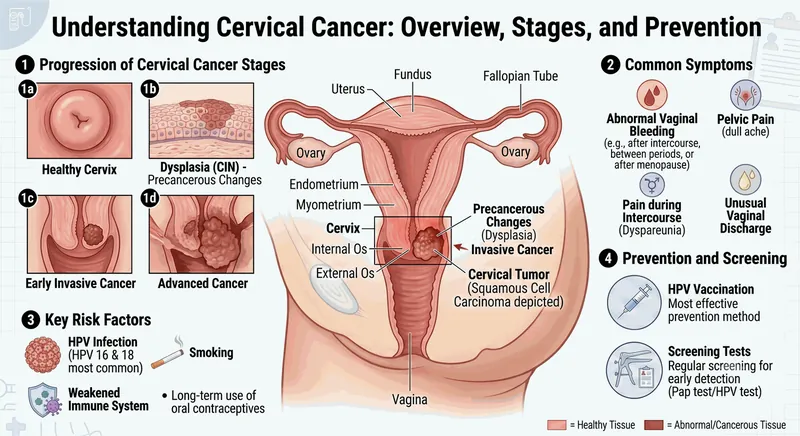
A cancer that is nearly always caused by persistent high-risk HPV infection and, uniquely among major cancers, is preventable through vaccination and detectable at the precancer stage through routine screening. Holistic nutrition is a complement, not a substitute, to oncology.
Last updated:
Cervical cancer is a malignancy of the cervix, the lower, narrow portion of the uterus that opens into the vagina. In virtually all cases, it begins with persistent infection by a high-risk strain of the human papillomavirus (HPV), most commonly HPV 16 or 18.
The disease develops slowly. Most HPV infections clear on their own within 1 to 2 years through normal immune surveillance. When infection persists for 10 years or more, the virus can integrate into cervical epithelial cells and gradually drive precancerous changes, called cervical intraepithelial neoplasia (CIN 1, 2, or 3), before progressing to invasive cancer. This long window is precisely why Pap smears and HPV co-testing are so effective at preventing the disease.
The two dominant histologic subtypes account for most cases and arise from different cell populations within the cervix. Less common but clinically important variants exist, including small-cell neuroendocrine carcinoma. FIGO staging (I to IV) describes how far the cancer has spread beyond the cervix and is the strongest predictor of treatment and prognosis:
"Persistent infection with high-risk human papillomavirus types is causally linked to virtually all cases of cervical cancer, and is found in 99.7 percent of cervical carcinomas worldwide."
โ Walboomers et al., Journal of Pathology (1999); reaffirmed by WHO 2023Arises from the squamous epithelial cells of the ectocervix (the outer surface that faces the vagina). The most common subtype and the one most reliably detected by traditional Pap cytology. Typically slow-growing through CIN precursor lesions.
Mixed glandular and squamous tumors. Generally treated similarly to the dominant component but tend to behave more aggressively than pure squamous tumors. Carefully reviewed by gynecologic-oncology pathology.
Small-cell neuroendocrine carcinoma is aggressive and treated more like small-cell lung cancer. Clear-cell carcinoma historically linked to DES exposure. Combined, these account for under 5 percent of cervical cancers but require specialized protocols.
Early-stage cervical cancer and its precancer precursors are usually silent, which is why screening matters far more than symptom-watching. Once symptoms appear, the disease is typically already invasive. Any abnormal bleeding warrants prompt evaluation.
Light spotting or frank bleeding after intercourse is one of the most classic early warnings of an invasive cervical lesion. Friable abnormal tissue bleeds easily on contact. Any episode warrants a prompt pelvic exam and Pap/HPV testing rather than waiting it out.
Unexpected spotting or bleeding between regular periods, especially in someone with previously stable cycles. While many benign causes exist (polyps, hormonal shifts), persistent intermenstrual bleeding must be evaluated to rule out cervical or endometrial pathology.
A persistent thin, watery discharge, sometimes blood-tinged or with an offensive odor, can reflect tumor necrosis and superimposed infection. This pattern is distinct from the cyclical mucus changes of a normal cycle and is never normal.
A clear change in menstrual pattern, periods becoming much heavier, longer, or accompanied by clots, deserves attention. While fibroids and adenomyosis are common explanations, cervical disease must be excluded, particularly when paired with any postcoital or intermenstrual bleeding.
Any bleeding after menopause is abnormal and must be investigated. While endometrial cancer is the more common cause, cervical cancer is on the differential. Same-week evaluation with pelvic exam, ultrasound, and biopsy as indicated is standard.
Deep pain during intercourse (dyspareunia) and persistent low-grade pelvic ache can reflect cervical inflammation or invasion into nearby tissues. Often mistakenly attributed to muscle tension or endometriosis without imaging.
A dull, deep ache in the pelvis, low back, or even radiating into the legs can reflect tumor extension into the parametrium, pelvic side wall, or nerves. This is a later-stage finding and warrants urgent imaging.
Swelling of one leg can develop when enlarged pelvic lymph nodes obstruct lymph drainage. This is a worrying sign of locally advanced disease and warrants urgent CT or MRI of the pelvis.
Tumor extension toward the bladder or ureters can cause urinary frequency, blood in the urine, or, in advanced disease, hydronephrosis (kidney swelling from blocked drainage). Any blood in the urine or sudden flank pain demands evaluation.
Posterior tumor extension can compress or invade the rectum, leading to constipation, narrow stools, or rectal bleeding. Always investigated by both gynecology and colorectal specialists when present alongside cervical disease.
Systemic symptoms of advanced cancer, including unexplained weight loss, loss of appetite, and a fatigue that does not improve with rest. Anemia from chronic bleeding compounds the picture and is often the trigger for an initial workup.
Metastatic spread most often involves lung, liver, and bone. A new persistent cough, bone pain (especially in the spine or pelvis), or jaundice in someone with known cervical cancer requires urgent staging imaging.
Diagnosis combines routine screening (Pap and HPV testing), confirmatory colposcopy with biopsy, and staging imaging. The single highest-leverage step is staying current on screening, even one missed cycle dramatically raises lifetime risk.
Cervical cancer cannot be reliably self-diagnosed, but you can dramatically lower your own risk by staying ahead of these patient-driven steps:
Know exactly when your last Pap and HPV test were done and when the next is due. US guidelines: ages 21 to 29, Pap every 3 years; ages 30 to 65, HPV test (or co-test) every 5 years. Set calendar reminders, the modal patient who develops cervical cancer is one who fell out of the screening pipeline.
FDA-cleared self-collection HPV kits are increasingly available in clinics and home programs. These can be excellent for patients who have avoided pelvic exams due to trauma, dysphoria, or access barriers. Discuss with your provider; abnormal results still require an in-clinic follow-up.
Flag any of the following for prompt evaluation: postcoital bleeding, intermenstrual bleeding, postmenopausal bleeding, persistent watery or foul-smelling discharge, new pelvic pain, or unilateral leg swelling. Also flag if you are overdue on screening, immunocompromised (HIV, transplant), or have a history of high-grade CIN.
For invasive cervical cancer, conventional oncology is the standard of care and is curative for most patients caught early. Holistic strategies are a complement to that care, supporting immune clearance of HPV at the precancer stage, mitigating treatment side effects, and reducing recurrence risk. They are not a substitute.
Immune resilience, HPV clearance at the precancer stage, microbiome and mucosal health, and supportive care during oncology treatment
Persistent HPV infection is the necessary driver, but it is not sufficient on its own. The cofactors below help explain why some women clear HPV easily and others progress to disease.
| Root Cause | How It Contributes to Cervical Cancer | Holistic Solution |
|---|---|---|
| Persistent High-Risk HPV Infection | HPV 16 and 18 cause ~70% of cervical cancers. Persistent infection (more than 1 to 2 years) allows the virus to integrate into host DNA and inactivate p53 and Rb tumor suppressors via E6/E7 oncoproteins. | Gardasil 9 vaccination; immune-supportive nutrition; smoking cessation; barrier protection; AHCC, EGCG, and DIM at the precancer stage under supervision |
| Smoking (Active or Passive) | Tobacco carcinogens (nicotine, benzo[a]pyrene) concentrate in cervical mucus, damage DNA repair, and triple the risk of HPV persistence. Smoking roughly doubles cervical cancer risk independent of HPV exposure. | Comprehensive cessation support, nicotine replacement, behavioral therapy, social network reset, replace ritual with movement or breathwork |
| Immunosuppression (HIV, Transplant Meds, Long-Term Steroids) | The immune system normally clears 90% of HPV infections within 2 years. Any condition that suppresses cell-mediated immunity raises persistence and progression risk dramatically; HIV+ women have 6x the cervical cancer risk. | Treat the underlying immune driver; optimize antiretroviral therapy; aggressive HPV/Pap surveillance (every 6 to 12 months); rebuild nutritional status |
| Folate, B12, and Methylation Deficiency | HPV-infected cells consume folate locally; low folate impairs DNA methylation and repair, accelerating progression from low- to high-grade lesions. MTHFR variants compound the issue. | Leafy greens, lentils, liver, eggs daily; supplemental L-methylfolate (400 to 800 mcg) and methyl-B12 (500 to 1000 mcg), especially with MTHFR variants |
| Vitamin D Deficiency | Vitamin D regulates the antiviral arm of innate immunity and cell-cycle control in cervical epithelium. Women with 25-OH-D below 30 ng/mL have higher rates of CIN and slower regression of low-grade lesions. | Sunlight exposure; vitamin D3 2000 to 5000 IU/day with K2; target 25-OH-D 40 to 60 ng/mL; retest every 3 to 6 months |
| Cervicovaginal Microbiome Disturbance (Low Lactobacillus) | A healthy vagina is dominated by Lactobacillus crispatus and L. gasseri, which acidify the environment and produce H2O2 and bacteriocins that hinder HPV persistence. Bacterial vaginosis (BV) triples HPV persistence risk. | Treat BV and recurrent yeast; oral and intravaginal probiotics with cervicovaginal-specific Lactobacillus strains; avoid douching and harsh soaps; fragrance-free care |
| Long-Term Oral Contraceptive Use (>5 years) | Long-term combined OCP use modestly raises cervical cancer risk in HPV+ women (RR ~1.5 to 1.9 after 5 years), likely via hormonal modulation of HPV gene expression. Risk normalizes within 10 years of discontinuation. | Reassess contraceptive options every few years; non-hormonal alternatives (copper IUD, barrier, fertility awareness); strict screening adherence if using long-term |
| Multiple Sexual Partners / Early First Intercourse | More lifetime partners increases cumulative exposure to high-risk HPV strains. First intercourse during adolescence, when the cervical transformation zone is most actively remodeling, increases vulnerability to HPV uptake. | Education, vaccination before first exposure ideally (ages 11 to 12), barrier protection, mutual monogamy reduces but does not eliminate HPV transmission |
| Chronic Inflammation & Co-Infections (Chlamydia, HSV) | Concurrent STIs (especially Chlamydia trachomatis and HSV-2) inflame the cervix and impair local immune surveillance, supporting HPV persistence. Chronic systemic inflammation (poor diet, obesity, gut dysbiosis) compounds the picture. | Test and treat coinfections; anti-inflammatory whole-food eating; address gut dysbiosis; weight optimization; omega-3, curcumin, EGCG |
| Socioeconomic & Access Barriers to Screening | The majority of US cervical cancers occur in women who missed screening, not in screened women with abnormal results. Lack of insurance, transportation, language access, or trauma-informed care are the dominant drivers of late-stage disease. | Free/low-cost screening programs (NBCCEDP); patient-navigator support; self-collection HPV kits where available; trauma-informed providers |
Nutrition is most powerful at the precancer (CIN) stage and as supportive care during and after oncology treatment. The goal is an anti-inflammatory, immune-supportive, methylation-rich eating pattern that builds the conditions for HPV clearance.
Cervical epithelium turns over quickly and depends on a steady supply of folate, B12, vitamin A, zinc, and selenium to replicate DNA accurately and resist HPV-driven dysregulation. The eating pattern is best described as a Mediterranean plus cruciferous-heavy template, rich in plant pigments, leafy greens, and clean protein.
During active chemotherapy or radiation, the priority shifts to maintaining weight, muscle mass, and tolerability, soft, calorie-dense, easily digested foods become more important than the textbook protocol. Coordinate any meaningful dietary change with the oncology team.
Supplements are most useful at the precancer (CIN) stage to support HPV clearance and as supportive care during and after oncology treatment. Every supplement below must be cleared with the oncology team, several can interact with chemo or radiation.
| Supplement | Role in Cervical Cancer Recovery | Suggested Dose | Timing | Notes |
|---|---|---|---|---|
| AHCC (Active Hexose Correlated Compound) | Mushroom-derived immune modulator. Phase II trial (Smith et al., 2022) showed ~64% HPV clearance after 6 months in women with persistent HPV infection. Boosts NK cell and T-cell activity. | 3 g per day | Empty stomach, morning | Best studied at the persistent-HPV / precancer stage. Coordinate with oncology if on active treatment. |
| L-Methylfolate | HPV depletes folate locally in cervical cells; folate supports DNA methylation and repair, slowing progression of low-grade CIN. Especially important with MTHFR variants. | 400 to 800 mcg per day | Morning with food | Use methylated form. Confirm B12 status before high-dose folate; pair with methyl-B12. |
| Methyl-B12 (Methylcobalamin) | Cofactor with folate in methylation; deficiency impairs cervical cell repair. Common in vegetarians, after PPIs, or with malabsorption. | 500 to 1000 mcg per day | Morning, sublingual or oral | Sublingual preferred when absorption is reduced. Retest serum B12 and MMA after 3 months. |
| Vitamin D3 (with K2) | Regulates antiviral innate immunity and cell-cycle control in cervical epithelium. Most women with CIN have suboptimal vitamin D. | 2000 to 5000 IU D3 + 100 to 200 mcg MK-7 K2 per day | With a fat-containing meal, morning preferred | Test 25-OH-D first; target 40 to 60 ng/mL. Retest after 3 months. |
| EGCG (Green Tea Extract) | Multiple trials in CIN 1-2 show regression with topical and oral EGCG. Inhibits HPV E6/E7 oncoproteins in cell models. | 400 to 800 mg EGCG per day | With meals | Pause during chemotherapy days; may interact with bortezomib. Hepatotoxicity rare but possible; avoid if liver disease. |
| DIM (Diindolylmethane) | Cruciferous-derived compound that supports favorable estrogen metabolism (2-OH over 16-OH pathway), which influences HPV expression. Trials suggest benefit at CIN 2/3. | 100 to 200 mg per day | With meals | Discuss with oncology if on hormonal therapy. Some women experience headaches initially; lower the dose if so. |
| Curcumin (Liposomal or with Piperine) | Anti-inflammatory and pro-apoptotic in HPV-infected cervical cells in vitro and small clinical trials. Supports general anti-tumor environment. | 500 to 1000 mg curcuminoids per day | With a fat-containing meal | Discuss with oncology before/during chemotherapy; may interact with some agents. Avoid with biliary obstruction. |
| Selenium (Selenomethionine) | Cofactor for glutathione peroxidase; deficiency is associated with cervical dysplasia progression in observational data. | 100 to 200 mcg per day | With meals | Do not exceed 400 mcg/day total (selenosis risk). Two Brazil nuts/day is a food-first alternative. |
| Zinc | Required for antiviral T-cell function and cervical epithelial repair. Mild deficiency is common in vegetarians and during stress. | 15 to 30 mg per day | With meals | Long-term use over 8 weeks at higher doses, add 1 to 2 mg copper to prevent imbalance. |
| Vitamin C | Supports antiviral immunity and collagen integrity of cervical stroma. Observational data link low vitamin C status to higher CIN risk. | 500 to 1000 mg per day | Split, AM and midday | High-dose IV vitamin C is sometimes used in integrative oncology; only under qualified integrative-oncology supervision and away from chemo days. |
| Beta-Carotene / Mixed Carotenoids | Cervical epithelium has high vitamin A requirements; mixed carotenoids support epithelial integrity. Whole food preferred over isolated synthetic beta-carotene. | From food first; 10,000 IU mixed carotenoid blend if supplementing | With a fat-containing meal | Avoid high-dose synthetic beta-carotene if smoking. Food-first via carrots, sweet potato, leafy greens, liver. |
| Omega-3 EPA/DHA | Reduces systemic inflammation and may improve treatment tolerability and lean-mass preservation during chemoradiation. | 2 to 3 g combined EPA+DHA per day | With meals | IFOS-certified for purity. Discuss bleeding risk with oncology before surgery. |
| Multi-Strain Probiotic (incl. cervicovaginal Lactobacillus) | Supports both gut and cervicovaginal microbiome. Specific Lactobacillus crispatus / rhamnosus strains can be used vaginally. | 25 to 50 billion CFU per day | Empty stomach or with light meal | Discuss with oncology if neutropenic. Vaginal probiotic use must be paused around active radiation. |
| Coenzyme Q10 (Ubiquinol) | Mitochondrial support, particularly helpful during chemo-induced fatigue; some evidence for anthracycline-related cardiac protection. | 100 to 200 mg ubiquinol per day | Morning with a fat-containing meal | Discuss with oncology; generally compatible. May lower blood pressure mildly. |
| Glutamine (L-Glutamine) | Supports intestinal mucosa during radiation-related mucositis and diarrhea; may reduce treatment-related GI side effects. | 5 to 15 g per day during active radiation | Split, with meals | Discuss with oncology, particularly if any active malignancy concerns; standard for radiation-related mucositis support. |
| Reishi (Ganoderma lucidum) Extract | Beta-glucan immune modulator with adaptogenic properties; supportive during recovery and survivorship. | 1 to 3 g extract per day | With meals | Discuss with oncology, mild antiplatelet effect, hold before surgery. |
| Vitamin E (Mixed Tocopherols) | Antioxidant support of mucosal tissues; mixed tocopherols preferred over isolated alpha-tocopherol. | 200 IU mixed tocopherols per day | With a fat-containing meal | Hold around chemotherapy or radiation days per the oncology team; mild antiplatelet effect. |
| Magnesium Glycinate | Supports sleep, GI motility, and stress recovery during treatment; often depleted by chemotherapy and proton-pump inhibitors. | 200 to 400 mg elemental magnesium per day | Evening, 30 to 60 min before bed | Reduce dose if loose stools; glycinate is the most calming and best-absorbed form. |
The two approaches are not in opposition for cervical cancer, conventional oncology is the curative path, and holistic care provides the supportive scaffolding before, during, and after.
Initial diet upgrade, smoking cessation if applicable, vitamin D and folate/B12 status assessed and corrected. Microbiome support started.
At the precancer stage, AHCC, EGCG, and methylation support layered in. Inflammation markers begin to fall. Energy and sleep improve.
Many CIN 1 and some CIN 2 lesions regress on repeat Pap/colpo. HPV clearance documented in a meaningful subset. Continued oncology follow-up.
During or after invasive-cancer treatment: better treatment tolerability, faster recovery, lean mass preserved. Survivorship lifestyle locked in.
Lower recurrence risk; resilient immune surveillance; durable lifestyle
Diagnosis confirmed, staging completed, multidisciplinary tumor board sets the plan. Surgery or chemoradiation initiated.
Active treatment phase. Side effects peak (fatigue, nausea, mucositis, marrow suppression). Holistic support reduces severity and helps maintain treatment dose intensity.
Post-treatment surveillance begins, every 3 to 6 months. Imaging at intervals, Pap from the vaginal cuff if hysterectomy was performed.
Most recurrences happen in the first 2 years. Sexual rehabilitation, pelvic-floor PT, bone-density monitoring, hormone replacement if ovarian function was lost.
~92% 5-year survival (localized); excellent cure rates when caught early
"Cervical cancer is the cancer we know how to prevent. Vaccinate against the cause, screen for the precursor, and treat the precancer before it becomes anything else."
Whether you are facing an abnormal Pap, a CIN diagnosis, an invasive cancer diagnosis, or survivorship, complementary nutrition and lifestyle support can be a meaningful part of your plan, alongside your oncology team.