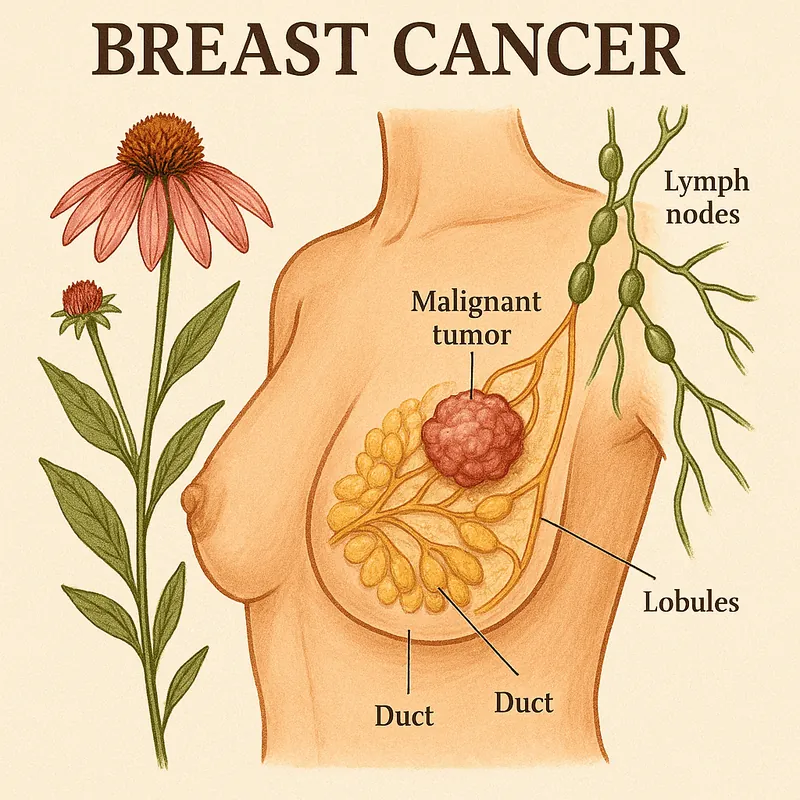
The most common cancer in women globally. ~70% are hormone-receptor positive. Risk is modulated by estrogen exposure, alcohol, body composition, vitamin D status, and gut microbiome (the "estrobolome"). Nutrition is a critical primary and secondary prevention lever.
Last updated:
Breast cancer is the most common cancer in women worldwide and the leading cause of cancer death in women globally. It arises from epithelial cells of breast ducts (~75%, ductal carcinoma) or lobules (~15%, lobular carcinoma). Modern classification by molecular subtype guides treatment dramatically.
Four main subtypes by receptor status: Luminal A (ER+/PR+/HER2-/low Ki-67), best prognosis; Luminal B (ER+/HER2+/- with high proliferation); HER2-enriched (ER-/HER2+); Triple-negative (ER-/PR-/HER2-), most aggressive but newer immunotherapies improving outcomes.
Risk factors include genetic (BRCA1/2, PALB2, CHEK2 mutations, 5-10% of cases), reproductive history (early menarche, late menopause, nulliparity), lifestyle (alcohol, obesity, sedentary), and environmental (radiation, hormone replacement therapy). The "estrobolome", gut bacteria that metabolize estrogens, is an emerging modifier of risk.
Cancer confined to ducts (DCIS) or small (β€2cm) without nodes. 5-year survival ~99%. Treatment: lumpectomy + radiation; possibly endocrine therapy if ER+.
Spread to distant sites, bones, lungs, liver, brain. 5-year survival ~30%. Increasingly treatable as chronic disease with newer targeted therapies, CDK4/6 inhibitors, ADCs.
Most early breast cancers are asymptomatic, found only by screening mammography. By the time symptoms appear, disease may be more advanced. Self-awareness matters.
Hard, painless, irregular borders, fixed in place. Most concerning when new and persistent. Most lumps are benign (cysts, fibroadenomas) but ALL new ones need evaluation.
Asymmetric swelling or shrinkage, breast distortion. Subtle changes may be the only sign. Comparison to old photos can help.
Dimpling, puckering, thickening, or skin texture like orange peel. May indicate inflammatory breast cancer (rare but aggressive) or skin invasion.
New nipple inversion (was previously normal), scaling/crusting/redness (suggests Paget disease), spontaneous bloody or clear discharge from one nipple.
Hard lump in axilla (armpit) or above collarbone. May be the first sign in some cases. Persistent enlargement warrants evaluation.
Persistent back, hip, or rib pain. Bone is the most common metastatic site for breast cancer. Always investigate persistent bone pain in cancer patients.
Constitutional symptoms, suggest advanced disease. Combined with bone/abdominal symptoms, raise concern for metastases.
May indicate lung or pleural metastases. New cough in breast cancer survivor warrants evaluation.
Standard screening from age 40 (USPSTF 40-74). 3D tomosynthesis improves detection in dense breasts. Diagnostic mammogram for evaluation of palpable findings.
Distinguishes cysts from solid masses. Used as adjunct in dense breasts or for evaluation of palpable findings. No radiation.
High-risk screening (BRCA carriers, lifetime risk >20%). Used for staging, evaluating extent. More sensitive but less specific than mammography.
Definitive diagnosis. Image-guided sampling of suspicious findings. Provides tissue for hormone receptor, HER2, Ki-67, and genomic testing.
For PREVENTION + ADJUNCT during/after conventional treatment. Never replaces oncologic care.
Mediterranean-style eating + cruciferous + soy + flax + low alcohol. The WHEL and WINS studies show diet impacts recurrence.
Broccoli, broccoli sprouts, cauliflower, kale, Brussels sprouts. Sulforaphane and indole-3-carbinol support estrogen detoxification toward protective metabolites.
Tempeh, edamame, miso, tofu. 1-2 servings/day. Reduces risk AND recurrence (Shanghai Breast Cancer Survival Study). Avoid isolated soy protein supplements.
Lignans modulate estrogen receptors; reduce tumor proliferation in clinical trials. Grind fresh or store ground in freezer.
Wild salmon, sardines, mackerel. Omega-3s anti-inflammatory; improve omega-3:omega-6 ratio.
Berries, green tea, dark chocolate, olive oil, herbs/spices. EGCG, resveratrol, quercetin, multiple anti-cancer mechanisms.
Each daily drink raises risk 7-10%. Ideally none, <1/day maximum. Alcohol elevates estrogens and damages DNA directly.
Limit red meat <3 servings/week; eliminate processed meats (bacon, sausage, deli). Heme iron, HCAs from cooking, nitrates contribute.
Drive insulin and IGF-1, cancer growth factors. Eliminate sodas, juices, sweets, white bread.
Mixed evidence. Some studies show increased risk with high intake of full-fat dairy. Choose organic; moderate intake; fermented forms (yogurt, kefir).
Strong associations with cancer in NutriNet-SantΓ© cohort. Trans fats, additives, emulsifiers may promote inflammation and dysbiosis.
CRITICAL: Discuss ALL supplements with oncology team. Some interact with chemo, endocrine therapy, anticoagulants. Best evidence: vitamin D, omega-3, melatonin, mushroom extracts (AHCC).
| Supplement | Mechanism & Evidence | Suggested Dose | Timing | Notes |
|---|---|---|---|---|
| Vitamin D3 | Strong inverse association with breast cancer. Levels >40 ng/mL associated with lower incidence and better survival. | 2,000-5,000 IU/day (titrate to 50-80 ng/mL) | With fat meal | Test baseline. Pair with K2 200mcg. |
| Omega-3 (EPA/DHA) | Anti-inflammatory; reduces aromatase activity; improves chemo tolerance. Higher tissue levels correlate with reduced recurrence. | 2,000-3,000mg EPA+DHA/day | With fat meal | Test omega-3 index. Pause before surgery (bleeding). |
| Melatonin | Anti-tumor effects in animal models. May enhance chemo efficacy and reduce side effects. Improves sleep. | 3-20mg at bedtime | 30 min before sleep | Higher doses (20-40mg) studied in metastatic disease, discuss with oncologist. |
| DIM (Diindolylmethane) | Promotes favorable estrogen metabolism (2-OH:16-OH ratio). Found in cruciferous vegetables. | 100-300mg/day | With food | Useful adjunct for ER+ disease. Discuss with oncologist if on endocrine therapy. |
| Curcumin (Bioavailable) | Anti-inflammatory, anti-proliferative, sensitizes tumors to chemo in lab studies. | 500-1,500mg/day (with piperine or liposomal) | With fat meal | Discuss timing around chemo with oncologist. |
| Mushroom Extracts (AHCC, Maitake, Reishi) | Beta-glucans support immune function. May reduce chemo-induced immunosuppression. | 1-3g/day | Empty stomach | AHCC has best evidence for immune support during treatment. |
| Magnesium | Often deficient; supports DNA repair. Helps with chemo-induced muscle cramps. | 200-400mg/day | Evening | Glycinate or threonate forms. |
| L-Glutamine (Chemo-Induced Neuropathy) | Reduces taxane-induced peripheral neuropathy and oral mucositis. | 10-30g/day during chemo | Between meals | Limited use during active chemo per oncologist guidance. CONTROVERSIAL, discuss. |
Breast cancer increasingly behaves like a chronic disease. Conventional oncologic care saves lives, and integrative nutrition, exercise, weight management, and mind-body practices significantly reduce recurrence risk and improve quality of life. Build a team that includes oncology + integrative medicine.