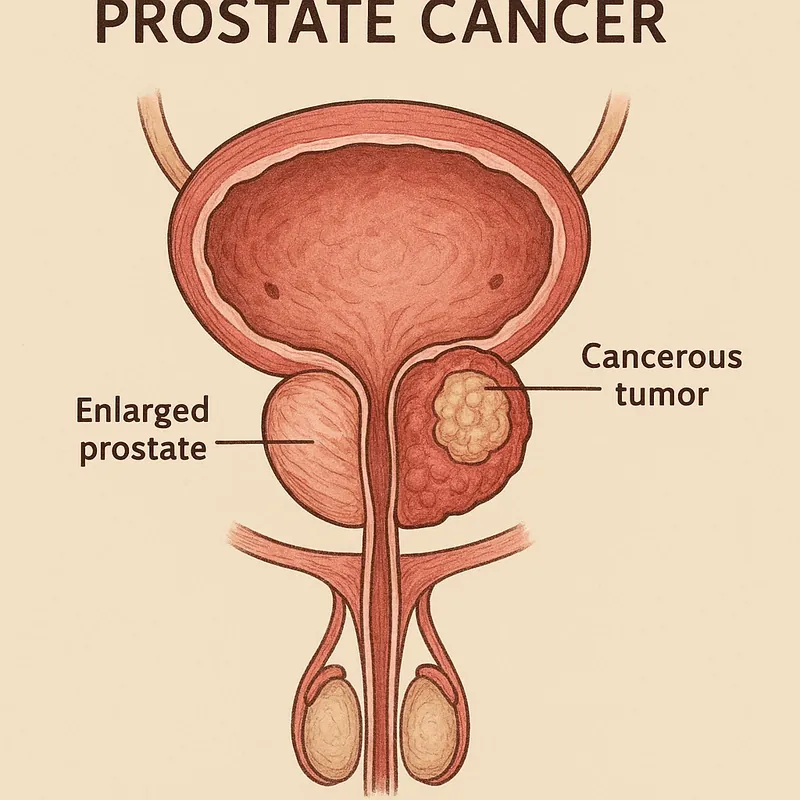
Prostate Cancer

The most common cancer in men. Often slow-growing; many cases never require treatment. Lifestyle factors, lycopene from tomatoes, omega-3, low animal fat, sufficient vitamin D, and aerobic exercise, significantly modify progression risk.

Cancer Evidence-Based Root-Cause Focus

Last updated:

What Is Prostate Cancer?

Prostate cancer arises from cells of the prostate gland, a walnut-sized organ below the bladder that produces seminal fluid. Most prostate cancers are adenocarcinomas. The disease is exceptionally heterogeneous, ranging from indolent tumors that never threaten life to aggressive cancers that rapidly metastasize.

Risk is influenced by age (rare under 50, common over 65), genetics (BRCA2, HOXB13, Lynch syndrome), race (highest in African American men), and lifestyle. The disease's androgen dependence drives both conventional treatment (androgen deprivation) and lifestyle approaches (managing IGF-1, insulin, inflammation).

The challenge is distinguishing "tigers" from "pussycats." Low-risk disease (Gleason โ‰ค6, PSA <10) often doesn't need immediate treatment, Active Surveillance with close monitoring spares men the side effects of overtreatment while preserving the option to treat if progression occurs.

๐Ÿ’ก Key Insight: Most men diagnosed with prostate cancer die WITH it, not FROM it. ~50% of 80-year-old men have microscopic prostate cancer at autopsy. Risk stratification (Gleason score, PSA dynamics, MRI, genomic tests) is essential, many men benefit from Active Surveillance rather than aggressive treatment.
Prostate Cancer illustration

Risk Stratification

๐ŸŒฑ Low / Very Low Risk

PSA <10, Gleason 6 (Grade Group 1), T1c-T2a. Active Surveillance preferred. Decades of life expectancy. Many never need treatment.

๐ŸŒ— Intermediate Risk

PSA 10-20 or Gleason 7 (Grade Groups 2-3) or T2b-T2c. Treatment usually indicated, surgery or radiation. Active Surveillance possible for select favorable intermediate.

๐ŸŒ‘ High Risk / Advanced

PSA >20, Gleason 8-10, or extracapsular extension. Aggressive treatment: surgery or radiation + ADT. Metastatic disease: ADT + chemo or newer agents.

~1 in 8
US men's lifetime risk
~290K
Annual US new diagnoses
~97%
5-year survival (all stages combined)
~50%
Of 80-year-olds have microscopic prostate cancer

Symptoms of Prostate Cancer

Most early prostate cancers are asymptomatic, found only by PSA screening or incidentally. Urinary symptoms usually indicate advanced disease OR more commonly benign prostatic hyperplasia (BPH).

๐Ÿšฝ Urinary Symptoms (Often BPH, Not Cancer)

๐Ÿ’ง

Difficulty Urinating

Weak or interrupted urine stream, straining to urinate, sense of incomplete emptying. Usually from BPH but warrants prostate evaluation.

๐ŸŒ™

Frequent Urination (Especially at Night)

Nocturia 2+ times nightly. Urgency. Frequent small voids during day. Most often BPH but evaluate.

๐Ÿฉธ

Blood in Urine or Semen

Hematuria or hematospermia. Always warrants evaluation. May indicate advanced prostate cancer, but more often other urologic causes.

๐Ÿ˜ฃ

Painful Urination or Ejaculation

May indicate prostatitis (more common), urethral involvement, or advanced cancer. Evaluation needed.

โš ๏ธ Advanced Disease

๐Ÿฆด

Bone Pain (Especially Spine, Pelvis, Ribs)

Persistent deep aching pain. Bone is the most common metastatic site. Spine metastases can cause cord compression, emergency.

๐Ÿฆต

Weakness or Numbness in Legs

Spinal cord compression, EMERGENCY. New-onset back pain with neurologic symptoms requires immediate evaluation. Permanent paralysis possible if delayed.

๐Ÿ˜ด

Unexplained Weight Loss & Fatigue

Constitutional symptoms of advanced disease. Anemia common from bone marrow involvement.

๐Ÿšฝ

Erectile Dysfunction (New Onset)

May indicate advanced local disease. More commonly age-related or due to other causes. Combination with urinary symptoms warrants prostate evaluation.

How Prostate Cancer Is Diagnosed

๐Ÿ” Screening & Detection

๐Ÿฉธ PSA (Prostate-Specific Antigen)

Blood test. Not cancer-specific (BPH, prostatitis also raise). PSA velocity (rise over time) and density (PSA/prostate volume) more informative than single values.

๐Ÿ‘† Digital Rectal Exam (DRE)

Palpates posterior prostate for nodules, asymmetry, induration. Insensitive (misses many tumors) but specific when abnormal. Adjunct to PSA.

๐Ÿ“ก Multiparametric MRI

3T MRI with PI-RADS scoring before biopsy. Reduces unnecessary biopsies and detects clinically significant cancers. Increasingly standard practice.

๐Ÿ”ฌ MRI-Targeted Biopsy

Image-guided sampling of MRI-detected lesions plus systematic cores. More accurate than systematic biopsy alone. Reports Gleason score, percent involvement.

๐Ÿงฌ Risk Stratification & Staging

๐Ÿงฌ Genomic Tests

Oncotype DX Prostate, Decipher, Prolaris. Assess aggressiveness and recurrence risk. Particularly useful for borderline Active Surveillance decisions.

๐Ÿงฌ BRCA & Germline Testing

Recommended for high-risk, metastatic, family history. BRCA2 carriers have more aggressive disease. PARP inhibitors available for BRCA-mutated metastatic.

๐Ÿ“ก Staging Imaging (High Risk)

For intermediate-unfavorable+: PSMA-PET (now standard, replaces conventional bone scan + CT). Highly sensitive for metastases.

๐Ÿฉธ Other Biomarkers

Free PSA, 4Kscore, PHI (Prostate Health Index), PCA3 urine test, refine PSA's specificity, reduce unnecessary biopsies.

Holistic vs. Conventional Treatment

๐ŸŒฟ HOLISTIC
๐Ÿ’Š CONVENTIONAL
๐ŸŒฟ

Holistic / Integrative Approach

Particularly relevant for Active Surveillance, prevention, and survivorship. Ornish lifestyle trial showed disease regression in early-stage.

Low-Risk Disease
Active Surveillance + aggressive lifestyle, Ornish trial showed disease regression markers
Prevention
Mediterranean + lycopene + omega-3 + low animal fat shifts risk profile dramatically
Survivorship
Reduce recurrence; manage ADT side effects (osteoporosis, metabolic syndrome, hot flashes)
Active Treatment
Adjunctive support, improves outcomes when combined with standard care
Lifestyle Strategies (Ornish-Style)
  • Plant-forward diet, Ornish trial: low-fat plant-based diet + lifestyle showed PSA stabilization and reduced cancer growth markers in Active Surveillance patients
  • Limit red and processed meat, strongest dietary risk factor. Heme iron, HCAs from grilling, IGF-1 elevation.
  • Lycopene from cooked tomatoes, 10+ servings/week of tomato sauce, paste, cooked tomatoes. Reduces aggressive prostate cancer risk ~30%.
  • Cruciferous vegetables daily, broccoli, kale, cauliflower. Sulforaphane has anti-prostate cancer activity.
  • Green tea 2-3 cups/day, EGCG modulates androgen receptor signaling
  • Omega-3 from fatty fish, anti-inflammatory; controversial if from supplements (some studies show possible increased risk at very high doses)
  • Pomegranate juice (4-8 oz/day), slows PSA doubling time in early studies
  • Vitamin D optimization, deficiency associated with worse prognosis. Target 50-80 ng/mL.
  • Regular vigorous exercise, 3+ hours/week vigorous activity reduces prostate cancer mortality ~30%
  • Limit dairy and calcium supplements, >1,500mg calcium/day associated with aggressive disease risk
  • Stress reduction, sleep, chronic stress suppresses anti-cancer immunity
  • Limit alcohol, <2 drinks/day; binge drinking particularly bad
  • For ADT patients: resistance training (preserves muscle), weight-bearing exercise (bones), Mediterranean diet (cardiometabolic protection)
โœ… Ornish Trial Insight: In low-risk prostate cancer on Active Surveillance, intensive lifestyle changes (plant-based diet + exercise + stress management + group support) led to PSA decreases and disease regression in over 90% of participants. Lifestyle IS a treatment for low-risk disease.

Diet for Prostate Cancer

Mediterranean + lycopene + cruciferous + plant-forward. Reduces risk of aggressive disease and slows progression.

โœ… Prioritize:

๐Ÿ… Cooked Tomato Products

Tomato sauce, paste, cooked tomatoes (10+ servings/week). Cooking + olive oil increase lycopene bioavailability 4x. 30% reduction in aggressive prostate cancer.

๐Ÿฅฆ Cruciferous Vegetables Daily

Broccoli, broccoli sprouts (especially), cauliflower, kale, cabbage. Sulforaphane has direct anti-prostate cancer activity.

๐Ÿต Green Tea (2-3 cups/day)

EGCG slows progression in early studies. May reduce risk of high-grade disease. Most effective when consumed regularly long-term.

๐ŸŸ Fatty Fish (2-3x/week)

Wild salmon, sardines, mackerel. Omega-3 anti-inflammatory. Avoid charred grilling.

๐Ÿ‡ Pomegranate (4-8 oz juice/day)

Slows PSA doubling time in recurrent disease. Antioxidant and anti-androgen effects in lab studies.

โŒ Limit Strictly:

๐Ÿฅฉ Red & Processed Meat

Strongest dietary risk factor. Especially well-done, grilled, or charred meats (HCAs, PAHs). Limit red meat <3 servings/week; eliminate processed.

๐Ÿฅ› High Dairy & Calcium

Total calcium >1,500mg/day associated with aggressive disease. Don't exceed dairy 1-2 servings/day. Avoid high-dose calcium supplements.

๐Ÿ” Trans Fats & Fried Foods

Pro-inflammatory. Associated with aggressive prostate cancer. Eliminate fast food, commercial baked goods, hydrogenated oils.

๐Ÿž Refined Carbs & Sugar

Drive insulin and IGF-1, growth factors for prostate cancer. White bread, sodas, sweets, juices.

๐Ÿท Heavy Alcohol

>2 drinks/day increases risk and may worsen prognosis. Heavy or binge drinking particularly harmful.

Evidence-Based Supplements

Best evidence: vitamin D, omega-3 (cautiously), lycopene, pomegranate, sulforaphane. ALWAYS discuss with urology/oncology team.

SupplementMechanism & EvidenceSuggested DoseTimingNotes
Vitamin D3Deficiency associated with aggressive disease and worse mortality. Anti-proliferative in lab studies.2,000-5,000 IU/day (titrate to 50-80 ng/mL)With fat mealTest baseline. Pair with K2 200mcg.
LycopeneCarotenoid concentrating in prostate. Food sources (cooked tomato) likely better than isolated supplements.15-30mg/day from supplement OR daily cooked tomatoesWith fat mealSynergy with cooking and olive oil.
Pomegranate ExtractSlows PSA doubling time. Anti-androgen effects in lab. Multiple bioactive compounds.8 oz juice/day OR 250-500mg extractWith foodReal fruit/juice preferred over extract.
Sulforaphane (or Broccoli Sprouts)Activates Nrf2 antioxidant pathway. Modulates androgen receptor. Best from fresh broccoli sprouts.20-100mg sulforaphane/day OR 2-4 oz fresh broccoli sproutsEmpty stomachSprouts have ~100x sulforaphane of mature broccoli. Activate with chewing or chopping.
Omega-3 (EPA/DHA)Anti-inflammatory. Mixed evidence in prostate cancer (some studies show increased risk at very high doses), moderate from food preferred.1,000-2,000mg EPA+DHA/day from supplement OR fatty fishWith fat mealFood-based preferred. Discuss high-dose supplements with oncologist.
Green Tea Extract (EGCG)Multiple anti-cancer mechanisms. Best evidence for prevention/early disease.500-1,000mg EGCG/dayEmpty stomachLiver toxicity rare at high doses. Discontinue if liver enzymes elevate.
SeleniumSELECT trial showed no benefit and possible harm from synthetic selenomethionine. Brazil nuts safer.1-2 Brazil nuts/day (food source)With foodDO NOT take selenium supplements based on current evidence, possible harm.
Modified Citrus PectinBinds galectin-3 (involved in metastasis). Small studies show PSA modulation.5g 3x/dayEmpty stomachLimited evidence but generally safe. Considered for advanced disease.

Choose Treatment Carefully

Many prostate cancers don't need aggressive treatment. Work with a urologist who supports Active Surveillance for appropriate cases, avoiding overtreatment matters as much as treating aggressive disease. Lifestyle changes (especially Ornish-style intervention) can be powerful for low-risk disease and survivorship.