Obesity

A chronic, relapsing condition in which excess body fat raises the risk of other disease. Roughly one in eight people worldwide now lives with obesity1. The biology that defends body weight is powerful and well described, which is why this is treated as a medical condition rather than a matter of resolve.

Metabolic Evidence-Based Root-Cause Focus

Last updated:

What Is Obesity?

Excess adipose tissue in an amount that harms health. The important word is adipose, because the problem is what fat tissue does hormonally and inflammatorily, not what a body looks like.

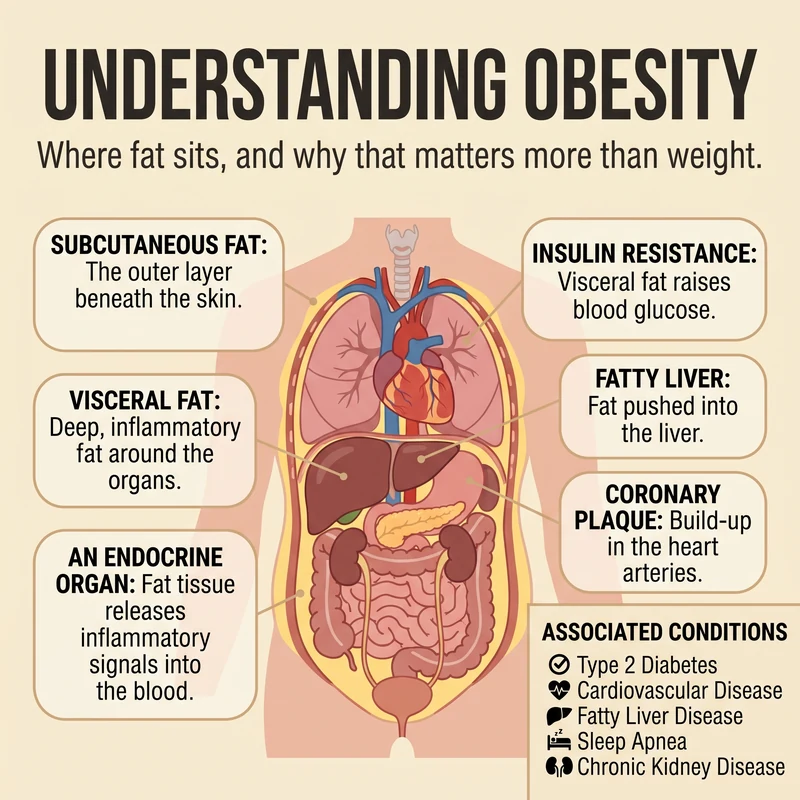
Where that fat sits matters more than how much of it there is. Subcutaneous fat, the layer under the skin, is comparatively inert. Visceral fat, packed around the liver, pancreas and intestines, behaves like an active endocrine organ: it releases inflammatory signals and free fatty acids straight into the portal circulation, which is the route by which it drives insulin resistance, raises blood pressure and pushes fat into the liver.

That is why two people at the same weight can have very different metabolic risk, and why a tape measure around the waist often tells you more than the number on a scale.
💡 Key Insight: Body weight is physiologically defended. After weight loss, circulating ghrelin rises and leptin falls, and in one study those changes were still measurable a full year after the diet ended2. Appetite after weight loss is a regulated biological signal, not a lapse of discipline. And weight loss is not the goal in every condition. In COPD and in sarcopenia being underweight carries the greater risk, so if you have either, any weight loss should be deliberate, supervised and protective of muscle.
Anatomical cutaway of a torso showing the subcutaneous fat layer beneath the skin and the visceral fat surrounding the liver, pancreas and intestines, with labels for insulin resistance, fatty liver and coronary plaque, beside a list of associated conditions

🧬 Why fat tissue matters

Adipose tissue is an endocrine organ. As it expands it releases inflammatory signals and free fatty acids that drive insulin resistance, raise blood pressure and push fat into the liver.

📏 Why BMI is limited

BMI is a population screening tool. It cannot distinguish muscle from fat or say where fat sits, and it performs differently across ethnic groups. It is a starting point for a conversation, not a diagnosis.

🍳 Why it is not simply intake

Genetics, sleep, medication, the food environment, socioeconomic constraint and previous dieting all shift the level a body settles at. Two people eating identically do not arrive at the same place.

⚠️ On language, deliberately. This page says people living with obesity rather than obese people, and it gives no target weight, calorie figure or rate of loss. Weight stigma is associated with worse health behaviour and worse outcomes, and numeric targets are the part of weight advice most likely to harm a reader with disordered eating. If food, weight or your body has become a source of distress, or eating feels out of control, that deserves care in its own right. Please speak to your doctor.

How Obesity Affects the Body

Obesity is usually identified by measurement rather than by symptoms. What follows are the conditions it raises the risk of, and the signs worth acting on.

🫀 Metabolic and cardiovascular

Type 2 diabetes, high blood pressure, raised triglycerides and low HDL, and fatty liver. Weight loss of 5 to 10% measurably improves blood pressure, triglycerides and glycaemic control3, and substantial weight loss can put type 2 diabetes into remission4.

😴 Sleep and breathing

Obstructive sleep apnea is common and frequently undiagnosed. Loud snoring, witnessed pauses in breathing, unrefreshing sleep and daytime sleepiness are worth raising with your doctor, because treating it improves blood pressure, mood and daytime function.

🦴 Joints and mobility

Load-bearing joints, particularly knees, carry a multiple of body weight with each step. Pain limits activity, and reduced activity compounds the problem, which is why keeping movement tolerable matters more than making it intense.

🧠 Mood and quality of life

Depression and obesity each raise the risk of the other. In a large trial of intensive lifestyle change, participants improved on depression scores, sleep apnea, mobility and physical function5, and those gains are worth having in their own right.

🚨 Seek medical assessment promptly for: chest tightness or pressure on exertion, breathlessness on mild exertion or when lying flat, witnessed pauses in breathing during sleep, a swollen or painful calf, or unintentional weight loss you did not set out to achieve. Unplanned weight loss in particular should always be investigated rather than welcomed.

How Obesity Is Assessed

A number on a scale describes very little on its own. What follows is what a thorough assessment actually looks at.

MeasureWhat it tells youWhat it misses
Body mass indexA quick population-level screen, and the entry point for most clinical pathwaysCannot separate muscle from fat, says nothing about fat distribution, and thresholds perform differently across ethnic groups
Waist circumferenceAbdominal fat, which carries most of the metabolic riskMeasurement technique varies, and it is affected by posture and breathing
Waist-to-height ratioAbdominal fat scaled to body size, useful across a range of heightsStill an external proxy for what is happening inside
HbA1c and fasting glucoseWhether glucose handling has already been affectedCan be normal while insulin resistance is well established
Lipid panel and blood pressureCardiovascular risk that is treatable now, independent of weightSingle readings mislead; blood pressure needs repeating
Liver enzymes and imagingFatty liver, which frequently travels with obesityEnzymes can be normal in significant steatosis; see the NAFLD guide
Sleep apnea screeningA common, treatable and frequently missed contributor to fatigue and blood pressureRequires asking; it is rarely volunteered
Thyroid functionAn uncommon but correctable contributor; see thyroid disordersRarely the whole explanation, and treating it alone seldom resolves weight
💡 Ask what changed, and when. Weight gain that began with a new medication, a pregnancy, a shift to night work, an injury that stopped exercise, or a period of food insecurity has a different starting point from weight carried since childhood. Several common prescriptions cause weight gain as a recognised effect. That is worth reviewing with your prescriber, and it is never a reason to stop a medicine on your own.

Holistic vs. Conventional Treatment for Obesity

🌿 HOLISTIC
💊 CONVENTIONAL
🌿

Holistic / Functional Approach

Diet quality, protein and fibre adequacy, sleep, resistance training, and treating what is treatable

What Diet Quality Buys
Weight loss of 5 to 10% measurably improves blood pressure, triglycerides, HDL and glycaemic control3
Which Diet
Healthy low-fat and healthy low-carbohydrate diets produced no significant difference over 12 months in 609 adults7. Adherence beats macronutrient split
Timeline
Blood pressure and glycaemic markers shift within weeks; the scale moves unevenly and plateaus are normal, not failure
Advantage
Much of the cardiometabolic benefit arrives before, and independently of, weight change, which is a reason to continue when the scale stalls

Full Holistic Approach Includes

  • Diet quality first, more vegetables, legumes and intact whole grains, less added sugar and refined starch. This is the change both arms of DIETFITS were asked to make.
  • Protein at each meal, which supports satiety and helps preserve lean mass while losing weight.
  • Fibre from food, for satiety and glycaemic steadiness.
  • Fewer ultra-processed foods, which drove about 500 extra calories a day in a controlled inpatient study without anyone being asked to eat more8.
  • Sleep, since short sleep raises appetite and worsens glucose handling.
  • Resistance training, to protect muscle, alongside activity you will actually repeat.
  • Treating what is treatable, particularly sleep apnea, depression and joint pain, each of which makes everything else harder.
🌿 Worth knowing: this approach is foundational, and for many people it is not sufficient on its own. That is a statement about the biology of a defended body weight, not about the person following it.

Diet for Obesity

The evidence here is unusually clear, and unusually unglamorous.

💡 The diet you pick matters less than you would expect. DIETFITS randomised 609 adults to a healthy low-fat or a healthy low-carbohydrate diet for twelve months. Both groups lost weight, and the difference between them was not statistically significant. Neither genotype pattern nor insulin secretion predicted who did better on which7. What people in both arms were asked to do was eat more vegetables and less added sugar and refined grain, and keep going.

✅ Emphasise

  • Vegetables and legumes, volume and fibre for comparatively little energy
  • Intact whole grains, oats, barley, brown rice, rather than flour made from them
  • Protein at each meal, fish, eggs, poultry, dairy, beans, lentils, tofu
  • Whole fruit, which behaves quite differently from juice
  • Water, tea and coffee as the default drinks

❌ Reduce

  • Sugar-sweetened drinks, the clearest single target in the whole diet
  • Ultra-processed foods, for the reason set out below
  • Refined starches eaten alone, without protein, fat or fibre alongside
  • Alcohol, energy-dense, appetite-raising, and a Group 1 carcinogen in its own right
💡 How food is made may matter as much as what is in it. Twenty adults lived on a metabolic ward and ate an ultra-processed diet and a minimally processed diet, matched for calories offered, sugar, fat, fibre and protein, each eating freely. On the ultra-processed diet they ate roughly 500 calories more per day without being asked to, and gained weight; on the minimally processed diet they lost it8. The study is small, and it is one of the most tightly controlled feeding studies available.
⚠️ Movement is worth it even when the scale does not move. Cardiorespiratory fitness and physical activity are associated with lower mortality across the range of body sizes9. Blood pressure, triglycerides, insulin sensitivity, sleep and mood all improve with better eating and more movement, and much of that improvement arrives before, and independently of, weight change. That is a reason to keep going when the scale stalls, which it will.

Evidence-Based Supplements

This is the shortest supplement section on this site, and that is the finding rather than an omission.

🚨 No supplement produces clinically meaningful weight loss. Weight-loss supplements are among the most heavily marketed products in existence and among the least supported. Several have been associated with liver injury serious enough to require transplantation, and the category is not reviewed for safety or effectiveness before sale10. Nothing below is offered as a route to weight loss. These are for correcting shortfalls and supporting the work that diet and activity are doing.
SupplementWhat it is actually forTypical rangeTimingNotes & cautions
Vitamin D3 Correcting a documented deficiency, which is more common at higher body weight because vitamin D distributes into adipose tissue. It supports bone and immune function. Test 25-OH-D first and set the dose with your clinician With a fat-containing meal Trials of vitamin D given for weight loss have not shown meaningful benefit11. Correct a deficiency because it is a deficiency, not as a weight strategy. Target 40 to 60 ng/mL, the Endocrine Society's preferred range, and retest at 3 months.
Viscous fibre (psyllium, glucomannan) Satiety and glycaemic steadiness where dietary fibre is hard to reach from food alone. 3 to 10 g per day, divided With water, before meals Increase slowly to avoid bloating. Take at least 2 hours apart from medication, since viscous fibre can reduce absorption. Anyone with a stricture or a history of bowel obstruction should not take bulking fibre without medical advice.
Protein powder (whey, casein or soy) Reaching protein targets during weight loss, which helps preserve lean mass. Food first; this is a convenience, not an upgrade. 20 to 40 g per serving as needed to reach intake from food plus supplement Around resistance training or at the meal lowest in protein Choose a product with a short ingredient list. Anyone with reduced kidney function should agree protein intake with their clinician, since the right target differs; see chronic kidney disease.
Creatine monohydrate Supporting strength and lean mass alongside resistance training, which matters because weight loss costs muscle as well as fat. 3 to 5 g per day Any time, consistently Well studied for strength, not for fat loss. Causes a small rise in scale weight from muscle water, which is worth expecting rather than misreading. Discuss with your clinician if you have kidney disease.
🚨 What to avoid, specifically. Garcinia cambogia, green coffee bean extract, raspberry ketone, bitter orange and combination “fat burner” and “thermogenic” products. The weight-loss evidence for these is weak or absent, several are associated with liver injury, and stimulant-containing blends raise heart rate and blood pressure10. Products bought online have repeatedly been found to contain undeclared pharmaceutical ingredients. If a product promises weight loss without changing anything else, that claim alone is the reason to be sceptical.
💡 Where the real leverage is. Sleep, protein, fibre, resistance training and treating sleep apnea, depression and joint pain. None of it is sold in a bottle, and all of it has better support than anything that is.

References & Evidence Notes

Each numbered entry below is either a source you can follow or a note setting out what the evidence does and does not support. Both are numbered together so the markers in the text line up.

Last reviewed 27 August 2026. Supplement entries are cross-checked against the NIH National Center for Complementary and Integrative Health and the Linus Pauling Institute Micronutrient Information Center.12 This page is nutrition education, not medical advice, and it does not replace your doctor. Nutrition does not treat obesity on its own, and nothing here is offered as an alternative to medication or surgery, both of which are legitimate treatments for a chronic condition with strong biological drivers. What nutrition education can do is help you understand the evidence well enough to have a better conversation with the clinician who does treat you.

  1. World Health Organization, obesity and overweight fact sheet, drawing on the NCD Risk Factor Collaboration pooled analyses of measured height and weight worldwide. who.int
  2. Sumithran P, et al. Long-term persistence of hormonal adaptations to weight loss. N Engl J Med. 2011;365(17):1597–1604. PubMed 22029981. Fifty participants completed a ten-week very-low-energy diet; ghrelin remained raised and leptin and peptide YY remained reduced at 12 months, alongside greater reported appetite.
  3. Wing RR, et al. Benefits of modest weight loss in improving cardiovascular risk factors in overweight and obese individuals with type 2 diabetes, a Look AHEAD analysis. Diabetes Care. 2011;34(7):1481–1486. PubMed 21593294. Weight loss of 5 to 10% was associated with improvements in HbA1c, blood pressure, triglycerides and HDL.
  4. Lean MEJ, et al. Primary care-led weight management for remission of type 2 diabetes (DiRECT), an open-label cluster-randomised trial. Lancet. 2018;391(10120):541–551. PubMed 29221645. Remission was strongly related to the amount of weight lost, reaching 86% among those losing 15 kg or more. See the diabetes guide.
  5. The Look AHEAD Research Group. Cardiovascular effects of intensive lifestyle intervention in type 2 diabetes. N Engl J Med. 2013;369(2):145–154. PubMed 23796131. 5,145 adults; the trial was stopped early for futility on the primary cardiovascular endpoint after a median 9.6 years, despite greater weight loss and improved fitness in the intervention arm. Secondary analyses reported benefits for sleep apnea, mobility, depression and quality of life.
  6. Sjostrom L, et al. Effects of bariatric surgery on mortality in Swedish obese subjects. N Engl J Med. 2007;357:741–752. PubMed 17715408. A prospective matched cohort rather than a randomised trial, which is a real limitation, reporting reduced overall mortality over a mean 10.9 years of follow-up.
  7. Gardner CD, et al. Effect of low-fat vs low-carbohydrate diet on 12-month weight loss in overweight adults and the association with genotype pattern or insulin secretion (DIETFITS). JAMA. 2018;319(7):667–679. PubMed 29466592. 609 adults; weight change at 12 months was −5.3 kg on the healthy low-fat diet and −6.0 kg on the healthy low-carbohydrate diet, a between-group difference of 0.7 kg (95% CI −0.2 to 1.6), which was not significant. Neither genotype pattern nor insulin secretion predicted differential response.
  8. Hall KD, et al. Ultra-processed diets cause excess calorie intake and weight gain, an inpatient randomised controlled trial of ad libitum food intake. Cell Metab. 2019;30(1):67–77. PubMed 31105044. Twenty adults, crossover design, diets matched for presented calories, sugar, fat, fibre and macronutrients; intake was about 500 kcal per day higher on the ultra-processed diet, with weight gain on that arm and weight loss on the other.
  9. Reviews of cardiorespiratory fitness and physical activity consistently find lower all-cause mortality at higher fitness across categories of body mass index: a meta-analysis found unfit individuals had roughly twice the mortality risk of normal-weight fit individuals regardless of BMI, PubMed 24438729. The observational design means fitness and mortality share confounders, so this supports pursuing activity for its own benefits rather than proving that fitness cancels the risks associated with adiposity.
  10. National Institute of Diabetes and Digestive and Kidney Diseases, LiverTox, on herbal and dietary supplements associated with liver injury, including weight-loss products. LiverTox. See also the NIH Office of Dietary Supplements fact sheet on weight-loss supplements, which concludes the evidence for effectiveness is limited and the safety of many ingredients is not established. ods.od.nih.gov
  11. Randomised trials and meta-analyses of vitamin D supplementation given for weight reduction report no clinically meaningful effect on body weight. Low 25-OH-D is common at higher body weight because vitamin D distributes into adipose tissue, which is a reason to test and correct it, not a reason to expect weight change from doing so.
  12. NIH National Center for Complementary and Integrative Health, nccih.nih.gov, and the Linus Pauling Institute Micronutrient Information Center, lpi.oregonstate.edu.