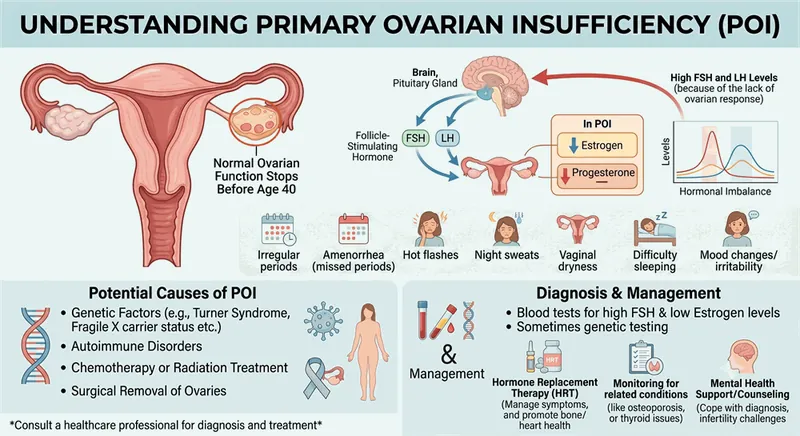
A loss of normal ovarian function before age 40, often presenting as irregular periods, hot flashes, and elevated FSH. Affects roughly 1 percent of women under 40 and 1 in 1000 under age 30, with major implications for fertility, bone, brain, and cardiovascular health.
Last updated:
POI is the loss of normal ovarian function before age 40, due to a decline in egg quantity or quality, or an autoimmune or genetic disruption of follicular activity. It is not simply "early menopause," because ovarian function in POI can fluctuate, and roughly 5 to 10 percent of women conceive spontaneously even after diagnosis.
The diagnostic standard is the presence of oligo- or amenorrhea for at least 4 months with two elevated FSH levels above 25 mIU/mL drawn at least 4 weeks apart, in a woman under 40. AMH is usually very low or undetectable, and estradiol is often (though not always) low. POI is different from "diminished ovarian reserve," which describes reduced fertility potential but preserved ovulation and cycles.
POI has profound downstream consequences if untreated, increased fracture risk from accelerated bone loss, higher cardiovascular and cognitive risk from premature estrogen loss, and a sharp drop in fertility. There are four main etiologic categories of POI, each with different implications for treatment and family-building plans:
"Primary ovarian insufficiency affects approximately 1 percent of women under 40 and is associated with increased risks of cardiovascular disease, osteoporosis, and cognitive decline if estrogen is not adequately replaced until the average age of natural menopause."
β ESHRE Guideline on POI, 2024 updateThe largest single category (~50%), where no clear cause is identified after thorough workup. Likely reflects a mix of subtle autoimmune, genetic, environmental, and oxidative-stress contributors.
Caused by ovarian damage from chemotherapy (especially alkylating agents), pelvic radiation, or bilateral ovarian surgery. Increasingly common as more young women survive cancer treatment.
~10 to 13% of POI is linked to FMR1 premutations (Fragile X-associated POI), Turner syndrome variants (45,X mosaics, structural X abnormalities), and other rare gene mutations. Strongly heritable, with family-counseling implications.
POI shows up as menopause-like symptoms appearing decades early, plus the emotional impact of an unexpected fertility limitation. The combination of reproductive, vasomotor, and systemic features in a woman under 40 should always trigger an FSH check.
Cycles that lengthen, skip, or stop entirely before age 40. May follow a "perimenopause-like" pattern of unpredictability, or stop abruptly after coming off contraception. Greater than 4 months of amenorrhea in a woman under 40 warrants FSH testing.
Often the presenting concern. Couples may struggle to conceive without realizing the egg pool is severely depleted. Low AMH and high FSH usually reveal the diagnosis, although intermittent ovulation means spontaneous conception is still occasionally possible.
Low estrogen thins vaginal tissue and reduces natural lubrication, causing burning, irritation, and painful intercourse. Genitourinary syndrome of menopause appears decades earlier than expected in POI.
Reduced sexual desire and arousal driven by lower estrogen and testosterone production. Often layered with body-image and relationship grief tied to the diagnosis.
Estrogen is the primary brake on bone resorption. POI without HRT triples osteoporosis risk by midlife. Bone-density (DEXA) testing is part of the standard POI workup.
Premature estrogen loss accelerates atherosclerosis, lipid changes, and endothelial dysfunction. Women with untreated POI have roughly double the long-term cardiovascular mortality risk.
Sudden flushing, sweating, and palpitations triggered by estrogen withdrawal. In POI, these can appear in the teens, 20s, or 30s and are often dismissed as "stress" or anxiety until FSH is checked.
Difficulty falling asleep, staying asleep, and frequent night sweats. Estrogen loss disrupts both sleep architecture and core temperature regulation, often years before a woman would consider it "menopausal."
Word-finding difficulty, lost trains of thought, and slower processing. Estrogen modulates hippocampal and prefrontal-cortex function; sudden withdrawal is cognitively measurable and reversible with adequate HRT.
Both the biological effect of estrogen loss and the psychological impact of fertility loss feed into elevated rates of anxiety and depression. Mental-health support is part of best-practice POI care, not optional.
Estrogen helps maintain cartilage and connective tissue. POI often causes new-onset stiffness, particularly morning stiffness, that can be misread as early rheumatologic disease.
Pervasive fatigue layered on poor sleep, hormonal shifts, and the emotional weight of the diagnosis. Worth screening for coexisting thyroid disease, adrenal insufficiency, and iron deficiency, all over-represented in POI.
Diagnosis is built on cycle history and two elevated FSH values (greater than 25 mIU/mL) at least 4 weeks apart, in a woman under 40 with at least 4 months of irregular or absent periods. Genetic and autoimmune workup follow.
These observations build the case for formal testing, especially when symptoms are subtle or attributed to stress:
Log cycle length, period flow, hot flashes, night sweats, vaginal dryness, sleep quality, and mood for at least 3 cycles. Apps like Clue, Flo, or Natural Cycles make this easy. Cycles that lengthen by more than a week, skip entirely, or show menopause-like symptoms in your 20s or 30s warrant FSH and AMH.
Check for relatives with early menopause (before 45), POI, fragile X syndrome, fragile X-associated tremor/ataxia, autoimmune diseases (Hashimoto's, type 1 diabetes, Addison's), or unexplained infertility. A strong family history can shift workup priorities to early FMR1 testing and karyotype.
Score 1 point for each: skipped or shortening cycles, hot flashes, night sweats, vaginal dryness, low libido, painful sex, brain fog, new-onset anxiety or insomnia, joint stiffness, family history of early menopause, autoimmune disease. Score of 4 or more under age 40 strongly suggests checking FSH and AMH.
POI is one of the conditions where holistic and conventional approaches are most clearly complementary, hormone replacement is generally indicated until the natural age of menopause (~51), with holistic support layered on top to optimize bone, cardiovascular, mood, and fertility outcomes.
Layer onto appropriate HRT, support remaining ovarian function, protect bone & heart, address autoimmune & inflammatory drivers
POI is the final common pathway of many upstream drivers, genetic, autoimmune, iatrogenic, environmental, and idiopathic. Identifying which categories contribute most in a given case guides both family-counseling and the holistic plan.
| Root Cause | How It Contributes to POI | Holistic Solution |
|---|---|---|
| FMR1 Premutation (Fragile X) | CGG repeats of 55 to 200 in the FMR1 gene disrupt follicular development, accounting for ~6 percent of sporadic and ~13 percent of familial POI. Carries family-planning and FXTAS risk. | Genetic counseling for relatives, fertility preservation considered early, donor-egg pathway if needed, HRT for cardiovascular & bone protection |
| Autoimmune Oophoritis | Lymphocytic infiltration of ovarian tissue, often co-occurring with autoimmune thyroid, adrenal, or pancreatic disease. Anti-ovarian, anti-adrenal antibodies may be present. | Autoimmune-protocol diet trial, gluten/dairy elimination, gut healing, vitamin D, omega-3, low-dose naltrexone considered, treat coexisting autoimmune disease |
| Chemotherapy & Radiation | Alkylating agents and pelvic radiation directly damage primordial follicles. Risk depends on agent, dose, and age at exposure; older age and higher dose mean higher risk. | Fertility preservation before treatment (egg/embryo/ovarian tissue cryopreservation), GnRH agonist co-administration when appropriate, post-treatment mitochondrial support |
| Turner Syndrome & X-Chromosome Variants | 45,X classic Turner, 45,X/46,XX mosaic, and structural X abnormalities accelerate follicle atresia, often producing POI in adolescence or early adulthood. | See Turner Syndrome page for full protocol, karyotype at diagnosis, growth/cardiac/renal monitoring, fertility & HRT counseling |
| Viral Infections (Mumps, HIV, CMV) | Direct viral oophoritis can damage follicles. Mumps oophoritis is now uncommon thanks to vaccination but historically significant. | MMR vaccination, treat underlying infection, immune-modulating nutrition, vitamin D, zinc, gut support |
| Endocrine-Disrupting Chemicals | Phthalates, BPA, PFAS, pesticides, and tobacco smoke accelerate follicle depletion in animal and human studies. Effects are cumulative over decades. | Glass / stainless instead of plastic, fragrance-free personal care, EWG Clean Fifteen / Dirty Dozen, filter water, swap conventional cosmetics |
| Cigarette Smoking | Smokers experience menopause 1 to 4 years earlier than non-smokers and have higher POI rates. Polycyclic aromatic hydrocarbons damage ovarian DNA. | Smoking cessation, NRT, behavioral support, antioxidant-rich diet, NAC, vitamin C, glutathione support |
| Oxidative Stress & Mitochondrial Dysfunction | Eggs are uniquely vulnerable to oxidative damage because they sit dormant for decades. Mitochondrial decline accelerates follicle loss and impairs egg quality. | Mitochondrial support, CoQ10 (ubiquinol), ALA, NAC, omega-3, B-vitamins, sleep, time-restricted eating, strength training |
| Pelvic / Ovarian Surgery | Bilateral oophorectomy is the most extreme case; even unilateral or endometrioma removal removes follicle pool. Cystectomies in young women should be conservative. | Tissue-sparing surgery when possible, AMH check before and after surgery, fertility preservation pre-op if oophorectomy planned |
| Severe Stress & HPA-Axis Dysregulation | Chronic stress and HPA dysregulation do not cause POI alone, but worsen its symptoms and accelerate menopausal-style decline. | Stress and HPA-axis work, breath work, vagal tone, daylight exposure, magnesium, adaptogens, therapy, sleep hygiene |
Nutrition cannot reverse follicle depletion, but it is the single highest-leverage tool for protecting bone, brain, heart, and remaining ovarian function. The pattern emphasizes anti-inflammatory, antioxidant-rich, calcium- and protein-adequate eating.
The POI-supportive eating pattern is essentially a Mediterranean + autoimmune-aware framework, focused on lowering oxidative stress on remaining follicles, providing the building blocks for bone and connective tissue, and reducing the inflammation that drives autoimmune disease.
The framework, anchor every meal with quality protein, fill half the plate with colorful vegetables, layer in healthy fats, ensure 3 to 4 calcium-rich foods per day, and emphasize polyphenol-rich foods at every meal. Carbohydrates come primarily from whole-food, slow-glycemic sources.
Supplements support remaining ovarian function, bone & cardiovascular protection, mood, and sleep. They are not a substitute for HRT. Coordinate with your physician, especially if you are on hormone replacement.
| Supplement | Role in POI Recovery | Suggested Dose | Timing | Notes |
|---|---|---|---|---|
| DHEA | Adrenal precursor to estrogen and testosterone. Multiple small trials suggest improved ovarian response and (modestly) IVF outcomes in poor responders. Discuss with reproductive endocrinologist. | 25 to 75 mg per day (typically 50 mg) | Morning with food | Monitor for acne, hirsutism, mood changes; check DHEA-S after 8 to 12 weeks. |
| Coenzyme Q10 (Ubiquinol) | Mitochondrial fuel for the few remaining oocytes. Most-studied supplement for egg quality, especially over age 35. | 200 to 600 mg ubiquinol per day | With a fat-containing meal, morning preferred | Ubiquinol is the more bioavailable form. Combine with omega-3. |
| Vitamin D3 (with K2) | Critical for bone, immune regulation, follicle development, and mood. Deficiency aggravates autoimmune POI and bone loss. | 2000 to 5000 IU D3 + 100 to 200 mcg MK-7 K2 per day | With a fat-containing meal, morning preferred | Test 25-OH-D; target 50 to 80 ng/mL. |
| Calcium (with Magnesium & K2) | Bone-mineralization foundation, especially important when HRT alone may not fully protect bone. Pair with K2 to direct calcium to bone, not arteries. | 500 to 1000 mg/day from food + supplement combined | Split doses, with meals | Food-first; supplement only if dietary calcium falls below 1000 mg/day. Avoid more than 500 mg in a single dose. |
| Magnesium Glycinate | Supports sleep, bone density, GABA balance, hot-flash modulation, and progesterone production. | 300 to 500 mg elemental magnesium per day | Evening, 30 to 60 min before bed | Glycinate is the calmest form. |
| Omega-3 EPA/DHA | Reduces inflammation, supports cardiovascular health, brain function, and mood. Particularly important in autoimmune POI. | 2 to 3 g combined EPA+DHA per day | With meals | Choose IFOS-certified for purity. |
| N-Acetylcysteine (NAC) | Boosts glutathione; reduces oxidative stress on follicles. Some evidence of improved ovarian response in poor responders. | 1200 to 1800 mg per day | Empty stomach, split twice daily | Particularly useful in autoimmune POI. |
| Myo-inositol + D-Chiro Inositol (40:1) | Improves oocyte quality and supports ovarian sensitivity to gonadotropins. Useful in IVF-cycle planning. | 4 g myo + 100 mg D-chiro per day | Split AM/PM with or without food | 3 to 6 months for full effect. |
| Alpha-Lipoic Acid (ALA) | Mitochondrial antioxidant; supports egg quality and insulin sensitivity. Reduces oxidative stress on remaining follicles. | 600 to 1200 mg per day, R-ALA preferred | 30 minutes before meals on an empty stomach | Can lower blood sugar; monitor if on diabetes medications. |
| L-Carnitine (Acetyl-L-Carnitine) | Mitochondrial transport; improves egg quality and metabolic flexibility. Limited but encouraging data in POI/poor responders. | 1000 to 3000 mg per day | Morning, empty stomach | Vegetarians and vegans are often deficient. |
| Vitamin E (Mixed Tocopherols) | Lipid-soluble antioxidant for ovarian and uterine tissue; supports skin and cardiovascular health. | 200 to 400 IU per day | With a fat-containing meal | Pause 1 to 2 weeks before surgery (mild antiplatelet). |
| Selenium | Required for glutathione peroxidase and thyroid function. Often low in autoimmune POI. | 100 to 200 mcg per day | With food | Two Brazil nuts per day is a food alternative. |
| Zinc | Required for ovulation, immune function, and bone metabolism. Often low in restrictive eating patterns. | 15 to 30 mg per day | With meals | Add 1 to 2 mg copper if using more than 8 weeks at higher doses. |
| Methylated B-Complex | Supports methylation, neurotransmitter balance, and homocysteine metabolism. Particularly relevant for mood, sleep, and cardiovascular protection. | 1 capsule per day per product label | Morning with food | Choose forms with L-methylfolate and methylcobalamin. |
| Black Cohosh | Evidence-based herb for hot flashes and night sweats, modest but real effect. Useful for women who cannot tolerate full HRT. | 40 to 80 mg standardized extract per day | Morning with food | Use the well-studied Remifemin formulation; avoid in liver disease. |
| Maca Root | Adaptogen with traditional use for libido, energy, and mood. Modest evidence in perimenopausal symptoms. | 1500 to 3000 mg per day | Morning with food | Choose gelatinized organic maca; pause if it worsens insomnia. |
| Ashwagandha | Adaptogen for HPA-axis support, sleep, and anxiety. Modest improvement in thyroid markers in autoimmune cases. | 300 to 600 mg KSM-66 per day | Evening or split AM/PM | Avoid in untreated hyperthyroidism and pregnancy. |
| Multi-Strain Probiotic | Supports the gut and estrobolome, important for estrogen metabolism on HRT, immune balance in autoimmune POI, and inflammation. | 25 to 50 billion CFU per day, multi-strain | Empty stomach or with light meal | Rotate brands every 2 to 3 months. |
POI is not "reversible" in the way PCOS often is, but symptoms, quality of life, and long-term risks can be dramatically modified by combining HRT with a holistic protocol.
Begin foundational supplements (D3, magnesium, omega-3, CoQ10) and adopt anti-inflammatory eating. Process diagnosis; reach out to therapy and peer support. Establish strength-training routine.
Hot flashes, night sweats, and sleep often improve as HRT takes effect and lifestyle changes consolidate. Mood and brain fog typically lift. Continue building bone and cardiovascular foundation.
Layer in mitochondrial and egg-quality support (CoQ10, NAC, inositol, ALA) if fertility is a goal. Address autoimmune drivers if present. Bone-density and metabolic labs re-checked.
Full integration of lifestyle, supplements, and HRT. Symptoms typically well-controlled. Family-building plans (IVF, donor egg, adoption) can proceed from a stronger physiologic baseline.
Quality of life close to non-POI peers; substantially reduced bone, heart, and cognitive risk vs untreated POI
Diagnosis confirmed by two FSH values. HRT initiated, transdermal estradiol plus progesterone. Bone-density and cardiovascular baseline. Hot flashes begin to ease within 2 to 4 weeks.
HRT dose optimized. Symptoms typically improve substantially. Fertility counseling and donor-egg discussion if pursuing pregnancy. Mental-health support often under-prescribed.
HRT continued; periodic dose adjustments. DEXA scans every 2 to 5 years. Lifestyle and nutrition guidance often not addressed in standard care.
HRT typically maintained until the natural age of menopause to protect bone, heart, and brain. Tapered or transitioned to standard postmenopausal HRT thereafter, individualized.
Symptoms controlled by HRT; bone and cardiovascular risks largely mitigated when adherent; lifestyle drivers often not addressed
"POI is not premature menopause, it is intermittent ovarian function. Women deserve hormone replacement until at least the average age of natural menopause, and they deserve a holistic plan layered on top, for the bone, brain, heart, and the woman herself."
Explore related conditions below or revisit the Symptom Checker to map your full symptom picture across the library.