A rare esophageal motility disorder where the lower esophageal sphincter fails to relax, preventing food from passing into the stomach. Often requires medical intervention; nutrition focuses on consistency modifications, upright posture, and weight maintenance.
Last updated:
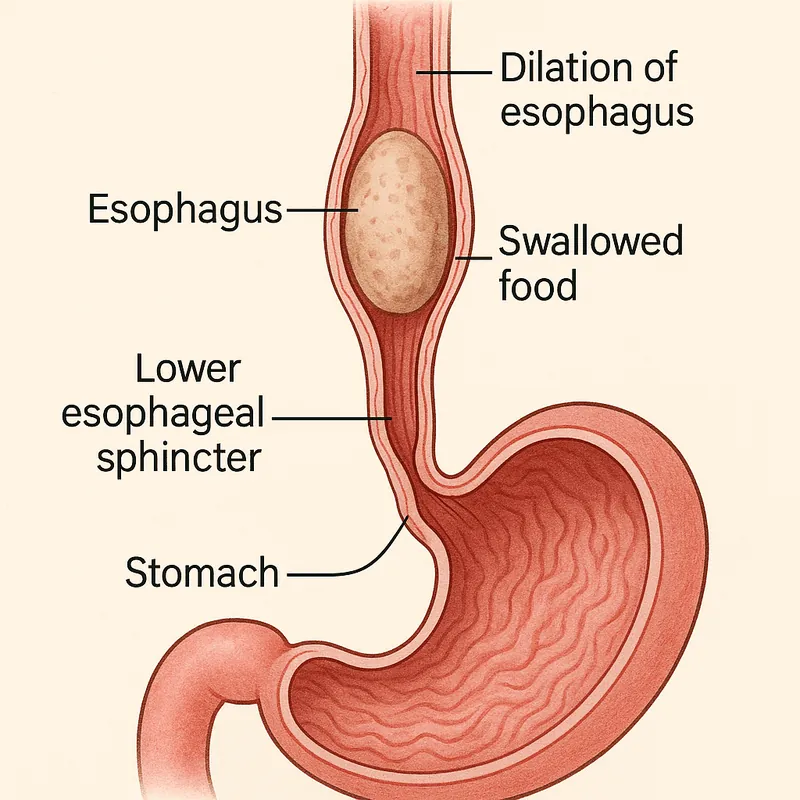
Achalasia is a rare neurodegenerative disorder of the esophagus. The lower esophageal sphincter (LES), the muscular valve between esophagus and stomach, fails to relax properly during swallowing, AND the muscular wall of the esophagus loses its coordinated peristaltic contractions. Food and liquids accumulate in the esophagus, causing progressive dilation and severe swallowing difficulty.
The underlying cause is destruction of inhibitory neurons in the myenteric plexus of the esophagus, autoimmune, viral, or genetic mechanisms are suspected but the precise trigger remains unclear in most cases. Chagas disease (Trypanosoma cruzi infection) causes a similar picture in endemic areas.
Achalasia is RARE, affecting about 1 in 100,000 annually. It tends to present in young adults to middle age (peak 25-60), affecting men and women equally. While not curable, modern treatments (Heller myotomy, POEM, pneumatic dilation) provide excellent symptom relief for most patients.
Aperistalsis, no contractions in the esophagus. ~25% of cases. Often presents later with significant dilation. Responds well to all standard treatments.
Premature spastic contractions in distal esophagus. ~5% of cases. Worst treatment response with standard surgical options. POEM with extended myotomy preferred.
Symptoms develop slowly over months to years. The classic tetrad: dysphagia, regurgitation, chest pain, weight loss. Often misdiagnosed as GERD initially.
Hallmark symptom. Initially solids more difficult than liquids; eventually BOTH equally affected (unusual for other esophageal conditions). Feeling food "stuck" behind the sternum.
Bringing up food that has NOT been mixed with stomach acid (unlike GERD reflux). Often occurs hours after eating, especially when lying down. Significant aspiration risk during sleep.
Substernal pain, often with eating or spontaneously. Particularly common in Type III (spastic) achalasia. Sometimes mistaken for cardiac chest pain, must rule out cardiac causes.
From reduced intake, patients learn to avoid foods that get stuck. Significant unintentional weight loss is common, particularly in advanced disease.
Food/saliva pooled in esophagus aspirates into airways when lying down. Causes nocturnal cough, recurrent pneumonia, and morning hoarseness.
Compensatory mechanism, saliva helps "wash" food down. Many patients carry water bottles constantly and develop maneuvers (arching back, deep breaths) to push food through.
Eating very slowly, drinking lots of water with meals, avoiding fibrous/dry foods (meat, bread). Some patients only eat alone due to embarrassment. Major quality of life impact.
In advanced disease, esophagus dilates to massive proportions and develops sigmoid (S-shape) configuration. Severe symptoms, often requires esophagectomy. Preventable with earlier treatment.
Gold standard. Measures pressure throughout esophagus during swallowing using catheter. Diagnoses achalasia AND classifies into Type I, II, or III (Chicago Classification 4.0). Essential for treatment planning.
Classic "bird's beak" appearance at LES with dilated proximal esophagus. Timed barium swallow measures column height to assess severity and treatment response. Visualizes degree of dilation.
Excludes pseudoachalasia (cancer at GE junction mimicking achalasia), retained food in esophagus, esophagitis. ALL patients with new suspected achalasia need EGD to rule out malignancy.
Dietary modification, eating mechanics, upright positioning, nutritional support, ADJUNCT to medical/surgical care, not replacement
The achalasia diet focuses on FOOD CONSISTENCY and EATING MECHANICS more than specific foods. Soft, moist foods pass more easily through the non-relaxing LES.
Smoothies, soups (blended), nutritional drinks (Ensure, Boost), protein shakes. Easier to gravitate through non-functioning LES. Calorie-dense to maintain weight.
Mashed potatoes, polenta, oatmeal, yogurt, pudding, applesauce, scrambled eggs. Avoid lumpy textures during severe symptoms.
Bananas, ripe melon, well-cooked pasta with sauce, tender fish, slow-cooked stews with broth. Moisture is key, sauce or gravy helps food slip down.
Drink water between every few bites. Carbonated water may briefly distend LES, helping passage (controversial, try and see).
Dry bread, rice, dry crackers, pasta without sauce. Get stuck easily. Always pair with sauce, gravy, or sufficient liquid.
Steak, dry chicken, tough cuts. Stringy vegetables (celery, asparagus stalks, fibrous greens). Highest stuck-food risk, choose tender preparations.
Small bites essential. Chew until almost liquid consistency. Take 30-45 min for meals. Hurried eating = food impaction.
Wait 2-3 hours before lying down. Aspiration of retained esophageal contents during sleep is a major risk. Elevate head of bed.
These supplements address malnutrition states common in achalasia and support recovery post-procedure.
| Supplement | Mechanism & Evidence | Suggested Dose | Timing | Notes |
|---|---|---|---|---|
| Liquid Multivitamin | Pre- and post-procedure nutritional support. Liquid form bypasses chewing/swallowing difficulty. | 1 daily serving | With breakfast smoothie | Comprehensive coverage for malnourished patients. |
| Protein Powder (Whey or Pea) | Maintain protein intake when solid food intake limited. Critical for weight maintenance and post-procedure healing. | 25-30g 1-3x/day | In smoothies between meals | Hydrolyzed whey easiest to digest. Pea protein for plant-based. |
| Vitamin B12 (Methylcobalamin) | Frequently low from impaired intake and absorption. Sublingual bypasses absorption issues. | 1,000mcg sublingual/day | Any time | Test serum B12 and methylmalonic acid. |
| Iron (Bisglycinate) | Common deficiency from poor intake. Bisglycinate is well-tolerated; less constipating than other forms. | 25-50mg elemental iron/day if deficient | Empty stomach + Vitamin C if tolerated | Test ferritin and transferrin saturation. |
| Vitamin D3 + K2 | Deficiency common from poor intake. Critical for bone health, especially in young patients. | D3: 2,000-5,000 IU/day; K2: 100-200mcg | With fat meal | Test 25(OH)D; target 50-70 ng/mL. |
| Magnesium Glycinate | Frequently low. Supports muscle function, may help reduce esophageal spasm in Type III achalasia. | 200-400mg elemental/night | Before bed | Calming form; glycinate gentle on GI. |
| Probiotic (Saccharomyces boulardii) | Useful especially around procedures and when antibiotics needed. Supports gut microbiome. | 500mg 1-2x/day | With meals | Safe with most medications. |
| Glutamine | Supports mucosal healing, useful post-myotomy or post-dilation when tissue healing matters. | 5-10g/day | In smoothies between meals | Tasteless. Particularly helpful in recovery phase. |
This rare condition needs definitive treatment (POEM, Heller myotomy, or dilation) to prevent progressive damage. Nutrition supports the journey but cannot replace these interventions. Find an esophageal motility specialist for optimal outcomes.