Pelvic Organ Prolapse (POP), Cystocele, Rectocele & Uterine Descent

A weakened pelvic floor allows the bladder, uterus, rectum, or vaginal vault to descend toward (or through) the vaginal opening. Affects ~50% of women over 50, yet most cases are mild and highly improvable with conservative care.

POP-Q Stages 0–IV ~50% Over Age 50 Often Reversible (Stages I–II) PT-First Recovery

Last updated:

What Is Pelvic Organ Prolapse?

Pelvic organ prolapse is the downward descent of one or more pelvic organs, bladder, uterus, rectum, small bowel, or the vaginal vault, into or through the vagina, caused by weakening or injury of the pelvic floor muscles, fascia, and connective tissue that normally hold these organs in place.

POP is staged using the standardized Pelvic Organ Prolapse Quantification (POP-Q) system, ranging from Stage 0 (no prolapse) to Stage IV (complete eversion). Roughly 40 to 50 percent of women over 50 have some objectively measurable prolapse on examination, but only a fraction are symptomatic. Pregnancy and vaginal delivery, chronic intra-abdominal pressure (constipation, chronic cough, heavy lifting), menopause-related collagen loss, and connective-tissue laxity are the dominant drivers.

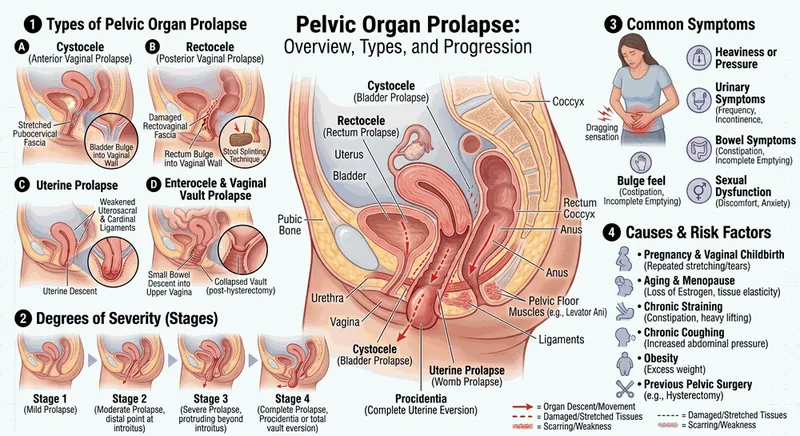
The condition is named by the organ involved, and most women have a combination rather than a single isolated prolapse. The four compartments (anterior, apical, posterior, and the small-bowel hernia behind) are described below, the stage of each is what determines management:

Pelvic organ prolapse, cystocele, rectocele, and uterine descent anatomy

"Pelvic floor muscle training, supervised by a trained therapist, reduces symptoms and stage of prolapse in women with stage I and II POP and should be offered as first-line management."

β€” Cochrane Review (Hagen et al., 2017), Pelvic Floor Muscle Training for Prolapse

πŸ…°οΈ Cystocele (Anterior Wall Prolapse)

The most common type: the bladder bulges down into the front wall of the vagina. Women describe a "ball" or pressure at the vaginal opening, dribbling, incomplete emptying, or needing to splint (push back) to fully urinate. Frequently coexists with stress incontinence.

  • β†’Hallmarks: Bladder bulge, urinary urgency, slow stream, splinting, recurrent UTIs from urinary stasis
  • β†’Primary lever: Pelvic floor PT, hypopressives, bladder retraining, weight optimization, estrogen-supportive nutrition
  • β†’Pessary fit: Ring or dish pessary, often highly effective in Stage II to III
  • β†’Surgical option: Anterior colporrhaphy (native-tissue repair); mesh use for anterior compartment is now restricted

πŸ…±οΈ Rectocele (Posterior Wall Prolapse)

The rectum bulges forward into the back wall of the vagina, creating a pocket where stool collects. Women describe difficulty emptying the bowels, needing to "splint" the back vaginal wall to defecate, a sense of incomplete evacuation, and pressure or fullness after meals.

  • β†’Hallmarks: Constipation, posterior splinting, stool trapping, bearing-down strain
  • β†’Primary lever: Aggressive constipation prevention, fiber and hydration, squat-position toileting, pelvic PT
  • β†’Pessary fit: Variable, sometimes a Gellhorn or cube for combined defects
  • β†’Surgical option: Posterior colporrhaphy with native tissue, levator plication where indicated

πŸ…² Uterine Prolapse (Apical Descent)

The uterus descends from its normal position into the vaginal canal as the uterosacral and cardinal ligaments stretch or tear. Stage III to IV ("procidentia") presents as a visible cervix or uterus protruding at or beyond the vaginal opening. Often coexists with cystocele and rectocele.

  • β†’Hallmarks: Heaviness or "dragging" sensation worse by evening, low back pain, lump felt or seen at vaginal opening
  • β†’Primary lever: Pelvic PT (Kegels, hypopressives, biofeedback) for Stage I to II; pessary for Stage II to III; vaginal estrogen postmenopause
  • β†’Pessary fit: Gellhorn or cube pessary often required at higher stages
  • β†’Surgical option: Sacrocolpopexy (uterine-preserving sacrohysteropexy) or vaginal hysterectomy with apical suspension

πŸ…³ Vaginal Vault Prolapse + Enterocele

After hysterectomy, the upper vagina can descend (vault prolapse), often dragging loops of small bowel into a hernia between the vagina and rectum (enterocele). One of the strongest reasons to preserve apical support during any hysterectomy, ~10 percent of post-hysterectomy women develop vault prolapse.

  • β†’Hallmarks: Bulge after prior hysterectomy, sensation of "everything falling out," dyspareunia, bowel pressure
  • β†’Primary lever: Pelvic PT plus pessary; surgical repair is often necessary at advanced stages
  • β†’Pessary fit: Gellhorn, cube, or donut depending on vaginal length
  • β†’Surgical option: Sacrocolpopexy (laparoscopic / robotic) is the gold-standard apical repair; uterosacral suspension as alternative

Pelvic Organ Prolapse Statistics & Research

~50%
women over age 50 have some objectively measurable POP on exam
12.6%
lifetime risk of undergoing surgery for prolapse or incontinence by age 80 (Wu et al., 2014)
~30%
of POP surgeries are repeat procedures for recurrence
17%
reduction in prolapse stage with 6 months of supervised pelvic floor PT (Hagen, Cochrane 2017)
~85%
of women find a pessary that is comfortable and effective on first or second fitting
2–3x
higher risk after each vaginal delivery; risk also rises with BMI and chronic constipation

How Pelvic Organ Prolapse Presents

Prolapse symptoms typically worsen across the day, with standing, lifting, exercise, or straining, and improve overnight when the woman is recumbent. Severity does not always match anatomy: a Stage II prolapse can feel debilitating while a Stage III may be barely noticed.

🩸 Pelvic, Vaginal & Sexual Symptoms

πŸ«₯

Vaginal Bulge or "Something Falling Out"

The defining symptom of prolapse. Many women describe feeling like they are "sitting on a ball," a softball-like lump at the vaginal opening, or seeing pink tissue when wiping. Worse with prolonged standing, by evening, and after lifting. Improves lying down.

βš“

Pelvic Heaviness & "Dragging" Sensation

A constant pressure, fullness, or pulling-down feeling in the pelvis or low vagina. Often the first symptom women notice. Frequently mistaken for "just being tired" or postpartum recovery, and often gets worse by the end of the day.

😣

Low Back Pain (Sacral Aching)

A dull sacral or low-back ache that worsens with standing and lifting and eases when lying down. Reflects the strain placed on the uterosacral and sacrospinous ligaments by descending pelvic organs. Often misattributed to disc or muscle issues.

πŸ’”

Painful Intercourse (Dyspareunia)

Discomfort, pain, or a sensation that "something is in the way" during intercourse. Atrophic vaginal tissue postmenopause amplifies this. Partners may also notice the change. One of the most under-reported symptoms, but highly responsive to PT, vaginal estrogen, and pessary use.

🧠

Sexual Avoidance & Body-Image Distress

Many women silently avoid intimacy after noticing a bulge, often without ever raising it with a provider. POP is associated with significant body-image distress, decreased sexual frequency, and depression risk, addressing these directly is part of treatment, not optional.

🩹

Vaginal Tissue Irritation, Bleeding or Ulceration

When the prolapse protrudes beyond the vaginal opening, exposed mucosa can become dry, chafed, and ulcerated against clothing. Spot bleeding, friction sores, or chronic discharge are red flags requiring exam, vaginal estrogen, and protective pessary or surgical referral.

🚽 Bladder, Bowel & Functional Symptoms

πŸ’§

Stress Urinary Incontinence (Cough, Sneeze, Laugh)

Involuntary urine loss with any rise in intra-abdominal pressure, coughing, sneezing, laughing, lifting, jumping, or running. Frequently coexists with cystocele. Pelvic floor PT cures or significantly improves stress incontinence in ~60 to 70 percent of women.

🚰

Urinary Urgency, Frequency & Incomplete Emptying

A bladder that has descended often cannot empty completely. Residual urine causes urgency, frequency, nocturia, and recurrent UTIs. Many women learn to "splint" (manually elevate the front vaginal wall) to fully void. Resolving the cystocele often resolves the UTIs.

πŸ’©

Constipation & Stool Trapping (Posterior Splinting)

A rectocele creates a pocket where stool accumulates. Many women describe pushing the back vaginal wall to evacuate, a sense of incomplete emptying, or thin "ribbon" stools. Aggressive constipation prevention is non-negotiable because straining worsens every type of prolapse.

πŸ’¨

Fecal & Flatal Incontinence

Inability to control gas or stool, sometimes a single episode of urgency without time to reach the bathroom. Often linked to obstetric anal-sphincter injury from prior vaginal delivery. Pelvic floor PT with biofeedback is highly effective and dramatically under-prescribed.

πŸšΆβ€β™€οΈ

Symptom Worsening With Standing, Lifting & Exercise

Symptoms reliably worsen with gravity and intra-abdominal pressure. A morning that feels fine deteriorates by evening. High-impact exercise, repetitive lifting, and chronic cough are all classic aggravators, and removable triggers in many cases.

😟

Anxiety, Avoidance & Quality-of-Life Impact

Many women restrict exercise, travel, intimacy, and work activities because of POP. The mental-health burden is meaningful: increased rates of depression, anxiety, and social isolation. Treatment plans should explicitly address activity restoration, not just anatomy.

⚠️ Pattern to watch for: A vaginal bulge or heaviness that worsens by evening and improves overnight, plus urinary or bowel symptoms (incomplete emptying, splinting, recurrent UTIs, constipation), is POP until proven otherwise. Symptoms can fluctuate week to week, do not be reassured by a "good day" alone.

How to Test for Pelvic Organ Prolapse

POP is primarily a clinical diagnosis based on examination using the standardized POP-Q system. Imaging and urodynamics are added selectively when symptoms do not match the exam or surgery is being planned.

🏠 At-Home Screening

These are not diagnostic but can identify patterns worth bringing to a pelvic-floor-trained physiotherapist or urogynecologist:

πŸͺž Self-Inspection (Visual + Tactile)

Standing with one foot on a low stool, gently bear down and use a mirror to inspect the vaginal opening. A visible bulge, descending tissue, or a "pink ball" at or beyond the vaginal opening is highly suggestive of Stage II to III POP. Clean fingers (one or two) inserted vaginally can also feel a bulging anterior wall (cystocele) or posterior wall (rectocele).

πŸ“‹ Symptom Diary & Diurnal Pattern

Track symptoms morning vs evening, before vs after activity, and across the menstrual cycle, for 2 to 4 weeks. A reliable evening worsening pattern, plus symptom improvement after lying down, is one of the strongest non-exam clues that prolapse is the cause. Note any urinary or bowel splinting maneuvers.

πŸ’ͺ At-Home Pelvic Floor Function Check

Lying on your back with knees bent, gently insert one clean finger into the vagina and contract your pelvic floor as if stopping urine flow. You should feel an upward "lift" against your finger. If you cannot feel a contraction, feel a downward push instead (bearing-down error), or have one side that contracts more than the other, that is a strong sign you need supervised PT before progressing to "Kegels at home."

πŸ”¬ Clinical & Imaging Tests

πŸ“ POP-Q Examination

The standardized Pelvic Organ Prolapse Quantification exam measures 9 anatomic points in centimeters relative to the hymen during maximal Valsalva. Stages run from 0 (no prolapse) through I (more than 1 cm above the hymen), II (within 1 cm of the hymen), III (more than 1 cm beyond), and IV (complete eversion). POP-Q standardization is what allows tracking response to treatment over time.

πŸ’ͺ Pelvic Floor Muscle Assessment (Modified Oxford Scale)

A pelvic-floor PT or trained provider grades resting tone, voluntary contraction strength (0 to 5 on the Modified Oxford Scale), endurance, repetitions, and coordination. Often reveals hypertonic ("too tight") pelvic floor in addition to weakness, an important nuance that changes the rehab plan from pure strengthening to a release-then-restrengthen sequence.

🩺 Urodynamic Testing

Measures bladder pressure, urinary flow, residual volume, and detrusor activity. Indicated when there is significant urinary urgency, incontinence, or planned anti-incontinence surgery alongside prolapse repair. Helps distinguish stress incontinence (sphincter issue) from urge incontinence (detrusor issue) from mixed.

πŸ“· Dynamic Pelvic MRI or Defecography

Reserved for complex multicompartment prolapse, suspected enterocele, or evaluation of obstructed defecation. Dynamic MRI imaging shows all three compartments simultaneously during strain; defecography is the gold standard for posterior compartment and intussusception. Not routine for first-line evaluation.

πŸ¦‹ Postvoid Residual (PVR) & Urine Culture

Ultrasound or in-and-out catheter measurement of urine left in the bladder after voiding. PVR greater than 150 mL is concerning for incomplete emptying and may explain recurrent UTIs. Urine culture rules out active infection that could be driving urgency or frequency independent of the prolapse.

🧫 Nutrient & Hormonal Status

In postmenopausal women, low estradiol drives vaginal and connective-tissue atrophy that worsens prolapse symptoms. 25-OH vitamin D, magnesium, iron / ferritin, and fasting glucose support healing and recovery. Vaginal estrogen is one of the highest-yield interventions before and after prolapse surgery.

Holistic vs. Conventional Treatment for Pelvic Organ Prolapse

Toggle between the two approaches to compare treatments, outcomes, and what each looks like in practice.

🌿 HOLISTIC
πŸ’Š CONVENTIONAL
🌿

Holistic / Functional Approach

Restore pelvic floor function, optimize intra-abdominal pressure, support connective tissue, and remove the daily mechanical aggravators

Primary Treatment
Supervised pelvic floor PT (Kegels, biofeedback, hypopressives) + constipation prevention + collagen-supportive nutrition + lifting/posture retraining + vaginal estrogen if postmenopausal
Duration
6 to 16 weeks of supervised PT for noticeable change; 6 to 12 months for sustained improvement
Effect on Underlying Disorder
First-line for Stages I to II, often reduces stage and symptoms; substantially improves Stage III function
Fertility / Activity Outcome
Return to running, lifting, and intimacy commonly possible; reduces or delays the need for surgery
Protocol Includes
  • Supervised pelvic floor PT, 1 to 2x per week for 8 to 16 weeks, addressing both strength and overactive (hypertonic) tone
  • Daily Kegel program once technique is verified, 3 sets of 10 contractions, mixed quick and 10-second holds
  • Hypopressive ("low-pressure") exercise, draws the organs upward through diaphragmatic recruitment, particularly useful post-vaginal delivery
  • EMG biofeedback or perineometer to retrain accurate contraction and avoid bearing-down errors
  • Aggressive constipation prevention: 25 to 35 g fiber/day, 2 to 3 L water, magnesium glycinate, squat-position toileting (Squatty Potty)
  • Lifting and posture retraining: exhale on exertion, hip-hinge mechanics, avoid Valsalva, brace the core without down-bearing
  • Weight optimization to reduce intra-abdominal load; address chronic cough (asthma, GERD, smoking)
  • Vaginal estrogen postmenopausal (cream, tablet, or ring) to thicken atrophic vaginal tissue and improve PT and pessary tolerance
  • Pessary fitting trial (ring, Gellhorn, or cube) for Stage II to III, often life-changing and reversible
  • Collagen-supportive nutrition, vitamin C, glycine, zinc, copper, anti-inflammatory whole-food eating
βœ… Side effects: Transient muscle soreness in the first 2 to 3 weeks of PT; mild vaginal discharge or irritation during early pessary use; vaginal estrogen rarely causes spot bleeding (always evaluated). No systemic, hormonal, or surgical risks.

Root Causes of Pelvic Organ Prolapse

POP develops from cumulative damage to the pelvic floor over time. Each driver below adds load; treatment is most effective when as many of these as possible are addressed simultaneously.

Root Cause How It Contributes to POP Holistic Solution
Pregnancy & Vaginal DeliveryPregnancy stretches the levator ani, the pudendal nerve, and the endopelvic fascia. Each vaginal delivery, especially with prolonged second stage, large baby, instrumentation (forceps/vacuum), or significant perineal tear, raises lifetime POP risk 2 to 3x.Postpartum pelvic floor PT for every woman by 6 to 12 weeks postpartum, regardless of symptoms. Avoid Valsalva pushing where possible; resume high-impact exercise gradually.
Menopausal Estrogen DeclineFalling estradiol causes vaginal mucosal thinning, loss of collagen and elastin in connective tissue, and reduced pelvic floor muscle bulk, all worsening prolapse symptoms.Vaginal estrogen (cream, tablet, or ring) is one of the highest-yield interventions; also consider systemic MHT when otherwise indicated; collagen-supportive nutrition and resistance training.
Chronic Constipation & StrainingRepeated bearing-down increases intra-abdominal pressure and shears the pelvic ligaments. Chronic straining is among the strongest independent risk factors for POP and is highly modifiable.25 to 35 g fiber/day, 2 to 3 L water, magnesium glycinate at night, squat-position toileting (Squatty Potty), exhale on evacuation, and never strain longer than 1 to 2 minutes.
Chronic Cough (Asthma, COPD, Smoking, GERD)A chronic cough delivers thousands of high-pressure pulses to the pelvic floor each year. POP risk is significantly elevated in smokers and women with poorly controlled cough conditions.Stop smoking, treat asthma/COPD/GERD aggressively, address allergic post-nasal drip; pelvic floor PT to learn pelvic floor pre-bracing before each cough ("the knack").
Heavy or Repetitive Lifting (Occupational and Recreational)Lifting with breath-holding (Valsalva) drives intra-abdominal pressure down onto the pelvic floor. Occupations and exercise programs involving repeated heavy lifting raise prolapse risk.Exhale on exertion, hip-hinge mechanics, brace the core without down-bearing, scale loads during postpartum return-to-exercise; work with a pelvic-floor-aware coach.
Connective Tissue Laxity / GeneticsConditions like Ehlers-Danlos, hypermobility spectrum, and family history of hernia or prolapse all increase risk, the same collagen that supports joints supports the pelvic floor.Lifelong PT awareness, avoid bearing-down maneuvers, collagen-supportive nutrition (vitamin C, glycine, zinc, copper), resistance training for muscular support.
Obesity / Elevated BMIHigher BMI increases sustained intra-abdominal pressure on the pelvic floor. Each 5-unit BMI rise above 25 raises POP risk meaningfully.Sustainable body composition change through whole-food nutrition, strength training, and metabolic health work, not just calorie restriction.
Prior Hysterectomy Without Apical SupportRemoving the uterus without re-suspending the vaginal apex leaves the top of the vagina unsupported. ~10 percent of women develop vault prolapse after hysterectomy.If hysterectomy is planned, demand concurrent apical suspension (uterosacral, McCall culdoplasty, or sacrocolpopexy). Consider uterine-preserving alternatives when feasible.
Aging & Loss of Collagen / Muscle MassPelvic floor muscle mass, fascial collagen, and nerve function all decline with age, particularly without resistance training and adequate protein intake.Resistance training 2 to 3x per week including the pelvic floor, 1.2 to 1.6 g protein/kg/day, vitamin D, vitamin C, glycine, hormone-replacement therapy where appropriate.
Hypertonic Pelvic Floor (Overactive, Not Just Weak)Many women with POP also have a "too-tight" pelvic floor that cannot recoil and absorb pressure. "Doing more Kegels" can actually worsen this pattern, an under-recognized but common issue.Assessment by a pelvic floor PT first; release work (down-training, breath work, diaphragmatic release) before strengthening. Hypopressives often suit this pattern especially well.

Pelvic Organ Prolapse Diet Guide

Nutrition does not "reverse" anatomical prolapse, but it directly controls two of the most powerful drivers: intra-abdominal pressure (via constipation prevention) and connective-tissue integrity (via collagen-supportive nutrients).

🌾

The Collagen-Plus-Easy-Stool Eating Pattern

Two food-driven mechanisms control day-to-day POP: connective-tissue quality (the collagen and elastin that hold the pelvic organs in place) and intra-abdominal pressure (driven primarily by stool consistency and straining). Get both right and most women experience meaningful symptom relief within 4 to 6 weeks, even before PT alone would produce visible change.

The framework is simple: protein at every meal (collagen substrate plus muscle preservation), enough soluble and insoluble fiber to make stools easy to pass without straining, abundant vitamin C and zinc for collagen synthesis, and aggressive avoidance of constipating, inflammatory foods.

The 4 Anchors of Every Meal:

  • 1Protein 25 to 40 g, including collagen-rich sources (bone broth, slow-cooked meats, gelatin) 3 to 5x/week
  • 2Fiber 25 to 35 g/day, half soluble (oats, chia, psyllium, fruit) and half insoluble (vegetables, lentils, whole grains)
  • 3Vitamin C + zinc + copper from peppers, citrus, kiwi, oysters, pumpkin seeds, organ meats, for collagen cross-linking
  • 4Healthy fats, olive oil, avocado, fatty fish, for hormone support and tissue elasticity

Hydration & Bowel Pattern:

  • πŸ’§2 to 3 L water per day, more in hot weather or with exercise; fiber without water actively causes constipation
  • πŸŒ…Largest meal earlier in the day to leverage the gastrocolic reflex for an easy morning bowel movement
  • 🚽Squat-position toileting (Squatty Potty or footstool), exhale on evacuation, never strain longer than 1 to 2 minutes
  • πŸŒ™Magnesium glycinate or citrate at night if stools are hard, gentler and safer than stimulant laxatives long-term
πŸ’‘ If you increase fiber too fast you can feel worse temporarily (gas, bloat). Add 5 g per week and pair every fiber increase with extra water.
⚠️ These foods either cause constipation/straining (the #1 mechanical aggravator of POP) or degrade collagen and connective tissue.
  • βœ—Refined sugar & sweets: Drive systemic inflammation, glycate collagen, and degrade connective-tissue strength over time
  • βœ—Refined flour and white starch: Low fiber, low nutrient, contribute to harder stools and straining
  • βœ—Ultra-processed cheese and excess dairy: Constipating in many women, especially A1-casein cheeses
  • βœ—Fried foods & industrial seed oils: Soybean, canola, corn, cottonseed; drive inflammation and slow gut motility
  • βœ—Alcohol: Dehydrates the colon, hardens stools, depletes magnesium, vitamin C, and B-complex
  • βœ—Excess caffeine: Mild diuretic that can dehydrate stools; high doses also worsen urinary urgency in POP
  • βœ—Low-residue "easy" foods on autopilot: White bread, instant oats, low-fiber cereals; harmless individually but quietly constipating as a daily pattern
  • βœ—Excess red meat without vegetables: Slow transit time, hard stools; pair every meat-heavy meal with at least 2 cups of vegetables
  • βœ—Smoking (every kind): Direct collagen toxin, worsens cough, dramatically raises POP and recurrence risk
πŸ’‘ Foods that build collagen, soften stools, reduce intra-abdominal pressure, and support pelvic floor muscle tissue.
  • βœ“Collagen-rich proteins: Bone broth, slow-cooked stews, chicken with skin, gelatin desserts; 1 to 2 servings/day for tissue substrate
  • βœ“Vitamin C powerhouses: Bell peppers, kiwi, citrus, strawberries, broccoli, dark leafy greens, for collagen cross-linking
  • βœ“Soluble fiber (stool softeners): Oats, chia, flax, psyllium, cooked apple, pear, oranges, lentils, sweet potato
  • βœ“Insoluble fiber (bulk & transit): Leafy greens, broccoli, Brussels sprouts, whole grains, beans, nuts and seeds
  • βœ“Zinc & copper sources: Oysters, pumpkin seeds, cashews, beef, lamb, organ meats, dark chocolate, for collagen enzymes
  • βœ“Quality protein at every meal: 1.2 to 1.6 g/kg/day; wild fish, pastured eggs, Greek yogurt, lean meats, lentils
  • βœ“Healthy fats: Extra-virgin olive oil, avocado, walnuts, almonds, fatty fish; aid hormone production and tissue elasticity
  • βœ“Hydrating produce: Cucumber, zucchini, watermelon, citrus, leafy greens, plus 2 to 3 L plain water and herbal teas daily
  • βœ“Fermented foods: Kimchi, sauerkraut, kefir, miso, supports microbiome diversity and bowel regularity

Key Supplements for Pelvic Organ Prolapse Recovery

Supplements support pelvic floor PT and nutrition, they do not replace either. The list below targets the three highest-yield levers: collagen synthesis, regular stools without straining, and hormone-supported vaginal/connective-tissue health.

Supplement Role in POP Recovery Suggested Dose Timing Notes
Hydrolyzed Collagen PeptidesProvides the amino acid building blocks (glycine, proline, hydroxyproline) for fascia, ligaments, and pelvic floor connective tissue. Clinical trials show measurable improvements in skin elasticity and joint connective tissue with 10 to 15 g/day for 8 to 12 weeks.10 to 20 g per dayAny time, often mixed into morning coffee, smoothie, or bone brothAlways pair with vitamin C (75 to 100 mg) at the same dose for collagen synthesis. Type I and III peptides cover skin and ligaments.
Vitamin C (with bioflavonoids)Essential cofactor for the hydroxylation step of collagen synthesis. Without adequate C, the body cannot build new collagen even with abundant amino acid substrate.500 to 1000 mg per daySplit AM and PM with mealsChoose buffered or with bioflavonoids if sensitive stomach. Smoking and alcohol use raise requirements.
Magnesium Glycinate (or Citrate)The most effective long-term tool to prevent constipation and straining. Magnesium also supports pelvic floor muscle relaxation in hypertonic patterns and improves sleep quality.300 to 500 mg elemental magnesium per dayEvening, 30 to 60 min before bedCitrate is more laxative; glycinate is calming and gentler. Increase slowly if stools become too loose.
Psyllium Husk (Soluble Fiber)Forms a gel that bulks and softens stool simultaneously, the single most evidence-backed supplement for chronic constipation. Reduces straining at toileting more than any other intervention.5 to 10 g per day1 to 2x daily with at least 12 oz waterStart with 5 g and titrate up over 2 weeks. Always with water, take 2 hours apart from medications.
Vitamin D3 (with K2)Supports pelvic floor muscle strength, bone density, and immune function. Deficiency is associated with weaker pelvic floor muscles and higher POP recurrence after surgery.2000 to 5000 IU D3 + 100 to 200 mcg MK-7 K2 per dayWith a fat-containing meal, morning preferredTest 25-OH-D first; target 50 to 80 ng/mL. Retest after 3 months.
Vaginal Estrogen (Topical, Postmenopausal)Restores vaginal mucosal thickness, improves lubrication, reduces UTIs, and improves response to pelvic floor PT and pessary comfort. Local effect, minimal systemic absorption.Cream 0.5 to 1 g 2 to 3x/week, OR tablet 10 mcg 2x/week, OR ring every 90 daysBedtime, after voidingPrescription-required. Discuss with provider if history of estrogen-sensitive cancer. One of the highest-yield interventions for postmenopausal POP.
Zinc (Picolinate or Bisglycinate)Cofactor for collagen-forming enzymes and tissue repair. Supports wound healing post-surgery and pelvic floor recovery postpartum.15 to 30 mg per dayWith meals (food prevents nausea)If using long-term (greater than 8 weeks at higher doses), add 1 to 2 mg copper to prevent imbalance.
Omega-3 EPA/DHAReduces systemic inflammation, supports tissue repair, lowers visceral inflammation that contributes to abdominal pressure.2 g combined EPA+DHA per dayWith mealsChoose IFOS-certified for purity. Important pre- and post-surgically.
Curcumin (Turmeric Extract)Anti-inflammatory; supports recovery from surgery and reduces muscle soreness during PT progression. Modulates NF-kB and TNF-Ξ± pathways.500 to 1000 mg curcumin per dayWith a fat-containing mealMust include piperine (black pepper) or be liposomal for absorption. Hold 1 week before surgery (mild platelet effect).
QuercetinBioflavonoid that supports collagen integrity, reduces inflammation, and stabilizes mast cells (useful with urinary urgency or recurrent UTIs from incomplete emptying).500 to 1000 mg per dayWith meals, split 2x dailyPairs well with vitamin C. Especially useful if recurrent UTI is part of the picture.
Probiotic with Lactobacillus rhamnosus & reuteriSupports vaginal and urinary microbiome, reducing recurrent UTIs that frequently accompany cystocele. Improves bowel regularity.10 to 25 billion CFU per day, multi-strainEmpty stomach or with light mealL. rhamnosus GR-1 and L. reuteri RC-14 are the best-studied strains for the urogenital microbiome.
D-MannosePrevents UTIs by binding E. coli adhesins. Particularly useful in women with cystocele who have recurrent UTIs from incomplete bladder emptying.2 g once or twice daily for prevention; 2 g 3x/day at first symptomsWith water, away from mealsDoes not disrupt microbiome the way antibiotics do. Diabetic patients should monitor blood sugar.
Methylated B-Complex (with L-methylfolate)Supports tissue repair, methylation pathways, and energy production during PT progression. Restores B12 if depleted by metformin or proton pump inhibitors.1 capsule per day per product labelMorning with foodIncludes B12, folate, B6, riboflavin; particularly useful in postmenopausal women.
Iron (if Deficient)Many menstruating women are iron-depleted, which limits collagen synthesis and pelvic floor muscle recovery. Treat only if ferritin is low.25 to 65 mg elemental iron every other day if ferritin less than 50 ng/mLMorning, empty stomach with vitamin CEvery-other-day dosing absorbs better than daily. Retest ferritin after 3 months.
Bone BrothA whole-food source of collagen, glycine, proline, glutamine, and minerals that supports gut lining and pelvic connective tissue simultaneously.1 to 2 cups per dayAny time, often as warm broth between mealsHomemade with organic bones is ideal. Look for at least 8 to 10 g protein per cup if buying.
L-GlutamineSupports gut lining integrity and bowel regularity, especially helpful in women with both POP and irritable-bowel patterns.5 to 10 g per dayEmpty stomach, away from protein mealsUseful in the first 8 to 12 weeks of gut work. Discontinue if no clear benefit by then.
MSM (Methylsulfonylmethane)Sulfur donor required for connective tissue and collagen cross-linking. Modest individual effect but synergistic with collagen and vitamin C.1 to 3 g per dayWith mealsOften paired with glucosamine in joint formulas; safe for long-term use.

Healing Timeline: Conventional vs. Holistic

Understanding what to expect from each approach helps set realistic expectations and make informed choices.

🌿 Holistic Protocol
Week 1–2

Constipation and straining resolve within days of fiber, water, magnesium, and squat-position toileting. Pelvic floor PT assessment establishes the rehab plan; vaginal estrogen begins if postmenopausal.

Month 1–3

Daily heaviness improves noticeably as pelvic floor strength and coordination return. Stress incontinence often resolves first. Pessary fitting (if chosen) usually delivers near-immediate relief.

Month 3–6

Many women report a measurable drop in POP-Q stage on follow-up exam. Return to exercise, lifting, intimacy with confidence. Tissue quality improves with vaginal estrogen and collagen support.

Month 6–12

Stage I and II prolapse may be functionally asymptomatic. Stage III commonly improved to a tolerable level on conservative care. Surgery, if still needed, occurs with stronger tissue and lower recurrence risk.

Long-Term Outlook

Sustainable function with maintenance PT, nutrition, and avoidance of aggravators; many delay or avoid surgery entirely

πŸ’Š Conventional Treatment
Week 1–4 (pessary or pre-op)

Pessary fitting can give near-immediate symptom relief. Pre-op workup if surgery planned: imaging, urodynamics, optimization of medical conditions.

Surgery + Week 1–6 Recovery

Reconstructive surgery (sacrocolpopexy, native-tissue repair, with or without hysterectomy). Lifting restrictions less than 10 lb, no intercourse, no high-impact activity for 6 to 12 weeks.

Month 2–6 Post-Op

Gradual return to activity. Anatomical support restored. New-onset urinary urgency or stress incontinence may emerge. Dyspareunia possible if mesh contraction or scar tissue develops.

Year 1–5

If pelvic floor function, constipation, and lifestyle aggravators were not addressed, symptoms can begin to return. Recurrence rates after primary prolapse surgery average ~30 percent over 10 years.

Long-Term Outlook

~30% recurrence over 10 years if PT and lifestyle drivers are not addressed; ~1–3% mesh erosion risk with sacrocolpopexy

"Prolapse is not failure of a single muscle, it is the cumulative result of how a woman has been asked to push, lift, deliver, strain, and stand for decades. Recovery starts with removing the daily mechanical insults."

Ready to Address Your Pelvic Organ Prolapse at the Root?

Explore related conditions below or revisit the Symptom Checker to map your full symptom picture across the library.