Widespread pain, exhausting fatigue and unrefreshing sleep, produced by a nervous system that has turned up the volume on pain signalling. It is a real condition with real mechanisms. The best evidenced treatment is not a diet or a supplement. It is graded exercise, and it is the one thing most people are never properly supported to do.
Last updated:
A disorder of pain processing. The nerves, spinal cord and brain amplify pain signals, so ordinary sensations register as painful and painful ones register as worse. The muscles and joints themselves are not damaged, which is why scans and blood tests come back normal and why that normality is so often misread as meaning nothing is wrong.
It travels with poor sleep, fatigue, and difficulty concentrating, and those are not separate complaints. Unrefreshing sleep worsens pain amplification and pain worsens sleep, which is the loop the condition runs in.
Normal tests are the expected finding, not a failure to find anything. Fibromyalgia is diagnosed on the pattern of symptoms, after conditions that mimic it have been excluded.
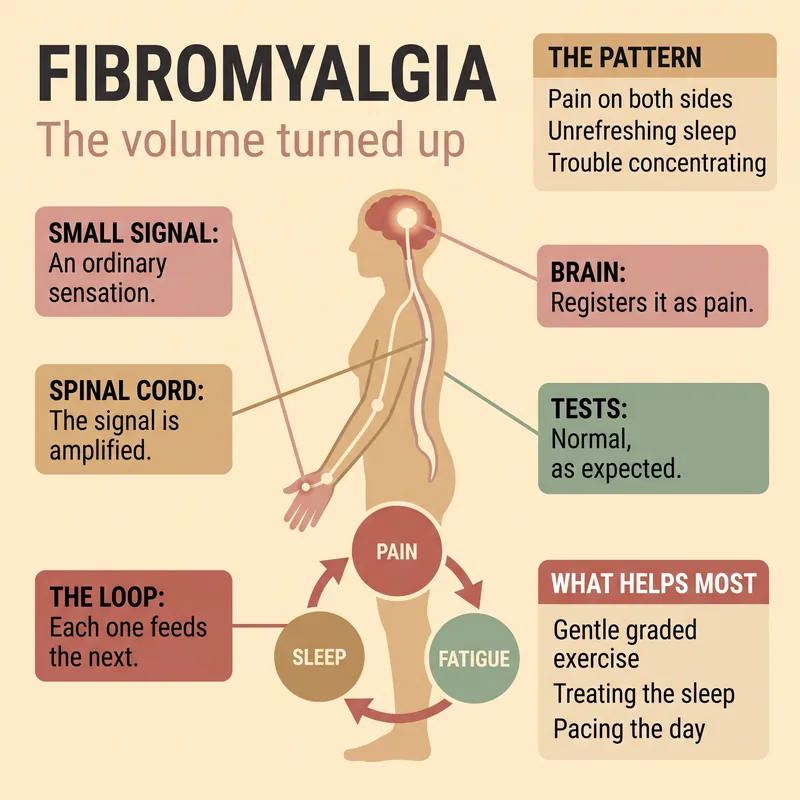
A Cochrane review found moderate-quality evidence that aerobic exercise probably improves quality of life, with smaller effects on pain and function2. Start lower than feels reasonable.
A best-evidence synthesis of dietary interventions in fibromyalgia found the studies few, small and mostly of limited quality3.
Unrefreshing sleep amplifies pain and pain wrecks sleep. Treating the sleep is treating the condition. See insomnia.
As a cluster, which is why single-symptom explanations keep missing it.
| Feature | What it looks like | Worth knowing |
|---|---|---|
| Widespread pain | Both sides, above and below the waist, for months | Aching, burning or deep. It moves, which is often held against people wrongly |
| Unrefreshing sleep | Waking as tired as you went to bed | One of the most consistent features, and one of the most treatable levers |
| Fatigue | Out of proportion to activity, not fixed by rest | Frequently the symptom people would most like addressed |
| Cognitive difficulty | Word-finding, concentration, short-term memory | Real and well described. It is not a sign of dementia |
| Tenderness to light pressure | Pressure that should not hurt does | This is the amplification, made visible |
| Headaches, and gut symptoms | Often overlapping with IBS and migraine | Common companions, and part of the same processing picture |
| Sensitivity to noise, light, cold or smells | Ordinary environments becoming intolerable | Consistent with amplified processing, and rarely asked about |
| Fever, weight loss, swollen joints, muscle weakness | Anything on this row | Not fibromyalgia. Report it. These point elsewhere and need investigating on their own |
By pattern, and by ruling out the conditions that look like it.
| Measure | What it tells you | What it misses |
|---|---|---|
| History and symptom pattern | The diagnosis. Widespread pain plus fatigue, sleep and cognitive symptoms | There is no confirmatory test, and the absence of one is not the absence of disease |
| Full blood count, inflammatory markers | Whether an inflammatory or haematological condition is present instead | Normal is expected in fibromyalgia. Normal does not mean nothing is wrong |
| Thyroid function | Hypothyroidism produces a strikingly similar picture and is treatable | Worth rechecking if things change. See thyroid disorders |
| Ferritin and B12 | Deficiencies that cause fatigue and are correctable | See iron deficiency and B12 and folate deficiency |
| Vitamin D where deficiency is likely | Whether correction is warranted for the usual reasons4 | A single value, and correcting it is not a treatment for the pain disorder |
| Sleep assessment | Whether sleep apnea is also present, which is treatable and commonly missed | Under-requested here, and snoring with witnessed pauses should prompt it |
| Mood assessment | Depression and anxiety are more common and are treatable | Treating mood is not saying the pain is imaginary. Both can be true and both can be treated |
| Commercial "fibromyalgia panels" and food intolerance tests | Nothing reliable | Expensive, unvalidated, and they typically end in a long list of foods to avoid for no benefit |
Graded movement, sleep, mood, and honesty about what diet can and cannot do
This is a page where the honest answer is that the evidence is thin, and saying so is more useful than filling the gap.
| Change | Why | Practical note |
|---|---|---|
| A varied, adequate, regular diet | Supports energy and sleep, and prevents the deficiencies that add fatigue of their own | Regular meals matter more than composition when fatigue makes cooking hard |
| Correct genuine deficiencies | Iron, B12 and vitamin D deficiency each cause fatigue independently and are correctable | Test rather than assume. See iron deficiency |
| A healthy weight | Excess weight adds load and worsens sleep apnea, both of which worsen the picture | Gradual, and not the focus if it becomes another source of failure |
| Caffeine, especially after midday | Fragments sleep, and unrefreshing sleep is central here | Reduce gradually. Abrupt withdrawal produces headaches that look like a flare |
| Alcohol | Sedates initially and fragments sleep in the second half of the night | Frequently used for sleep and reliably makes it worse |
| A low FODMAP trial only if IBS symptoms are prominent | For the gut symptoms, which genuinely overlap. Not for the pain disorder | Short trial with reintroduction, ideally with a dietitian. See IBS |
| Gluten-free without coeliac disease | Not supported here | If gluten seems to affect you, ask for coeliac testing before excluding it, since testing needs you to be eating it |
| Long elimination diets and detox regimens | No evidence, and a real cost | They narrow nutrition, add expense and effort to a day that has little to spare, and delay the things that do help |
Short, because the honest evidence is short, and a long list here would be the problem rather than the answer.
| Supplement | What it is actually for | Typical range | Timing | Notes & cautions |
|---|---|---|---|---|
| Vitamin D | Correcting a deficiency. A meta-analysis of randomised trials in fibromyalgia reported some benefit on pain, from a small evidence base4. | Test 25-OH-D first, then set a daily dose with your clinician | With a fat-containing meal | Test rather than assume. This is the entry with the most support on the page, and the evidence base behind it is still small. See osteoporosis for the vitamin D cautions. |
| Iron or B12, if deficient | Correcting a deficiency that causes fatigue in its own right, which is worth separating from the fibromyalgia fatigue. | Set by your clinician on the basis of blood results | As advised | Do not supplement iron without a test. Excess iron is harmful. See iron deficiency anaemia. |
| Magnesium | Widely recommended for muscle pain in this condition, on a thin evidence base. | Discuss with your clinician rather than escalating on your own | With food, often in the evening | Listed honestly rather than recommended. Loose stools are the usual limit. Dose needs care in reduced kidney function; see chronic kidney disease. |
| Sleep and mood supplements generally | The interaction risk is the point of this row. Several are serotonergic or sedating and combine badly with medicines used in fibromyalgia. | Not recommended without discussing it first | Not applicable | St John's wort in particular interacts with a long list of medicines. Kava and high-dose ashwagandha carry liver injury reports; see anxiety. |
Each numbered entry below is either a source you can follow or a note setting out what the evidence does and does not support. Both are numbered together so the markers in the text line up.
Last reviewed 3 September 2026. Supplement entries are cross-checked against the NIH National Center for Complementary and Integrative Health and the Linus Pauling Institute Micronutrient Information Center.5 This page is nutrition education, not medical advice, and it does not replace your doctor. No diet and no supplement treats fibromyalgia, and the dietary evidence base in this condition is small and of limited quality. The best evidenced intervention is graded exercise, and the effect sizes for every treatment here are modest. Nothing on this page replaces the assessment that excludes the conditions which mimic fibromyalgia, and a new symptom that does not fit the pattern still needs investigating. What nutrition education can do is help you understand the evidence well enough to have a better conversation with the clinician who does treat you.