Sleep Apnea

The airway collapsing repeatedly during sleep, sometimes hundreds of times a night, each time interrupting breathing and fragmenting sleep. It is common, it is strongly linked to body weight, and the majority of people who have it do not know1. Nutrition has one substantial lever here, and it is not a supplement.

Mostly Undiagnosed Weight-Responsive Evidence-Based

Last updated:

🚨 If you are falling asleep during the day, do not drive until you have been assessed. Untreated obstructive sleep apnea impairs alertness, and sleepiness at the wheel is the most immediately dangerous consequence of this condition. If you have ever nodded off while driving, stopped at lights, or in a meeting, treat that as urgent and say so plainly when you book the appointment. This is placed first, and on purpose, because it is the part of this page that could matter tonight.

What Is Obstructive Sleep Apnea?

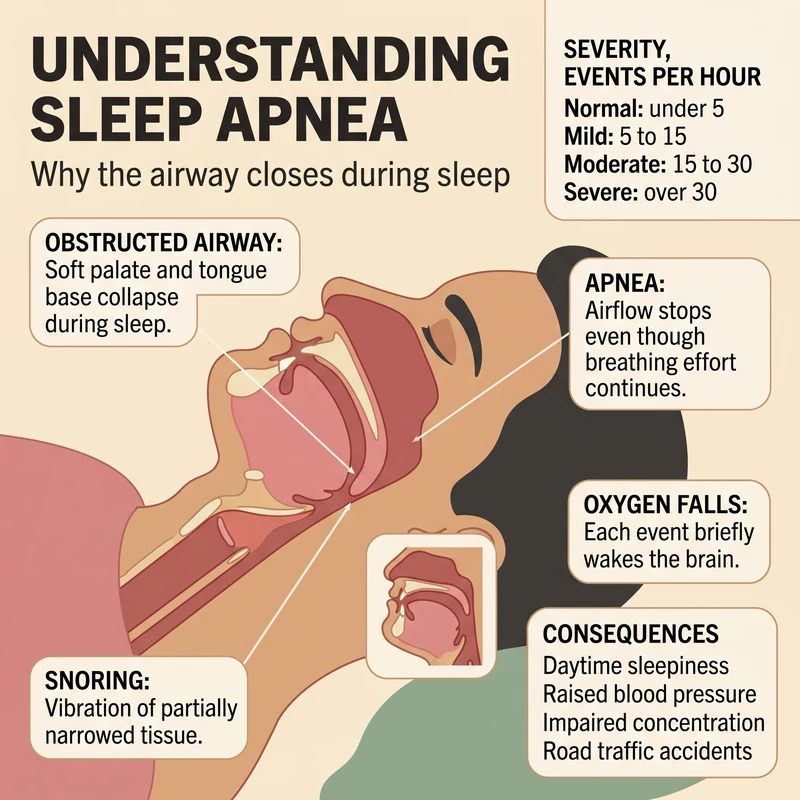
Repeated collapse of the upper airway during sleep. Each event stops or reduces airflow, oxygen falls, and the brain briefly wakes just enough to reopen the airway. The sleeper usually remembers none of it.

This is a mechanical problem before it is anything else. During sleep the muscles holding the throat open relax. If the airway is already narrow, because of fat deposited around the neck and tongue, the shape of the jaw, large tonsils, or nasal obstruction, that relaxation is enough to close it.

The consequences follow from the repetition. Sleep never consolidates, which produces the daytime sleepiness. And each oxygen dip triggers a surge of sympathetic activity, which is the mechanism proposed to link untreated apnea with high blood pressure and with the rest of the cardiometabolic cluster. See metabolic syndrome and high blood pressure.
💡 Key Insight: Sleep apnea and obesity make each other worse. Weight raises the risk of airway collapse, and the sleep fragmentation and daytime exhaustion that follow make eating well and moving more considerably harder. Treating the apnea often makes the rest of the work possible, which is why it appears in the assessment section of several other guides on this site.
Cross-section of the head and neck of a sleeping person showing the soft palate and tongue base collapsing against the back of the throat, with an inset of the same airway open while awake, beside a table of severity by events per hour

⚖️ Why weight is the lever

In a randomised trial in adults with type 2 diabetes, an intensive weight-loss programme reduced the severity of sleep apnea significantly more than the control condition2. It is the one nutritional intervention with randomised support here.

🍸 Why alcohol matters

Alcohol relaxes the muscles holding the airway open. A systematic review and meta-analysis found alcohol consumption associated with more snoring and worse sleep apnea4, and the effect is dose-related and same-night.

😴 Why most cases are missed

The symptoms happen while you are asleep, and the daytime ones look like ordinary tiredness. A large share of moderate to severe cases are undiagnosed, which is why several other guides on this site tell you to ask about it.

How Sleep Apnea Presents

Much of the evidence is reported by whoever sleeps beside you. Snoring alone is common and not the point; snoring with pauses is.

SignWhat it suggestsWorth knowing
Witnessed pauses in breathing, choking or gaspingThe most specific sign there isAlmost always reported by a partner rather than noticed by the sleeper
Loud habitual snoringAirway narrowing, though snoring alone is common and not diagnosticAbsence of snoring does not exclude apnea, particularly in women
Daytime sleepinessFragmented sleep, the main daytime consequenceSleepiness while driving is an emergency, not an inconvenience
Waking unrefreshed, morning headache, dry mouthPoor sleep quality and mouth breathing overnightEasily attributed to age, stress or work
Waking to pass urine repeatedlyA recognised and frequently overlooked featureOften blamed on the prostate or on fluid intake instead
Poor concentration, irritability, low moodCognitive and mood effects of fragmented sleepSometimes mistaken for depression; see insomnia for the different picture there
Blood pressure that is hard to controlApnea is a recognised contributor to resistant hypertensionWorth raising if several medicines are not achieving target
Night-time refluxApnea and reflux are associated, plausibly through pressure swings in the chestA systematic review found the two conditions linked5; see the GERD guide
⚠️ It is not only a condition of large men who snore. Women more often present with fatigue, insomnia, morning headache and low mood rather than classic snoring and witnessed apneas, and are diagnosed later as a result. It also occurs in people who are not overweight, where jaw and airway anatomy, nasal obstruction or large tonsils are doing the work. A normal body weight does not rule it out.

How Sleep Apnea Is Assessed

This is one condition that genuinely cannot be diagnosed from symptoms alone. It needs a sleep study.

MeasureWhat it tells youWhat it misses
Symptom questionnairesWhether a sleep study is warranted; useful for triageScreening tools only. They neither diagnose nor exclude, and they perform less well in women
Home sleep apnea testAirflow, effort and oxygen levels in your own bed; sufficient to diagnose in many straightforward casesCan underestimate severity, and is not suitable where heart or lung disease, or other sleep disorders, are suspected
In-laboratory polysomnographyThe fuller picture, including sleep stages, limb movements and other sleep disordersLess convenient, and sleeping in a laboratory is not sleeping at home
Apnea-hypopnea indexEvents per hour, the number used to grade severityA single night varies, and the index correlates only loosely with how a person actually feels
Overnight oximetry aloneOxygen dips; sometimes used as a first lookMisses events that fragment sleep without a large drop in oxygen
Blood pressure, HbA1c, lipidsThe cardiometabolic cluster that travels with untreated apneaSee metabolic syndrome; treating the apnea does not replace treating these
Thyroid functionAn uncommon but correctable contributorRarely the whole explanation; see thyroid disorders
💡 Ask for the test rather than the reassurance. Sleep apnea is a diagnosis that has to be looked for, and the people most likely to have it are frequently told they are simply tired, overweight or stressed. If the pattern above fits, ask specifically whether a sleep study is indicated. It is also worth reviewing sedating medicines with your prescriber, since several relax the airway further, and that is a conversation rather than a reason to stop anything on your own.

Holistic vs. Conventional Treatment for Sleep Apnea

🌿 HOLISTIC
💊 CONVENTIONAL
🌿

Holistic / Functional Approach

Weight, alcohol, sleep position, nasal patency, and treating what travels with it

Strongest Measure
Weight loss. An intensive lifestyle programme reduced apnea severity significantly more than control in adults with type 2 diabetes2
Same-Night Effect
Alcohol avoidance, particularly in the hours before bed, since the airway-relaxing effect is immediate4
Timeline
Alcohol and position change things the same night; weight-related improvement builds over months
Limitation, stated plainly
Weight loss reduces severity but frequently does not abolish the condition, and it is slow. It does not replace treatment in the meantime

Full Holistic Approach Includes

  • Weight reduction where there is weight to lose, the one nutritional lever with randomised support. See the obesity guide.
  • Avoiding alcohol before bed, and reducing it generally.
  • Positional measures, since events are frequently worse lying on the back. Some people are almost entirely positional.
  • Treating nasal obstruction, allergy or otherwise, which makes mouth breathing and airway collapse more likely.
  • Not adding sedatives, including sleeping tablets and sedating antihistamines, which relax the airway further.
  • Regular sleep timing, which does not treat the apnea but stops sleep deprivation compounding the daytime effects.
  • Treating the reflux if present, since the two aggravate each other. See the GERD guide.
🌿 Worth knowing: none of this is a reason to defer a sleep study or to stop using a device that is working. Moderate to severe apnea needs treatment while the weight work is happening, not instead of it.

Diet for Sleep Apnea

There is no sleep apnea diet. There is weight, there is alcohol, and there is the timing of what you eat and drink.

💡 Weight loss is the nutritional intervention with randomised support here. In adults with type 2 diabetes and obstructive sleep apnea, an intensive weight-loss lifestyle programme produced a significantly greater reduction in apnea severity than a control condition, and a proportion of participants no longer met the criteria at follow-up2. The honest qualification is that severity fell more often than the condition disappeared, so this is a reason to pursue weight loss alongside treatment rather than instead of it.
ChangeEvidencePractical note
Weight reduction where there is weight to loseStrongest, randomisedReduces severity; frequently does not abolish it. Fat around the neck and tongue is the part that matters
Alcohol, especially in the eveningSupportedRelaxes airway muscles the same night. A meta-analysis links intake with more snoring and worse apnea4
Large late mealsMechanistically soundWorsens night-time reflux, which travels with apnea and disturbs sleep further
Caffeine late in the dayIndirectDoes not cause apnea, but fragments sleep further in people whose sleep is already broken
Anti-inflammatory dietary patternsWeak, observationalSensible for the cardiometabolic risk that travels with apnea, but do not expect it to change the apnea itself
Fluid timingLimitedFluid shifting from the legs to the neck overnight may contribute in some people, particularly with heart or kidney disease
⚠️ Sleep apnea and reflux aggravate each other. A systematic review found an association between obstructive sleep apnea and gastroesophageal reflux disease5. The practical overlap is convenient: leaving a gap between the last meal and lying down, raising the head of the bed, moderating alcohol and losing excess weight all help both conditions. See the GERD guide for the detail.

Evidence-Based Supplements

This section is short because the answer is short. No supplement treats obstructive sleep apnea.

🚨 The most important thing on this page is what NOT to take. Sedating sleep aids, including prescription hypnotics, sedating antihistamines sold for sleep, and alcohol used as a nightcap, all relax the muscles that hold the airway open and can make untreated apnea worse6. Somebody who is exhausted from undiagnosed sleep apnea is exactly the person most likely to reach for a sleep aid, and that is the wrong direction. If you are sleepy in the daytime and snoring, the answer is a sleep study, not a sedative. See insomnia, where the picture and the advice are genuinely different.
SupplementWhat it is actually forTypical rangeTimingNotes & cautions
Vitamin D3 Correcting a documented deficiency, which is common in this group. It is not a treatment for apnea, and correcting it will not open the airway. Test 25-OH-D first and set a daily dose with your clinician With a fat-containing meal Deficiency is associated with apnea severity in observational studies, which almost certainly reflects shared causes including body weight and time spent indoors rather than a causal path. Avoid large intermittent doses; see osteoporosis for why.
Iron, only if deficient Correcting deficiency, which causes fatigue that can be mistaken for, or can compound, the sleepiness of apnea. It is also relevant to restless legs, which disturbs sleep separately. Test ferritin and full blood count first; dose set with your clinician As advised, away from tea, coffee and calcium Do not supplement iron without testing. See iron deficiency anaemia. Excess iron is harmful and is not a fatigue remedy.
Melatonin Circadian timing problems, which are a different condition from apnea. Included here to be clear that it is not a treatment for apnea. Agree with your clinician; the lowest effective dose As advised Do not use it to push through daytime sleepiness caused by untreated apnea. Causes drowsiness, interacts with anticoagulants and some anticonvulsants, and does nothing for airway collapse.
🚨 What to avoid, specifically. Any product marketed as an anti-snoring supplement, spray or strip that claims to treat sleep apnea; there is no supplement evidence for this condition, and using one instead of getting assessed wastes the time that matters. Alcohol as a sleep aid. Sedating antihistamines taken for sleep. Muscle relaxants and opioids, which depress breathing and are a prescriber conversation rather than something to manage yourself. And do not stop using a prescribed airway device in order to try any of the above.
💡 Where the real leverage is. Getting the sleep study. Using the treatment that follows it. Weight where there is weight to lose, alcohol out of the evening, sleeping off your back, and clearing the nose. None of it is sold in a bottle, and all of it has better support than anything that is.

References & Evidence Notes

Each numbered entry below is either a source you can follow or a note setting out what the evidence does and does not support. Both are numbered together so the markers in the text line up.

Last reviewed 2 September 2026. Supplement entries are cross-checked against the NIH National Center for Complementary and Integrative Health and the Linus Pauling Institute Micronutrient Information Center.7 This page is nutrition education, not medical advice, and it does not replace your doctor. Nutrition does not treat obstructive sleep apnea. This condition is diagnosed with a sleep study and treated with a device or a procedure, and nothing here is a substitute for either. What nutrition education can do is help you understand the evidence well enough to have a better conversation with the clinician who does treat you.

  1. Peppard PE, et al. Increased prevalence of sleep-disordered breathing in adults. Am J Epidemiol. 2013;177(9):1006–1014. PubMed 23589584. Population estimates from the Wisconsin Sleep Cohort, showing substantially higher prevalence than earlier figures, driven largely by rising body weight. The estimates are for sleep-disordered breathing on testing, most of which is undiagnosed clinically.
  2. Foster GD, et al. A randomized study on the effect of weight loss on obstructive sleep apnea among obese patients with type 2 diabetes: the Sleep AHEAD study. Arch Intern Med. 2009;169(17):1619–1626. PubMed 19786682. Intensive lifestyle intervention produced significantly greater reduction in apnea-hypopnea index than diabetes support and education. Participants all had type 2 diabetes and obesity, so applying it to other groups is an extrapolation. Severity fell more often than the condition resolved.
  3. McEvoy RD, et al. CPAP for prevention of cardiovascular events in obstructive sleep apnea (SAVE). N Engl J Med. 2016;375(10):919–931. PubMed 27571048. 2,717 adults with moderate to severe apnea and established cardiovascular disease; therapy did not reduce cardiovascular events, but did improve snoring, daytime sleepiness, mood and quality of life. Mean adherence was about 3.3 hours per night, and participants with severe daytime sleepiness were excluded, both of which limit how far the null result can be generalised.
  4. Impact of alcohol consumption on snoring and sleep apnea: a systematic review and meta-analysis. Otolaryngol Head Neck Surg. 2020;163(6):1078–1086. PubMed 32513091. Alcohol consumption was associated with increased snoring and with worse obstructive sleep apnea measures. Largely observational and experimental short-term data rather than long-term randomised evidence.
  5. Association between obstructive sleep apnea and gastroesophageal reflux disease: a systematic review and meta-analysis. J Gastroenterol Hepatol. 2023;38(8):1244–1251. PubMed 37300443. The two conditions are associated. The direction of causation is not established, and shared risk factors, particularly body weight, plausibly explain part of it.
  6. Effect of sedative-hypnotics, anesthetics and analgesics on sleep architecture in obstructive sleep apnea. Expert Rev Clin Pharmacol. 2014;7(6):787–806. PubMed 25318836. See also predictive factors for sleep apnoea in patients on opioids for chronic pain, BMJ Open Respir Res. 2019, PubMed 31908788. The underlying mechanism is the pharmacology of upper airway muscle tone: alcohol, benzodiazepine and related hypnotics, sedating antihistamines and opioids all reduce the tone of the muscles that hold the pharynx open, and opioids additionally depress the respiratory drive. This is why the page advises against reaching for a sleep aid while apnea is untreated, and why sedating medication should be reviewed with a prescriber rather than stopped independently.
  7. NIH National Center for Complementary and Integrative Health, nccih.nih.gov, and the Linus Pauling Institute Micronutrient Information Center, lpi.oregonstate.edu.