Cancer of the esophagus, most often adenocarcinoma (linked to chronic GERD and Barrett esophagus) or squamous cell (linked to alcohol/tobacco). Addressing reflux, alcohol moderation, and antioxidant-rich nutrition reduce risk.
Last updated:
Esophageal cancer arises from cells lining the esophagus, the muscular tube connecting throat to stomach. It has two distinct histologic subtypes with different risk factors, geographic distribution, and trends. Among the most aggressive cancers, with overall 5-year survival ~22%.
Two main types: Adenocarcinoma (~70% in Western countries), develops in lower esophagus, strongly linked to chronic GERD, Barrett's esophagus, and obesity. Squamous cell carcinoma (~30% Western, >90% in Asia/Africa), develops in upper/middle esophagus, linked to tobacco, alcohol, hot beverages, low fruit/vegetable intake, achalasia.
Adenocarcinoma has risen dramatically in Western countries (paralleling GERD/obesity epidemic), while squamous cell has declined with reduced tobacco/alcohol use. Most cases present late with dysphagia (difficulty swallowing), by then, disease is often advanced. Identifying and treating high-risk lesions (Barrett's, dysplasia) is the cornerstone of prevention.
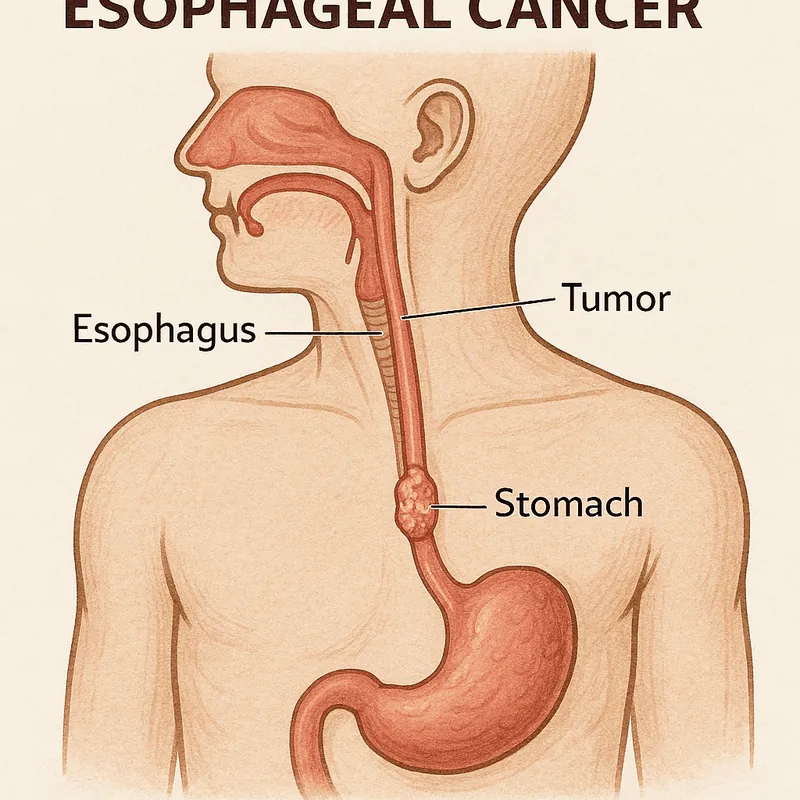
Lower esophagus, GE junction. Risk factors: chronic GERD, Barrett's esophagus, obesity, male sex, white race. Rising rapidly in Western countries.
Small cell carcinoma, GISTs, lymphoma, sarcomas. Less than 5% combined. Treatment depends on specific histology and stage.
Often asymptomatic until advanced. Progressive dysphagia is the hallmark, unfortunately by the time it appears, disease is often locally advanced.
Difficulty swallowing, first solids, then softer foods, then liquids. Feeling food "sticking" in the chest. Progresses over weeks-months. PATHOGNOMONIC and URGENT.
Significant unintentional weight loss. Combination of reduced intake (due to dysphagia) and cancer cachexia. Often dramatic by presentation.
Pain with swallowing, sharp pain in chest or back during/after eating. May indicate tumor ulceration or invasion. Suggests advanced disease.
Food backs up undigested, sometimes hours after eating. May aspirate at night (cough, recurrent pneumonia). Worsens with tumor progression.
Persistent burning, pressure, or dull pain in chest, behind breastbone, or in back. Worse after eating. May radiate. Indicates tumor invasion.
Hoarseness suggests recurrent laryngeal nerve involvement (locally advanced). Aspiration cough common. Recurrent pneumonia.
Vomiting blood (hematemesis) or black stools (melena) from tumor erosion. Iron-deficiency anemia from chronic blood loss. Urgent evaluation.
Profound fatigue, muscle wasting (sarcopenia). Both from cancer effects and inability to eat. Major predictor of treatment tolerance.
PRIMARY diagnostic test. Direct visualization of esophagus, biopsy of suspicious lesions. Determines histology (adenocarcinoma vs squamous). Should sample multiple sites.
Older test. May show "apple-core" lesion or stricture. Largely replaced by endoscopy but useful when endoscopy not immediately available.
Determines T-stage (depth) and N-stage (nearby nodes). Critical for staging. Can biopsy enlarged lymph nodes.
Identifies distant metastases. Standard for staging. Restaging after neoadjuvant therapy.
PRIMARILY PREVENTION (treat GERD/Barrett's) + nutritional support during/after conventional treatment
For prevention: Mediterranean + low alcohol + no smoking. During treatment: liquid/soft, calorie-dense, high protein. Post-esophagectomy: small frequent meals.
Broccoli, cauliflower, kale, Brussels sprouts. Isothiocyanates protective against esophageal cancer.
During treatment when intake is limited. Smoothies, eggs, fish, peanut butter, full-fat dairy if tolerated.
Smoothies, soups, yogurt, scrambled eggs, mashed vegetables. Adjust texture to dysphagia level.
After esophagectomy: 6-8 small meals/day. Sit upright. Chew thoroughly. Liquids between meals.
Fish, olive oil, vegetables, fruits, nuts, legumes. Protective for esophageal cancer.
Major risk factor for both adenocarcinoma and squamous cell. Continuing during treatment worsens outcomes.
Major risk factor especially for squamous cell. Synergistic with smoking. Eliminate during treatment; limit to <1 drink/day long-term.
Drinking very hot (>65ยฐC/149ยฐF) tea, coffee, soup associated with squamous cell esophageal cancer. Let beverages cool first.
Spicy foods, fried foods, citrus, chocolate, mint, coffee, alcohol if cause significant reflux. Individual triggers vary.
Bacon, sausage, hot dogs. Group 1 carcinogens. Limit during recovery and long-term.
Coordinate with oncology team. Post-esophagectomy patients need lifelong B12, calcium, vitamin D, iron monitoring.
| Supplement | Mechanism & Evidence | Suggested Dose | Timing | Notes |
|---|---|---|---|---|
| Vitamin B12 (Post-Esophagectomy) | Required after esophagectomy (loss of intrinsic factor production). Often lifelong supplementation needed. | 1,000mcg IM monthly OR 1,000-2,000mcg sublingual daily | Monthly IM or daily sublingual | Test B12 levels regularly. Monitor for deficiency symptoms. |
| Iron | Reduced absorption after gastric anatomy changes. Iron-deficiency anemia common. | Per ferritin levels, typically 65-150mg elemental iron daily | With vitamin C, away from calcium | Test ferritin regularly. Some patients need IV iron. |
| Calcium + Vitamin D3 | Reduced absorption after surgery. Bone loss common. Test and replace. | Calcium 1,000-1,200mg + Vitamin D 2,000-5,000 IU/day | With meals (Ca); with fat (D) | DEXA scan to monitor bone density. Pair D with K2 200mcg. |
| Multivitamin (Post-Esophagectomy) | Multiple micronutrient deficiencies common. Especially fat-soluble vitamins (A, D, E, K). | 1 quality multivitamin daily | With food | Choose one with adequate B-complex. |
| Pancreatic Enzymes (Some Patients) | Post-gastric/esophageal surgery may have enzyme insufficiency. Improve fat digestion. | Per oncology team | With meals | Discuss with surgical and oncology team. |
| Omega-3 (EPA/DHA) | Anti-inflammatory; may reduce cachexia. Supports muscle preservation. | 2,000-3,000mg EPA+DHA/day | With fat meal | Discuss with oncologist. |
| Whey Protein / Protein Supplements | Critical when intake limited by dysphagia or post-op anatomy. | 20-40g/day supplement | Between meals | Easy way to boost protein when appetite limited. |
| Probiotics | Restore microbiome after antibiotics. Support gut function. | 10-30 billion CFU/day, multi-strain | With or without food | Especially after surgery or antibiotic courses. |
Most esophageal adenocarcinoma develops on a background of chronic GERD and Barrett's esophagus, a window for prevention. If you have chronic heartburn, talk to your doctor about screening endoscopy. For squamous cell prevention: avoid tobacco, limit alcohol, avoid very hot beverages, maintain healthy diet. After diagnosis, treatment at a high-volume center significantly improves outcomes.