Benign Prostatic Hyperplasia

Non-cancerous enlargement of the prostate, common enough that roughly half of men in their fifties have it. It is not cancer and does not become cancer. It is also the condition with the best-selling supplement in men's health, and saw palmetto failed to beat placebo in two of the most rigorous trials ever run on it.

Benign, Not Cancer Evidence-Based Root-Cause Focus

Last updated:

🚨 Being completely unable to pass urine, with a painful full bladder, is an emergency. Go to an emergency department. Acute urinary retention needs a catheter, not a wait. Also get assessed promptly for blood in the urine, fever with back or flank pain, or a sudden change in your usual pattern, none of which are typical of simple prostate enlargement. Common cold and allergy remedies containing decongestants, and some antihistamines, can precipitate retention in men with BPH, which is worth knowing before you buy one. This warning is first because it is the part that could matter tonight.

What Is Benign Prostatic Hyperplasia?

Growth of the prostate gland with age, which squeezes the urethra running through it and obstructs the flow of urine. The bladder then has to work harder, and over time becomes thickened and irritable, which is why the symptoms are a mix of poor flow and urgency rather than one or the other.

It is benign. It is not prostate cancer, it does not turn into prostate cancer, and having it does not raise your risk of it. The two can coexist simply because both are common with age, which is why symptoms still need assessing rather than assuming.

Prostate size correlates poorly with symptoms. A large prostate can cause little trouble and a modest one can cause a great deal, so treatment follows how much it is affecting you rather than a measurement.
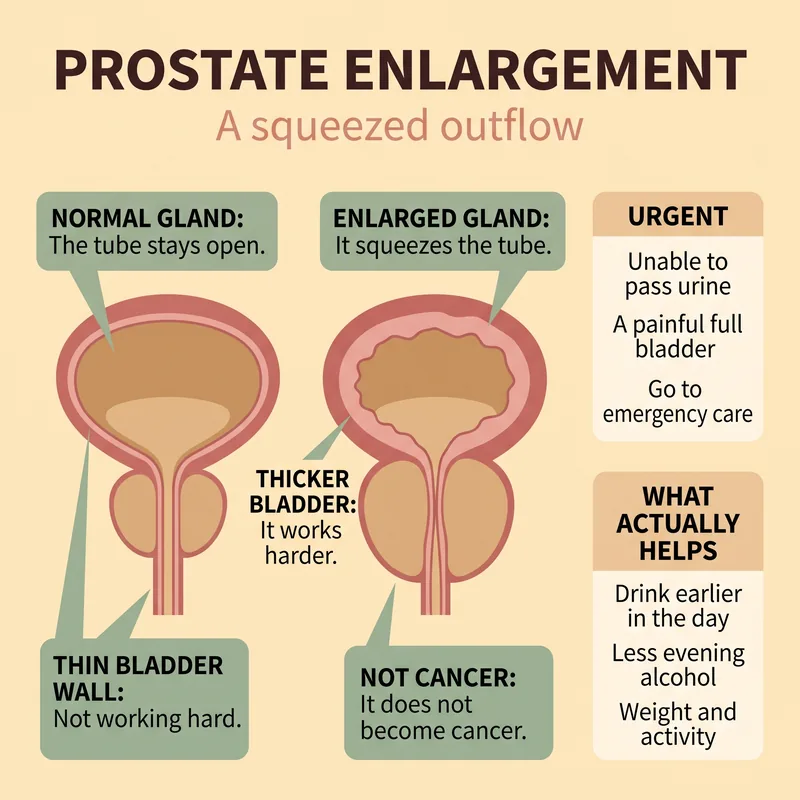
💡 Key Insight: Saw palmetto is among the most widely sold supplements in the world for this condition. A randomised trial escalating the dose found it did not reduce lower urinary tract symptoms more than placebo1, and an earlier rigorous trial found no improvement over placebo either2. This page reports that plainly rather than leaving it out.
Cross-section comparing a normal prostate around an open urethra with an enlarged prostate compressing the urethra and a thickened bladder wall above

🌿 Saw palmetto did not beat placebo

Two rigorous randomised trials, one escalating the dose, found no benefit over placebo12. It remains the best-selling product for this condition.

⚖️ The metabolic link is real

Symptom severity was associated with metabolic syndrome, and with the number of its components present3. That is where the modifiable ground is.

💉 It is not cancer

Benign enlargement does not become prostate cancer. Both are common with age, so symptoms are still assessed. See prostate cancer.

How BPH Presents

In two groups, and most men have some of each.

FeatureWhat it looks likeWorth knowing
Weak or slow streamTaking longer, less force than it used to haveAn obstructive symptom. Usually the earliest and most gradual
Hesitancy, straining, stopping and startingWaiting for it to begin, or it stalling mid-flowAlso obstructive, and often adapted to before it is reported
Dribbling at the endContinuing after you think you have finishedVery common and rarely mentioned unprompted
Getting up at night to pass urineOnce, twice, or moreOften the symptom that finally prompts a visit, because it wrecks sleep. See insomnia
Urgency and frequencyNeeding to go suddenly, and oftenFrom the bladder becoming irritable, not from the prostate directly. It can persist after the obstruction is treated
Feeling the bladder has not emptiedGoing again shortly afterwardsWorth reporting, since retained urine raises infection and stone risk
Complete inability to pass urine, painful full bladderSudden, distressingEmergency. Acute urinary retention needs same-day treatment
Blood in the urine, fever, or weight lossAnything on this rowNot typical of simple BPH. Report it and have it assessed
⚠️ Watch the medicine cabinet. Decongestants in cold and flu remedies, and some older antihistamines, tighten the bladder outlet or reduce bladder contraction, and can tip a man with BPH into acute retention. Ask a pharmacist before buying an over-the-counter cold remedy, and mention BPH when any new prescription is started. This is one of the most preventable emergencies on this site.

How BPH Is Assessed

By how much it is affecting you, plus a short list of things that must be excluded.

MeasureWhat it tells youWhat it misses
A symptom scoreHow severe it is and whether treatment is helping, in a number you can trackDoes not distinguish prostate obstruction from bladder overactivity, which behave differently
A bladder diaryWhat is actually happening, including how much you drink and whenFrequently more useful than any test, and almost never suggested
Urine dipstick and cultureInfection, blood, glucoseBlood in the urine needs following up regardless of BPH
Post-void residualWhether the bladder is emptyingVaries between measurements, so one high reading is not a verdict
Examination of the prostateSize and texture, and anything that feels irregularSize correlates poorly with symptoms, which surprises people
PSA, as a shared decisionPart of assessing whether cancer is also presentEnlargement itself raises PSA, and some BPH medicines lower it, so results need interpreting in context. Discuss the pros and cons; see prostate cancer
Kidney functionWhether long-standing obstruction has affected the kidneysSee chronic kidney disease
Glucose, blood pressure, lipids, waistThe metabolic picture associated with symptom severity3Rarely connected to the urinary complaint, and it is where the modifiable ground is. See metabolic syndrome
💡 Keep a bladder diary for three days before your appointment. Times, rough volumes, and what you drank and when. It routinely reveals things a scan will not, such as most of the night-time waking following an evening fluid or alcohol pattern that is simple to change.

Holistic vs. Conventional Treatment for BPH

🌿 HOLISTIC
💊 CONVENTIONAL
🌿

Holistic / Functional Approach

Fluid timing, the metabolic picture, and honesty about the supplements

Where The Modifiable Ground Is
Weight, activity and the metabolic picture, which was associated with symptom severity and with the number of components present3
Quickest Practical Win
Fluid timing and evening alcohol and caffeine, which often account for much of the night-time waking
Timeline
Behavioural changes show within a week or two. The metabolic work is measured in months
Limitation, stated plainly
The best-selling supplement for this condition did not beat placebo in two rigorous trials12

Full Holistic Approach Includes

  • Shifting fluid earlier in the day, without reducing the daily total, which usually backfires by concentrating the urine.
  • Reducing evening alcohol and caffeine, both of which increase urine production and bladder irritability.
  • Double voiding: waiting a moment and going again, which helps emptying.
  • Weight and activity, aimed at the metabolic picture associated with severity3.
  • Treating constipation, since a loaded rectum worsens bladder emptying. See IBS.
  • Reviewing over-the-counter remedies, particularly decongestants and older antihistamines.
  • Bladder training where urgency rather than flow is the main problem.
  • Treating the sleep consequences, since night waking does damage of its own.
🌿 Worth knowing: the honest holistic offering here is behavioural and metabolic, and it is genuinely useful. What it is not is a herbal alternative to treatment. This site would rather tell you that the fluid timing works and the capsules did not, than sell you the reverse.

Diet for BPH

Mostly about when you drink, and about the metabolic picture underneath.

💡 Where the association actually sits. Symptom severity was significantly related to metabolic syndrome, and the risk of being treated for these symptoms rose with the number of metabolic components present3. That is observational, so it shows association rather than proof, and it points at weight, activity, blood pressure and glucose as the ground worth working on. See metabolic syndrome.
ChangeWhyPractical note
Move fluid earlier in the dayDirectly reduces night-time wakingKeep the daily total. Stop two to three hours before bed
Do not cut total fluidConcentrated urine irritates the bladder and raises infection and stone riskThe commonest self-treatment, and it usually makes things worse. See kidney stones
Less evening alcoholIncreases urine production and worsens the nightThe single change most men notice fastest
Less caffeine, especially after middayBladder irritant and a diureticReduce gradually to avoid withdrawal headaches
Weight and waistPart of the metabolic picture associated with severity3Gradual. See obesity
Regular physical activityConsistently associated with fewer urinary symptomsWalking counts. It does not need to be strenuous
Enough fibre to avoid constipationA loaded rectum worsens bladder emptyingIncrease gradually, with fluid
A vegetable-forward patternServes the metabolic and cardiovascular picture that travels with thisSensible rather than proven for the prostate itself, and presented that way
⚠️ Cutting fluids is the wrong instinct. It is the first thing most men try, and it produces concentrated urine that irritates the bladder, worsens urgency, and raises the risk of infection and stones. The fix is timing, not volume. Keep drinking what you normally drink, and move it earlier.

Evidence-Based Supplements

A short and mostly negative section, which is the honest state of this field.

🚨 No supplement has been shown to treat BPH in a rigorous trial. Tell your clinician what you take before a PSA test, and never use a supplement as a reason to postpone assessment of blood in the urine, recurrent infection, or poor bladder emptying, all of which have consequences. Complete inability to pass urine is an emergency, not something to manage at home.
SupplementWhat it is actually forTypical rangeTimingNotes & cautions
Saw palmetto Not supported. A trial escalating the dose found no reduction in symptoms beyond placebo1, and an earlier rigorous trial found no improvement over placebo2. Listed to answer the question, not to recommend it Not applicable The most heavily sold product for this condition, tested more carefully than most supplements ever are, and it did not work. Generally well tolerated, so the main cost is money and delay.
Beta-sitosterol and pygeum Older and smaller trials suggested symptom improvement; the evidence is weaker and less consistent than the saw palmetto evidence that turned out negative. Discuss with your clinician rather than self-selecting With food Presented honestly rather than recommended. The saw palmetto story is a caution about how promising early results in this field have read.
Weight loss and activity The metabolic picture associated with symptom severity3, and not a supplement. Gradual, and sustainable Not applicable In this table deliberately, because it has more behind it than anything sold in a bottle for this condition.
Zinc and testosterone products Not supported for BPH, and testosterone in particular needs medical supervision for other reasons. Not recommended for this purpose Not applicable Marketed heavily to men through prostate and vitality products. Discuss anything hormonal with a clinician rather than buying it.
🚨 What to avoid, specifically. Over-the-counter decongestants and older antihistamines, which can precipitate acute retention; ask a pharmacist first. Cutting your fluid intake, which worsens urgency and raises infection and stone risk. Products claiming to shrink the prostate naturally. Using supplements as a reason to delay assessment of blood in the urine or poor emptying. And taking a PSA test without telling whoever interprets it what you are taking.
💡 Where the real leverage is. Moving fluid earlier without cutting the total, reducing evening alcohol, working on weight and activity, checking cold remedies with a pharmacist, and getting assessed rather than adapting for years. Those five do more than every prostate supplement on the market combined.

References & Evidence Notes

Each numbered entry below is either a source you can follow or a note setting out what the evidence does and does not support. Both are numbered together so the markers in the text line up.

Last reviewed 3 September 2026. Supplement entries are cross-checked against the NIH National Center for Complementary and Integrative Health and the Linus Pauling Institute Micronutrient Information Center.4 This page is nutrition education, not medical advice, and it does not replace your doctor. No supplement has been shown to treat benign prostatic hyperplasia in a rigorous trial, and the most widely sold one failed to beat placebo in two. Benign enlargement is not prostate cancer and does not become it, but symptoms still need assessing, and blood in the urine, fever, or inability to pass urine are not part of simple enlargement. What nutrition education can do is help you understand the evidence well enough to have a better conversation with the clinician who does treat you.

  1. Barry MJ, Meleth S, Lee JY, et al. Effect of increasing doses of saw palmetto extract on lower urinary tract symptoms: a randomized trial. JAMA. 2011;306(12):1344–1351. PubMed 21954478. The CAMUS trial. Increasing doses of saw palmetto fruit extract did not reduce lower urinary tract symptoms more than placebo. Escalating the dose was the specific test of the common objection that earlier negative trials had under-dosed.
  2. Bent S, Kane C, Shinohara K, et al. Saw palmetto for benign prostatic hyperplasia. N Engl J Med. 2006;354(6):557–566. PubMed 16467543. The earlier rigorous randomised trial, which found no improvement in symptoms or objective measures over placebo. Cited alongside CAMUS because two independent negative trials is a stronger statement than either alone.
  3. Association between metabolic syndrome and severity of lower urinary tract symptoms (LUTS): an observational study. BJU Int. 2015. PubMed 25229124. Symptom frequency and severity were significantly related to metabolic syndrome, and the risk of being treated rose with the number of metabolic components present. The authors suggest dietary change and regular physical activity as prevention of the modifiable factors, which is the basis of the diet section on this page. Observational, so association rather than causation.
  4. NIH National Center for Complementary and Integrative Health, nccih.nih.gov, and the Linus Pauling Institute Micronutrient Information Center, lpi.oregonstate.edu.