The progressive loss of muscle strength and mass with age. It is treated as an inevitable part of getting older, and it is not. The intervention with the strongest evidence is resistance exercise. Protein supports it and does not replace it, which is the wrong way round from how this is usually sold.
Last updated:
The loss of skeletal muscle strength, mass and function that accompanies ageing, and which accelerates sharply with inactivity, illness and inadequate eating. Frailty is the broader state it leads to: reduced reserve, so that a minor illness or a few days in bed causes a step down that is never fully regained.
The European consensus definition puts low muscle STRENGTH first, ahead of muscle mass, because strength predicts what actually happens to people better than size does1. That reordering matters here, because strength responds to training and mass alone does not tell you much.
It is not a diagnosis of decline. Muscle in older adults remains responsive to loading into very late life, and the losses from a hospital stay or a sedentary winter are partly recoverable. The reason this page exists is that almost nobody is told that.
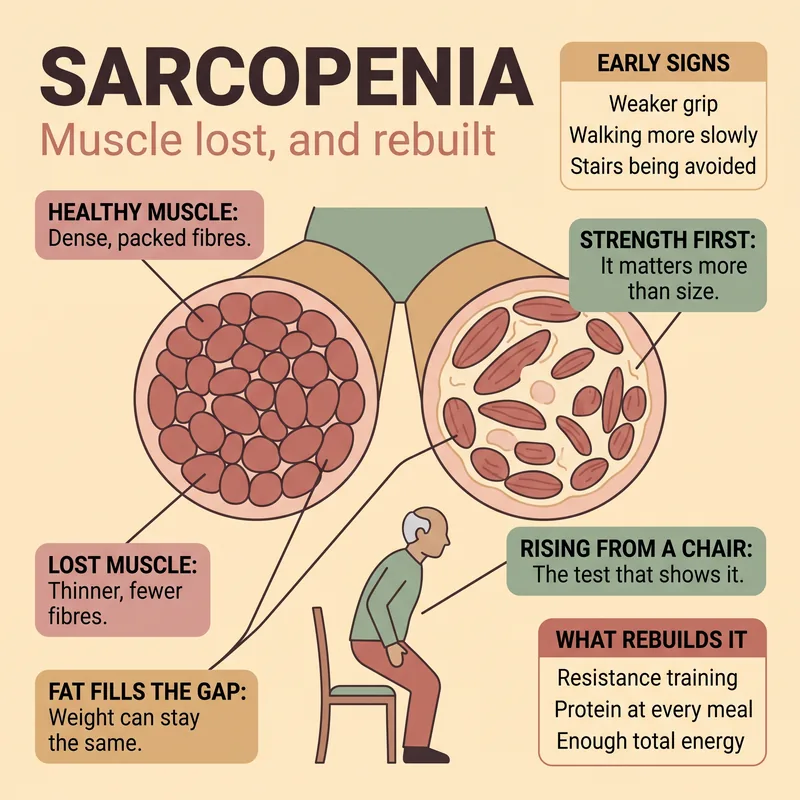
Resistance exercise improved grip strength, gait speed and sit-to-stand performance in older adults with sarcopenia2. Nothing in a tub does that on its own.
The European consensus made low strength the primary criterion1, because it predicts falls, disability and outcomes better than muscle mass does.
Higher protein is the advice here and is not the advice in chronic kidney disease. If you have both, the kidney team sets the number. See chronic kidney disease.
As things that get quietly worked around rather than reported.
| Feature | What it looks like | Worth knowing |
|---|---|---|
| Difficulty rising from a chair | Using the arms, or needing two attempts | One of the most useful single signs, and it is measurable in a clinic in one minute |
| Weaker grip | Jars, taps, carrying shopping | Grip strength is the primary criterion in the European definition1 |
| Slower walking | Being overtaken, not finishing a pedestrian crossing in time | Gait speed predicts a great deal, and improves with training |
| Stairs becoming a decision | Planning routes to avoid them | Avoidance accelerates the loss, which is the trap in this condition |
| Falls, or near-falls | Catching yourself, or a first fall | Report a fall. It is a clinical event with causes worth finding, not clumsiness |
| Unintended weight loss | Clothes and rings looser | Needs investigating on its own, not filing under age |
| Weight stable but shape changed | Less muscle, more fat, same number on the scale | Sarcopenic obesity. The scale is reassuring and wrong |
| A step down after illness | Never quite recovering after a hospital stay or a chest infection | Days in bed cost a surprising amount of muscle, and rebuilding needs to be deliberate |
With simple measurements that take minutes and are almost never done.
| Measure | What it tells you | What it misses |
|---|---|---|
| Grip strength | The primary criterion in the European consensus1 | Needs a dynamometer, which many practices do not have. Ask anyway |
| Chair stand test | Leg strength and function, with no equipment at all | A good substitute where grip cannot be measured |
| Gait speed | Severity, and a strong predictor of outcomes | Affected by joint pain and by fear of falling, so interpret it with those |
| A screening questionnaire | Whether formal assessment is warranted | Screening only. A negative answer with obvious weakness is not reassuring |
| Weight trend, not a single weight | Whether loss is happening | A stable weight hides muscle replaced by fat |
| Bloods for treatable causes | Thyroid, anaemia, B12, vitamin D, kidney function, inflammation | See thyroid disorders and B12 and folate deficiency |
| Kidney function, specifically | Whether the protein advice on this page applies to you at all | The single most important test before acting on anything below. See chronic kidney disease |
| A medication review | Sedatives, steroids and several others contribute to weakness and falls | Rarely done, and often the quickest win available |
Load the muscle, feed it enough, and find the treatable causes
Enough protein, enough energy, spread through the day, and paired with training.
| Change | Why | Practical note |
|---|---|---|
| Protein at every meal, not just dinner | Older muscle responds less to a given amount, so spreading it across the day works better than one large serving | Breakfast is where most people are short. Eggs, dairy, beans, fish |
| Enough total energy | Protein eaten in an energy deficit is burned rather than built | If appetite is poor, eat smaller and more often, and make each mouthful count |
| Do the training | The nutrition is material; the training is the signal2 | Not a dietary change, and it is the reason the dietary changes work at all |
| Correct vitamin D if deficient | Relevant to muscle function, falls and bone | Test rather than assume. See osteoporosis |
| Dairy, fish, eggs, legumes | Practical, affordable protein that does not require cooking a joint of meat | Tinned fish, yoghurt and beans need almost no preparation, which matters when energy is low |
| Enough fluid | Thirst blunts with age, and dehydration worsens weakness and confusion | Within any limit set for heart or kidney disease |
| Address a poor appetite as its own problem | Taste changes, dental problems, low mood and medication all reduce intake | Each of those is addressable, and none of them is age itself |
| Weight-loss diets in later life | Risky without resistance training | Weight lost without training is disproportionately muscle. If losing weight is right for you, train while you do it |
All of them are adjuncts to training. None of them substitutes for it.
| Supplement | What it is actually for | Typical range | Timing | Notes & cautions |
|---|---|---|---|---|
| Resistance training | The intervention, listed at the top of this table on purpose because it outranks everything below it2. | Two or three sessions a week, progressing the load | Not applicable | Not a supplement. It is here because a reader scanning only this table should not leave without it. |
| Protein supplements | Closing a genuine shortfall when appetite or preparation makes food difficult. Combined exercise and nutrition programmes are what the evidence supports3. | Set with a dietitian, alongside meals rather than replacing them | Spread across the day, and after training | Food first where possible. Little benefit if intake is already adequate. Not without kidney team involvement in chronic kidney disease. |
| Vitamin D3 | Correcting deficiency, which is relevant to muscle function, falls and bone. | Test 25-OH-D first, then set a daily dose with your clinician | With a fat-containing meal | Test rather than assume. Avoid large intermittent doses; see osteoporosis for the vitamin D cautions. |
| Creatine, alongside training | One of the better studied training adjuncts for strength and lean mass in older adults. | Discuss with your clinician rather than self-selecting a loading protocol | Daily, with food | Only worth considering if you are actually training, since it works by supporting the training. Discuss first in reduced kidney function; see chronic kidney disease. |
Each numbered entry below is either a source you can follow or a note setting out what the evidence does and does not support. Both are numbered together so the markers in the text line up.
Last reviewed 3 September 2026. Supplement entries are cross-checked against the NIH National Center for Complementary and Integrative Health and the Linus Pauling Institute Micronutrient Information Center.4 This page is nutrition education, not medical advice, and it does not replace your doctor. No supplement builds muscle without a training stimulus, and the protein advice on this page assumes normal kidney function. In chronic kidney disease the target is different and is set by your kidney team, not by this page. Weakness that came on over weeks rather than years needs investigating rather than attributing to age. What nutrition education can do is help you understand the evidence well enough to have a better conversation with the clinician who does treat you.