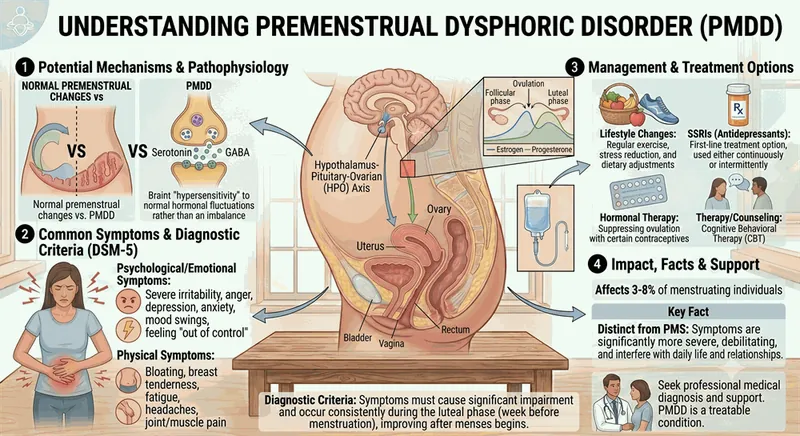
Premenstrual Dysphoric Disorder (PMDD), Severe Luteal Mood + Hormone Sensitivity

A severe, cyclical mood disorder triggered by normal hormonal fluctuations during the luteal phase. Affects approximately 5 to 8 percent of menstruating women. Now classified by DSM-5 as a mental health disorder, but driven by a treatable biology, not "just bad PMS".

DSM-5 Recognized Disorder 5โ€“8% of Menstruating Women ~12 yrs Diagnostic Delay Resolvable with Targeted Care

Last updated:

What Is Premenstrual Dysphoric Disorder (PMDD)?

PMDD is a severe, cyclical mood disorder in which normal hormonal fluctuations during the luteal phase (the 7 to 14 days before menstruation) trigger profound depression, anxiety, irritability, and physical symptoms, all of which resolve within a few days of menstrual onset.

PMDD is not "PMS plus". It is now recognized by the DSM-5 as a distinct mental health diagnosis. Research from the NIH and others has shown that women with PMDD do not have abnormal hormone levels, they have an abnormal neurosensitivity to normal estrogen and progesterone fluctuations, especially to the progesterone metabolite allopregnanolone and its modulation of GABA-A receptors. Approximately 5 to 8 percent of menstruating women meet criteria, but average diagnostic delay is 12 years and 30+ percent of women with PMDD report a suicide attempt at some point, making rapid recognition critical.

PMDD presents in several clinical patterns. Identifying yours helps target the right interventions:

Premenstrual Dysphoric Disorder, severe luteal phase mood and hormone sensitivity

"Women with PMDD are not depressed, anxious, or irritable people who happen to menstruate. They are women whose nervous systems react to ovarian hormone fluctuations with severe but reversible mood symptoms. The biology is real."

โ€” Peter Schmidt, MD, NIMH PMDD Research, NEJM 2017

๐Ÿ…ฐ๏ธ Classic / Affective PMDD

The most common pattern, dominated by sudden depression, hopelessness, tearfulness, and anhedonia in the luteal phase. Women describe feeling "like a different person" until the period starts. Strong response to SSRIs and to GABAergic nutrient support.

  • โ†’Hallmarks: Profound depression, tearfulness, hopelessness, dread, suicidal ideation in luteal phase
  • โ†’Primary lever: GABA support (allopregnanolone biology), B6, magnesium, calcium, omega-3
  • โ†’Cycle pattern: Symptoms begin day 14 to 21, resolve within 2 days of period onset
  • โ†’Key supports: Vitex (chasteberry), magnesium glycinate, B6, vitamin D, omega-3, NAC

๐Ÿ…ฑ๏ธ Anger / Irritability-Dominant PMDD

Rage, snapping, interpersonal conflict, and impulsive behavior are the dominant features rather than depression. Often described as "Jekyll and Hyde" by partners and family. Most commonly misdiagnosed as borderline or bipolar disorder.

  • โ†’Hallmarks: Explosive anger, rage outbursts, snapping at family, impulsive decisions
  • โ†’Primary lever: Blood sugar stability, magnesium, L-theanine, omega-3 (EPA particularly), B-vitamins
  • โ†’Watch-out: Easily misdiagnosed as borderline personality disorder or bipolar II
  • โ†’Key supports: Magnesium, L-theanine, B-complex, omega-3 (high EPA), glycine, ashwagandha

๐Ÿ…ฒ Anxious / Insomnia-Dominant PMDD

Severe anxiety, panic attacks, racing thoughts, and insomnia dominate the luteal phase. Often the GABA-allopregnanolone connection is most obvious in this subtype. Sleep disruption itself worsens every other symptom.

  • โ†’Hallmarks: Panic, racing thoughts, dread, insomnia, hypervigilance in luteal phase
  • โ†’Primary lever: Sleep restoration, GABA-supportive nutrients, magnesium, L-theanine, taurine
  • โ†’Cycle pattern: Anxiety peaks late luteal, often with insomnia 3 to 7 days before period
  • โ†’Key supports: Magnesium, L-theanine, taurine, glycine, ashwagandha, lavender oil (Silexan)

๐Ÿ…ณ PME (Premenstrual Exacerbation of an Existing Disorder)

Technically not PMDD by DSM-5 criteria, but operationally important. Existing depression, anxiety, bipolar, ADHD, or migraine symptoms intensify dramatically in the luteal phase. Treating the cyclical component reduces overall disease burden.

  • โ†’Hallmarks: Symptoms present all month but markedly worse in the luteal phase
  • โ†’Primary lever: Treat the underlying condition + add luteal-phase cyclical support
  • โ†’Watch-out: Often missed, women think "it's just my depression getting worse"
  • โ†’Key supports: Existing treatment + luteal-targeted magnesium, B6, omega-3, vitex

PMDD Statistics & Research

5โ€“8%
of menstruating women meet DSM-5 PMDD criteria
~12 yrs
average diagnostic delay from symptom onset
~30%
report at least one suicide attempt in their lifetime
~70%
have at least one co-occurring mood / anxiety disorder
~14 days
per cycle of disabling symptoms in the luteal phase
~50%
respond to SSRIs; ~70% to combined holistic protocol

How PMDD Presents

PMDD is defined by the timing as much as by the symptoms. Identical-looking depression, anxiety, or irritability in the follicular phase (after the period) is NOT PMDD. The cyclical pattern, severe in the luteal phase, gone by day 3 of menses, is what makes the diagnosis.

๐Ÿง  Emotional & Cognitive Symptoms

๐Ÿ˜ข

Severe Depression & Hopelessness

Sudden onset of profound sadness, hopelessness, worthlessness, and tearfulness 7 to 14 days before menstruation. Often described as "the curtain dropping" or "becoming someone else". Resolves within days of menstrual onset. Suicide ideation in this window is a recognized PMDD emergency.

๐Ÿ˜ก

Rage & Irritability

Disproportionate anger, snapping at family or partner, road rage, and interpersonal conflict that one would not consider in character. Often the symptom that damages relationships and careers most. Reflects GABA receptor dysregulation more than "personality".

๐Ÿ˜ฐ

Severe Anxiety & Panic Attacks

Racing thoughts, sense of impending doom, panic attacks, and hypervigilance that may not be present in the follicular phase at all. Often misdiagnosed as primary anxiety disorder until the cyclical pattern is recognized.

๐ŸŒซ๏ธ

Cognitive Symptoms (Brain Fog, Memory)

Significant difficulty with concentration, decision-making, and short-term memory in the luteal phase. Many women describe feeling "stupid" or like their IQ drops 20 points. Reverts to baseline after menstruation begins. Real and measurable on neuropsychiatric testing.

๐Ÿ™…

Withdrawal & Loss of Interest (Anhedonia)

Activities, people, and pleasures that normally bring joy become flat or actively unwanted. Withdrawal from family and friends is common in late luteal. Often results in missed work, social isolation, and damaged relationships.

โš ๏ธ

Suicidal Ideation & Self-Harm Urges

Approximately 30 percent of women with PMDD experience suicidal thoughts in the luteal phase, and lifetime suicide attempt rate is substantially higher than the general population. This is a recognized medical emergency, not a personality flaw or attention-seeking. Safety planning is essential.

๐Ÿฉธ Physical, Behavioral & Quality-of-Life Symptoms

๐Ÿ˜ด

Insomnia & Sleep Disturbance

Inability to fall asleep despite exhaustion, frequent night waking, vivid distressing dreams, and waking 3 to 5 AM with racing thoughts are typical luteal-phase sleep patterns. Conversely, hypersomnia and inability to wake also occur. Either pattern is disabling and worsens every other symptom.

๐Ÿซ

Carbohydrate Cravings & Binge Eating

Intense urges for refined carbs, chocolate, and sweet foods in the luteal phase, often progressing to binge episodes. Reflects falling serotonin and a serotonin-precursor self-medication attempt. Worsens energy crashes and mood instability.

๐Ÿค•

Headaches & Migraines

Hormonal-trigger migraines and tension headaches are common, especially in the days before the period when estrogen drops sharply. Often the most disabling physical symptom and can extend the suffering period to 7+ days.

๐Ÿคฐ

Bloating, Breast Tenderness & Weight Fluctuation

2 to 5 pounds of water retention, severe breast tenderness, and abdominal bloating are universal. Add to body image distress and worsen the mood symptoms. Resolve within 2 to 3 days of menstruation onset.

๐Ÿ˜ฉ

Severe Fatigue & Low Energy

Crushing tiredness disproportionate to the day's demands, often paired with insomnia (paradoxically). The combination is one of the most disabling features and the strongest predictor of work absences during PMDD weeks.

๐Ÿ’”

Relationship Strain & Lost Workdays

PMDD has the same disability burden as major depression but compressed into 7 to 14 days each month. Average women with PMDD lose 1500+ workdays over their reproductive years. Partners and children are often deeply affected, making partner education a core part of treatment.

โš ๏ธ Suicide safety: If you have thoughts of self-harm during your luteal phase, do not wait. Call or text 988 (US Suicide & Crisis Lifeline) or your local crisis line. Tell your provider this is PMDD-pattern (cyclical) and request a same-week appointment. The IAPMD (International Association for Premenstrual Disorders) maintains a directory of PMDD-aware providers.

How to Test for PMDD

PMDD is a clinical diagnosis based on the DSM-5 criteria and the requirement of two consecutive months of prospective daily symptom tracking. There is no blood test, but lab work is used to rule out look-alikes (thyroid, anemia, low ferritin, vitamin D deficiency).

๐Ÿ  At-Home Screening

The most important diagnostic step for PMDD happens at home, daily tracking. Without it, the cyclical pattern cannot be confirmed and women are misdiagnosed with bipolar, borderline, or chronic depression.

๐Ÿ““ DRSP (Daily Record of Severity of Problems)

The gold-standard tracking tool, available free from IAPMD. Score 24 symptoms on a 1 to 6 scale every evening for 2 full cycles. PMDD diagnosis requires at least one core symptom at severity 4+ in the luteal phase that drops to 1 to 2 in the follicular phase. The pattern is more important than the absolute scores.

๐Ÿ“ฑ PMDD-Tracking Apps

Apps like Me v PMDD, Clue, and Premom enable structured daily tracking with cycle alignment. Look for apps that overlay symptoms with cycle phase. Bring screenshots of 2 cycles to your appointment, this single thing dramatically shortens diagnostic delay.

๐Ÿ“‹ PMDD Symptom Checklist (DSM-5)

Score for each in the luteal week: marked depression, marked anxiety/tension, marked affective lability, persistent anger, decreased interest, difficulty concentrating, lethargy/fatigue, appetite/cravings, sleep disturbance, sense of being overwhelmed, physical symptoms. 5+ symptoms (with 1+ from the first four) confirmed over 2 cycles meets DSM-5 PMDD criteria.

๐Ÿ”ฌ Lab & Clinical Tests

๐Ÿฆ‹ Thyroid & Pituitary Panel

TSH, free T4, free T3, TPO antibodies, reverse T3. Hypothyroidism and Hashimoto's both produce cyclical mood and fatigue that overlap with PMDD. Subclinical thyroid disease in particular is common and missed. Treat thyroid first if positive before concluding PMDD.

๐Ÿงซ Nutrient & Inflammation Status

25-OH vitamin D (target 50 to 80 ng/mL), ferritin (often low if heavy periods, contributes to mood and fatigue), B12 + MMA, magnesium RBC, folate, homocysteine. These are the foundational levers a holistic protocol uses.

๐Ÿ’‰ Reproductive Hormone Panel

Estradiol, progesterone (day 21 of cycle for confirmation of ovulation), SHBG, DHEA-S, testosterone, prolactin. Hormone levels are usually NORMAL in PMDD, the disorder is in the brain's response, not the levels. Useful primarily to rule out PCOS, perimenopause, and prolactinoma.

๐Ÿฉธ Metabolic & Inflammation Panel

Fasting glucose, fasting insulin, HOMA-IR, HbA1c, hs-CRP. Insulin resistance and chronic low-grade inflammation worsen PMDD substantially. Glucose roller-coaster amplifies all mood symptoms in the luteal phase.

๐Ÿง  Psychiatric Differential Evaluation

Detailed history to rule out major depressive disorder (continuous), bipolar I/II, generalized anxiety, borderline personality disorder, and complex PTSD. PME (premenstrual exacerbation) is the most common misdiagnosis, the underlying condition needs treatment AND luteal-phase support.

๐Ÿงช Optional Functional Testing

DUTCH (Dried Urine Test for Comprehensive Hormones) shows estrogen metabolism, cortisol pattern, and neurotransmitter precursors. Organic acids test (OAT) for B-vitamin status and neurotransmitter metabolism. Not required, but useful for treatment optimization.

Holistic vs. Conventional Treatment for PMDD

Toggle between the two approaches to compare treatments, outcomes, and what each looks like in practice.

๐ŸŒฟ HOLISTIC
๐Ÿ’Š CONVENTIONAL
๐ŸŒฟ

Holistic / Functional Approach

Stabilize GABA-allopregnanolone signaling, support neurotransmitter precursors, eliminate inflammatory drivers, restore the cycle from the inside

Primary Treatment
Cycle-aware nutrition + magnesium/B6/calcium/omega-3 stack + vitex + sleep restoration + GABA support
Duration
2 to 3 cycles for noticeable change; 6 to 9 months for full stabilization
Effect on Underlying Disorder
Addresses the underlying neuro-sensitivity, sustained relief possible
Fertility & Cycle
Cycle remains intact and may even normalize; pregnancy possible while on protocol
Protocol Includes
  • Stable blood sugar throughout the cycle, protein-anchored meals, no skipping meals (especially in luteal)
  • Magnesium glycinate 300 to 400 mg + B6 (P5P) 50 to 100 mg + calcium 600 mg + omega-3 2 g daily
  • Vitex (chasteberry) 400 to 1000 mg daily, taken throughout the cycle (8 to 12 weeks for effect)
  • L-theanine, glycine, taurine for GABA support, especially in luteal phase
  • NAC 1200 to 1800 mg/day, supports glutathione and reduces oxidative-stress mood component
  • Vitamin D3 + K2 to optimize neurosteroid pathway (target 50 to 80 ng/mL)
  • Sleep optimization, 7 to 9 hours, especially in luteal phase, magnesium and lavender at bedtime
  • Cycle-tracking + luteal-phase preparedness (lighter schedule, no big decisions, partner check-ins)
  • Daily walking, strength training 2 to 3x/week, mood-protective and insulin-sensitizing
  • Therapy support (CBT, IFS, DBT skills) for the emotional weight of the diagnosis
โœ… Side effects: Loose stools from magnesium (reduce dose), occasional irregular cycles from vitex (resolve in 8 to 12 weeks), mild detoxification fatigue first 2 weeks. None of the systemic side effects of pharmaceuticals.

Root Causes of PMDD

PMDD is rarely caused by a single thing. It is a stack of neuro-endocrine sensitivity, micronutrient depletion, gut and HPA-axis dysregulation, and trauma stored in the nervous system. Identifying the dominant drivers in your case targets the treatment.

Root Cause How It Contributes to PMDD Holistic Solution
GABA-Allopregnanolone Receptor SensitivityThe luteal-phase progesterone metabolite allopregnanolone normally calms the brain via GABA receptors. In PMDD, the receptor response is paradoxical, normal allopregnanolone triggers anxiety and depression rather than calm.GABA-supportive nutrients (magnesium, taurine, L-theanine, glycine), avoid hormonal contraceptives that disrupt the pathway, NAC, lifestyle calm
Magnesium DeficiencyMagnesium is required for over 300 enzymatic reactions including neurotransmitter synthesis, GABA signaling, and progesterone metabolism. Deficient in approximately 60 percent of women with PMDD.Magnesium glycinate 300 to 400 mg/day evening; dark leafy greens, pumpkin seeds, dark chocolate; epsom salt baths in luteal phase
Vitamin B6 (P5P) DeficiencyB6 is a co-factor for serotonin, dopamine, and GABA synthesis from amino-acid precursors. Studies show 50 to 100 mg/day reduces PMDD symptoms substantially.Methylated B-complex with B6 as P5P (pyridoxal-5-phosphate); cap at 100 mg/day to avoid neuropathy from high-dose pyridoxine
Vitamin D DeficiencyVitamin D is a neurosteroid hormone itself. Deficiency worsens depression, anxiety, and PMDD. Most women with PMDD test low (< 30 ng/mL).Test 25-OH-D; supplement 2000 to 5000 IU D3 + K2 daily; sunlight; target 50 to 80 ng/mL; retest after 3 months
Blood Sugar Instability / Insulin ResistanceThe glucose roller-coaster amplifies every mood symptom in the luteal phase. Women with insulin resistance have substantially worse PMDD scores.Protein-anchored meals, half plate vegetables, no skipped meals, especially in luteal; 10-minute walk after each meal; strength training
Gut Dysbiosis & InflammationThe gut microbiome regulates estrogen metabolism (estrobolome) and produces ~90% of serotonin. Dysbiosis raises inflammation, disrupts hormone clearance, and worsens mood.Fermented foods, soluble fiber, broad-spectrum probiotics, remove gut irritants, address SIBO/candida if present, treat constipation
Chronic Stress & HPA-Axis DysregulationSustained cortisol depletes progesterone (the "pregnenolone steal"), worsens allopregnanolone sensitivity, and amplifies emotional reactivity in the luteal phase.Daily breathwork, vagal tone exercises, daylight exposure, magnesium, adaptogens (ashwagandha, rhodiola), boundaries
Trauma & ACE ScoreWomen with childhood adversity have 2 to 4x higher PMDD prevalence and severity. Trauma stored in the nervous system amplifies hormonal sensitivity.Trauma-informed therapy (EMDR, IFS, somatic experiencing), body-up nervous system work, community support, IAPMD peer groups
Postpartum or Post-Hormonal TriggerPMDD often appears or worsens after pregnancy, after discontinuing OCP, or after a stressful hormonal transition. The hormonal sensitivity threshold has shifted.Postpartum mineral repletion (magnesium, iron, B12), gradual return to ovulation support, sleep restoration, partner-included care
Genetic ESR1 / Methylation VariantsVariations in estrogen receptor genes (ESR1) and methylation genes (MTHFR, COMT) increase PMDD risk by altering hormone signaling and clearance.Methylated B-complex, address COMT/MTHFR with appropriate methyl-donor support, optimize estrogen detoxification with cruciferous and DIM

PMDD Diet Guide

Food is one of the most underused PMDD levers. Blood sugar instability, micronutrient depletion, and inflammatory diets all amplify luteal-phase symptoms substantially. The right pattern supports neurotransmitter synthesis, GABA receptors, and progesterone metabolism.

๐ŸŒ™

What Is the Cycle-Aware, Mood-Stabilizing Eating Pattern?

The PMDD diet is not a "diet" in the weight-loss sense. It is a structure that keeps blood sugar steady all month, supplies neurotransmitter precursors abundantly, and adds extra support specifically in the luteal phase when needs spike.

The framework: anchor every meal with protein, fill half the plate with non-starchy vegetables, add healthy fats, and time slow complex carbs strategically, more in the luteal phase to support serotonin production, less in the follicular phase when insulin sensitivity is highest.

The 4 Anchors of Every Meal:

  • 1Protein 25 to 40 g, supplies tryptophan and tyrosine for serotonin and dopamine
  • 2Non-starchy vegetables fill half the plate, fiber, magnesium, B-vitamins
  • 3Healthy fats, olive oil, avocado, walnuts, wild fish, hormone and brain support
  • 4Slow carbs from whole foods, sweet potato, quinoa, lentils, especially in luteal phase

Luteal Phase Specifics:

  • โฐEat every 3 to 4 hours, low blood sugar amplifies all luteal symptoms
  • ๐ŸŒพAdd 1 to 1.5x normal slow carbs in luteal phase for serotonin synthesis
  • ๐Ÿง‚Mind sodium & potassium, dilute fluids and reduce salt to manage bloating
  • ๐ŸšซDrop alcohol completely in the luteal week, single biggest dietary lever
๐Ÿ’ก Many women find the single highest-impact change is eliminating alcohol during the luteal phase. It worsens sleep, depletes B-vitamins and magnesium, and amplifies every mood symptom.
โš ๏ธ These foods worsen blood-sugar swings, deplete key nutrients, and amplify luteal-phase mood symptoms. The first three are non-negotiable.
  • โœ—Alcohol: Disrupts sleep, depletes B-vitamins and magnesium, worsens GABA dysfunction, amplifies mood symptoms; eliminate especially in luteal phase
  • โœ—Refined sugar & baked goods: Glucose roller-coaster amplifies anxiety, irritability, and crashes; soda, candy, pastries, sweetened coffee drinks
  • โœ—Caffeine excess: > 200 mg/day worsens anxiety, sleep, and breast tenderness; cut by half in luteal phase
  • โœ—Refined flour & ultra-processed foods: White bread, pasta, packaged snacks lack the nutrients PMDD biology needs
  • โœ—Industrial seed oils: Soybean, canola, corn, sunflower, safflower drive inflammation that worsens mood
  • โœ—Conventional dairy: Inflammatory for many; A1 casein may worsen mood symptoms in sensitive women; trial 60 days
  • โœ—Artificial sweeteners: Aspartame, sucralose may disrupt gut and serotonin metabolism; use stevia or monk fruit instead
  • โœ—Salt-heavy convenience foods: Frozen meals, deli meats, chips worsen bloating and breast tenderness
  • โœ—Skipping meals or grazing on snacks: Both destabilize blood sugar; build structured 3 meals + 1 to 2 protein snacks in luteal
๐Ÿ’ก Foods that supply neurotransmitter precursors, magnesium, B-vitamins, omega-3, and the building blocks for hormone metabolism.
  • โœ“Quality proteins: Wild salmon, sardines, pastured eggs, grass-fed beef (tryptophan, tyrosine, B12 for neurotransmitters)
  • โœ“Magnesium-rich foods: Pumpkin seeds, dark chocolate (85%+), spinach, Swiss chard, almonds, black beans, avocado
  • โœ“Slow carbs in luteal phase: Sweet potato, butternut squash, quinoa, lentils, steel-cut oats (supports serotonin synthesis)
  • โœ“Omega-3 fatty fish: Wild salmon, sardines, mackerel 3 to 4x/week (EPA particularly helps mood)
  • โœ“Cruciferous vegetables: Broccoli, kale, Brussels sprouts, cauliflower (estrogen metabolism via DIM/I3C)
  • โœ“B-vitamin rich foods: Pastured eggs, liver, sardines, leafy greens, sunflower seeds, nutritional yeast
  • โœ“Fiber for estrogen clearance: Flaxseed (1 to 2 tbsp/day), chia, ground flax, beans, vegetables, supports estrobolome
  • โœ“Calming herbal teas: Chamomile, lemon balm, passionflower, valerian (luteal/evening), tulsi, rose
  • โœ“Fermented foods: Kimchi, sauerkraut, plain kefir, miso (gut and estrobolome support)

Key Supplements for PMDD Recovery

Supplements are accelerators on top of nutrition and lifestyle. The protocol below combines the most evidence-backed PMDD interventions with foundational nutrients that PMDD biology consistently depletes.

Supplement Role in PMDD Recovery Suggested Dose Timing Notes
Magnesium GlycinateThe single most-evidence-backed PMDD supplement. Required for GABA synthesis, progesterone production, and neurotransmitter balance. Multiple RCTs show 200 to 400 mg/day reduces PMDD severity substantially.300 to 400 mg elemental per dayEvening, 30 to 60 min before bedGlycinate is most absorbable and calming. Can split AM/PM in luteal week.
Vitamin B6 (P5P)Cofactor for serotonin, dopamine, and GABA synthesis. Meta-analyses show 50 to 100 mg/day reduces overall PMDD symptoms by ~50 percent.50 to 100 mg P5P per dayMorning with foodUse P5P (pyridoxal-5-phosphate), not high-dose pyridoxine. Cap at 100 mg to avoid neuropathy.
Calcium Carbonate or CitrateRCT-validated reduction in PMDD severity at 1000 to 1200 mg/day. May work via calcium's role in PMS-related estrogen metabolism and bone-mineral cycling.1000 to 1200 mg per day, in divided dosesSplit between mealsCitrate is gentler on the stomach. Take separately from iron and zinc supplements.
Vitex (Chasteberry)Modulates dopamine receptors in the pituitary, supporting progesterone production via the luteal phase. Multiple RCTs show 40 to 60% improvement in PMDD over 3 cycles.400 to 1000 mg per day (standardized extract)Morning, daily throughout cycleTakes 8 to 12 weeks for full effect. Avoid with hormonal contraception and during pregnancy.
Omega-3 EPA/DHAEPA-dominant omega-3 reduces depressive symptoms in PMDD via anti-inflammatory and serotonergic mechanisms. Strong RCT evidence at 2 g+ EPA/DHA daily.2 g combined EPA+DHA per day (EPA-dominant)With mealsChoose IFOS-certified. Higher EPA ratio specifically helps depressive symptoms.
Vitamin D3 (with K2)Acts as a neurosteroid. Deficiency strongly correlates with PMDD severity. Restoring optimal levels improves cycle regularity, mood, and immunity.2000 to 5000 IU D3 + 100 to 200 mcg MK-7 K2 per dayWith a fat-containing mealTest 25-OH-D, target 50 to 80 ng/mL. Retest after 3 months.
L-TheanineAmino acid from green tea that increases GABA, dopamine, and alpha brain waves. Calming without sedation, ideal for luteal-phase anxiety.200 to 400 mg per day, split as neededAnytime; especially when anxiety buildsNon-habit forming. Pairs well with magnesium and ashwagandha.
N-Acetylcysteine (NAC)Boosts glutathione, modulates glutamate signaling (often hyperactive in PMDD), and supports mood regulation. RCT data for anxiety, depression, and PMS.1200 to 1800 mg per dayEmpty stomach, split twiceInexpensive and well-tolerated. May take 8 weeks for full effect.
TaurineAmino acid that supports GABA receptor function and dampens excitatory glutamate signaling. Helpful for irritability and anxiety subtypes.500 to 2000 mg per dayEvening or before stressEspecially helpful in irritability-dominant PMDD.
GlycineInhibitory neurotransmitter that supports calm and deep sleep. RCT evidence for sleep quality improvement.3 g at bedtime30 minutes before bedTastes mildly sweet. Especially helpful with insomnia component.
Ashwagandha (KSM-66)Adaptogen that lowers cortisol, supports HPA-axis recovery, and reduces anxiety. RCT evidence in chronic stress and anxiety.300 to 600 mg standardized extract per dayEvening preferredAvoid in autoimmune thyroid (Hashimoto's) without supervision.
Methylated B-ComplexProvides B1, B2, B3, B5, B6 (P5P), B7, B9 (L-methylfolate), B12 (methylcobalamin) for neurotransmitter synthesis and methylation, often impaired in PMDD.1 capsule per day per product labelMorning with foodChoose with L-methylfolate (not folic acid) and methylcobalamin.
Saffron Extract (Crocus sativus)RCT evidence for mild to moderate depression and PMS/PMDD. Works via serotonin and dopamine modulation.30 mg standardized extract twice dailyWith mealsLook for affronยฎ or other standardized clinical-trial extract.
Iron (if Ferritin Low)Heavy menstrual bleeding is common in PMDD and depletes ferritin. Low ferritin worsens fatigue, mood, and restless legs.25 to 65 mg elemental per day (if ferritin < 50 ng/mL)Empty stomach with vitamin CTest ferritin first. Use bisglycinate or ferrous sulfate. Recheck after 3 months.
Probiotic (Multi-Strain)Supports estrobolome (estrogen-metabolizing gut bacteria) and the gut-brain axis that influences mood. RCT evidence in depression and anxiety.25 to 50 billion CFU, multi-strain per dayEmpty stomach or with light mealRotate brands every 2 to 3 months for diversity.
Curcumin (Turmeric Extract)Anti-inflammatory and antidepressant in RCT data. Helpful for PMS/PMDD physical and emotional symptoms.500 to 1000 mg curcumin per dayWith a fat-containing mealMust include piperine or be liposomal for absorption.
Lavender Oil (Silexan)Standardized oral lavender extract with RCT evidence for anxiety, sleep, and PMS. Comparable efficacy to low-dose lorazepam in some trials.80 mg per day, oral capsuleEvening or daytime as neededPharmaceutical-grade Silexan recommended. Different from aromatic lavender oil.

Healing Timeline: Conventional vs. Holistic

Understanding what to expect from each approach helps set realistic expectations and make informed choices.

๐ŸŒฟ Holistic Protocol
Cycle 1 (Weeks 1โ€“4)

Track symptoms with DRSP. Begin magnesium, B6, omega-3, vitamin D. Eliminate alcohol and refined sugar in luteal phase. Sleep optimization.

Cycle 2โ€“3 (Month 2โ€“3)

Add vitex, calcium, NAC. Pattern often noticeably softer, anxiety lower, sleep improving. Less rage and depression. Cycle tracking confirms shift.

Cycle 4โ€“6 (Month 4โ€“6)

Layer L-theanine, saffron, taurine, ashwagandha. Many women report 50 to 70% symptom reduction. Address co-occurring depression/anxiety.

Month 6โ€“12

Maintenance protocol. Most women report PMDD weeks now resemble manageable PMS rather than disabling crisis. Therapy work continues.

Long-Term Outlook

Sustained reduction or remission when protocol is maintained; cycle intact

๐Ÿ’Š Conventional Treatment
Week 1โ€“4

SSRI started, sometimes luteal-only. Side effects (nausea, sexual dysfunction, sleep changes) appear in many. Combined OCP may be added.

Month 1โ€“3

About 50% respond clinically. Mood blunting, emotional flatness, libido loss common. Underlying nutritional and neurosteroid factors not addressed.

Year 1โ€“2

Many stay on medications long-term. Some try multiple SSRIs. Refractory cases offered GnRH agonists, severe side effect profile.

On Discontinuation

Symptoms typically return rapidly. Withdrawal symptoms add to picture. Post-OCP amenorrhea can occur. Many describe being "stuck" on medications.

Long-Term Outlook

Chronic medication dependence with persistent side effects; surgical menopause for refractory cases

"PMDD is not in your head. It is in your GABA receptors, your magnesium status, your B-vitamins, your gut, your sleep, and your nervous system. Treat the biology, and the suffering shifts."

Ready to Address Your PMDD at the Root?

Explore related conditions below or revisit the Symptom Checker to map your full symptom picture across the library.