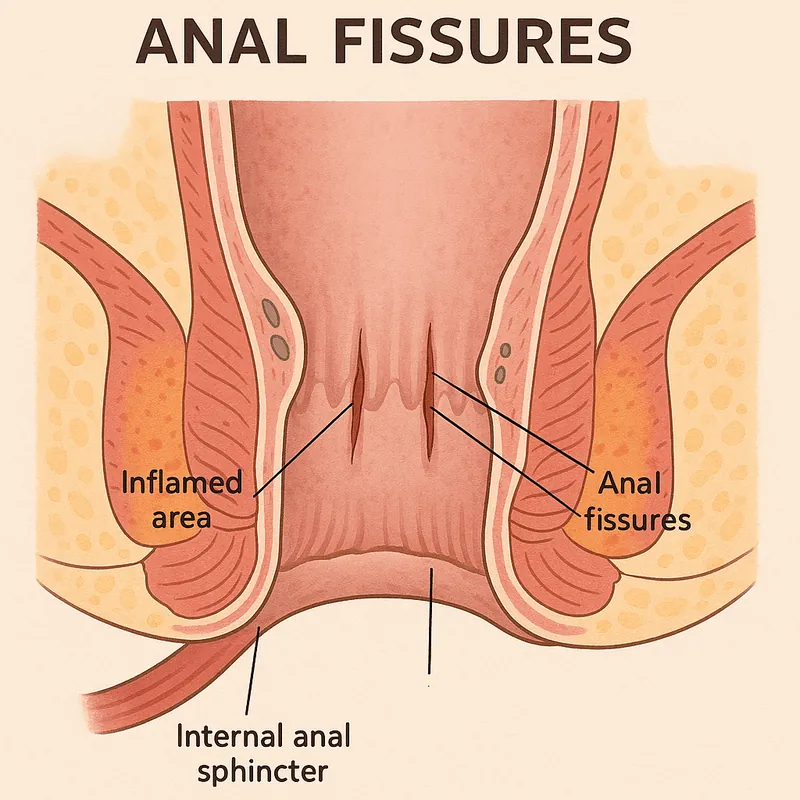
Anal Fissures

Small tears in the anal canal lining, usually from hard stool. Cause sharp pain during and after defecation. High fiber, hydration, magnesium for stool softening, and warm sitz baths heal most fissures within weeks.

Gut & Digestive Evidence-Based Root-Cause Focus

Last updated:

What Are Anal Fissures?

Anal fissures are small linear tears or cracks in the lining of the anal canal, typically extending from the anal verge into the squamous epithelium. Most occur in the posterior midline (~90%), with the remainder anterior. They cause characteristic sharp tearing pain during defecation that often persists for hours afterward.

Acute fissures (<6 weeks) heal in >90% of cases with conservative management, primarily addressing the constipation that caused them. Chronic fissures (>6 weeks) develop classic features: hypertrophied anal papilla above, sentinel skin tag below, and visible internal sphincter muscle in the base. Underlying anal sphincter hypertonia maintains the fissure.

The pathophysiology centers on a vicious cycle: hard stool tears the lining โ†’ pain triggers sphincter spasm โ†’ reduced blood flow โ†’ impaired healing โ†’ chronic fissure. Fissures NOT in the typical midline locations (lateral, multiple) raise concern for underlying disease, Crohn's, HIV, tuberculosis, syphilis, anal cancer, and warrant evaluation.

๐Ÿ’ก Key Insight: The primary treatment is breaking the cycle: softening stool (high fiber, water, magnesium, stool softeners), reducing sphincter spasm (sitz baths, topical nitrates or calcium channel blockers), and patience. Most acute fissures heal in 4-6 weeks. Surgery (lateral internal sphincterotomy) is reserved for chronic refractory cases.
Anal Fissures illustration

Types of Anal Fissures

๐ŸŒฑ Acute Fissure (<6 weeks)

Simple linear tear from hard stool. Heals in >90% with conservative management. Posterior midline most common.

๐ŸŒ— Chronic Fissure (>6 weeks)

Persistent fissure with hypertrophied papilla, sentinel skin tag, visible sphincter. Sphincter spasm maintains it. Often requires more intensive treatment.

๐ŸŒ‘ Atypical Fissure

Lateral location, multiple fissures, painless. Raises concern for Crohn's, HIV, TB, syphilis, anal cancer. Workup needed.

~1 in 350
Annual incidence in general population
~90%
Of acute fissures heal with conservative care
~90%
Occur in posterior midline
~95%
Surgical cure rate (lateral sphincterotomy)

Symptoms of Anal Fissures

Characteristic pain pattern usually makes diagnosis straightforward. Atypical features warrant further evaluation.

๐Ÿ” Classic Symptoms

โšก

Sharp Tearing Pain with BM

Severe, knife-like pain during bowel movement. Often described as passing broken glass. Pathognomonic for fissure.

๐Ÿ˜ฃ

Persistent Burning Pain After BM

Aching, burning pain lasting minutes to hours after defecation. Worse with sphincter spasm. May be incapacitating.

๐Ÿฉธ

Bright Red Blood on Wiping

Small amounts of fresh blood on toilet paper, occasionally on stool surface. Never large volumes (suggests other diagnosis).

๐Ÿ˜ฐ

Fear of Defecation

Anticipation of pain leads to stool holding, which worsens constipation โ†’ harder stool โ†’ more pain. Vicious cycle.

โš ๏ธ Atypical / Warning Features

๐Ÿ“

Lateral or Multiple Fissures

Fissures NOT in midline location, multiple fissures, raise concern for Crohn's, HIV, TB, syphilis, anal cancer. Need workup.

๐Ÿ˜ถ

Painless Fissure

Most fissures painful. Painless fissures suggest other diagnosis, Crohn's, syphilis, HIV, malignancy. Evaluate.

๐Ÿฉธ

Significant Bleeding

Large volumes of blood, dark blood, blood mixed with stool, NOT typical of fissure. Investigate for IBD, polyps, cancer.

๐Ÿ’ง

Anal Discharge / Drainage

Suggests fistula formation. May indicate underlying Crohn's. Often presents with intermittent perianal swelling.

How Anal Fissures Are Diagnosed

๐Ÿฉบ Clinical Examination

๐Ÿ“‹ History & Symptom Pattern

Classic pain pattern with defecation + bright red blood. Constipation history. Often diagnostic without further testing.

๐Ÿ‘๏ธ Visual Inspection

Gentle separation of buttocks reveals fissure at posterior or anterior midline. Sentinel skin tag and hypertrophied papilla in chronic fissures.

โš ๏ธ Digital Rectal Exam (Often Deferred)

Usually too painful in acute fissure. Often deferred until healing. If performed, may be done with topical anesthetic.

๐Ÿ“‹ Bowel Habit Assessment

Constipation, hard stools, straining, hemorrhoids, diet, fiber intake, fluid intake. Identifies treatable factors.

๐Ÿ”ฌ Workup for Atypical Fissures

๐Ÿ”ฌ Anoscopy / Sigmoidoscopy

After healing for atypical features. Visualizes fissure, evaluates rectum for IBD, polyps, malignancy.

๐Ÿ”ฌ Colonoscopy

For age >45 (screening anyway), atypical features, persistent bleeding after fissure heals, family history of colon cancer.

๐Ÿฆ  Infection Workup

HIV test, syphilis, TB testing for atypical fissures. Cultures if discharge present.

๐Ÿงช IBD Workup

Fecal calprotectin, CRP for suspected Crohn's. Anal fissures may be presenting feature of Crohn's disease.

Holistic vs. Conventional Treatment

๐ŸŒฟ HOLISTIC
๐Ÿ’Š CONVENTIONAL
๐ŸŒฟ

Holistic / Functional Approach

FIRST-LINE for acute fissures. >90% heal with conservative management. Address root cause: constipation.

Healing Rate
>90% of acute fissures heal with conservative care in 4-6 weeks
Core Strategy
Soften stool + warm sitz baths + sphincter relaxation + patience
Address Root Cause
Treat constipation aggressively to prevent recurrence
Long-Term
Sustainable bowel habits prevent recurrence, daily fiber, hydration, regular toilet schedule
Comprehensive Conservative Care
  • High fiber diet (30-40g/day), vegetables, fruits, whole grains, legumes, chia/flax seeds. Soft, formed stools heal fissures.
  • Adequate hydration (2-3L water/day), fiber needs water to work. Helps stool consistency.
  • Magnesium citrate 200-400mg, gentle stool softening. Take at night.
  • Psyllium fiber supplement, gradually increase to 1-2 tbsp daily. Most evidence-based fiber.
  • Stool softeners, docusate (Colace) 100-200mg/day; polyethylene glycol (MiraLAX) 17g/day if needed
  • Warm sitz baths, 10-15 minutes, 2-3x/day. Especially after BM. Relaxes sphincter, improves blood flow, promotes healing.
  • Squatting position, Squatty Potty or footstool. Improves anorectal angle, reduces straining.
  • Don't strain, relax during BM, don't push hard. Take your time. If no stool comes in 5-10 minutes, get up and try later.
  • Topical preparations: petroleum jelly, zinc oxide, calendula creams for protection and comfort
  • Coconut oil application, anti-inflammatory, moisturizing; gentle barrier
  • Probiotics, support healthy bowel movements; prevent constipation
  • Regular exercise, promotes regular bowel movements
  • Establish toilet routine, try same time daily, often after meals (gastrocolic reflex)
  • Avoid wiping hard, use moist wipes (alcohol-free), gentle pat dry, or bidet
  • Address underlying issues, opioid use, iron supplements (try slow-release or bisglycinate forms), pelvic floor dysfunction
  • Pelvic floor therapy, for sphincter dyssynergia or recurrent fissures
  • Be patient, healing takes 4-6 weeks even with perfect care. Consistency matters more than aggressive treatment.
โœ… Conservative Care Works: >90% of acute anal fissures heal with consistent conservative management focused on soft stool, sitz baths, and addressing constipation. The most common reason for treatment failure is inadequate attention to bowel habits. Be patient and consistent.

Diet for Healing & Prevention

Soft, formed stools heal fissures and prevent recurrence. High fiber + adequate water is the foundation.

โœ… Prioritize:

๐ŸŒพ High Fiber (30-40g/day)

Vegetables, fruits, whole grains, legumes, ground flax, chia seeds. Increase gradually to avoid gas/bloating. Soluble + insoluble fiber both important.

๐Ÿ’ง Adequate Hydration (2-3L/day)

Fiber without water causes constipation. Water, herbal teas, soups. Increase in hot weather or with exercise.

๐Ÿ‡ Prunes & Dried Fruits

Prunes, figs, raisins, apricots. Sorbitol acts as natural stool softener. 3-5 prunes daily very effective.

๐ŸŒฑ Probiotic-Rich Foods

Kefir, yogurt, sauerkraut, kimchi, miso. Support healthy microbiome; regular bowel movements.

๐Ÿฅ‘ Healthy Fats

Olive oil, avocado, nuts, fatty fish. Stimulate gallbladder contraction; lubricate digestive tract.

โŒ Avoid:

๐Ÿ” Low-Fiber Processed Foods

White bread, fast food, processed snacks. Cause constipation. Replace with whole food alternatives.

๐Ÿง€ Excessive Dairy (Individual Variation)

Some people constipated by dairy. If so, limit during healing. Yogurt/kefir usually well-tolerated.

๐ŸŒถ๏ธ Very Spicy Foods (During Healing)

Can irritate fissure during defecation. Capsaicin passes through digestive tract. Limit while healing.

โ˜• Excess Caffeine

Can cause dehydration. Stimulant effect on bowel may worsen pain. Moderate intake usually fine.

๐Ÿท Alcohol

Dehydrating. Worsens constipation. Limit during healing.

Evidence-Based Supplements

Focus on stool softening, healing support, and constipation prevention.

SupplementMechanism & EvidenceSuggested DoseTimingNotes
Psyllium FiberMost evidence-based fiber. Soft, bulky stools. Gradual approach to avoid gas.1-2 tablespoons/day in waterWith meals + waterStart with 1 tsp, gradually increase. Take with plenty of water.
Magnesium CitrateGentle stool softener via osmotic effect. Often deficient.200-400mg/dayEveningEffective for constipation. Reduce if causing loose stools.
Polyethylene Glycol (PEG, MiraLAX)Osmotic laxative. Gentle, effective, well-tolerated.17g/day (1 capful)Morning in waterExcellent option for chronic constipation. Safe for long-term use.
Docusate (Stool Softener)Surfactant, water enters stool, softens. Best with adequate hydration.100-200mg, 1-3x/dayWith foodUseful during initial healing. May not work alone for chronic constipation.
Probiotics (Multi-Strain)Support healthy gut microbiome and regular bowel movements.10-30 billion CFU/day, multi-strainWith or without foodEspecially after antibiotics. May reduce constipation.
Vitamin CMild laxative effect at higher doses. Supports collagen synthesis for tissue healing.500-2,000mg/dayDivided dosesHigher doses cause loose stools, useful for constipation.
ZincSupports tissue healing. Anti-inflammatory.15-30mg/day during healingWith foodDon't exceed 30mg long-term. 2-4 weeks during healing.
Collagen PeptidesProvides amino acids for tissue repair. May support fissure healing.10-15g/dayAny timePair with vitamin C for collagen synthesis.

Address the Root Cause: Constipation

Most anal fissures heal completely with consistent conservative management focused on soft stools and sphincter relaxation. The key is breaking the pain-spasm cycle while addressing the underlying constipation that caused the fissure. Be patient, healing takes 4-6 weeks. Establish long-term bowel habits to prevent recurrence.