A form of inflammatory arthritis caused by crystals of uric acid forming inside a joint. It is one of the most diet-responsive conditions in medicine, and also one where diet alone usually cannot do the whole job. Both halves of that sentence matter.
Last updated:
Uric acid rising high enough, for long enough, that it comes out of solution and forms needle-shaped crystals inside joints. The pain is not the crystals themselves. It is the immune system reacting to them.
Uric acid is the end product of breaking down purines, which come partly from food and mostly from the body's own cell turnover. It leaves in the urine. Gout develops when production outpaces clearance, and in most people the problem is clearance rather than intake.
That single fact explains why diet helps less than people expect. Roughly two thirds of the body's uric acid is made internally, and the kidneys handle the rest. Food is real but it is the smaller lever.
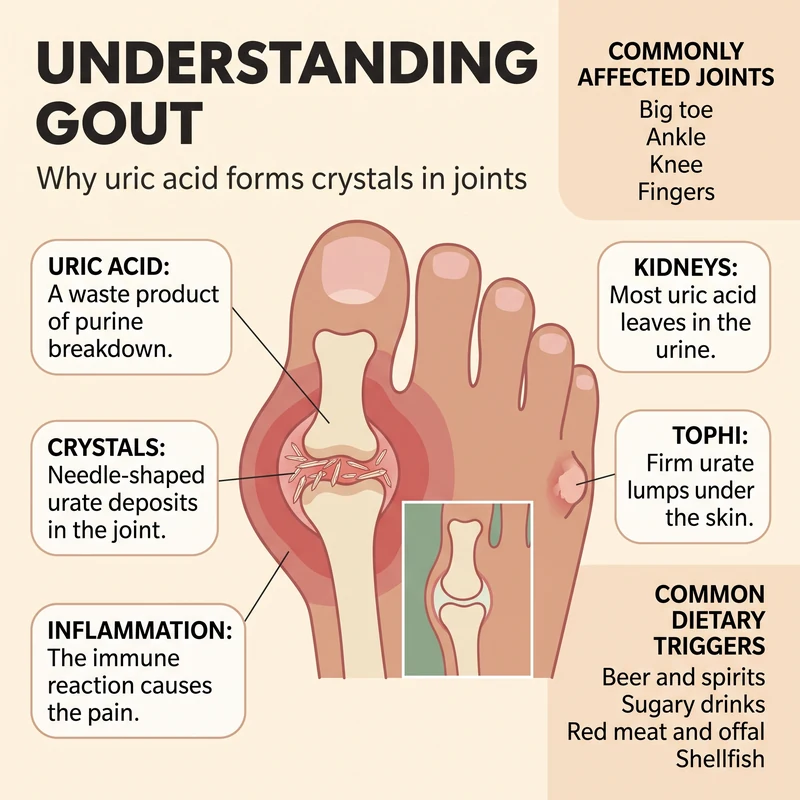
Urate crystallises more readily where it is cooler, and the joint at the base of the big toe is the coolest and most peripheral large joint. Attacks often begin overnight for the same reason.
In more than 47,000 men followed for 12 years, higher dairy intake was associated with LOWER gout risk, while meat and seafood raised it2. Dairy appears to promote urate excretion.
Alcohol raises urate, and beer does it twice over: the alcohol reduces excretion and the brewer's yeast adds purines. Beer carried the highest risk, spirits less, wine least3.
The classic attack is unmistakable to anyone who has had one, and easy to mistake for something else the first time.
| Feature | What it looks like | Worth knowing |
|---|---|---|
| Sudden onset, often overnight | Pain going from nothing to severe within hours | The speed is characteristic; osteoarthritis does not do this |
| One joint, usually the big toe | Hot, red, swollen, exquisitely tender to any pressure | Also common in ankle, midfoot and knee; see osteoarthritis for the slower pattern |
| Skin peeling as it settles | The overlying skin often flakes during recovery | A useful retrospective clue when someone describes a past episode |
| Resolves in days to weeks even untreated | Then a symptom-free gap, sometimes years long | The gap is not remission. Crystals continue to accumulate silently |
| Tophi | Firm, painless lumps of urate under the skin, often on fingers, elbows or the ear | A sign of long-standing untreated disease, and a reason to see a doctor rather than wait |
| Attacks becoming more frequent | More joints involved, longer episodes, shorter gaps | The natural course without urate-lowering treatment |
| Kidney stones | Severe loin or flank pain, blood in the urine | Uric acid stones share the same underlying chemistry |
The blood test everyone expects to be decisive is the one most likely to mislead.
| Measure | What it tells you | What it misses |
|---|---|---|
| Joint fluid aspiration | Urate crystals seen under polarised light, which is definitive | Requires a needle in an exquisitely painful joint, so it is not always done |
| Serum urate | The level to be lowered, and the number treatment targets | Can be normal or low DURING an attack, so a normal result then does not exclude gout. Retest weeks later |
| Joint fluid culture | Excludes infection, which can look identical | Nothing; this is the test that matters when infection is possible |
| Kidney function | Reduced clearance is the commonest reason urate is high | Also determines which treatments are suitable |
| Ultrasound or dual-energy CT | Urate deposits in and around joints, without a needle | Not available everywhere, and less useful very early |
| Blood pressure, HbA1c, lipids | The cluster that habitually travels with gout | Not part of a gout assessment unless someone asks for them |
| Medication review | Diuretics and some other drugs raise urate as a recognised effect | Requires someone to look; a prescriber conversation, never a reason to stop a medicine yourself |
Alcohol, sugary drinks, weight, dairy, coffee and fluid, and treating what travels with it
Drinks matter more than meat, which is the opposite of what most people expect.
| Food or drink | Direction | Practical note |
|---|---|---|
| Beer | Raises risk most | Alcohol reduces urate excretion and brewer's yeast adds purines. Alcohol-free beer is not automatically exempt |
| Spirits | Raises risk | Less than beer, more than wine |
| Sugar-sweetened drinks and fruit juice | Raises risk | Fructose raises urate as it is broken down. Diet drinks were not associated with higher risk in the same study |
| Red meat and offal | Raises risk | Offal is far higher in purines than muscle meat; the everyday change is portion size, not elimination |
| Seafood, especially shellfish, anchovies, sardines | Raises risk | Worth moderating rather than banning, since oily fish has other benefits |
| Low-fat dairy | LOWERS risk | One of the few genuinely protective associations here2 |
| Coffee | Lowers urate, observationally | A reason not to stop, not a reason to start drinking it medicinally |
| Purine-rich vegetables, spinach, asparagus, mushrooms, peas | No meaningful effect | Vegetable purines did not raise urate the way animal purines did5. This is the most persistent piece of outdated gout advice still circulating |
| Water | Helpful | Enough to keep urine pale; also reduces uric acid stone risk |
Two are widely promoted for gout. The honest reading of both is modest at best.
| Supplement | What it is actually for | Typical range | Timing | Notes & cautions |
|---|---|---|---|---|
| Vitamin C | A modest reduction in serum uric acid. A meta-analysis of randomised trials found supplementation lowered serum urate, though by a margin well short of a treatment effect7. | 500 mg per day is the commonly studied amount | With food | High doses raise urinary oxalate and can promote calcium oxalate kidney stones, which matters because gout and stones already travel together. Do not exceed the commonly studied amount hoping for more effect. Discuss with your clinician if you have had any kidney stone. |
| Cherries or tart cherry juice | Possibly fewer attacks. A systematic review found consistent signals across small studies but concluded larger trials were needed before recommending it8. | No established dose; studies vary widely | Daily in the studies that showed a signal | Cheap, safe and pleasant, which is why it is reasonable to try. Cherry juice carries a meaningful sugar load, and fructose raises urate, so whole cherries are the more sensible form. Not a substitute for treatment. |
| Vitamin D3 | Not a gout treatment. Correcting a documented deficiency, which is common in the group of people who get gout because it travels with obesity and kidney disease. | Test 25-OH-D first and set a daily dose with your clinician | With a fat-containing meal | Correct a deficiency because it is a deficiency. Avoid large intermittent doses; see osteoporosis for why. |
Each numbered entry below is either a source you can follow or a note setting out what the evidence does and does not support. Both are numbered together so the markers in the text line up.
Last reviewed 2 September 2026. Supplement entries are cross-checked against the NIH National Center for Complementary and Integrative Health and the Linus Pauling Institute Micronutrient Information Center.10 This page is nutrition education, not medical advice, and it does not replace your doctor. Nutrition does not treat gout on its own. Diet shifts serum urate modestly, and for most people with recurrent attacks urate-lowering therapy is what stops them. Nothing here is a reason to decline or stop that treatment. What nutrition education can do is help you understand the evidence well enough to have a better conversation with the clinician who does treat you.