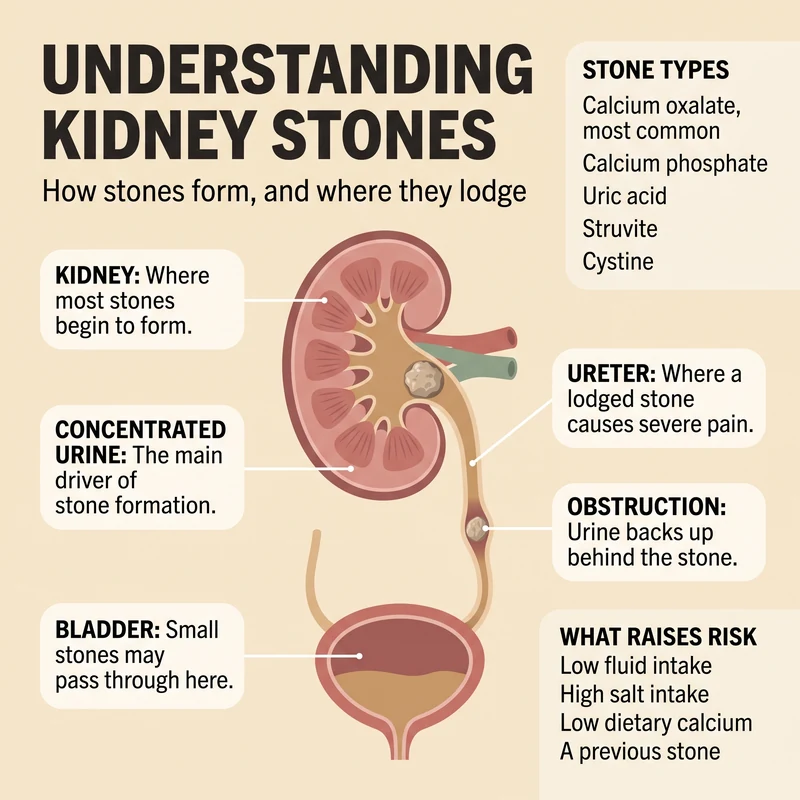
Crystals that clump together in the urinary tract until they are large enough to block it. This page exists largely to correct one piece of advice that is still given constantly and is the opposite of what the evidence shows: cutting dietary calcium makes calcium stones MORE likely, not less1.
Last updated:
Solid deposits that form when the urine becomes concentrated enough for dissolved minerals to crystallise, stick together and grow. About four in five are made of calcium oxalate. That is why the oxalate advice here is written for stone formers and nobody else; the high blood pressure guide recommends the same high-oxalate greens to everyone, correctly, and tells stone formers to pair them with a calcium food rather than drop them.
The pain does not come from the stone sitting in the kidney, where stones are frequently silent for years. It comes when one moves into the ureter, the narrow tube to the bladder, and blocks it. Pressure builds behind the obstruction, and that is the pain people describe as the worst of their lives.
Stones are a recurring condition rather than a one-off event. Without a change in what drives them, a substantial share of people form another within five to ten years, which is why prevention rather than treatment is the whole point of this page.
In more than 45,000 men, higher dietary calcium intake was associated with a LOWER risk of symptomatic stones1. The direction surprises almost everyone, including some clinicians.
In women, dietary calcium was again protective while supplemental calcium was associated with HIGHER risk2. Timing is the likely explanation: food calcium meets oxalate in the gut, a pill taken apart from meals does not.
A five-year randomised trial in first-time stone formers found that increasing urine volume roughly halved recurrence compared with no intervention4. Nothing else on this page is that cheap.
The dietary advice differs by stone type, which is why having a stone analysed changes what you should actually do.
| Type | Roughly how common | What drives it | What changes |
|---|---|---|---|
| Calcium oxalate | The large majority | Concentrated urine, high urinary oxalate, low urinary citrate, high sodium | Fluid, normal dietary calcium WITH meals, less salt, moderate oxalate |
| Calcium phosphate | Less common | Alkaline urine, high urinary calcium | Fluid and salt still matter; alkalinising agents may not suit, so type-specific advice is needed |
| Uric acid | Uncommon | Persistently acidic urine, high urate | Fluid, less animal protein, and treating gout where present. These can sometimes be dissolved |
| Struvite | Uncommon | Urinary infection with urea-splitting bacteria | Diet does not treat these. They need urological and antibiotic management |
| Cystine | Rare | An inherited transport disorder | Very high fluid intake and specialist care |
Diagnosing the stone is the easy part. Working out why it formed is the part that prevents the next one, and the part most often skipped.
| Measure | What it tells you | What it misses |
|---|---|---|
| CT of the urinary tract | Whether a stone is present, its size and where it sits, which decides treatment | Says nothing about why it formed |
| Ultrasound | Obstruction and larger stones, without radiation; usually first in pregnancy | Misses small stones, particularly in the ureter |
| Stone analysis | The stone type, which determines the entire dietary plan | Requires actually catching the stone, so strain your urine |
| 24-hour urine collection | Volume, calcium, oxalate, citrate, uric acid, sodium; the single most informative test for prevention | Inconvenient, and one collection may not represent a typical day |
| Blood calcium and parathyroid hormone | Screens for overactive parathyroid glands, a treatable cause | Easily missed if nobody thinks to check |
| Kidney function | Whether repeated stones or obstruction have caused damage | See chronic kidney disease |
| Medication and supplement review | Several medicines, and vitamin C supplements, raise stone risk | Requires someone to ask; supplements in particular are rarely volunteered |
Fluid, normal dietary calcium with meals, less salt, moderate animal protein
Assuming calcium oxalate stones, which are the large majority. Other types need different advice, which is why the stone analysis matters.
| Change | Why | Practical note |
|---|---|---|
| More fluid | Dilutes everything that crystallises | The single highest-value change. Aim for pale urine, and drink before bed |
| Normal dietary calcium, with meals | Binds oxalate in the gut so it is never absorbed | Dairy, calcium-set tofu, tinned fish with bones. Timing is the whole point, so eat it alongside the oxalate |
| Less salt | Sodium drives calcium into the urine | Mostly processed food rather than the salt cellar |
| Moderate animal protein | Raises acid load, urinary calcium and uric acid, and lowers citrate | Moderation, not elimination |
| Moderate the highest-oxalate foods | Reduces the oxalate available to crystallise | Spinach, rhubarb, beetroot, almonds, swiss chard. Pair them with a calcium food rather than banning them |
| Citrus and citrate | Citrate binds calcium in urine and inhibits crystal growth | Lemon in water is a reasonable habit; it is a mild effect, not a treatment |
| Limit sugar-sweetened drinks | Associated with higher stone risk | Water is both the substitute and the treatment |
| Keep vegetables and fruit | Associated with lower risk, and a source of citrate and potassium | Do not strip the diet down in the name of oxalate |
This is a section mostly about what to stop taking.
| Supplement | What it is actually for | Typical range | Timing | Notes & cautions |
|---|---|---|---|---|
| Calcium, as FOOD not a pill | Binding oxalate in the gut. This is the single most misunderstood item on the page. | Normal dietary intake from food; do not restrict | With the meal containing oxalate | Supplemental calcium was associated with HIGHER stone risk while dietary calcium was protective2, plausibly because a pill taken between meals never meets the oxalate. If a supplement is genuinely needed for bone health, take it WITH food and discuss it with your clinician; see osteoporosis. |
| Potassium citrate | Raising urinary citrate, which inhibits crystal formation. Usually prescribed rather than bought, and guided by a 24-hour urine result. | A prescriber decision, based on your urine chemistry | As prescribed | Not a supplement to self-select. Potassium loading is hazardous in reduced kidney function and with several common medicines; see chronic kidney disease. Lemon juice in water is the food-level version and is much weaker. |
| Magnesium | Sometimes used as a crystallisation inhibitor. The evidence is thin and it is not a first-line measure. | Only if intake from food is low, and agreed with your clinician | With food | Can loosen stools. Reduce or avoid in reduced kidney function, where magnesium accumulates. Do not add it while also taking potassium citrate without medical advice. |
| Vitamin D3 | Correcting a documented deficiency. Not a stone treatment, and worth a conversation first. | Test 25-OH-D first and set a daily dose with your clinician | With a fat-containing meal | Vitamin D raises calcium absorption, so discuss it with your clinician if you form calcium stones or have raised blood calcium. Avoid large intermittent doses; see osteoporosis. |
Each numbered entry below is either a source you can follow or a note setting out what the evidence does and does not support. Both are numbered together so the markers in the text line up.
Last reviewed 2 September 2026. Supplement entries are cross-checked against the NIH National Center for Complementary and Integrative Health and the Linus Pauling Institute Micronutrient Information Center.7 This page is nutrition education, not medical advice, and it does not replace your doctor. An obstructing stone is a urological problem and diet does not treat it. The advice here is about preventing the next stone, it assumes calcium oxalate stones unless yours have been analysed, and it is not a substitute for a metabolic evaluation. What nutrition education can do is help you understand the evidence well enough to have a better conversation with the clinician who does treat you.