Depression

A medical condition affecting mood, thinking, sleep, appetite and energy. This page sets out what the nutrition evidence actually shows, which is more than nothing and considerably less than the internet claims. Nutrition supports treatment for depression. It does not replace it.

A Medical Condition Nutrition Is Supportive Evidence-Based

Last updated:

🚨 If you are thinking about harming yourself, or feel unable to keep yourself safe, please get help now rather than reading on. Contact your local emergency number, a crisis line in your country, or go to your nearest emergency department. If you can, tell someone you trust today. This page is nutrition education. It is not a crisis service, and it is not treatment. Nothing here should delay you contacting a doctor, and this warning is placed first for that reason.

What Is Depression?

Persistent low mood or loss of interest, lasting at least two weeks and present most of the day, together with changes in sleep, appetite, energy, concentration and how a person sees themselves. It is diagnosed clinically, not by any blood test.

It is not sadness, and it is not a failure of effort or character. Sadness has a cause and lifts. Depression frequently has no proportionate cause, does not lift on its own schedule, and takes with it the very capacities, energy, motivation and hope, that would be needed to climb out of it. That is why telling someone to eat better is not only unhelpful but can add to the burden.

Nutrition genuinely appears in this picture, though further from the centre than most articles suggest. Diet quality is associated with depression risk across many populations, and one randomised trial found a dietary intervention improved symptoms. Set against that, the large trials testing whether supplements PREVENT depression have been negative.

💡 Key Insight: The association between poor diet and depression runs in both directions. Depression reduces appetite, energy and the capacity to shop and cook, so poor diet is partly a consequence. Any honest account has to say that observational studies cannot separate the two.
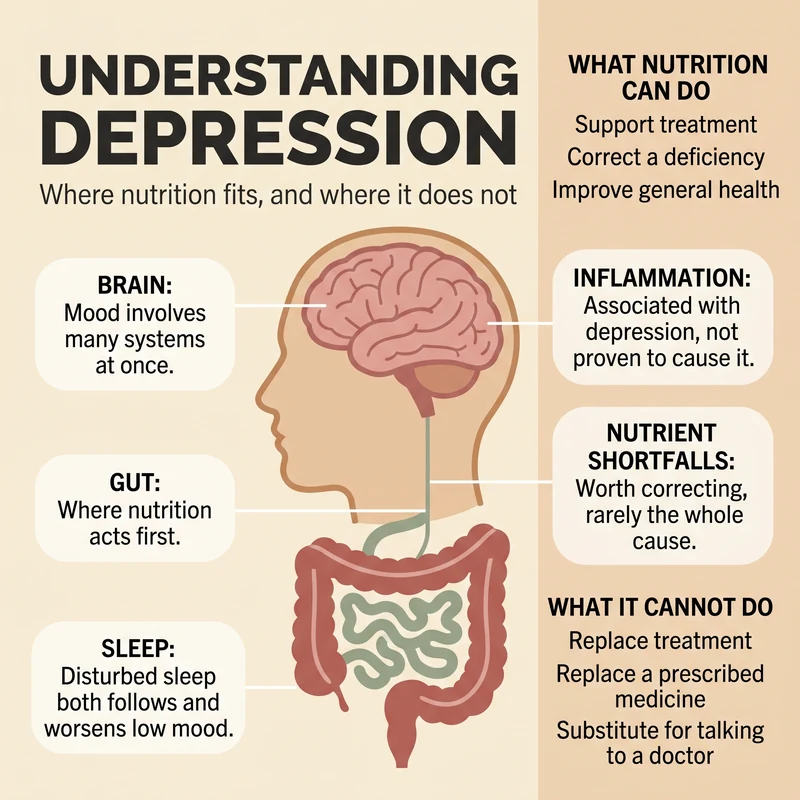
Calm clinical illustration of a head in profile showing the brain, with the digestive tract below and a line connecting them, labelled with the roles of sleep, inflammation and nutrient shortfalls

🥗 What the diet trial found

The SMILES trial randomised adults with major depression and poor diet to dietary support or social support. The dietary group improved more on depression scores over 12 weeks1. It was small and could not be blinded, which matters.

💊 What the supplement trials found

Long-term vitamin D3 did not reduce the risk of depression or clinically relevant depressive symptoms in more than 18,000 adults3. Supplements have not prevented depression in the large trials.

🚫 What is NOT true

That depression is caused by a food, cured by removing one, or fixed by a supplement. No dietary change has been shown to replace treatment, and the claim that it can is the most harmful idea in this whole area.

⚠️ Some things that look like depression are not. An underactive thyroid, anaemia, obstructive sleep apnea, vitamin B12 deficiency and the effects of alcohol can all produce fatigue, low mood and poor concentration. These are worth excluding rather than assuming, because each has its own treatment. See thyroid disorders, iron deficiency anaemia and sleep apnea.

How Depression Presents

It does not always look like sadness. In many people it looks like exhaustion, irritability, or simply nothing at all.

FeatureWhat it looks likeWorth knowing
Persistent low moodMost of the day, most days, for at least two weeksDuration and persistence are what separate it from ordinary low periods
Loss of interest or pleasureThings that used to matter stop matteringOften the more telling symptom, and frequently present without obvious sadness
Appetite and weight changeEither direction; loss of appetite or eating for comfortThis is where nutrition and depression meet most directly, and why a nutrition page exists at all
Sleep disturbanceEarly waking, difficulty falling asleep, or sleeping far more than usualSee insomnia, and consider sleep apnea where daytime sleepiness dominates
Fatigue and slowed movementEverything takes more effort than it shouldEasily attributed to overwork, and easily missed
Difficulty concentrating or decidingReading, working and choosing all become harderFrequently mistaken for a memory problem, particularly in older adults
Worthlessness or excessive guiltA harsh and distorted view of oneselfThe distortion is a symptom, not an accurate assessment
Thoughts of death or self-harmFrom feeling life is not worth living to specific plansTell a doctor today. See the warning at the top of this page
⚠️ If low mood has ever alternated with periods of unusually high energy, reduced need for sleep or uncharacteristic decisions, say so before any treatment starts. That pattern points to bipolar disorder rather than depression, and it changes treatment substantially, because antidepressants given alone in bipolar disorder can trigger a manic episode. See the bipolar disorder guide.

How Depression Is Assessed

There is no blood test for depression. The blood tests exist to find the things that imitate it.

MeasureWhat it tells youWhat it misses
Clinical assessment and symptom questionnairesThe diagnosis itself, severity, and riskQuestionnaires screen and track; they do not diagnose on their own
Thyroid functionAn underactive thyroid, which imitates depression closely and is treatableSee thyroid disorders
Full blood count and ferritinAnaemia, a common and correctable cause of fatigueSee iron deficiency anaemia
Vitamin B12 and folateDeficiencies that affect mood and cognition, more common with age, vegan diets, and some medicinesCorrecting a deficiency helps that deficiency; it is not a depression treatment
25-OH vitamin DWhether deficiency is presentCorrect it as a deficiency, not as a mood treatment. Supplementation did not reduce depression risk in a large trial3
Sleep history, and apnea screening where indicatedA treatable cause of daytime exhaustion and low moodRarely asked about unless someone raises it
Alcohol and substance historyBoth a cause and a consequence, and it changes what will workNeeds asking without judgement, or it is not answered honestly
Medication reviewSeveral common medicines list low mood as a recognised effectA prescriber conversation, never a reason to stop something on your own
💡 Tell your clinician about every supplement you take. This matters more here than on almost any other page on this site, because several supplements marketed for mood interact with antidepressants. The interaction section below explains why.

Holistic vs. Conventional Treatment for Depression

🌿 HOLISTIC
💊 CONVENTIONAL
🌿

Holistic / Functional Approach

Diet quality, sleep, activity, alcohol, and correcting what is deficient. Alongside treatment, never instead of it

Best Dietary Evidence
The SMILES trial found greater improvement in depression scores with dietary support than with social support over 12 weeks1
Association
Better diet quality is associated with lower depression risk across prospective cohorts5, though cause runs both ways
Timeline
Weeks in the trials that showed anything, and this is an adjunct rather than a first move
Limitation, stated plainly
No dietary or supplement intervention has been shown to replace treatment for major depression

Full Holistic Approach Includes

  • A Mediterranean-style dietary pattern, the one tested in the trials that showed benefit.
  • Regular eating, which matters more when appetite has gone. Something simple and repeated beats an ambitious plan that does not happen.
  • Reducing alcohol, which worsens mood and sleep and interacts with treatment.
  • Sleep, treated in its own right; see insomnia.
  • Physical activity, which has reasonable evidence and does not require enthusiasm to start.
  • Correcting documented deficiencies, B12, folate, iron, vitamin D, because they are deficiencies.
  • Not doing this alone. The clearest finding in this field is that treatment works and that isolation makes everything worse.
🌿 Worth knowing: depression removes the energy and motivation that these changes require, which is not a personal failing but a symptom. Start with one small thing, and treat difficulty as evidence for getting help, not against it.

Diet for Depression

One trial worth taking seriously, one association worth understanding, and a great deal of overstatement to discount.

💡 The trial that made this a serious question. SMILES randomised adults with major depression and a poor baseline diet to either dietary support toward a modified Mediterranean pattern or to a social support control, alongside whatever treatment they were already receiving. The dietary group showed greater improvement in depression scores at 12 weeks1. The limitations matter and are usually omitted: it was small, participants could not be blinded to which group they were in, and it tested dietary change ADDED to existing care rather than instead of it. Later work found dietary interventions affected some symptom profiles more than others2.
ChangeEvidencePractical note
Mediterranean-style patternThe tested oneVegetables, legumes, fruit, whole grains, fish, olive oil, nuts. This is what SMILES actually asked people to do
Eating regularly at allPractical rather than trialledWhen appetite has gone, consistency beats quality. Simple repeated meals are a legitimate goal
Reducing alcoholConsistentWorsens mood and sleep, interacts with medication, and is easy to increase without noticing
Oily fish twice a weekReasonableFood first. See the supplement section for why the capsule is rated lower
Reducing ultra-processed foodsAssociatedPart of what better diet quality means in the cohort studies5
Caffeine, if sleep is disturbedIndirectDoes not cause depression, but it fragments sleep, and poor sleep worsens mood
Restrictive or elimination dietsNot supported, and risky hereThey narrow intake, add pressure, and can worsen an already difficult relationship with eating
⚠️ If eating has become a source of distress in itself, that needs care in its own right. Depression and disordered eating frequently occur together, and advice designed for one can worsen the other. If food, weight or your body has become a source of anxiety, or eating feels out of control, please tell your doctor, and treat the advice on this page as something to discuss with them rather than to follow alone.

Evidence-Based Supplements

The interactions on this page are more important than the benefits.

🚨 St John's wort is the single most important safety item on this page, and it is sold without a prescription in most countries. Taken with an SSRI or other serotonergic antidepressant it can cause serotonin syndrome, which is potentially life-threatening. It is also a powerful inducer of drug metabolism, which means it can reduce the effectiveness of oral contraceptives, anticoagulants, immunosuppressants, some HIV and cancer medicines, and more6. Do not take it alongside an antidepressant, and tell your prescriber and pharmacist before taking it at all. Anyone with any history of mania must not take it; see the bipolar disorder guide.
SupplementWhat it is actually forTypical rangeTimingNotes & cautions
Vitamin B12 and folate Correcting a documented deficiency, which can itself cause low mood, fatigue and poor concentration. Not a treatment for depression in people who are replete. Test first; dose set with your clinician As advised Do not supplement folate without checking B12 first, because folate can mask B12 deficiency while nerve damage continues. More likely to be relevant with age, a vegan diet, metformin use or malabsorption.
Omega-3 (EPA and DHA) Modest and inconsistent evidence as an addition to treatment. Food first, oily fish twice weekly. Agree any supplement dose with your clinician With a fat-containing meal Trials are mixed and heterogeneous, and a trial of omega-3 for PREVENTING depression was unsupportive4. Tell your clinician if you take an anticoagulant or antiplatelet, and before planned surgery.
Vitamin D3 Correcting a documented deficiency. Not a mood treatment. Test 25-OH-D first and set a daily dose with your clinician With a fat-containing meal In more than 18,000 adults, long-term supplementation did not reduce depression risk or improve mood scores3. Correct a deficiency because it is a deficiency. Avoid large intermittent doses; see osteoporosis.
St John's wort Listed here only so that the risks are stated, not as a recommendation. Not recommended on this page See the warning above. Serotonin syndrome with serotonergic antidepressants, and it reduces blood levels of a long list of medicines including oral contraceptives6. Never combine it with an antidepressant, and never start it without telling your prescriber.
🚨 What to avoid, specifically. Any product promising to replace an antidepressant, or to cure depression. Stopping prescribed treatment to try a supplement, which is the most dangerous single action associated with this topic. St John's wort alongside an antidepressant. 5-HTP and SAM-e taken with serotonergic medicines, for the same serotonin syndrome reason. Kratom and other unregulated mood products. And be wary of anyone who tells you depression is caused by a single food or nutrient, because the evidence for that does not exist.
💡 Where the real leverage is. Getting treatment, and staying on it long enough to work. Sleep, alcohol, regular meals, some movement, and other people. Nutrition supports all of that, and it is the support rather than the treatment.

References & Evidence Notes

Each numbered entry below is either a source you can follow or a note setting out what the evidence does and does not support. Both are numbered together so the markers in the text line up.

Last reviewed 2 September 2026. Supplement entries are cross-checked against the NIH National Center for Complementary and Integrative Health and the Linus Pauling Institute Micronutrient Information Center.7 This page is nutrition education, not medical advice, and it does not replace your doctor. Nutrition does not treat depression. Depression is a medical condition with effective treatments, and no dietary change or supplement on this page has been shown to replace them. Nothing here is a reason to decline, delay or stop treatment. What nutrition education can do is help you understand the evidence well enough to have a better conversation with the clinician who does treat you.

  1. Jacka FN, et al. A randomised controlled trial of dietary improvement for adults with major depression (the SMILES trial). BMC Med. 2017;15(1):23. PubMed 28137247. Dietary support produced greater improvement in depression scores than social support over 12 weeks. Limitations that matter: a small sample, participants could not be blinded to their allocation, and the intervention was added to existing treatment rather than compared against it.
  2. Effects of dietary interventions on depressive symptom profiles: results from the MooDFOOD depression prevention study. Psychol Med. 2022;52(14):3247–3256. PubMed 33823960. Dietary intervention effects differed across symptom profiles rather than acting uniformly, which is a reason to be specific about what is being claimed.
  3. Okereke OI, et al. Effect of long-term vitamin D3 supplementation vs placebo on risk of depression or clinically relevant depressive symptoms and on change in mood scores. JAMA. 2020;324(5):471–480. PubMed 32749491. More than 18,000 adults, median follow-up over five years; no significant difference in depression risk or mood scores. The participants were not selected for vitamin D deficiency, so this argues against supplementing replete people rather than against correcting deficiency.
  4. Effects of vitamin D3 and marine omega-3 fatty acids supplementation on indicated and selective prevention of depression. J Clin Psychiatry. 2023;84(4). PubMed 37378490. Further evidence against supplementation for the prevention of depression.
  5. Diet quality and depression risk: a systematic review and meta-analysis of prospective studies. J Affect Disord. 2025. PubMed 40158860. Higher diet quality was associated with lower depression risk. Observational, and reverse causation is a serious concern here, because depression itself reduces appetite, energy and the capacity to shop and cook. See also the Mediterranean diet review, PubMed 38219230.
  6. Advantages and disadvantages of using St John's wort as a treatment for depression. Cureus. 2022;14(9):e29468. PubMed 36299970. Reviews the interaction profile, including serotonin syndrome with serotonergic antidepressants and induction of drug metabolism reducing the effectiveness of many other medicines. This page cites it for the RISKS and does not endorse the use.
  7. NIH National Center for Complementary and Integrative Health, nccih.nih.gov, and the Linus Pauling Institute Micronutrient Information Center, lpi.oregonstate.edu.