An immune-driven disease that shows on the skin but does not stop there. It travels with cardiovascular and metabolic risk, and it is one of the few skin conditions where a dietary change has randomised trial evidence behind it. That change is weight loss in people who carry excess weight, and it is not a cure.
Last updated:
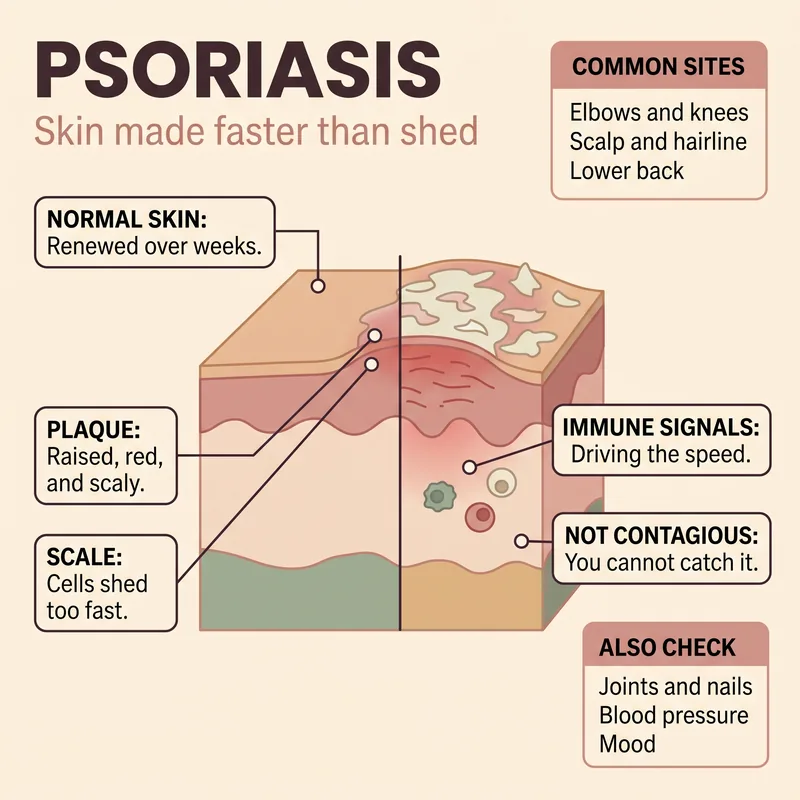
A chronic immune-mediated disease in which skin cells are made far faster than they are shed, building raised plaques with silvery scale. The immune signalling that drives it is systemic, which is why psoriasis is associated with joint disease and with cardiovascular and metabolic conditions rather than being a problem of the skin alone.
Roughly one in three people with psoriasis develops psoriatic arthritis, and joint symptoms can begin before the skin is bad or years after it has settled. Stiffness, swollen fingers or toes, and heel pain are worth reporting rather than waiting for them to pass.
It is not contagious, it is not caused by poor hygiene, and it is not an allergy. Nothing you ate caused it. That matters, because a great deal of psoriasis diet advice is built on the assumption that something did.
A randomised trial found a low-energy diet improved psoriasis severity in people with obesity2. It is the best evidenced dietary lever on this page.
A review of eighteen randomised trials found inconsistent results, with the intravenous studies more favourable than the oral ones4. Worth knowing before buying capsules.
Psoriasis travels with cardiovascular and metabolic risk. Treating the skin and ignoring blood pressure, lipids and glucose treats the visible half.
In several patterns, and the joints are the part most often missed.
| Feature | What it looks like | Worth knowing |
|---|---|---|
| Raised plaques with silvery scale | Elbows, knees, lower back, scalp | The commonest pattern. Scale returns quickly after it is removed |
| Scalp involvement | Thick scale at the hairline and behind the ears | Frequently mistaken for dandruff and treated with the wrong product for years |
| Nail changes | Pitting, thickening, lifting from the nail bed | Associated with a higher chance of joint involvement. Worth mentioning |
| Joint pain, stiffness or swelling | Fingers or toes swollen along their whole length, heel pain, morning stiffness | Report this. Psoriatic arthritis can cause permanent joint damage and is treatable |
| Flexural pattern | Smooth red areas in skin folds, without much scale | Often misdiagnosed as a fungal infection |
| Small drop-like spots after a sore throat | Sudden shower of small lesions, often in younger people | Guttate psoriasis, commonly triggered by streptococcal infection |
| Itch | Frequently underestimated by clinicians | Say if it is bad. It affects sleep and mood and it changes treatment choices |
| Worsening with stress, injury, smoking or alcohol | New plaques appearing at sites of skin injury | New lesions at a scratch or scar is the Koebner phenomenon, and it is characteristic |
The skin is diagnosed by looking at it. The rest of the assessment is the part usually skipped.
| Measure | What it tells you | What it misses |
|---|---|---|
| Clinical examination | The diagnosis, the pattern and how much skin is involved | Severity scores track skin, not how much the disease affects your life |
| Asking about joints | Whether psoriatic arthritis is present, which changes treatment entirely | Under-asked. Raise it yourself if nobody does |
| Blood pressure, lipids, glucose or HbA1c | The cardiometabolic risk that travels with psoriasis | Often not monitored in a dermatology clinic. Ask who is doing it |
| Weight and waist | Whether the best evidenced dietary intervention applies to you1 | A number without a plan changes nothing |
| Smoking and alcohol | Both are associated with more severe disease and poorer response | Rarely revisited once recorded |
| Mood | Depression and anxiety are more common and are treatable | Almost never measured in a skin appointment |
| Coeliac testing only if there are symptoms of it | Whether a gluten-free diet has any basis in your case | Testing everyone is not recommended. A gluten-free diet without coeliac disease has no established benefit here |
| Vitamin D level where deficiency is suspected | Whether correction is warranted for the usual reasons | Topical vitamin D analogues are a skin treatment. Swallowing vitamin D is not the same thing |
Weight where it applies, a Mediterranean pattern, and the risk factors nobody is watching
One recommendation with trial evidence, one pattern with cohort evidence, and a lot of noise.
| Change | Why | Practical note |
|---|---|---|
| Weight loss if you carry excess weight | The one dietary intervention with randomised trial support here2 | Gradual and supervised. Crash dieting is not what was tested and is not what is meant |
| A Mediterranean pattern | Higher adherence was associated with less severe psoriasis in a large cohort3 | Observational, so association rather than proof. It also serves the cardiovascular risk, which makes it worth doing either way |
| Oily fish as food | Part of that pattern, and useful for cardiovascular reasons | Different from capsules, and the capsule evidence is mixed4 |
| Less alcohol | Associated with more severe disease, and it interacts with several psoriasis medicines | Discuss limits with your prescriber if you are on systemic treatment |
| Vegetables, fruit, legumes, olive oil | The components that carried the Mediterranean association | The pattern rather than any single item |
| Gluten-free diet only if you have coeliac disease | Benefit is established for coeliac disease, not for psoriasis in general | Get tested before excluding gluten, not after. Testing is unreliable once you have already stopped eating it |
| Smoking | Associated with more severe psoriasis and poorer response to treatment | Not a dietary change, and more useful than most on this table |
| Detox regimens and elimination diets | No evidence, and a real cost | They narrow the diet, add expense and guilt, and delay treatment that works |
A short section, because the honest evidence here is short.
| Supplement | What it is actually for | Typical range | Timing | Notes & cautions |
|---|---|---|---|---|
| Fish oil | Commonly recommended, and the evidence is genuinely mixed. A review of eighteen randomised trials found inconsistent results4. | Discuss with your clinician rather than self-selecting a high dose | With a meal | Listed honestly rather than recommended. Eating oily fish achieves the cardiovascular part without the uncertainty, and the cardiovascular part matters here. |
| Vitamin D, oral | Correcting a deficiency, for the usual reasons. Not a substitute for the vitamin D analogue applied to the skin, which is a prescribed topical treatment. | Test first, then set a daily dose with your clinician | With a fat-containing meal | The two are constantly confused. Applying it and swallowing it are different interventions with different evidence. See osteoporosis for the vitamin D cautions. |
| A weight-management approach | The best evidenced dietary intervention on this page, and it is not a supplement12. | Set with a dietitian or your clinician | Not applicable | Included in this table deliberately, because the evidence behind it is stronger than for anything sold in a bottle for this condition. |
Each numbered entry below is either a source you can follow or a note setting out what the evidence does and does not support. Both are numbered together so the markers in the text line up.
Last reviewed 3 September 2026. Supplement entries are cross-checked against the NIH National Center for Complementary and Integrative Health and the Linus Pauling Institute Micronutrient Information Center.5 This page is nutrition education, not medical advice, and it does not replace your doctor. No diet clears psoriasis and no supplement treats it. The one dietary intervention with randomised trial support is weight loss in people who are overweight or obese, and it improves severity rather than resolving the disease. Nothing here replaces topical treatment, phototherapy or systemic therapy, and stopping a systemic medicine suddenly can be followed by a severe flare. What nutrition education can do is help you understand the evidence well enough to have a better conversation with the clinician who does treat you.