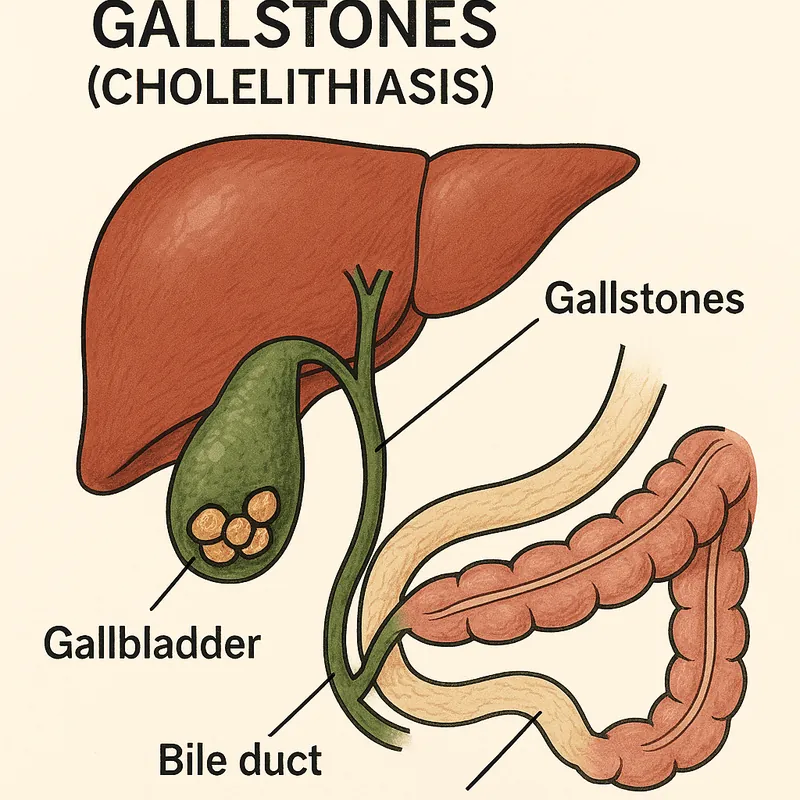
Cholesterol or pigment stones forming in the gallbladder. Risk factors: female, fertile, forty, obese, plus rapid weight loss. Bile-supportive nutrition (artichoke, beet, taurine, ox bile, healthy fats) and fiber prevent recurrence and support gallbladder function.
Last updated:
Gallstones (cholelithiasis) are hardened deposits that form in the gallbladder, a small organ tucked under the liver that stores and concentrates bile. About 80% of gallstones are cholesterol stones (yellow-green); the rest are pigment stones (black or brown, from excess bilirubin). Many gallstones never cause symptoms ("silent" stones); others cause biliary colic, cholecystitis, or pancreatitis.
Stones form when bile becomes supersaturated with cholesterol (most common), when the gallbladder doesn't empty properly (stasis), or when there's excess bilirubin (hemolytic conditions). Modern Western diet, high in refined carbs, low in fiber, sedentary, has dramatically increased gallstone prevalence.
The classic risk factors are summarized as "the 5 F's": Female, Forty, Fertile (estrogen exposure), Fair (white/Hispanic ethnicity), Fat (overweight), plus rapid weight loss, prolonged fasting, and certain medications. Diet has profound influence on stone formation AND on the symptoms of existing stones.
Yellow-green stones from supersaturated cholesterol. Risk factors: obesity, high refined carb diet, low fiber, rapid weight loss, estrogen (HRT, pregnancy, OCP). Most amenable to dietary and lifestyle prevention.
Form in bile ducts (not gallbladder), usually associated with infection or parasites. Calcium bilirubinate with cholesterol. Requires both stone removal and infection treatment.
Symptoms range from completely silent to medical emergency. The hallmark is "biliary colic", predictable right upper quadrant pain triggered by fatty meals.
Sudden, severe, steady pain in right upper quadrant or epigastrium, often radiating to right shoulder or upper back. Typically 30 min to several hours. Triggered 30-60 min after fatty meals. Constant, not crampy.
Discomfort, nausea, or pain after eating fried foods, fatty meats, dairy, or rich desserts. Reflects gallbladder dysfunction even before frank stones. May precede stone formation by years.
Often accompanies biliary colic. Vomiting may transiently relieve pain. Persistent nausea between attacks suggests ongoing gallbladder inflammation.
Common between attacks. Reflects impaired fat digestion and gas production. Often misdiagnosed as IBS or dyspepsia.
Stone blocking common bile duct. Yellow sclera, dark urine, pale stools. Often with pruritus (itching). MEDICAL EMERGENCY, needs urgent ERCP or surgery.
Acute gallbladder infection from stone obstruction. Constant pain >6 hours, fever, sometimes chills. Charcot's triad (jaundice + RUQ pain + fever) suggests ascending cholangitis, life-threatening.
Gallstone blocking pancreatic duct causes acute pancreatitis. Excruciating pain often relieved by leaning forward. Vomiting, severe systemic symptoms. EMERGENCY.
Severe, persistent symptoms with vomiting, no food tolerance. Suggests gallbladder obstruction or severe inflammation. Seek immediate care.
First-line imaging. Highly sensitive (~95%) for gallstones. Detects stones, gallbladder wall thickening, fluid (signs of inflammation). Cheap, no radiation, accessible. Definitive test for most cases.
Nuclear imaging of bile flow. Evaluates gallbladder function (ejection fraction). Useful when ultrasound is normal but symptoms persist (biliary dyskinesia). EF <35% suggests dysfunction.
Non-invasive MRI of biliary tree. Excellent for detecting common bile duct stones. Used when ductal involvement is suspected. Replaces diagnostic ERCP for many cases.
Bile-supportive nutrition + fiber + healthy fats + taurine + lifestyle, prevention and asymptomatic stone management
Counterintuitively, the diet that prevents gallstones is NOT low-fat. It's adequate healthy fat at regular meals, lots of fiber, and minimal refined carbs.
Olive oil, avocado, nuts, fatty fish. Stimulate regular gallbladder emptying, preventing bile stasis. Mediterranean diet reduces gallstone risk significantly.
Beans, lentils, oats, vegetables, fruits, whole grains. Soluble fiber binds bile acids, lowering cholesterol pool. Strongly associated with reduced gallstone risk.
Multiple cohort studies show coffee drinkers have 20-40% lower gallstone risk. Stimulates bile flow and gallbladder contraction. Black or with minimal cream, no sugar.
Arugula, dandelion, endive, radicchio, beets stimulate bile production and flow. Include in salads, smoothies, or juices.
White bread, pasta, rice, sweets, sodas. Drive insulin resistance and metabolic syndrome, major drivers of cholesterol gallstones.
Fast food, packaged snacks, industrial seed oils. High in refined carbs + inflammatory oils. Major driver of metabolic dysfunction and gallstone formation.
Counterintuitively HARMFUL. Cause gallbladder stasis, bile sits unstimulated, becomes supersaturated, forms stones. Avoid extreme low-fat or prolonged fasting (>16 hr regularly).
>1.5kg/week from very low-calorie diets or bariatric surgery dramatically increases stone formation (up to 30% within 6 months). Aim for 0.5-1kg/week steady loss.
These supplements support bile production, gallbladder function, and prevention, also valuable post-cholecystectomy for ongoing fat digestion.
| Supplement | Mechanism & Evidence | Suggested Dose | Timing | Notes |
|---|---|---|---|---|
| Taurine | Amino acid required for bile acid conjugation. Supports cholesterol metabolism into bile acids, reducing stone formation. Animal evidence strong; human data emerging. | 500-1,500mg/day | Empty stomach or with meals | Especially valuable if you eat little meat (taurine source). |
| Artichoke Leaf Extract | Cynarin stimulates bile production and flow (choleretic). Lowers cholesterol. Multiple human studies show improved fat digestion. | 320-640mg standardized extract/day | With meals | Cynara scolymus extract. Avoid if active bile duct obstruction. |
| Ox Bile (Bile Salts) | Direct bile acid replacement, especially valuable post-cholecystectomy. Improves fat digestion and absorption of fat-soluble vitamins. | 125-500mg per fat-containing meal | With meals | Especially helpful post-cholecystectomy. Start low to assess tolerance. |
| Digestive Enzymes (with Lipase) | Lipase-rich enzyme blends improve fat digestion, especially post-cholecystectomy or with biliary dyskinesia. | Per product label, with each meal | Start of meal | Choose products with at least 6,000 USP units lipase per dose. |
| Vitamin C | Cofactor for cholesterol 7ฮฑ-hydroxylase, the rate-limiting enzyme converting cholesterol to bile acids. Deficiency associated with increased gallstone risk. | 500-1,000mg/day | With meals | Liposomal or buffered forms easier on stomach if sensitive. |
| Phosphatidylcholine (Lecithin) | Component of bile that emulsifies cholesterol, preventing crystallization. Sunflower lecithin (non-soy) provides phosphatidylcholine. | 1,200-2,400mg/day | With meals | Sunflower lecithin preferred over soy. Synergistic with taurine. |
| Magnesium | Smooth muscle relaxant, may reduce gallbladder spasm. Population studies associate magnesium intake with reduced gallstone risk. | 300-400mg elemental/night | Before bed | Glycinate form. Most Americans deficient. |
| Fat-Soluble Vitamins (A, D, E, K) | Cholecystectomy and/or biliary dysfunction impair fat-soluble vitamin absorption. Check levels; supplement if deficient. | Per blood levels | With fat meal | Particularly important post-cholecystectomy. Have levels tested annually. |
~80% of gallstones never cause symptoms. With bile-supportive nutrition and lifestyle, symptomatic risk drops dramatically. If surgery becomes necessary, the same nutritional strategies support recovery and prevent post-cholecystectomy syndrome.