GERD (Acid Reflux)

Reflux becomes a disease when it causes troublesome symptoms or damages the oesophagus1. Roughly one adult in five in Western countries has heartburn or regurgitation weekly. The useful thing about GERD is that a small number of measures have real evidence behind them, and most of the famous trigger-food rules do not.

About 1 in 5 Adults Weekly Evidence-Based Root-Cause Focus

Last updated:

🚨 See a doctor promptly, before changing your diet, if any of these are present. Difficulty swallowing, or food sticking. Pain on swallowing. Weight loss you did not intend. Vomiting blood, or stools that are black and tarry. Anaemia or a low iron result. Persistent vomiting. A first onset of reflux symptoms after about age 60. These are the alarm features that professional guidelines say should prompt investigation rather than treatment1. They are listed first here, and on purpose, because a warning sign placed underneath a list of harmless ones tends not to be read.

What Is GERD?

Stomach contents moving back up into the oesophagus often enough, or damagingly enough, to count as a disease rather than an occasional nuisance. Almost everybody refluxes a little; the threshold is symptoms that trouble you, or visible injury.

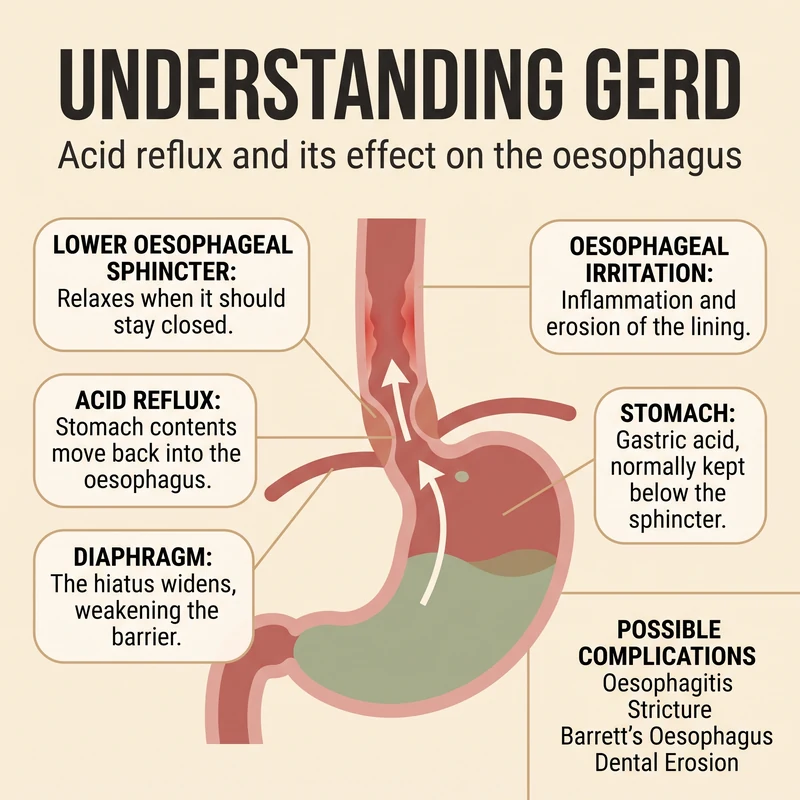
The mechanism is a valve problem more than an acid problem. A ring of muscle at the bottom of the oesophagus, the lower oesophageal sphincter, normally stays shut between swallows. In GERD it relaxes when it should not, or the pressure below it is raised, or the anatomy holding it in place has changed. That last case is a hiatal hernia.

This matters for what helps. Acid-suppressing medication makes the refluxed material less corrosive, which relieves symptoms and heals inflammation, but it does not stop the reflux itself. Measures that lower abdominal pressure or use gravity address the movement rather than the acidity, which is why the two approaches work together rather than competing.
💡 Key Insight: The strongest lifestyle evidence in GERD is not about food at all. It is about body weight, the timing of the last meal, and the angle you sleep at3. The famous list of trigger foods has much weaker support than its fame suggests.
Anatomical illustration of the lower oesophagus, sphincter, diaphragm and stomach, with arrows showing stomach contents moving up into the oesophagus and inflammation of the lining, beside a list of possible complications

🧠 Why weight matters most

Abdominal fat raises the pressure pushing stomach contents upward. In more than 10,000 women there was a dose-response relationship between body mass index and reflux symptoms, and it was present even within the normal BMI range2.

😴 Why gravity matters

Lying flat removes the only thing keeping stomach contents down. Raising the head of the bed and leaving time between the last meal and lying down are among the measures that survived an evidence review4.

🍽️ Why trigger lists disappoint

The classic eliminations, coffee, citrus, spice, chocolate, were not supported by that same review for improving oesophageal acid exposure. Individual triggers are real; the universal list is not.

⚠️ Reflux that is treated but never assessed is a missed opportunity. Long-standing reflux is a recognised risk factor for oesophageal adenocarcinoma, and the risk rises with how frequent, how severe and how long-lasting the symptoms have been5. The absolute risk for any one person remains low, and this is a reason to have persistent symptoms properly assessed rather than a reason to be frightened. See the oesophageal cancer guide.

How GERD Presents

Heartburn and regurgitation are the classic pair. A large minority of people have neither, which is why GERD is missed so often.

PresentationWhat it feels likeWorth knowing
HeartburnBurning behind the breastbone, often after meals or on lying downThe most specific symptom, though its absence does not rule GERD out
RegurgitationSour or bitter fluid rising into the throat or mouth, without nausea or retchingResponds less reliably to acid suppression than heartburn does
Chest painPressure or burning that can closely mimic cardiac painCardiac causes must be excluded first. Never assume new chest pain is reflux
Chronic cough, hoarseness, throat clearingOften without any heartburn at allFrequently attributed to reflux on scant evidence; see the LPR guide
Dental erosion, bad tasteEnamel wear on the inner surfaces of the teethSometimes the first objective sign a dentist notices
Disturbed sleepWaking with coughing, choking or a sour tasteNight-time reflux is the pattern most responsive to bed elevation and meal timing
Worse in pregnancyHeartburn from raised abdominal pressure and hormonal effects on the sphincterCommon and usually temporary; medicines in pregnancy need a clinician's advice
🚨 New chest pain is a cardiac question until somebody rules that out. Reflux and heart pain are not reliably distinguishable by how they feel, and self-diagnosing chest pain as heartburn is one of the more dangerous mistakes available. If chest pain is new, severe, or comes with breathlessness, sweating, or pain spreading to the arm or jaw, treat it as an emergency.

How GERD Is Assessed

Most people with typical symptoms and no alarm features are treated without any test at all. These are what the tests add when they are used.

ApproachWhat it tells youWhat it misses
Symptom pattern and a trial of acid suppressionThe usual starting point in typical, uncomplicated refluxResponse is not proof of GERD, and non-response does not exclude it
Upper endoscopyInflammation, narrowing, Barrett's oesophagus, and other diagnoses entirelyIs normal in a large share of people who genuinely have GERD
Ambulatory pH or pH-impedance monitoringWhether acid exposure is genuinely raised, and whether symptoms line up with reflux episodesUncomfortable, and results vary between days
Oesophageal manometryHow the oesophagus moves; required before any anti-reflux surgeryDoes not diagnose reflux itself; it excludes conditions that mimic it, such as achalasia
Barium studyAnatomy, including a large hiatal herniaPoor at detecting reflux disease itself, and involves radiation
Testing for H. pyloriA different, treatable cause of upper abdominal symptomsNot a GERD test; see gastritis and peptic ulcer disease
💡 Ask what changed, and when. Reflux that began with weight gain, a pregnancy, a new medication, a change in shift pattern or a period of heavy alcohol use has a different starting point from reflux present for decades. Several common prescriptions relax the lower oesophageal sphincter or irritate the oesophagus directly. That is worth reviewing with your prescriber, and it is never a reason to stop a medicine on your own.

Holistic vs. Conventional Treatment for GERD

🌿 HOLISTIC
💊 CONVENTIONAL
🌿

Holistic / Functional Approach

Weight, meal timing, sleeping position, tobacco, and finding your own triggers rather than adopting a list

Strongest Measure
Weight reduction where there is weight to lose. The BMI relationship with reflux symptoms is dose-responsive and present even within the normal range2
Also Supported
Raising the head of the bed, leaving time between eating and lying down, and stopping tobacco3
Timeline
Positional and timing changes act within days; weight-related benefit builds over months
Advantage
Addresses the reflux event itself rather than the acidity of what refluxes, which is the part medication does not do

Full Holistic Approach Includes

  • Weight reduction where relevant, the single measure with the most consistent evidence. See the obesity guide.
  • A gap between the last meal and lying down, commonly advised as around three hours.
  • Raising the head of the bed by blocks under the legs or a wedge under the mattress. Extra pillows bend the neck instead and do not achieve the same thing.
  • Sleeping on the left side, which places the stomach below the oesophageal junction.
  • Stopping tobacco, which lowers sphincter pressure and reduces saliva, the body's own acid buffer.
  • Smaller meals, since volume raises pressure inside the stomach.
  • Finding your own triggers with a short diary, rather than removing everything on a published list.
🌿 Worth knowing: these measures reduce symptoms and reduce how much medication is needed. They are not a substitute for treating oesophagitis or Barrett's oesophagus, which are diagnoses requiring medical management.

Diet for GERD

The honest position is that the universal trigger list is weaker than its reputation, and that how and when you eat matters more than a list of banned foods.

⚠️ The famous trigger foods have surprisingly thin evidence. An evidence-based review of lifestyle measures found support for weight loss and for elevating the head of the bed, but did not find that eliminating coffee, chocolate, citrus, spicy food, carbonated drinks or fatty meals improved oesophageal acid exposure or symptoms4. That is a statement about populations, not about you. If a food reliably gives you symptoms, avoid it. What is not supported is removing a long list of foods that were never causing you any trouble, which narrows the diet for nothing.
ChangeEvidencePractical note
Weight reduction where there is weight to loseStrongestDose-responsive with symptoms, and the effect appears even within the normal BMI range2
Head of the bed raisedSupportedBlocks under the bed legs or a wedge under the mattress. Extra pillows bend the neck and do not work
Gap between last meal and lying downSupportedAround three hours is the usual advice; night-time symptoms respond best
Stopping tobaccoSupportedLowers sphincter pressure and reduces protective saliva
Smaller, less hurried mealsMechanistically soundStomach volume raises pressure; large late meals combine both problems
AlcoholMixedRelaxes the sphincter and often disrupts sleep; worth testing individually
Blanket elimination of coffee, citrus, spice, chocolateNot supported as a universal ruleTest each one on yourself for a week or two rather than removing them all indefinitely
💡 A dietary pattern, rather than a list of bans. A retrospective comparison in people with laryngopharyngeal reflux found a plant-based Mediterranean-style diet with alkaline water performed at least as well as acid-suppressing medication on a symptom index6. It was not randomised, the two groups were treated in different periods, and it studied LPR rather than classic GERD, so it is a reasonable prompt to try a dietary pattern rather than evidence that it replaces medication. It is included because it points the same way as the rest of this section: build the diet up, rather than cutting it down.
⚠️ A conflict with our own IBS guide, stated plainly. Enteric-coated peppermint oil is one of the better-supported treatments for IBS, and peppermint also relaxes the lower oesophageal sphincter, which is exactly the wrong effect in reflux. The coating exists to carry the oil past the stomach, so the two uses are not quite in contradiction, but anyone taking peppermint for IBS who also has reflux should watch for worsening heartburn and stop if it appears. Peppermint tea and confectionery have no such coating.

Evidence-Based Supplements

Modest options, described honestly. None of them heals oesophagitis, and none replaces a prescribed medicine.

🚨 Do not self-treat reflux that has alarm features, and do not stop prescribed acid suppression to try a supplement. Stopping abruptly can cause rebound acid secretion and symptoms worse than the original. Anything below is an addition to be discussed with your clinician, not a replacement for treatment that is healing an inflamed oesophagus.
SupplementWhat it is actually forTypical rangeTimingNotes & cautions
Alginate (raft-forming) preparations Forming a physical barrier on top of the stomach contents, which is a different mechanism from reducing acid. The best-supported non-prescription option here. As directed on the product After meals and at bedtime Widely available and generally well tolerated. Many formulations carry a meaningful sodium load, which matters if you have been advised to restrict sodium; see high blood pressure. Take at least 2 hours apart from other medication.
DGL licorice (deglycyrrhizinated) Stimulating mucus production in the oesophageal and gastric lining, a protective rather than acid-suppressing effect. 400 to 800 mg chewable, 2 to 3 times daily About 20 minutes before meals, chewed DGL only. The glycyrrhizin has been removed, which is the compound in whole licorice that raises blood pressure, lowers potassium and can cause fluid retention. Whole licorice root must not be substituted, particularly with high blood pressure, low potassium, kidney disease or diuretic use. Must be chewable; swallowed capsules bypass the effect.
Melatonin Small studies suggest a possible effect on sphincter pressure and symptoms. Included because people ask, and rated honestly as weak. Small studies have used 3 mg at night; agree it with your clinician At bedtime Evidence is limited, mostly small and from single centres, and it is not a reason to defer proper assessment. Causes drowsiness. Interacts with anticoagulants and with some anticonvulsants and sedatives. Not for children without paediatric advice.
Magnesium, calcium and vitamin B12 attention Not a reflux treatment. Long-term acid suppression is observationally associated with lower magnesium and B12 and with reduced calcium absorption, so these are worth attention rather than assumption. Food first. Test before supplementing rather than supplementing blind With food Test rather than guess, since supplementing an adequate level achieves nothing. Magnesium should be reduced or avoided in reduced kidney function; see chronic kidney disease.
🚨 What to avoid, specifically. Whole licorice root, for the reasons above. Peppermint oil taken uncoated, which relaxes the sphincter. Baking soda used repeatedly as an antacid, which delivers a large sodium load and has caused stomach rupture when taken on a full stomach. Apple cider vinegar, which is widely promoted for reflux on the theory that the problem is too little acid; there is no trial evidence for this in GERD, and acid on an inflamed oesophagus is a poor idea. High-dose peppermint, spearmint or menthol lozenges used for throat symptoms.
💡 Where the real leverage is. Weight where there is weight to lose, the gap between dinner and bed, the angle of the bed, stopping tobacco, and identifying your own two or three genuine triggers instead of adopting somebody else's list of twenty.

References & Evidence Notes

Each numbered entry below is either a source you can follow or a note setting out what the evidence does and does not support. Both are numbered together so the markers in the text line up.

Last reviewed 2 September 2026. Supplement entries are cross-checked against the NIH National Center for Complementary and Integrative Health and the Linus Pauling Institute Micronutrient Information Center.8 This page is nutrition education, not medical advice, and it does not replace your doctor. Nutrition does not treat GERD on its own. Oesophagitis and Barrett's oesophagus are medical diagnoses needing medical management, and nothing here is a reason to stop or reduce a prescribed medicine. What nutrition education can do is help you understand the evidence well enough to have a better conversation with the clinician who does treat you.

  1. Katz PO, et al. ACG clinical guideline for the diagnosis and management of gastroesophageal reflux disease. Am J Gastroenterol. 2022;117(1):27–56. PubMed 34807007. The source for the definition used here, for the alarm features prompting endoscopy, and for acid suppression as the most effective medical therapy.
  2. Jacobson BC, et al. Body-mass index and symptoms of gastroesophageal reflux in women. N Engl J Med. 2006;354(22):2340–2348. PubMed 16738270. More than 10,000 women in the Nurses' Health Study; a dose-response relationship between BMI and frequent reflux symptoms, present even among women within the normal BMI range. Observational, and a cohort of women only, so it establishes a strong and graded association rather than proving causation.
  3. Ness-Jensen E, et al. Lifestyle intervention in gastroesophageal reflux disease. Clin Gastroenterol Hepatol. 2016;14(2):175–182. PubMed 25956834. A systematic review concluding that weight reduction and tobacco cessation have supporting evidence, while the routine dietary eliminations do not.
  4. Kaltenbach T, et al. Are lifestyle measures effective in patients with gastroesophageal reflux disease? An evidence-based approach. Arch Intern Med. 2006;166(9):965–971. PubMed 16682569. Reviewed the individual lifestyle measures; weight loss and head-of-bed elevation were supported, while eliminating the classic trigger foods was not shown to improve oesophageal acid exposure or symptoms. This is the source for the deliberately unfashionable position taken in the diet section.
  5. Lagergren J, et al. Symptomatic gastroesophageal reflux as a risk factor for esophageal adenocarcinoma. N Engl J Med. 1999;340(11):825–831. PubMed 10080844. A population-based case-control study; risk rose with the frequency, severity and duration of reflux symptoms. The absolute risk for an individual with reflux remains low, which is why this appears here as a reason for assessment rather than alarm.
  6. Zalvan CH, et al. A comparison of alkaline water and Mediterranean diet vs proton pump inhibition for treatment of laryngopharyngeal reflux. JAMA Otolaryngol Head Neck Surg. 2017;143(10):1023–1029. PubMed 28880991. Retrospective, comparing two groups treated in different time periods, and studying laryngopharyngeal reflux rather than classic GERD. Those limitations are why it is presented as a prompt rather than as evidence that diet replaces medication.
  7. Associations between long-term acid suppression and lower magnesium, lower vitamin B12 and reduced calcium absorption come from observational cohorts rather than randomised trials, and confounding by indication is difficult to exclude. The reasonable response is periodic review of continued need and attention to those nutrients, not discontinuation of treatment that is healing the oesophagus.
  8. NIH National Center for Complementary and Integrative Health, nccih.nih.gov, and the Linus Pauling Institute Micronutrient Information Center, lpi.oregonstate.edu.