Bone that has lost enough density and structure to break under a force that should not break it. The diagnosis is made on a scan, but the thing that matters is a fracture, and the nutrition evidence here contains a genuine surprise: more vitamin D is not better, and given in the wrong way it did harm3.
Last updated:
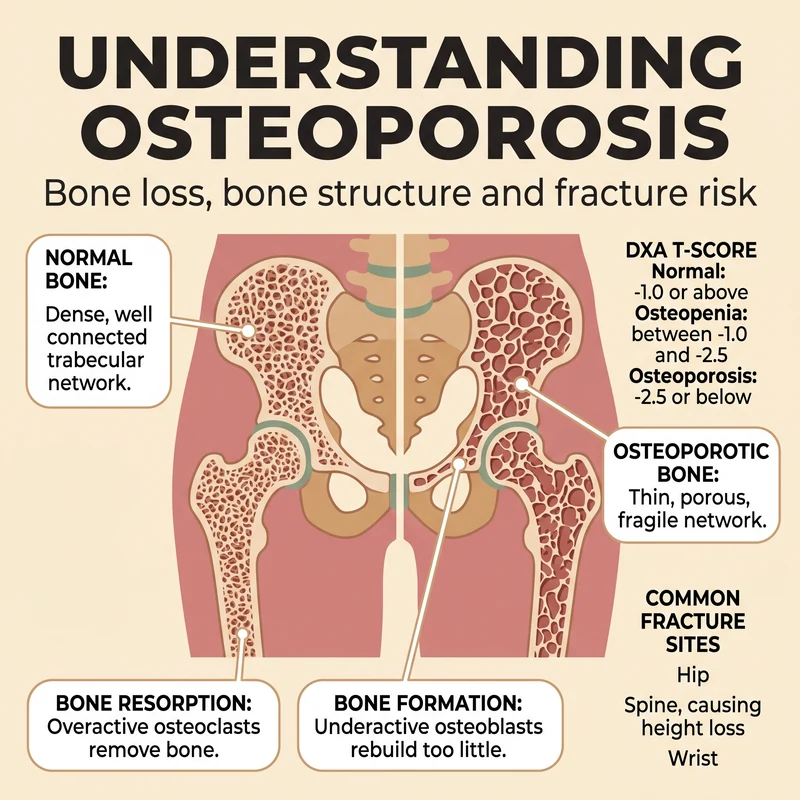
A skeletal condition of reduced bone mass and deteriorated bone structure, which together raise the risk that a bone breaks. Formally it is diagnosed when bone density on a scan sits far enough below a young adult reference, or when a fragility fracture has already happened.
Bone is not inert scaffolding. It is remodelled continuously, broken down by one cell population and rebuilt by another, and the balance between the two shifts across a lifetime. Peak bone mass is reached in the twenties. After that the balance tips slowly, and around the menopause it tips sharply for several years as oestrogen falls, which is why the condition is so much more common in women.
The distinction that matters most for reading anything about osteoporosis: bone density is a measurement, and fracture is the outcome. An intervention can improve the measurement without preventing a single break. Several of the findings below are exactly that case, which is why this page keeps asking what happened to fractures rather than what happened to the scan.
The old idea that dietary protein leaches calcium from bone did not survive testing. A systematic review for the National Osteoporosis Foundation found higher protein intake was not harmful to bone, and may modestly help at the lumbar spine7.
Bone adapts to the forces put through it. A Cochrane review of exercise in postmenopausal women found a small but statistically significant effect on bone density, with combination programmes performing best6.
Almost every hip fracture involves a fall. Strength, balance, vision, footwear, home hazards and sedating medication are part of fracture prevention, and no amount of calcium substitutes for them.
It has no symptoms at all until a bone breaks, which is the whole problem. These are the things that identify risk before that happens.
| Sign or risk factor | What it means | Worth knowing |
|---|---|---|
| A fracture from a fall at standing height or less | A fragility fracture, which by itself can establish the diagnosis | The single strongest predictor of the next fracture, and frequently not followed up |
| Height loss, or a stooped upper back | Possible vertebral fractures, which often happen without any recognised event | Most vertebral fractures are never diagnosed at the time |
| Sudden mid-back pain in an older adult | May be a vertebral fracture | New severe back pain deserves assessment rather than being attributed to age |
| Early menopause, or premature ovarian insufficiency | A longer period of life without oestrogen's protective effect on bone | See menopause and premature ovarian insufficiency |
| Long-term oral corticosteroid use | One of the most important causes of secondary osteoporosis | Bone protection is often indicated alongside; a prescriber question, never a reason to stop the steroid |
| Coeliac disease or other malabsorption | Calcium and vitamin D absorbed poorly for years, sometimes silently | See coeliac disease; unexplained osteoporosis is a recognised reason to test for it |
| Overactive thyroid, or over-replacement of thyroid hormone | Accelerated bone turnover | See thyroid disorders; worth reviewing the dose with your prescriber |
| Low body weight, smoking, heavy alcohol use | Each independently associated with lower bone density and higher fracture risk | All three are modifiable, and all three also raise falls risk |
A scan gives a number. A proper assessment asks why the number is what it is, and what the actual fracture risk is.
| Measure | What it tells you | What it misses |
|---|---|---|
| DXA bone density scan | Bone mineral density at hip and spine, and the diagnostic classification | Says nothing about bone quality or falls risk, and about half of fractures occur above the osteoporotic threshold |
| Fracture risk calculators | Estimated probability of fracture over the next ten years, combining density with clinical risk factors | Population tools; they do not know about your stairs, your eyesight or your sedating medication |
| 25-OH vitamin D | Whether deficiency is present and needs correcting | A number, not an instruction to take a large dose; see the danger note above |
| Calcium, phosphate, alkaline phosphatase, kidney function | Screens for other bone and mineral disorders | Normal results do not exclude poor dietary intake |
| Coeliac serology | A treatable malabsorptive cause that can be silent for years | Must be done while still eating gluten; see coeliac disease |
| Thyroid function, and review of thyroid hormone dose | Over-replacement accelerates bone loss and is common | A prescriber conversation; see thyroid disorders |
| Medication review | Corticosteroids, some anticonvulsants and several other classes affect bone or falls risk | Requires someone to actually look; it is rarely volunteered |
| Falls and balance assessment | The other half of fracture risk, and the half most often ignored | Not part of a DXA report, so it has to be asked for |
Protein, calcium from food, adequate vitamin D, loading the skeleton, and not falling over
Feed the bone and feed the muscle that keeps you off the floor. Those are two jobs, and diet does both.
| Nutrient | Why it matters here | Best food sources |
|---|---|---|
| Protein | Bone matrix is largely protein, and muscle strength determines whether you fall | Dairy, eggs, fish, poultry, legumes, tofu, nuts. Spread across meals rather than concentrated in one |
| Calcium | The mineral the matrix is filled with. Food sources come with protein and other nutrients that supplements do not | Dairy, tinned sardines and salmon with bones, calcium-set tofu, fortified plant milks, kale, bok choy |
| Vitamin D | Required for calcium absorption. Sufficiency is the goal, not high levels | Oily fish, egg yolk, fortified foods, sunlight. Test rather than assume |
| Vitamin K | Needed to carboxylate osteocalcin, a bone matrix protein. See the anticoagulant warning below | Leafy greens for K1; natto, some cheeses and fermented foods for K2 |
| Magnesium | A structural component of bone and involved in vitamin D metabolism | Nuts, seeds, legumes, whole grains, leafy greens |
| Potassium and fruit and vegetables | Associated with better bone density in observational work, plausibly through the acid-base load of the diet | Vegetables and fruit generally; no supplement needed |
| Sodium, in excess | Raises urinary calcium loss | Most dietary sodium comes from processed food, not the salt cellar |
| Alcohol, in excess | Affects bone-forming cells and substantially raises falls risk | The falls effect alone is reason enough to moderate it |
This is a section where the honest answer includes a warning about taking too much, which is unusual.
| Supplement | What it is actually for | Typical range | Timing | Notes & cautions |
|---|---|---|---|---|
| Vitamin D3 | Correcting a measured deficiency so that calcium is absorbed properly. Not a fracture treatment in people who are already replete. | Test 25-OH-D first and set a DAILY dose with your clinician | Daily, with a fat-containing meal | Do not take large intermittent doses. An annual high dose increased falls and fractures3 and a monthly high-dose regimen increased falls4. In generally healthy adults supplementation did not reduce fractures at all5. Retest at 3 months. |
| Calcium | Filling a genuine dietary shortfall only, where food cannot realistically reach an adequate intake. | Enough to top up food intake, not a fixed large dose. Divide doses; absorption falls above roughly 500 mg at once | With food, split through the day | Food first, for the cardiovascular question above2. Can cause constipation and bloating. Reduces absorption of thyroid hormone, some antibiotics and iron, so separate them by several hours. Discuss with your clinician if you have had kidney stones or have kidney disease; see chronic kidney disease. |
| Vitamin K2 (MK-7) | Carboxylating osteocalcin. Three years of low-dose MK-7 reduced the loss of bone mineral density in healthy postmenopausal women8. | 100 to 200 mcg per day; the trial above used 180 mcg | With a fat-containing meal | See the anticoagulant warning above; this is the important one. The trial measured bone density and bone strength rather than fractures, so treat it as promising and not as proven fracture prevention. |
| Magnesium | Correcting a shortfall where dietary intake is low. A structural component of bone and involved in vitamin D metabolism. | 200 to 400 mg per day of elemental magnesium if food intake is low | Evening, with food | Citrate and glycinate are better tolerated than oxide. Can loosen stools. Reduce or avoid in reduced kidney function, where magnesium accumulates. |
Each numbered entry below is either a source you can follow or a note setting out what the evidence does and does not support. Both are numbered together so the markers in the text line up.
Last reviewed 2 September 2026. Supplement entries are cross-checked against the NIH National Center for Complementary and Integrative Health and the Linus Pauling Institute Micronutrient Information Center.10 This page is nutrition education, not medical advice, and it does not replace your doctor. Nutrition does not treat established osteoporosis on its own. No dietary measure here has been shown to prevent fractures the way prescribed treatment does, and nothing on this page is a reason to decline or stop it. What nutrition education can do is help you understand the evidence well enough to have a better conversation with the clinician who does treat you.