Benign smooth-muscle tumors of the uterus that affect up to 70 to 80 percent of women by age 50. Estrogen-driven, fiber-responsive, and far more modifiable through nutrition and lifestyle than the surgical-or-suppression conversation usually suggests.
Last updated:
Uterine fibroids, also called leiomyomas or myomas, are benign tumors that arise from the smooth muscle and connective tissue of the uterus. They are estrogen- and progesterone-sensitive, range from millimeter-sized seedlings to grapefruit-sized masses, and are the most common pelvic tumor in women.
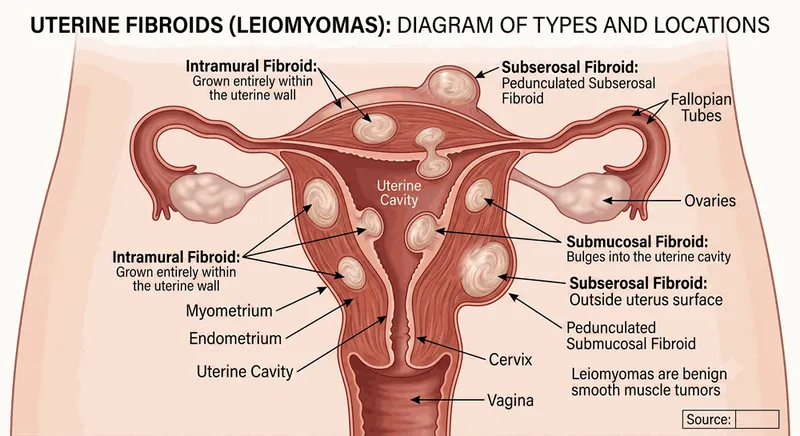
The hallmark of a fibroid is its sensitivity to the hormonal milieu around it. Estrogen and progesterone, along with growth factors like IGF-1, drive their growth, which is why fibroids typically appear in the reproductive years, often expand in pregnancy, and shrink after menopause. The amount of trouble a fibroid causes depends overwhelmingly on its location, not just its size, a small submucosal fibroid pressing on the endometrium can cause far more bleeding than a large subserosal fibroid sitting on the outer wall.
Modern classification uses the FIGO system (types 0 through 8) based on exact location within the uterine wall. The categories below summarize the four most clinically important location patterns (see below):
"Uterine fibroids are the most common pelvic tumors in women, with a cumulative incidence of up to 70 percent in white women and over 80 percent in Black women by age 50."
โ Stewart et al., 2017 Nature Reviews Disease PrimersFIGO type 3 to 5. The most common fibroid type, sitting entirely within the myometrium (uterine muscle wall). Symptoms depend on size: small intramural fibroids may be silent, while larger ones distort the uterine cavity and produce heavy bleeding, cramping, and bulk symptoms.
FIGO type 6 and 7. Sit on the outer surface of the uterus and bulge outward into the pelvis. Often relatively quiet from a bleeding standpoint but produce significant bulk pressure on the bladder, bowel, and back. Pedunculated subtypes hang from a stalk and can twist (torsion).
FIGO type 8 (cervical, outside the corpus) and pure intracavitary (entirely within the cavity, FIGO 0). Less common but disproportionately symptomatic. Cervical fibroids can obstruct the cervix and complicate delivery; intracavitary fibroids cause severe bleeding and recurrent pregnancy loss.
Many fibroids are clinically silent and discovered incidentally. When they cause trouble, the pattern is typically heavy bleeding + bulk pressure + iron-deficiency fatigue. Location matters more than size, a small submucosal fibroid can cause more symptoms than a large subserosal one.
Soaking through a pad or super tampon every 1 to 2 hours, periods lasting more than 7 days, large clots (greater than a quarter), and bleeding through to bedding or clothing. The single most common and disabling fibroid symptom and the main driver of iron-deficiency anemia in this population.
Intense uterine cramping that fails to fully respond to over-the-counter NSAIDs, often radiating into the back and thighs. May worsen progressively year over year as fibroids enlarge. Acute severe pain can signal fibroid degeneration (loss of blood supply), which is usually self-limited but uncomfortable.
Spotting or bleeding between periods, or bleeding after intercourse, often points to submucosal or cervical fibroids. Always warrants evaluation to rule out other causes (polyps, endometrial pathology), but fibroids are a common explanation.
Deep pelvic pain with intercourse, especially in certain positions, often points to a posterior fibroid impinging on the cul-de-sac or a large fundal fibroid being pressed against. Cervical fibroids cause sharper, more localized pain.
Submucosal and intracavitary fibroids significantly raise the risk of implantation failure and miscarriage. Intramural fibroids greater than 4 cm and those distorting the cavity also impact fertility. Removal of submucosal fibroids before conception can improve outcomes meaningfully.
Fibroids can grow rapidly in pregnancy under hormonal stimulation, occasionally cause painful "red degeneration," and raise the risk of malpresentation, preterm labor, placental abruption, and cesarean delivery. Most pregnancies with fibroids still go well with appropriate monitoring.
A constant sense of fullness, "something taking up space" in the lower pelvis, often paired with visible lower-abdominal distension that does not correlate with what was eaten. Many women report needing to size up clothes despite no weight gain. A near-universal symptom of large or multiple fibroids.
Anterior fibroids compress the bladder, producing constant urgency, frequent small voids, nocturia (multiple wakings to urinate), and a sense of incomplete emptying. Differs from a UTI in that there is no burning and cultures are negative.
Posterior fibroids press on the rectum and sigmoid colon, causing new-onset constipation, straining, painful bowel movements, and a rectal-pressure sensation. Often misdiagnosed as IBS for years before imaging is done.
Chronic heavy bleeding depletes iron stores faster than diet alone can replace, producing fatigue, brain fog, breathlessness on stairs, restless legs, brittle nails, and hair shedding. About 30 percent of women with fibroids meet criteria for iron-deficiency anemia.
Large posterior or fundal fibroids can press on lumbosacral nerves and the pelvic floor, producing low back pain, sciatica-like leg pain, and pelvic-floor dysfunction. Often misattributed to musculoskeletal causes until imaging clarifies.
Fibroids almost always co-exist with the broader estrogen-dominance pattern, severe PMS, cyclical breast tenderness, jawline acne, mood swings, water retention. Addressing this pattern is what reduces growth and recurrence over the long run.
Diagnosis combines symptom history with imaging and bloodwork. The goal is to confirm the fibroids, characterize their location and size (FIGO type), assess for anemia, and rule out other causes of heavy bleeding.
These are not diagnostic on their own but build a strong case for formal imaging:
Track at least 3 cycles, noting flow heaviness, cycle length, period duration, clot size, pad/tampon use per day, and breakthrough bleeding. Apps like Clue or Flo work, or a paper chart. Persistent menstrual flow greater than 80 mL (roughly soaking more than 16 normal pads or tampons per cycle), periods longer than 7 days, or large clots strongly suggests fibroid-grade bleeding worth imaging.
Lying flat with bladder empty, gently feel along the lower abdomen above the pubic bone. A firm, irregular mass that you can feel above the pelvic brim almost always indicates a uterine size greater than 12-week pregnancy equivalent and warrants imaging. Note any new or worsening abdominal distension that does not match diet.
Score 1 point for each: heavy periods (more than 7 days, soaking pads, large clots), pelvic pressure or visible distension, new urinary frequency, constipation or bowel pressure with periods, severe period cramping, anemia or persistent fatigue, painful intercourse, family history of fibroids in mother or sister, Black or African ancestry, age 30 to 50. Score of 4 or more strongly warrants pelvic ultrasound.
Toggle between the two approaches to compare treatments, outcomes, and what each looks like in practice.
Slow or stop growth via estrogen-detox, lower inflammation, rebuild iron, address endocrine disruptors
Fibroids are rarely caused by one thing. They sit on a stack of hormonal, inflammatory, nutritional, gut, stress, and environmental drivers. Addressing these is what slows growth, reduces bleeding, and lowers recurrence after any procedure.
| Root Cause | How It Contributes to Fibroids | Holistic Solution |
|---|---|---|
| Estrogen Dominance / Poor Estrogen Clearance | Fibroids contain more estrogen and progesterone receptors than the surrounding uterus. Excess estrogen relative to progesterone, plus sluggish liver and gut clearance, directly drives growth and bleeding. | Cruciferous vegetables daily, DIM 100 to 200 mg, calcium-D-glucarate 500 to 1500 mg, daily BM, 30+ g fiber/day, support liver phase I and II detox (B vitamins, glycine, methylation) |
| Endocrine-Disrupting Chemicals | BPA, phthalates, parabens, pesticides, and PCBs mimic estrogen and have been directly linked to higher fibroid prevalence and growth in multiple studies. Personal care products are a major exposure route. | Glass / stainless instead of plastic, fragrance-free personal care, EWG Skin Deep app, filter water, organic for the Dirty Dozen, avoid heating food in plastic |
| Vitamin D Deficiency | Vitamin D regulates fibroid cell proliferation and ECM production. Multiple studies show women with low D have higher fibroid prevalence and faster growth, and supplementation slows growth. | Test 25-OH vitamin D, target 50 to 80 ng/mL with D3 (2000 to 5000 IU) + MK-7 K2 100 to 200 mcg, retest after 3 months |
| Chronic Inflammation | Fibroids are partly an inflammatory and fibrotic process. Elevated cytokines (TNF-ฮฑ, IL-6) drive ECM deposition and fibroid expansion, while oxidative stress amplifies it. | Anti-inflammatory diet, omega-3 EPA/DHA 2 g/day, curcumin 500 to 1000 mg, NAC, remove seed oils and refined sugar, address food sensitivities |
| Gut Dysbiosis & Estrobolome Imbalance | The gut microbiome regulates estrogen recycling via beta-glucuronidase. Dysbiosis raises this enzyme's activity, recirculating estrogens and worsening estrogen dominance that fuels fibroids. | Fermented foods, soluble fiber 30+ g/day, targeted probiotics, address SIBO or candida if present, calcium-D-glucarate to inhibit beta-glucuronidase |
| Insulin Resistance & Metabolic Dysfunction | Hyperinsulinemia raises bioavailable estrogen via reduced SHBG, drives IGF-1 (a fibroid growth factor), and promotes inflammation. Strong association with fibroid prevalence. | Low-glycemic eating, protein at every meal, strength training, 10 to 15 min post-meal walks, inositol or berberine if appropriate, sleep optimization |
| Iron Deficiency Anemia (consequence + driver) | Heavy bleeding from fibroids causes iron deficiency, which produces fatigue, hair loss, and brain fog and then often worsens menstrual flow as a vicious cycle. Repletion is foundational. | Heme iron from red meat, liver, sardines paired with vitamin C; iron bisglycinate 25 to 50 mg if ferritin under 50; lactoferrin in some cases; address heavy bleeding in parallel |
| Chronic Stress / HPA-Axis Dysfunction | Sustained cortisol lowers progesterone, worsens estrogen dominance, promotes inflammation, and raises insulin resistance. Pregnenolone steal shifts hormone precursors toward cortisol. | Breathwork, vagal tone, daylight exposure, magnesium, adaptogens (ashwagandha, rhodiola), 7 to 9 hours of sleep, boundaries, therapy if trauma is a factor |
| Genetic Predisposition & Ancestry | Black and African ancestry confers higher prevalence, earlier onset, larger fibroids, and more symptoms. Family history (first-degree relatives) increases risk 2 to 3-fold. Genetic, hormonal, and environmental factors interact. | Genetics load the gun; lifestyle and environmental levers still work. Earlier and more aggressive root-cause intervention is warranted in higher-risk women. |
| Nutrient Deficiencies (D, Mg, B, Iron) | Vitamin D regulates fibroid biology; magnesium supports estrogen metabolism and reduces cramping; B vitamins support methylation and estrogen detox; iron addresses anemia. All are commonly low in fibroid patients. | Comprehensive nutrient panel and repletion: vitamin D3 + K2, magnesium glycinate 300 to 400 mg, methylated B-complex, iron as indicated by ferritin and CBC |
Food is the most powerful tool for changing the hormonal climate that grows fibroids. The goal is twofold: lower the estrogen-inflammation drivers that feed growth, and aggressively replete iron lost to heavy bleeding so the rest of the body has the resources to heal.
Most fibroid patients live in a state of estrogen dominance plus iron depletion, the very combination that perpetuates the cycle. Estrogen feeds the fibroid; the fibroid bleeds heavily; the bleeding depletes iron; the depletion drives fatigue, hair loss, and brain fog; and chronic stress amplifies it all. The eating pattern that breaks this loop is whole-food, anti-inflammatory, cruciferous-rich, fiber-dense, with intentional heme-iron sources paired with vitamin C.
The framework: anchor every meal with protein (heme iron sources featured several times per week), fill half the plate with non-starchy vegetables (cruciferous most days), add healthy fat, include whole-food slow carbs, and aim for daily bowel movements.
Supplements are accelerators, not replacements for nutrition, lifestyle, and stress work. The list below combines the most evidence-backed fibroid- and bleeding-supportive interventions with foundational nutrients commonly depleted by this pattern.
| Supplement | Role in Recovery | Suggested Dose | Timing | Notes |
|---|---|---|---|---|
| Green Tea Extract (EGCG) | Multiple human RCTs show reductions in fibroid volume and bleeding severity. Inhibits fibroid cell proliferation, induces apoptosis, and lowers inflammation in fibroid tissue. | 800 mg EGCG per day (standardized extract) | Split, with meals | Strongest single-supplement evidence for fibroids. Avoid empty-stomach high doses, rare liver concerns. |
| Vitamin D3 (with K2) | Directly regulates fibroid cell biology. Multiple studies show low D is linked to higher fibroid prevalence and faster growth, and that repletion slows growth meaningfully. | 2000 to 5000 IU D3 + 100 to 200 mcg MK-7 K2 per day | With a fat-containing meal, morning preferred | Test 25-OH-D first; retest after 3 months. Target 50 to 80 ng/mL. Higher temporary doses if severely deficient. |
| DIM (Diindolylmethane) | A cruciferous-vegetable metabolite that shifts estrogen metabolism toward the favorable 2-hydroxy pathway and away from 16-hydroxy estrogens. Directly relevant to estrogen-dependent fibroid growth. | 100 to 200 mg per day | With a meal containing fat | Combine with calcium-D-glucarate for synergy. May darken urine harmlessly. |
| Calcium-D-Glucarate | Inhibits beta-glucuronidase, the gut enzyme that recirculates estrogens. Supports complete excretion of metabolized estrogens via stool, reducing the estrogen burden that feeds fibroids. | 500 to 1500 mg per day | Split, with meals | Most useful when paired with DIM and adequate fiber. Constipation must be addressed first. |
| Iron Bisglycinate | The most absorbable and gentlest form of supplemental iron. Critical for repleting stores depleted by heavy menstrual bleeding. Target ferritin greater than 50, ideally 75 to 100 ng/mL. | 25 to 50 mg elemental iron per day | Morning, away from coffee/tea, with vitamin C | Bisglycinate causes less GI distress than ferrous sulfate. Retest ferritin after 3 months. Stop at target to avoid overload. |
| Vitamin C | Dramatically increases non-heme iron absorption, supports collagen and uterine tissue integrity, antioxidant for menstrual blood loss recovery. | 500 to 1000 mg per day | With iron-containing meals or supplements | Food sources (bell peppers, citrus, kiwi) work just as well; supplement when intake is low. |
| Curcumin (Turmeric Extract) | Potent anti-inflammatory with emerging fibroid-specific data showing inhibition of fibroid cell proliferation. Also supports liver detoxification of estrogens. | 500 to 1000 mg curcumin per day | With a fat-containing meal | Must include piperine (black pepper) or be liposomal for absorption. Caution if on anticoagulants. |
| Omega-3 EPA/DHA | Reduces systemic inflammation, lowers menstrual prostaglandin-driven pain, supports overall fibroid-related inflammation reduction. | 2 g combined EPA+DHA per day | With meals | Choose IFOS-certified for purity. Cod liver oil acceptable, watch total vitamin A. |
| Magnesium Glycinate | Supports estrogen metabolism, smooth-muscle relaxation (reduces cramping), progesterone production, sleep, and stress resilience. | 300 to 400 mg elemental magnesium per day | Evening, 30 to 60 min before bed | Glycinate is the most absorbable and calming form. Magnesium oxide is poorly absorbed. |
| N-Acetylcysteine (NAC) | Glutathione precursor that lowers oxidative stress in fibroid tissue, supports liver estrogen detoxification, and has emerging human trial data for fibroid symptom reduction. | 1200 to 1800 mg per day | Empty stomach, split twice daily | Take 30 minutes before food. Pair with zinc and selenium for antioxidant synergy. |
| Methylated B-Complex (with L-methylfolate) | Supports methylation, liver phase II estrogen detox, and homocysteine metabolism. Critical if MTHFR variants are present and for fibroid-related anemia recovery. | 1 capsule per day per product label | Morning with food | Ensure 400 to 800 mcg L-methylfolate if trying to conceive. B12 especially important if vegetarian. |
| Vitex (Chasteberry) | Supports luteal-phase progesterone, which balances unopposed estrogen and can reduce heavy bleeding in some women with fibroids. | 400 to 800 mg per day (standardized extract) | Morning, daily | Avoid in pregnancy and with hormonal contraception. Allow 3 to 6 cycles for full effect. Pause if cycles shorten unhelpfully. |
| Resveratrol | Polyphenol with anti-estrogenic, anti-inflammatory, and anti-proliferative effects on fibroid tissue in laboratory studies. | 800 to 1500 mg per day (trans-resveratrol) | Morning, with food | Effects build over 8 to 12 weeks. Pair with omega-3 and curcumin for synergy. |
| Zinc | Supports immune function, skin healing, and modulates estrogen metabolism. Often depleted with chronic heavy bleeding. | 15 to 30 mg per day | With meals (food prevents nausea) | Add 1 to 2 mg copper if using long-term at higher doses to prevent imbalance. |
| Milk Thistle (Silymarin) | Hepatoprotective and supports liver phase I and II estrogen-clearance pathways. Helpful when estrogen-detox capacity is sluggish. | 140 to 420 mg silymarin per day | With meals | Generally well-tolerated. Coordinate with provider if on prescription medications metabolized by the liver. |
| Multi-Strain Probiotic | Improves the estrobolome (gut bacteria that metabolize estrogen), lowers beta-glucuronidase activity, and supports healthy estrogen clearance. | 25 to 50 billion CFU per day, multi-strain | Empty stomach or with light meal | Rotate brands every 2 to 3 months for strain diversity. Stop if SIBO symptoms worsen. |
| Lactoferrin | Iron-binding glycoprotein that improves iron absorption and modulates inflammation. RCT data shows efficacy comparable to oral iron with fewer GI side effects. | 200 to 400 mg per day | Morning, away from meals | Especially helpful when oral iron causes GI distress. Often combined with iron bisglycinate. |
| Ashwagandha | Adaptogen that lowers cortisol, supports HPA-axis recovery, and improves sleep. Particularly useful when chronic stress is a clear driver of cycle disruption and inflammation. | 300 to 600 mg KSM-66 extract per day | Evening with food | Avoid in hyperthyroidism and during pregnancy. Trial for 8 to 12 weeks. |
Understanding what to expect from each approach helps set realistic expectations and make informed choices.
Begin anti-inflammatory diet, cruciferous daily, foundational supplements (vitamin D, magnesium, iron, green tea EGCG, DIM). Bloating often eases; cramping starts to soften.
Ferritin starts rising; energy and mood improve. Menstrual flow often noticeably lighter by cycle 3. PMS, breast tenderness, mood swings reduced.
Iron stores rebuilt. Bleeding meaningfully reduced for many. Fibroid growth typically halted on imaging. Skin clearer, sleep better, cycles more predictable.
Repeat imaging often shows stable or measurably reduced fibroid volume in many women. Quality of life dramatically improved. Fertility potential preserved.
Stable or reduced fibroid burden, lower recurrence after any necessary surgery, preserved uterus and fertility
Initial ultrasound and bloodwork. Hormonal suppression started (COCP, IUD, GnRH agonist) or watchful waiting. Some early bleeding reduction with hormonal therapy.
GnRH agonists shrink fibroids by 30 to 50 percent but cause menopausal side effects. COCP/IUD reduce bleeding. Surgical consultation if symptoms persist.
Procedural intervention often performed (UAE, MRgFUS, myomectomy, hysterectomy). Recovery and post-procedure symptoms depend heavily on which option chosen.
Suppression-treated fibroids typically regrow within 6 to 12 months of stopping medication. Myomectomy preserves uterus but recurrence in 15 to 30 percent within 5 years if underlying drivers unaddressed.
Symptom control while medicated; high recurrence after suppression stops; hysterectomy definitive but ends fertility and carries lifelong sequelae
"Fibroids are not just a surgical problem, they are an estrogen, inflammation, and environmental problem that happens to show up in the uterus. Treat the terrain, and the uterus follows."
Explore related conditions below or revisit the Symptom Checker to map your full symptom picture across the library.