A syndrome in which the heart cannot move blood around the body well enough to meet its needs. Two things on this page run against the usual advice: the largest randomised trial of sodium restriction did not reduce hospital admissions or deaths1, and losing weight here can be a warning sign rather than an achievement.
Last updated:
Not the heart stopping, and not a single disease. It is a syndrome in which the heart either cannot fill properly or cannot pump strongly enough, so blood backs up and tissues receive less than they need.
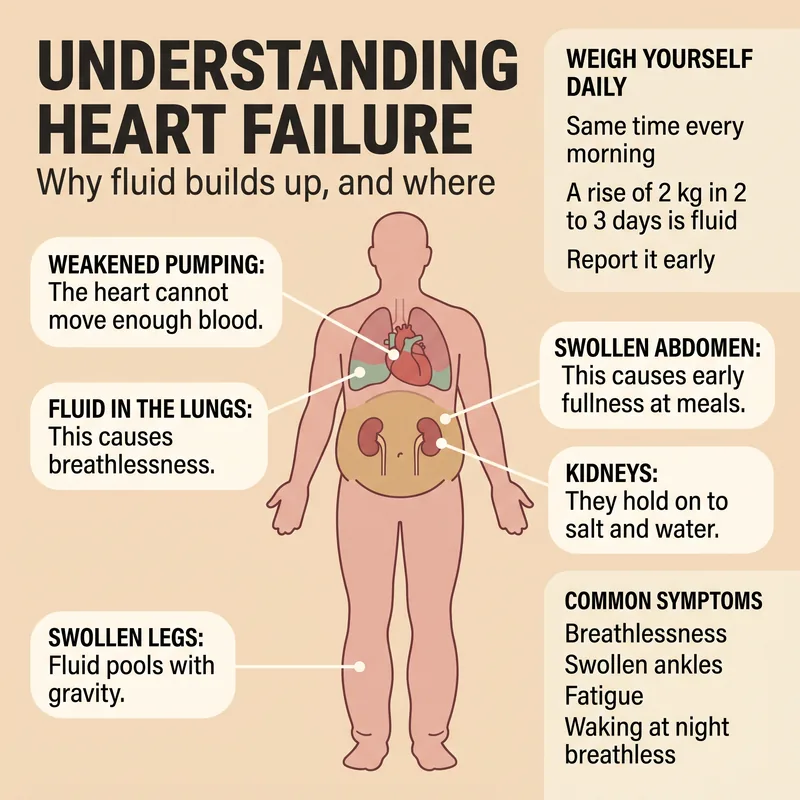
The backing up is what produces the symptoms people notice: fluid in the lungs causing breathlessness, fluid in the legs causing swelling, and fluid in the abdomen causing bloating and early fullness at meals. The reduced forward flow produces the fatigue.
Nutrition matters here in three specific ways, and they are more particular than general healthy eating. Sodium and fluid affect how much volume the circulation has to carry. Certain nutrients are lost through the very diuretics used to treat it. And appetite frequently falls just when the body needs more, which is why unintended weight loss in heart failure is a serious finding rather than a good one.
SODIUM-HF randomised over 800 patients to a low-sodium target or usual care. It did not reduce hospital admissions, emergency visits or deaths, though quality of life and symptoms improved modestly1.
Unintended loss of weight and muscle, called cardiac cachexia, is associated with worse outcomes. In heart failure the goal is usually to protect weight and muscle, which reverses the advice given almost everywhere else.
Thiamine deficiency was found in a meaningful share of stable heart failure outpatients on standard therapy2. Loop diuretics increase its loss in urine, which is a treatable and easily missed problem.
Mostly as breathlessness, swelling and fatigue. The pattern of when they happen is what distinguishes it.
| Feature | What it looks like | Worth knowing |
|---|---|---|
| Breathlessness on exertion | Doing less than before without stopping | Often attributed to age or being unfit, and so presented late |
| Breathlessness lying flat | Needing more pillows, or sleeping upright | Fairly specific for fluid, and a useful thing to report by number of pillows |
| Waking at night gasping | Suddenly, one to two hours after falling asleep | Report this promptly. It suggests fluid redistributing when lying down |
| Swollen ankles, legs or abdomen | Worse by evening, better after a night lying flat | Shoes and rings becoming tight is often noticed first |
| Rapid weight gain | Roughly 2 kg or more in two to three days | This is fluid, not fat, and it is the earliest actionable signal. Weigh daily |
| Fatigue and reduced exercise tolerance | Everything takes longer and costs more | Frequently the most limiting symptom, and the least visible |
| Early fullness, nausea, poor appetite | Eating little and losing weight without trying | Fluid in the abdomen and gut congestion. A reason to see a clinician, not to diet |
| Reduced urine output, or new confusion | Particularly in older adults | Can indicate worsening kidney perfusion; seek advice promptly |
Diagnosis is one thing. What matters for nutrition is which type it is, how the kidneys are, and what the diuretics are doing.
| Measure | What it tells you | What it misses |
|---|---|---|
| Echocardiogram | How the heart fills and empties, and which type of heart failure it is | A single snapshot; function varies with fluid status |
| Natriuretic peptide blood test | Whether breathlessness is likely to be cardiac | Affected by kidney function, age, weight and rhythm |
| Daily weight at home | Fluid accumulating, days before symptoms appear | Only works if done consistently, same time, same clothing |
| Kidney function and electrolytes | What is safe regarding potassium, fluid and protein | Changes with diuretic dose, so it needs repeating rather than assuming |
| Iron studies including ferritin and transferrin saturation | Iron deficiency, which is common in heart failure and worth treating even without anaemia | Ferritin rises with inflammation, so it can look falsely reassuring; see iron deficiency anaemia |
| Thiamine status, where diuretic use is long-standing | A correctable deficiency that loop diuretics promote2 | Rarely tested unless someone asks |
| Sleep assessment | Sleep apnea, which is common in heart failure and treatable | See sleep apnea |
| Weight trend over months | Cachexia, the loss of weight and muscle that predicts worse outcomes | Easily hidden by fluid gain masking muscle loss on the scale |
Daily weights, moderate sodium, protecting muscle, and treating what is deficient
More individual than almost any other page on this site, because kidney function and diuretic dose change what is safe.
| Change | Why | Practical note |
|---|---|---|
| Weigh daily | Detects fluid before symptoms | Same time, after the toilet, before breakfast. Report a rise of about 2 kg over two to three days |
| Moderate sodium | Symptoms and quality of life1 | Mostly processed foods, bread, sauces and takeaways rather than the salt cellar. Not severe restriction |
| Protein and energy | Protecting muscle, because losing it predicts worse outcomes | Small frequent meals if early fullness limits intake. Do not diet unless a clinician has said to |
| Fluid | Individual to you | Ask what your limit is, if any. Do not adopt one from the internet |
| Alcohol | Directly toxic to heart muscle | A cause of heart failure in its own right. Where that is the cause, stopping can improve function substantially |
| Iron-containing foods, plus treatment if deficient | Iron deficiency is common here and worsens symptoms | Food alone rarely corrects an established deficiency; see iron deficiency anaemia |
| Potassium-rich foods | Depends entirely on your kidney function and medicines | Beneficial for some, hazardous for others. Ask before increasing them |
| Liquorice, and some herbal products | Cause sodium and fluid retention | Whole liquorice raises blood pressure and lowers potassium4; avoid it here |
A short list, and an unusually long set of interactions, because heart failure medicines are unforgiving.
| Supplement | What it is actually for | Typical range | Timing | Notes & cautions |
|---|---|---|---|---|
| Thiamine (vitamin B1) | Correcting a deficiency promoted by loop diuretics, which increase urinary thiamine loss. Deficiency was present in a meaningful share of stable heart failure outpatients on standard therapy2. | Discuss with your clinician, particularly on long-term loop diuretic therapy | With food | Cheap, safe and easily missed. It is a correction of a drug-induced loss rather than a treatment for heart failure itself. Severe deficiency can itself cause a form of heart failure, which is why it is worth asking about. |
| Iron, only if deficient and as directed | Treating iron deficiency, which is common in heart failure and worsens fatigue and breathlessness. | Assessed and prescribed by your clinician; intravenous iron is often used here rather than tablets | As advised | Do not self-supplement iron. Deficiency is diagnosed differently in heart failure because inflammation raises ferritin. See iron deficiency anaemia. |
| Vitamin D3 | Correcting a documented deficiency. Not a heart failure treatment. | Test 25-OH-D first and set a daily dose with your clinician | With a fat-containing meal | Correct a deficiency because it is a deficiency. Avoid large intermittent doses; see osteoporosis. Discuss first if your blood calcium is raised. |
| Omega-3 (EPA and DHA) | Food first, oily fish. Modest evidence in heart failure and not a substitute for anything. | Agree any supplement dose with your clinician | With a fat-containing meal | Tell your clinician if you take an anticoagulant or antiplatelet, which many people with heart failure do, and before any planned procedure. |
Each numbered entry below is either a source you can follow or a note setting out what the evidence does and does not support. Both are numbered together so the markers in the text line up.
Last reviewed 3 September 2026. Supplement entries are cross-checked against the NIH National Center for Complementary and Integrative Health and the Linus Pauling Institute Micronutrient Information Center.5 This page is nutrition education, not medical advice, and it does not replace your doctor. Nutrition does not treat heart failure. The survival benefit comes from prescribed medicines, and nothing here is a reason to stop, reduce or delay them. Fluid and potassium advice in particular must come from the clinician who knows your kidney function and your prescriptions, because generic advice on those two is genuinely unsafe. What nutrition education can do is help you understand the evidence well enough to have a better conversation with the clinician who does treat you.