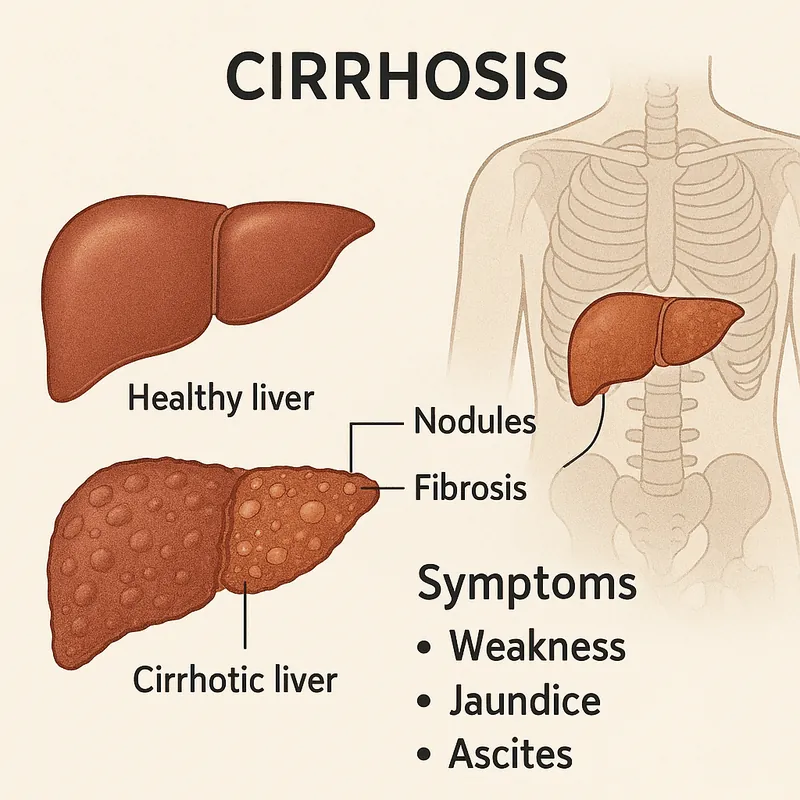
Late-stage liver scarring from prolonged injury, alcohol, viral hepatitis, NAFLD, or autoimmune causes. Once established, cirrhosis is partially reversible only in early stages. Nutrition supports liver regeneration capacity and prevents decompensation.
Last updated:
Cirrhosis is the late stage of progressive liver scarring (fibrosis) from any chronic liver injury. Normal liver tissue is replaced by scar tissue and regenerative nodules, distorting architecture and impairing function. It is the end-stage of NAFLD, alcoholic liver disease, chronic hepatitis B/C, autoimmune hepatitis, and hemochromatosis.
Cirrhosis is classified as compensated (liver still functions; often asymptomatic) or decompensated (signs of liver failure: ascites, variceal bleeding, hepatic encephalopathy, jaundice). Decompensation marks a sharp prognostic decline, median survival drops from 10-12 years to 1-2 years without transplant.
Early-stage fibrosis is partially reversible if the underlying cause is removed (alcohol cessation, HCV cure, weight loss for NAFLD). Established cirrhosis is largely irreversible but progression can be halted and complications managed. The goal becomes preserving remaining function, surveillance for hepatocellular carcinoma, and timing transplant evaluation.
Liver scarring present but function preserved. Often asymptomatic. Discovered incidentally on imaging or labs. Median survival ~12 years. Removing cause may stabilize disease for decades.
Recurring decompensation events, refractory ascites, hepatorenal syndrome, severe encephalopathy. MELD >15. Liver transplant is the only cure.
Compensated cirrhosis is often silent. Decompensation produces dramatic, recognizable signs of liver failure.
Most common early symptom. Often disabling. Disproportionate to lab values. Worsens with disease progression.
Early sarcopenia (muscle wasting) common. Reduced caloric intake combined with hypermetabolic state. Significant predictor of poor outcomes.
Red palms; spider-like blood vessels on chest/face. Caused by altered estrogen metabolism in failing liver. Often the only early visible sign.
Reduced clotting factor synthesis (prolonged INR/PT). Thrombocytopenia from splenomegaly/portal hypertension. Nosebleeds, bleeding gums.
Distended abdomen, weight gain, leg swelling. First sign of decompensation in 60%. Refractory ascites is a transplant indication. SBP (infection) is a deadly complication.
Vomiting bright red blood or black tarry stools. Esophageal varices from portal hypertension rupture. Life-threatening, mortality 15-20% per episode.
Confusion, sleep-wake cycle reversal, asterixis (flapping tremor), eventually coma. Ammonia accumulation. Triggered by infection, GI bleed, dehydration, sedatives.
Yellow skin/eyes, dark urine, itching from bile salts. Indicates failing bile excretion. Associated with worse prognosis.
Non-invasive measurement of liver stiffness. Stage F4 (โฅ12.5 kPa) = cirrhosis. Has largely replaced biopsy. Repeatable for monitoring progression.
Nodular liver surface, splenomegaly, portal vein dilation, ascites. Doppler shows portal hypertension. First-line imaging.
Bilirubin + INR + creatinine + sodium. Predicts 90-day mortality. Guides transplant priority. Score >15 typically indicates transplant referral.
Gold standard but invasive. Used when non-invasive tests are equivocal or to determine etiology. Risks: bleeding, pain.
Aggressive nutritional support + remove cause. Prevents progression and complications.
High protein, high calorie, frequent meals, late-night snack. Sarcopenia is the #1 modifiable predictor of mortality in cirrhosis.
Eggs, fish, poultry, dairy, legumes. Plant + dairy protein may be better tolerated than red meat in encephalopathy. Don't restrict, sarcopenia kills.
Bedtime carb+protein snack (yogurt with berries, nut butter on toast, cheese with crackers). Prevents overnight muscle catabolism. Evidence-based intervention.
Olive oil, avocado, nuts, fatty fish. Cirrhotic patients need 30-35 kcal/kg/day. Don't fear fat unless cholestasis.
5-6 meals/day rather than 3 large ones. Improves nitrogen balance. Maximum 3-6 hour fasting intervals during waking hours.
Strongly associated with slower fibrosis progression and reduced HCC risk in cirrhosis. Black or with minimal additives.
Accelerates all forms of cirrhosis. Even non-alcoholic cirrhosis patients must abstain completely. No safe amount.
<2g/day if ascites present. Processed foods, canned soups, deli meats, restaurant food. Read labels obsessively.
Vibrio vulnificus infection (from raw oysters) is potentially fatal in cirrhotic patients. AVOID raw oysters absolutely.
Worsens any concurrent steatosis. Drives insulin resistance. Eliminate sodas, juices, HFCS-containing products.
NSAIDs cause kidney injury and GI bleeding in cirrhosis. Limit acetaminophen to <2g/day. Never combine with alcohol.
Always discuss with your hepatologist, some "liver herbs" can be toxic. The supplements below have evidence in cirrhosis specifically.
| Supplement | Mechanism & Evidence | Suggested Dose | Timing | Notes |
|---|---|---|---|---|
| BCAAs (Branched-Chain Amino Acids) | Leucine, isoleucine, valine. Improve muscle mass, may reduce encephalopathy episodes, improve quality of life. | 12-15g/day divided | Between meals + bedtime | Best-studied supplement in cirrhosis. Particularly helpful for sarcopenia. |
| Vitamin D3 | Deficiency near-universal in cirrhosis. Improves outcomes. Reduces bone loss. | 2,000-5,000 IU/day (titrate to 50-80 ng/mL) | With fat meal | Pair with K2 200mcg. Test baseline. |
| Zinc | Deficient in cirrhosis. Reduces encephalopathy episodes. Improves taste/appetite. | 30-50mg/day | With food (away from copper) | Don't exceed 50mg long-term, risks copper deficiency. |
| Magnesium | Commonly deficient. Reduces muscle cramps (a cirrhosis complication). Supports liver enzymes. | 200-400mg/day | Evening | Glycinate or malate forms best tolerated. |
| Milk Thistle (Silymarin) | Antioxidant, hepatoprotective. Modest evidence for stabilization in chronic liver disease. | 600-900mg/day standardized | Divided with meals | Choose phosphatidylcholine-bound for absorption. |
| N-Acetyl Cysteine (NAC) | Glutathione precursor. Used IV in acute liver failure. Oral supplementation supports antioxidant capacity. | 600-1,800mg/day | Divided doses | Well-tolerated. Also protects against acetaminophen toxicity. |
| Vitamin K | Reduced synthesis in liver disease, corrects bleeding tendency partly. Test PT/INR response. | 1-10mg/day | With fat meal | Address bleeding risk; monitor INR. |
| Coenzyme Q10 | Antioxidant; supports mitochondrial function in stressed hepatocytes. Some evidence for cirrhosis. | 100-300mg/day | With fat meal | Ubiquinol form more bioavailable in older adults. |
The window for halting cirrhosis progression is now. Remove the cause, prevent sarcopenia with high-protein nutrition, screen religiously for HCC, and work with both a hepatologist and a knowledgeable nutritionist. Early cirrhosis may be partially reversible, late cirrhosis can still be managed effectively.