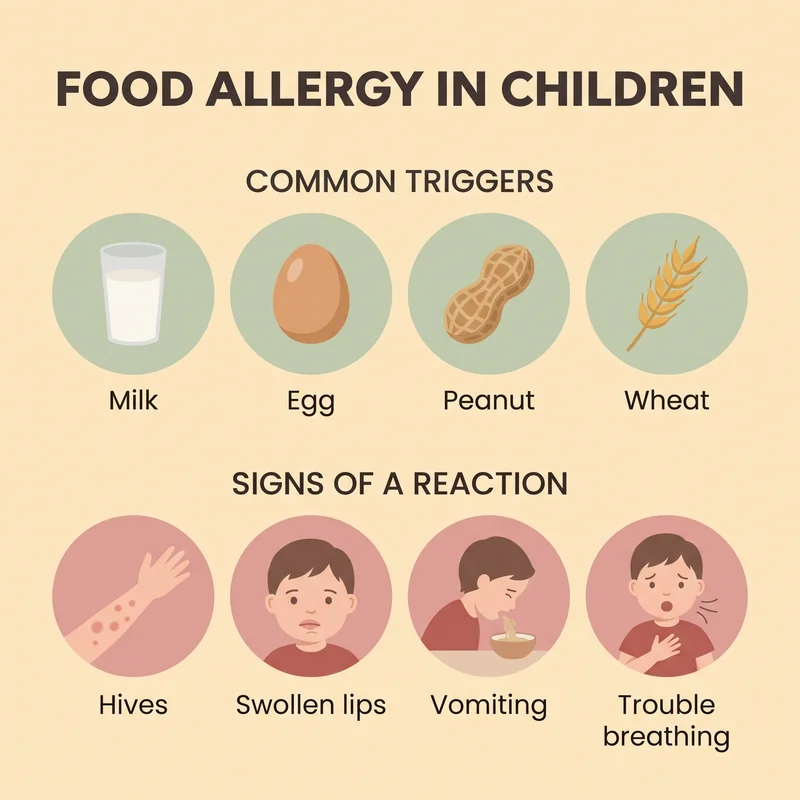
Milk, egg and peanut are the usual triggers in young children. Many children outgrow milk allergy, early peanut and egg can prevent allergy, and cutting foods without a diagnosis can create one. Diet is the treatment here, so getting the diagnosis right matters more than anything else on this page.
Last updated:
An immune reaction to a protein in a food, which happens each time the food is eaten. It is not the same as a food intolerance, such as lactose intolerance, which does not involve the immune system.
There are two main kinds. IgE-mediated allergy causes fast reactions, usually within minutes: hives, swelling, vomiting or breathing trouble. Non-IgE allergy causes slower reactions in the gut or skin over hours or days, such as blood or mucus in a baby's stool. Cow's milk can cause both, and cow's milk allergy is the most complex and common food allergy in infants4.
In US children, the most common allergies are peanut, milk, shellfish and tree nuts5.
In high-risk babies whose skin test for peanut was negative at the start, eating peanut from infancy cut peanut allergy at age 5 from 13.7% to 1.9%7.
In a European birth cohort, 69% of children with milk allergy tolerated milk one year after diagnosis8.
In the first year, only breast milk or an infant formula can feed a baby; almond, rice and other plant drinks cannot9.
Fast reactions and slow reactions look different, and both matter.
| Sign | What it looks like | Worth knowing |
|---|---|---|
| Hives, redness and itch | Raised itchy welts, often around the mouth, soon after a food | The most common sign of a fast, IgE-mediated reaction |
| Swelling | Lips, eyes or face | Swelling of the tongue or throat is an emergency |
| Cough, wheeze, a hoarse voice or trouble breathing | Within minutes of a food | Use epinephrine if prescribed and call 911 1 |
| Vomiting or belly pain soon after a food | Within minutes | Can be part of anaphylaxis, especially with other signs |
| Repeated vomiting a few hours after a food, then pale and floppy | Hours, not minutes, after the food | Get emergency care. This can be FPIES, a delayed non-IgE allergy that can lead to shock11 |
| Blood or mucus in the stool of a baby who is otherwise well | Streaks in the diaper | Non-IgE milk allergy is one cause, but an occasional spot of blood alone is common and is not proof6 |
| Food sticking on the way down | Swallowing that hurts, or food that will not pass | Food that will not pass, or a child who cannot swallow their saliva, is an emergency: call 911 or go to the emergency department. Otherwise this may be a different allergic condition of the esophagus; see the eosinophilic esophagitis guide |
| Eczema that flares | Itchy dry patches | Usually not caused by a food; see the eczema guide before removing anything |
Food allergy is more common in children who already have other allergic conditions5. Some of what raises the risk can be changed.
| Cause | How It Contributes to Food Allergy in Babies and Children | What Helps |
|---|---|---|
| Eczema | Babies with severe eczema or egg allergy were the high-risk group in the trial that showed eating peanut early prevents peanut allergy7 | Treating the eczema, and asking your child's doctor when and how to start peanut13 |
| Delaying the common allergens | There is no evidence that waiting beyond 4 to 6 months to give peanut, egg and other allergenic foods prevents allergy14 | Giving well-cooked egg and peanut as part of first foods15, as the diet section describes |
| Stopping a food a child already eats | Avoiding a food was linked to new immediate reactions to it3 | Keeping a food in the diet unless an allergy has been diagnosed |
| Regular cow's milk formula in the first week | A European guideline suggests avoiding it as a top-up for breastfed babies in the first week of life, on low-certainty evidence15 | Asking the hospital team about the options if a breastfed newborn needs a top-up |
| The immune system's own response | The body treats a harmless food protein as a threat; milk can trigger the fast and the slow kind4 | A confirmed diagnosis, so only the right food is avoided |
Both overdiagnosis and underdiagnosis cause harm, and overdiagnosis is far more common6.
| Measure | What it tells you | Worth knowing |
|---|---|---|
| An allergy-focused history | Which food, what happened and how fast; it is where diagnosis starts12 | Nothing on this list replaces it |
| Skin prick test or blood IgE test | Whether the child is sensitized to a food the history points to12 | A positive test means sensitization, not allergy. Testing foods a child eats happily produces false alarms |
| Oral food challenge | The reference standard: the food is given in steps under medical supervision12 | Needs a clinic for fast reactions and for FPIES16 |
| A 2 to 4 week trial without milk, then milk again | The cornerstone for milk allergy: symptoms should settle, then return when milk comes back6 | Skipping the return step is how overdiagnosis happens |
| Retesting over time | When a food can safely come back12 | Without it, children avoid foods they have outgrown |
| Growth checks on any milk-free diet | Whether the diet is costing nutrition | Misdiagnosis carries risks of growth faltering and missing nutrients16 |
Avoiding only what is diagnosed, and keeping everything else varied
Avoid what is diagnosed, replace what it provided and introduce everything else early.
Food allergy in babies and children: what to avoid, what replaces it and how to introduce the common allergens
| Food | What to do | Practical note |
|---|---|---|
| Milk, if diagnosed | Avoid milk, cheese, yogurt, butter, cream, whey and casein | Look for "Contains: Milk" or milk named in parentheses on the label18 |
| A milk-allergic baby's milk | Breast milk, or a specialized formula chosen by the pediatrician4 | Never a plant drink in the first year9 |
| Calcium after 12 months, milk-free | Sardines with their soft bones, white beans, kale and bok choy | Ask the dietitian whether a formula is still needed9 |
| Peanut, if not allergic | From around 4 to 6 months, with first foods15 | Ask the doctor first if your baby has severe eczema or egg allergy13. Smooth peanut butter thinned into food, never whole nuts or spoonfuls of nut butter, which can choke20 |
| Egg, if not allergic | Well-cooked, never raw, from around 4 to 6 months15 | Hard-boiled and mashed, or baked into food |
| Keep it regular | Once a food is in, keep giving it | In one trial, children who kept to regular amounts of peanut and egg had less of those allergies, though the main analysis showed no benefit21 |
| Cow's milk as a drink | Not before 12 months | Yogurt can come earlier13 |
| A breastfeeding mother's diet | No need to avoid allergens to prevent allergy14 | Cut milk only if advised for a diagnosed baby, with calcium and vitamin D17 |
| Hydrolyzed formula to prevent allergy | Not supported for prevention14 | A review of 37 trials found no consistent benefit22; treating a diagnosed allergy is a different question |
Short, because food and formula do the work here.
| Supplement | What it is for | Typical range | Timing | Notes & cautions |
|---|---|---|---|---|
| Vitamin D | The American Academy of Pediatrics (AAP) recommends at least 400 IU a day for all babies and children; breastfed and partly breastfed babies, and babies drinking less than about 32 oz (1 L) of formula a day, need it as a supplement from soon after birth23. | 400 IU a day, the AAP's minimum; your pediatrician confirms the product and the amount | Daily | Matters more on a milk-free diet. Not a treatment for allergy. |
| Calcium | Filling the gap when milk is out and food does not cover it. | Set by your pediatrician or dietitian from what your child eats | As your dietitian advises | Food first. A supplement only when a dietitian finds the diet short. |
| Probiotic (Lactobacillus rhamnosus GG) in formula | In one trial of 220 milk-allergic children, a formula with this probiotic was linked to faster tolerance24; a review rates the evidence low quality25. | Only as part of a formula your pediatrician chooses | Not applicable | Not a standalone treatment, and not a reason to delay retesting. |
| Calcium and vitamin D for a breastfeeding mother | Protecting the mother's own intake if she cuts out milk for a diagnosed baby17. | Set with her own doctor or dietitian | Daily while milk-free | Only when her diet is milk-free on advice. |
| Fish oil, vitamins or probiotics to prevent allergy | No recommendation for or against, in pregnancy, breastfeeding or infancy15. | Listed to answer the question, not to recommend it | Not applicable | Early introduction of egg and peanut has far better evidence. |
Many children outgrow milk and egg allergy, so the plan is reviewed rather than fixed.
A diagnosis from a clinician, a written plan for reactions and label reading. For milk allergy, a 2 to 4 week trial without milk and then a return to milk confirms it6.
A dietitian checks the milk-free diet and growth. Other first foods, including egg and peanut where advised, keep going in15.
Older advice, not based on trials, suggests a first milk-free period of at least 6 months or until 9 to 12 months of age; then milk is tried again, often step by step16.
Call 911 for breathing trouble, throat or tongue swelling, difficulty swallowing or fainting after a food, after giving epinephrine if prescribed1. Get emergency care for repeated vomiting hours after a food with paleness or floppiness11. See the doctor for poor weight gain on a restricted diet.
Get new guides in your inbox. Once a month: new condition guides and research updates, including the trials that did not work. Free, no spam, and you can unsubscribe in one click.
Avoid only the food a clinician has diagnosed, replace what it provided and keep everything else varied. Never remove a food from a baby's diet without a clinician following them. Many children outgrow milk and egg allergy, so the plan is reviewed.
Each numbered entry below is either a source you can follow or a note setting out what the evidence does and does not support. Both are numbered together so the markers in the text line up.
Last reviewed October 20, 2026. Supplement entries are cross-checked against the NIH National Center for Complementary and Integrative Health and the Linus Pauling Institute Micronutrient Information Center.27 This page is nutrition education, not medical advice, and it does not replace your child's doctor. A food allergy is diagnosed by a clinician, and the diet that treats it is set with a pediatrician, an allergist or a dietitian. Nothing here replaces epinephrine in a reaction, a specialized formula a pediatrician has chosen or a plan to bring foods back. What nutrition education can do is help you understand the evidence well enough to have a better conversation with the people who care for your child.