⏳ Intermittent Fasting

A schedule, and what you eat still matters. You change the hours in which you eat, and the quality of the food in those hours still counts. This page covers what that actually does, what it does not do despite the claims, who should not try it at all and the practical detail that decides whether it works.

Last updated:

A Schedule, and What You Eat Still Matters

Intermittent fasting changes the hours in which you eat, and the food in those hours still needs to be real food. The usual patterns are time-restricted eating, where the daily fast runs roughly 14 to 18 hours and every meal sits in the hours that remain, and the day-based approaches, where intake is cut sharply on some days and normal on the rest.
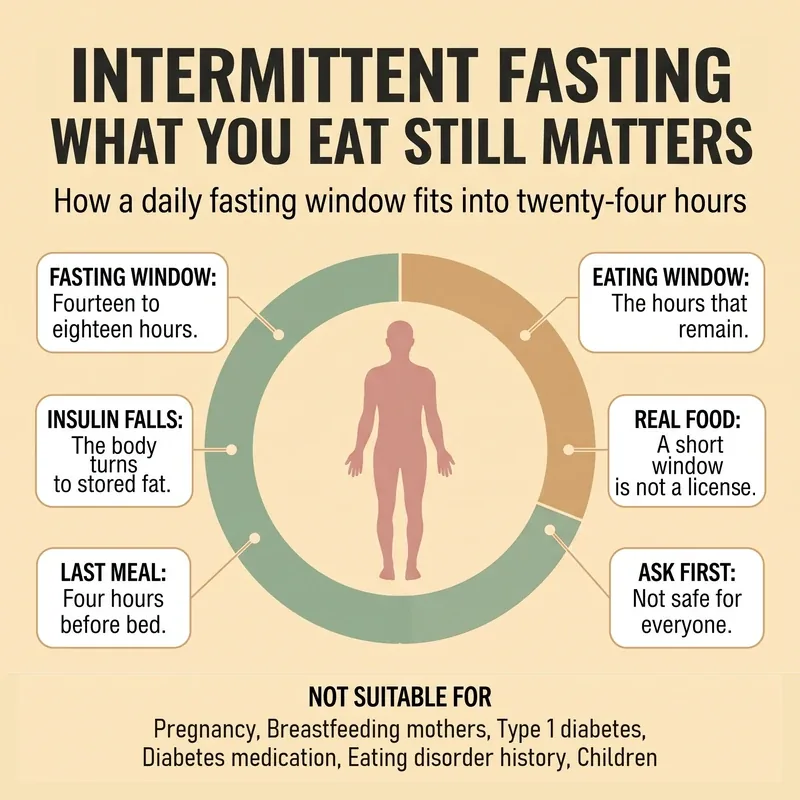
A ring showing a 14 to 18 hour daily fasting window, the remaining hours for eating and who intermittent fasting is not suitable for

What Fasting Actually Does

Four things worth knowing before you decide whether it is for you.

  • Most of the effect comes from eating less, not from the clock. A Cochrane review of intermittent fasting in adults with overweight or obesity concluded that, compared with regular dietary advice, it may make little to no difference to weight loss or quality of life1.
  • It helps people who find a rule easier than arithmetic. "No meal in the 4 hours before bed" is easier to keep than counting everything.
  • A short eating window is not a license. Ultra-processed food eaten inside eight hours is still ultra-processed food.
  • The overnight fast is the place to start. Finish dinner earlier and push breakfast later. Most people already fast for ten hours without calling it anything.

What People Hope For, and Where the Evidence Sits

The two halves of the fasting conversation are not equally supported, and separating them is more useful than picking a side.

Better supported

  • Fat loss without counting. A shorter eating window usually means less eaten overall, which is where most of the result comes from.
  • Steadier blood sugar and insulin. Trials of time-restricted eating report improvements, and they are clearest when the window sits earlier in the day.
  • Blood pressure and blood fats improve. Several trials show movement in the right direction, mostly alongside the weight that came off.
  • Calmer nights and less reflux. Moving the last meal away from bedtime is what does it.
  • Fewer decisions. One rule replaces a running tally, and adherence is what separates a diet that works from one that does not.

Claimed more confidently than the evidence allows

  • Autophagy, the cell's cleanup process. Real, and Nobel-recognized, but shown mainly in cell and animal work. In people it is largely inferred, and the fasting lengths used in the laboratory are longer than most people keep2.
  • Mental clarity and energy. Widely reported by people who fast, and hard to separate from expectation and from simply eating fewer heavy meals.
  • Detoxification. Your liver and kidneys do this continuously. Fasting does not switch on an extra system.
  • Longevity. The animal data are striking. The human data are short-term and measure markers, not lifespan.

The Practical Part

Most people who give up on fasting do so for reasons that have nothing to do with willpower.

  • Salt and minerals matter more than people expect. Some of the headaches, fatigue and lightheadedness in the first 2 weeks may trace back to low sodium, potassium and magnesium rather than to hunger. Salt your food properly, keep potassium-rich foods in the eating window, and during the fasting hours add a pinch of sea salt to your water or use an electrolyte mix with no sugar in it. Not if you have been told to limit sodium, which includes many people with high blood pressure, heart failure or kidney disease; ask your own clinician first.
  • Water, black coffee and plain tea do not break a fast. Anything with calories does, including milk in coffee and a splash of juice.
  • Break it gently. Protein and vegetables first. A large refined-carbohydrate meal after a long fast is the quickest route to feeling worse than before you started.
  • Give it two weeks before judging it. Headache, irritability and afternoon flatness usually settle as the body adjusts. If they are still there after 2 weeks, this is not the right tool for you.
  • Sleep is part of the schedule. A late finish plus an early start turns a fast into simple sleep deprivation, and that undoes the rest of it.

Where people go wrong

  • Grazing through the window. Continuous snacking inside 8 hours is not time-restricted eating; it is the same day with a shorter name.
  • Too little protein. Fewer meals means protein has to be deliberate, or muscle goes along with the fat.
  • Training hard on empty. Easy movement while fasted suits most people. Heavy or long sessions usually go better fed. Stop if you feel lightheaded.
  • Pushing the window longer and longer. Longer is not automatically better, and the returns flatten well before the risks do.
  • Women may do better starting shorter. The evidence in women is thinner than the confident advice suggests. Begin at the short end, and stop if your cycle changes.

Who Should Not Do This

This is the part of the page that matters most. Fasting is not a mild intervention for everybody.

  • Pregnant or breastfeeding.
  • Type 1 diabetes, or anyone taking insulin or a sulfonylurea. Skipping meals on these carries a real risk of hypoglycemia3.
  • Anyone taking an SGLT2 inhibitor (diabetes medicines whose names end in "-gliflozin"). Cutting food on these can cause ketoacidosis even with normal blood sugar, so clear any fasting plan with your prescriber first.
  • Anyone with a history of disordered eating. A restriction schedule can restart it4.
  • Children and adolescents.
  • Anyone underweight, frail, or recovering from illness or surgery.
  • Anyone on medication that has to be taken with food.
โš ๏ธ Talk to your own clinician before starting, particularly if you take any medication. Fasting changes when your medicines meet food, and for some drugs that timing matters as much as the dose.

Begin With the Overnight Fast

Finish dinner earlier and push breakfast later. Most people are already fasting for 10 hours without calling it anything, and the step from there is small.

References & Evidence Notes

Each numbered entry below is either a source you can follow or a note setting out what the evidence does and does not support. Both are numbered together so the markers in the text line up.

Last reviewed October 20, 2026. This page is nutrition education, not medical advice, and it does not replace your doctor. Intermittent fasting is a schedule, not a treatment. It does not treat any condition named on this site, and for several groups listed above it is actively unsafe. If you take medication that assumes you will eat, the timing of your meals is a clinical matter and not a lifestyle choice, and it belongs in a conversation with the clinician who prescribes it.

  1. Intermittent fasting for adults with overweight or obesity. Cochrane Database Syst Rev. 2026. PubMed 41692034. The authors' conclusion is that, compared with regular dietary advice, intermittent fasting may result in little to no difference in weight loss or quality of life, and may make little to no difference to adverse events although that evidence is very uncertain. This is the source for the page saying the schedule is not where the effect comes from. ↩
  2. On autophagy. The mechanism is real and Nobel-recognized, and it is demonstrated mainly in cell and animal work. In people it is largely inferred rather than measured, and the fasting durations used in the laboratory are longer than the schedules described on this page. ↩
  3. On fasting with insulin or a sulfonylurea. These two drug classes lower blood glucose whether or not a meal arrives, which makes them the classes most likely to cause hypoglycemia when a meal is skipped. Other diabetes medicines carry their own risks with fasting, so clear any fasting plan with your prescriber whatever you take. Removing meals without adjusting the dose is the mechanism of hypoglycemia, and dose adjustment is a prescriber's decision rather than a self-directed one. This entry is a note rather than a single citation, because the risk is a property of how the drugs work and not a finding from one trial. ↩
  4. On fasting and disordered eating. Scheduled restriction resembles the behavior that eating disorders are built from, and the evidence base here is observational and cannot separate cause from effect. That uncertainty is a reason for caution rather than reassurance: the group at risk is identifiable in advance, and the cost of being wrong falls entirely on them. ↩