About one adult in seven lives with chronic constipation1. Most are told to eat more fiber and drink more water, and then left to work out the rest. This issue is about the rest: what counts as constipation; what the trials found for fruit, fiber and fluid; the habits that cost nothing; what to skip; and the signs that mean a doctor rather than a diet change.
It is not only about how often you go
Three bowel movements a week is within the normal range. What matters is whether passing stool is hard work: straining, hard or lumpy stools, the feeling of not having finished. Many people who go every day are constipated by that definition. The shape of the stool says more than the count, and hard, separate lumps mean stool is moving slowly through the colon2.
Check your medicines too
Opioid pain relievers, iron and calcium supplements, some antacids, several antidepressants and some blood pressure medicines all slow the bowel3. Ask your prescriber before stopping or changing any of them.
What the trials found
Fruit did as well as fiber supplements, or better
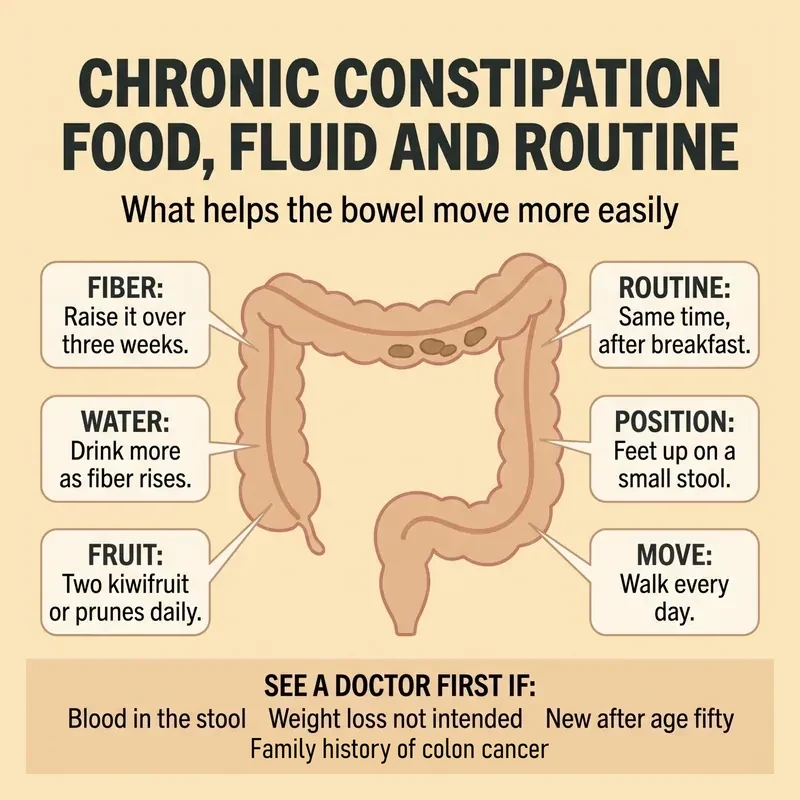
Two green kiwifruit a day added about one and a half complete bowel movements a week in a large international trial4. Prunes, about ten to twelve a day split into two servings, did better than psyllium in a crossover trial5. In a US trial that compared all three, kiwifruit had the fewest side effects6. Eat the fruit whole: juice leaves the fiber behind.
Fiber works, slowly and with water
Across sixteen trials, 66% of people responded to fiber supplements against 41% on control, with psyllium the best supported and the benefit at more than 10 g a day taken for at least four weeks7. Raise fiber from legumes, oats, whole grains, vegetables and whole fruit over two to three weeks, because a sudden jump causes the gas and bloating that make people give up. And drink with it: in one trial, people eating the same fiber who drank about 2 quarts (2 liters) a day had more bowel movements and used fewer laxatives than those who drank about 1 quart (1 liter)8.
Habits that cost nothing
A regular time, usually after breakfast, when the colon is naturally most active, and going as soon as you feel the urge3. Feet raised on a small footstool, knees above hips, which in a crossover study reduced straining and time on the toilet and improved the sense of emptying9. And daily movement, walking included.
When fiber is the wrong tool
Fiber bulks up the stool, which is what helps when the problem is slow transit. It does not help a pelvic floor that tightens when it should relax, and more bulk behind that kind of problem can mean more bloating and straining. If fiber has made things worse, tell your clinician: a pelvic floor problem is found by testing and retrained with biofeedback, which laxatives do not replace3.
What to skip
"Detox" teas, colon cleanses and herbal laxative blends are not treatments for constipation. Many herbal teas contain senna at an unlabeled dose, which makes cramping and reliance on the product more likely, not less. Colon cleansing is not supported by evidence, and it can have serious side effects10. Probiotics are not a first step either: results vary between trials and strains, and a result for one product cannot be assumed for another11. If you try one and it makes no difference, stop it.
Laxatives are not a failure
When food and habits are not enough, an osmotic laxative such as polyethylene glycol or magnesium oxide is the usual next step, chosen with a pharmacist or clinician12. Many people avoid stimulant laxatives because they fear a "lazy bowel." A 2024 review found no convincing evidence that they cause lasting damage at normal doses, and one of its authors worked for a laxative manufacturer, a conflict of interest worth weighing13. Avoid magnesium laxatives with reduced kidney function unless your clinician advises otherwise14.
Read the chronic constipation guide →
If you live with a related condition
Straining is a main cause of hemorrhoids and anal fissures, and it worsens pelvic organ prolapse. If abdominal pain eases when you go, read the IBS & IBD guide. Constipation is also common in diverticular disease, Parkinson's disease and multiple sclerosis.
Not sure where to start?
The free symptom checker covers every guide in the library. Check what applies and it shows the guides worth reading, with the warning signs that need a doctor, not a website, placed first.